
Pros and Cons of Inflatable Boats for Cost, Comfort and Lifespan
The pros and cons of inflatable boats come down to a clear trade-off: they’re easier to store and transport than many hard-hulled runabouts, but ride comfort, puncture resistance and lifespan depend on design, materials and care. A high-quality, well-maintained inflatable can last ten or more years, while some PVC boats last less than five. The right choice depends on how you’ll use it and what you expect from your time on the water.
It’s easy to focus on a lighter hull or compact storage, then wonder whether an inflatable will feel as capable and comfortable underway. Those are practical concerns when choosing a boat for fishing, family outings or coastal exploring.
This comparison explains how inflatables and runabouts differ in cost, flotation, ride, storage, capacity and lifespan. You’ll see where an inflatable can make everyday boating simpler, where a hard hull may suit you better, and how construction and maintenance can shape your decision.
Key Takeaways
- Compare the full cost of getting afloat, including the boat, motor and equipment, rather than focusing on the hull alone.
- Look for multiple flotation chambers to limit the effect of a puncture, and take care around hooks and other sharp gear.
- Match the hull design and load to your usual conditions; an inflatable keel can help soften the ride in a non-RIB inflatable.
- Assess storage needs and passenger capacity together, using the boat’s specifications to judge whether it suits your crew and gear.
- Material and care shape lifespan: some PVC inflatables last less than five years, while high-quality, well-cared-for boats can last ten or more.
Cost compared with runabouts
An inflatable boat can reduce transport and storage demands, but the purchase price is only part of the ownership calculation. Compare the complete setup: hull, motor, fuel or battery system, safety equipment, maintenance and storage. A trailerable runabout may also require suitable towing capacity, registration and storage space, while a compact inflatable may be easier to put away between trips.
For a fair comparison, price equivalent uses rather than hulls alone. A fishing setup needs room for tackle and a suitable motor; a tender needs enough capacity for passengers and gear. Include the motor and essential equipment in both estimates. Then consider transport: a RIB, including its hull, inflatable float and onboard equipment, is generally two to three times lighter than an equivalent hard-hulled boat. That difference can affect towing and launching arrangements.
How do inflatable boats compare with aluminium, fibreglass and folding boats? Aluminium and fibreglass boats have rigid hulls, while an inflatable’s tubes provide buoyancy and a RIB combines inflatable floats with a rigid hull. Folding boats prioritise compact storage through a structure that can be assembled or folded, so compare setup effort and carrying needs as well as purchase and upkeep costs.
| Option | Cost factors | Transport and storage | Best cost comparison |
|---|---|---|---|
| Inflatable | Hull, motor, accessories and fabric care | Can be deflated for compact storage | Compare total kit with storage savings |
| Aluminium runabout | Rigid hull, motor, trailer and upkeep | Requires suitable transport and storage | Compare a complete ready-to-launch setup |
| Fibreglass runabout | Rigid hull, motor, trailer and maintenance | Needs space for the assembled boat | Compare equivalent capacity and equipment |
| Folding boat | Boat structure, motor and assembly needs | Designed to pack down between outings | Include setup time and transport requirements |
Electric motor compatibility depends on the boat’s transom, mounting arrangement and the motor’s specifications. Match the motor to the boat’s stated limits, then account for battery weight and placement. For example, a compact inflatable for quiet trips may suit an electric setup if the motor and battery fit the boat’s design and intended load. Compare a runabout’s motor and power system too, not just its hull.
Before choosing, take three steps: list the equipment each boat needs, compare where it will be stored and transported, then weigh expected maintenance against how often you’ll use it. If you are tallying ongoing costs and equipment checklists in a spreadsheet, guides and templates from Biz Infographs can help keep your comparison data neatly formatted and readable. The pros and cons of inflatable boats become clearer when you apply the same fishing or day-trip requirements to each option. Choose the format that meets those needs without paying for capacity or storage you won’t use.
Floatation chambers and puncture risk
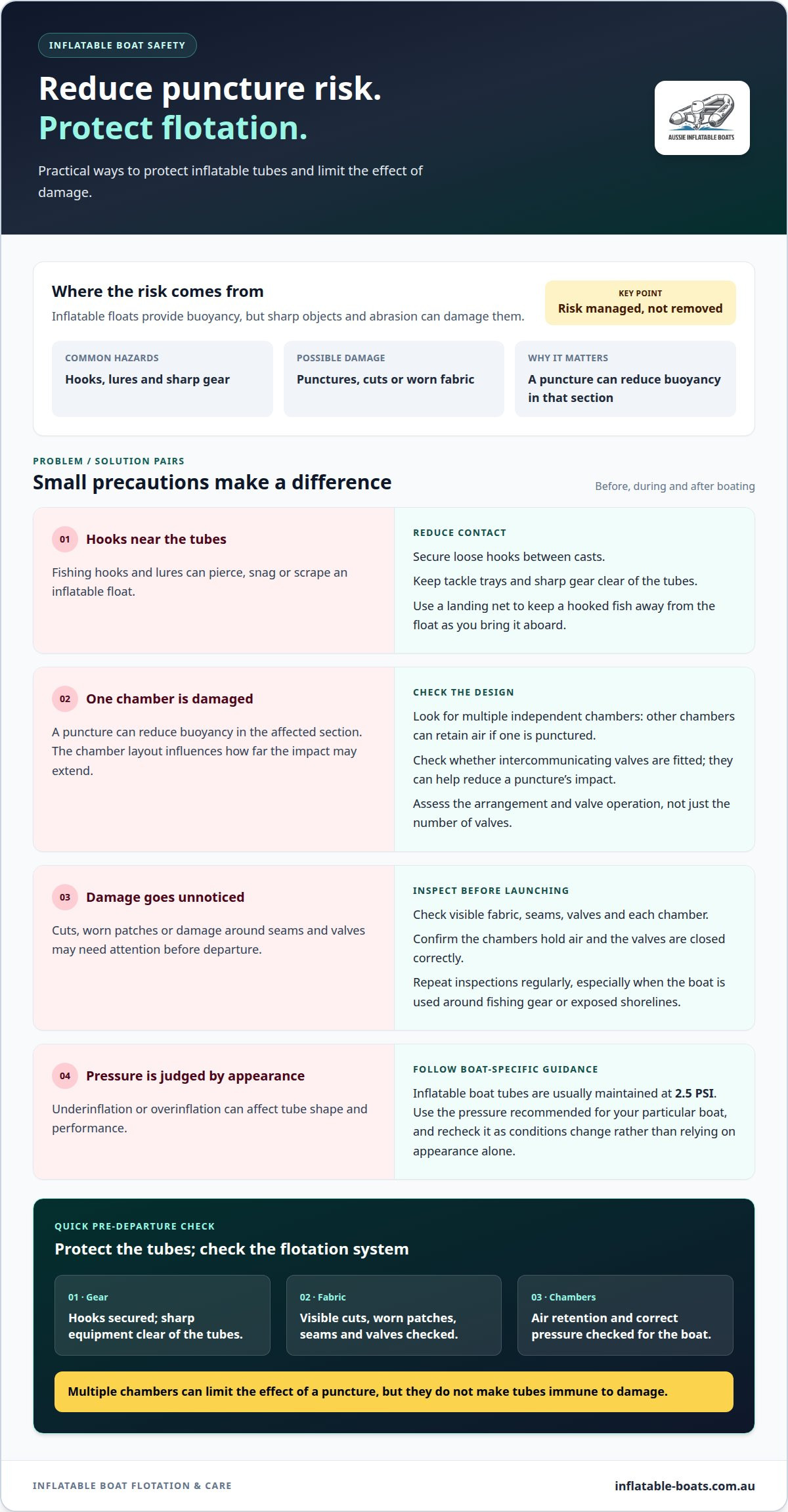
A semi-rigid boat has a two-part design: a conventional submerged hull and inflatable floats that add buoyancy. Those floats help support the boat, but they’re also exposed to sharp objects and abrasion. A puncture can reduce buoyancy in the affected section, so chamber layout matters alongside hull construction. In a fully inflatable design, the tubes play a central role in flotation, making their condition especially important.
Look for multiple independent chambers. If one is punctured, the others can retain air, limiting the effect compared with a single undivided tube. Intercommunicating valves are another feature to consider, as they can help reduce a puncture’s impact. Check the chamber arrangement and how the valves operate when assessing construction. A feature’s value depends on the boat’s design, not just the number of valves.
Punctures can result from ordinary boating gear. A fishing hook can pierce a RIB’s inflatable float, and a lure with two treble hooks can snag or scrape the tube. A landing net helps keep a hooked fish away from the float as you bring it aboard. Stow hooks securely between casts, and keep tackle trays and other sharp equipment clear of the tubes. Small habits help prevent avoidable contact.
Before launching, inspect the tubes for cuts, worn patches and damage around seams or valves. Check that each chamber holds air and that valves are closed correctly. Inflatable boat tubes are usually maintained at 2.5 PSI. Use the pressure recommended for the particular boat, since underinflation and overinflation can affect its shape and performance. Recheck pressure as conditions change, rather than relying on appearance alone.
- Before fishing: secure loose hooks and keep lures away from the tubes.
- While landing a fish: use a landing net to control its movement beside the boat.
- Before departure: inspect the chambers, valves and visible fabric for damage.
A puncture is still possible, even with multiple chambers; compartmentalisation manages the consequences rather than making tubes immune to damage. For a boat used around fishing gear, exposed shorelines or crowded storage, weigh that risk against the flotation arrangement and your ability to inspect the fabric regularly. Comparing inflatable boat construction can help clarify which chamber design suits your use.
When comparing flotation, look for multiple chambers and preferably intercommunicating valves, which can reduce the effect of a puncture. Consider this feature alongside the boat’s intended use and the need for regular inspection. A chamber layout can limit the effect of damage, but it doesn’t remove the need to protect and check the tubes.
Ride comfort and water handling
Ride comfort depends on hull shape, tube design, load and the water you travel through. A rigid inflatable boat (RIB) has a conventional submerged hull supported by inflatable floats, while a non-RIB inflatable relies more heavily on its inflatable structure. That difference affects how each design handles chop. For a non-RIB inflatable, an inflatable keel can help deliver a softer ride by shaping the hull as it moves through the water.
Load matters too. A lightly loaded inflatable may ride differently from one carrying passengers and fishing gear. In light conditions, the boat can sit higher and move more with passing waves. An account from an inflatable boat user described light-load boats struggling to cut through waves over 1 foot high, with chop and wind making handling difficult. That’s a useful reminder to consider your usual conditions, not just a calm-water test.
Compare hull designs with the conditions you typically encounter. A protected estuary, a sheltered bay and an exposed crossing each present different demands. A boat used mainly on calm water may prioritise easy handling and a compact setup. Regular travel through choppy water makes hull shape, load distribution and the operator’s experience more important. No design removes the need to match the trip to the conditions.
Before heading out, organise the load and steer gradually. Keep heavier items low and balanced rather than stacked on one side. If passengers move across the boat, their shifting weight can change trim and handling. Take time to learn how the boat responds to acceleration and turns in a sheltered area before travelling farther.
- Check the hull: a non-RIB inflatable with an inflatable keel may provide a softer ride.
- Plan the load: distribute passengers and equipment evenly, then reassess trim.
- Choose conditions carefully: light loads can handle chop and wind differently from heavier ones.
Fishing comfort involves more than the ride. A compact inflatable can make it easier to reach a sheltered shoreline or fishing spot, but space and movement affect how practical each outing feels. Before choosing, picture a real session: where the angler sits, where the tackle goes, and whether another passenger can move without disrupting balance. A crowded layout can make casting and changing position awkward, even on calm water.
When fishing from a RIB, plan seating and tackle placement so anglers can move without leaning heavily over one side. In a non-RIB inflatable, consider how the keel and load affect the ride during a slow drift. Match the boat to your usual water and fishing style. Good handling depends on a suitable design, balanced equipment and measured decisions on the water.
Storage and passenger capacity
For fishing, choose a layout with room for tackle and controlled movement; for family boating, prioritise seating and space for day-trip gear. A tender usually needs a compact footprint and enough capacity for its intended passengers. Match the boat’s type and size to its stated passenger and load limits, rather than judging capacity by appearance.
Passenger numbers tell only part of the story. A boat carrying four people has less room for bags, fishing equipment or a cooler than one carrying fewer passengers. Add up the people and gear you’ll actually take, then compare that load with the boat’s stated capacity. Two anglers with rods need a different layout from passengers on a short tender run with minimal baggage.
Inflatables can be deflated for storage, but packing them away still takes planning. Choose a clean, dry space that protects the fabric from sharp tools, heavy objects and unnecessary abrasion. A garage corner may suit a packed boat, while an assembled boat needs room for its full footprint. Keep the pump, oars and removable floor components together so the next setup doesn’t turn into a search for loose parts.
Space limits become clear once people and equipment are aboard. Inflatable tubes take up part of the boat’s perimeter, and bulky gear can obstruct movement across the floor. A family carrying bags, food and fishing rods should decide where each item will go before departure. Keep seats and essential equipment accessible, and distribute loads evenly to avoid crowding one side.
- Fishing: allow room for rods, tackle and casting movement.
- Family outings: include passenger space and the day’s bags in your load assessment.
- Tender use: consider the packed storage space and the people carried per trip.
What are the disadvantages and limitations of inflatable boats? Their tubes reduce usable floor space, sharp gear can damage the fabric, and even a packed boat needs room for storage and setup. Passenger capacity also competes with equipment space, so the maximum stated load doesn’t necessarily mean a comfortable layout for every trip.
Maintenance and storage begin after each outing: rinse salt water off the boat, clean the tubes regularly and let surfaces dry before packing. Inspect fabric welds at least annually, and store the boat away from sharp objects and unnecessary pressure. These steps help you spot wear early and protect the fabric between trips.
Before choosing, sketch your typical load: passengers, fishing gear, bags and any removable floor parts. Compare the available floor space and packed storage footprint with your garage, vehicle and usual launch routine. A boat that fits the crew but leaves no room for essentials may be the wrong size for your trips.
Boat lifespan
An inflatable boat’s working life depends on its fabric, seams, exposure and care. Some PVC inflatable boats last less than five years, while high-quality, well-maintained boats can last ten or more years. That range makes construction and maintenance central to comparing lifespan, rather than the material name alone.
Material choice matters. CSM can double an inflatable boat’s life compared with PVC, while PVC fabric can be damaged by the sun’s UV rays. A boat stored outdoors between trips faces different exposure from one kept under cover. Consider where you’ll use and store it, then compare materials with those conditions in mind.
Seam construction is another useful point to assess. Welded seams are preferable to simple glued seams because seams join fabric sections and can affect long-term durability. Look closely at seam quality around high-stress areas, including joins and fittings. A well-made seam helps resist separation through repeated inflation, handling and use.
Reported lifespans vary widely. One Australian family inflatable was reported to be 25 years old and still going strong, while another account put most PVC inflatable tubes as worn out after 15 years. These examples sit alongside boats that last less than five years. They show why a single age estimate can’t describe every boat: fabric, construction, exposure and upkeep all shape the outcome.
Use a practical inspection routine to catch deterioration early. Examine the fabric for fading, cracking, abrasion or repairs, and pay close attention to seams and valve areas. Note whether air loss or visible wear changes between outings. Damage is easier to assess while it’s small, before it spreads across a larger section of tube.
- Compare materials: weigh PVC against CSM and the boat’s expected sun exposure.
- Inspect seam type: favour welded seams over simple glued seams.
- Track condition: record visible wear and repairs so changes are easier to spot.
For example, a PVC boat used regularly in strong sun needs careful protection and routine checks. A CSM boat may offer a longer service life, but the material alone doesn’t eliminate the need for care. Check the fabric, seams and valves as part of your normal ownership routine, and address damage before further use makes it worse.
Use material, seam construction and storage conditions to judge likely longevity, not a single anecdote. The pros and cons of inflatable boats include a lifespan that can vary substantially between models and owners. If durability is your priority, explore boat options for your intended use and compare their construction details before deciding.
Inflatable Boats: Inflatable Boats
Inflatable Boats can help if you’re comparing designs or need support for an inflatable vessel. Explore inflatable boats alongside accessories and spare parts to equip or maintain your setup. If wear or damage affects your boat, Inflatable Boats also provides repair and restoration services.
Turn to Inflatable Boats when you’re ready to choose a watercraft, source parts or accessories, or arrange a repair. As you narrow down your options, consider your usual trips, storage space, passenger load and care routine.
For help with your next step, contact Inflatable Boats.
Choose the boat that fits your next adventure
The pros and cons of inflatable boats matter most when measured against your actual boating routine. Before deciding, picture a typical day on the water: who’s aboard, what you’ll carry, where you’ll launch and how you’ll store the boat afterwards. Those details turn a broad comparison into a practical choice.
Write down your priorities, then rank them. Easy transport may matter more than a rigid hull; fishing space may outweigh compact storage. Decide which trade-offs you can accept and which would make each outing harder. If you’re still weighing options, focus on the feature that will most affect how often and comfortably you use your boat.
When you’re ready to take the next step, contact Inflatable Boats to explore the options. A clear picture of your intended use will help guide the conversation. Choose with purpose, prepare for the conditions you’ll face, and make room for more time afloat.
Frequently Asked Questions
What are the main advantages of inflatable boats?
Inflatable boats offer flexibility when a rigid hull is inconvenient. Their deflated form can make transport easier, while inflatable tubes provide buoyancy around the hull. For example, a tender can be packed away between trips, then launched to move people or gear between vessels and shore. Its practical value depends on matching the design and load capacity to its intended use.
How safe are inflatable boats in Australian waters and what risks should owners know?
Inflatable boats are safest when their design, load and operating conditions suit the trip. Australian waterways can bring changing wind, chop, traffic and distance from shelter, so plan around the conditions rather than the boat’s compact size. Key risks include punctures, overloading and loss of control in unsuitable water. Keep passengers and gear balanced, inspect the boat before departure, and avoid trips beyond its intended use.
How durable are inflatable boat tubes, and how long do they typically last?
Tube durability varies with fabric, construction, exposure and upkeep, so age alone doesn’t show whether a boat remains serviceable. Look for changes such as persistent air loss, brittle surfaces, expanding repairs or distortion around fittings. Keep a record of repairs and recurring pressure loss, since a pattern can indicate a broader issue rather than an isolated puncture. Professional repairs can address damage and help maintain an inflatable vessel.
Are inflatable boats suitable for offshore use, rough water and carrying multiple passengers?
Suitability depends on the boat’s construction, capacity and intended operating conditions, not simply on its inflatable design. Offshore travel and rough water call for careful attention to weather, distance, load distribution and access to shelter. For multiple passengers, count people and equipment together against the boat’s stated capacity, then consider whether everyone can sit and move without crowding. A sheltered-water tender and an offshore boat serve different needs.