
How to Repair Thermo-Welded Seams on an Inflatable Boat
A thermo-welded seam can often be repaired in the field by re-welding compatible thermoplastic fabric with a handheld welding device. Knowing how to repair a boat with thermo-welded seams starts with identifying the fabric and understanding how heat and pressure fuse its coated surfaces. It’s a different job from repairing a glued seam.
A seam that looks simple from the outside does an important job: it must contain air as the boat flexes, moves through water and carries people and gear. Heat, sunlight, saltwater, fuel and cleaning agents can also affect boat materials, so a careful repair starts with understanding what has failed and why.
This guide explains how thermo-welding joins fabric, how welded seams differ from glued ones, and what stresses can cause damage. It covers field-repair principles, including when thermoplastic fabric can be re-welded or reinforced and why damage to a fitting or a larger seam may need a more thorough repair. Use it to assess the problem and make an informed decision before heading back out on the water.
Key Takeaways
- Understand how heat and pressure fuse compatible thermoplastic boat fabric into a seam.
- Learn why glued and thermo-welded seams respond differently to sunlight, saltwater, fuel and heat.
- See how temperature changes, inflation and movement on the water can place stress on seams.
- Recognise why identifying the fabric and the type of damage matters before attempting a field repair.
- Understand when Inflatable Boats’ Inflatable Boat Repairs can help with seam or fitting damage.
How thermo-welding joins inflatable boat fabric
Thermo-welding joins compatible thermoplastic-coated fabric with heat and pressure, not adhesive. In hot-air welding, a handheld tool heats the coating along the joint. A roller presses the softened surfaces together so they fuse as they cool. The bond forms in the coating, while the reinforced fabric base supports the inflatable boat’s structure.
That distinction matters during repair. A seam that looks welded does not necessarily mean the material can be welded again. The method depends on the coating, fabric construction and damage location. PVC and thermoplastic polyurethane, or TPU, can be re-welded when the repair material is compatible. A matching patch must fuse with the existing coating, not simply cover it.
“Urethane” can refer to different formulations, so the word alone does not identify a suitable welding material. TPU means thermoplastic polyurethane, but not every urethane coating behaves alike under heat. PVC is also thermoplastic. By contrast, Hypalon and neoprene-coated fabrics rely on adhesive bonding, not the same heat-fusion process. Using a welding tool on the wrong fabric can damage its coating instead of restoring the seam.
The coated surface and the reinforcement beneath it have different jobs. A woven base, often made from synthetic fibres, provides strength; the outer coating helps contain air and resist water. Water absorption depends on the base fibre and construction, while an intact coating limits water reaching the weave. If a cut exposes the base, moisture can enter, so the fabric must be clean and dry before attempting a weld or patch.
For a field repair, identify the material before applying heat. Look for manufacturer information or material markings, then match the repair fabric to the boat’s coating. A PVC patch cannot be assumed to fuse properly to TPU, and a glued Hypalon seam cannot be repaired as if it were PVC. Dirt, moisture and damaged coating at the joint can also prevent a sound bond.
Heat and pressure must be controlled together. Too little heat may leave the surfaces unfused; too much can distort or weaken the coating. The roller keeps the surfaces in contact as the softened layers cool. No single temperature or travel speed suits every fabric, so the material and welding equipment determine the settings. Understanding how the seam was made is central to repairing it in the field.
Use controlled heat and roller pressure to soften compatible PVC coatings and hold them together as they cool. The required settings depend on the fabric and welding equipment.
Differences between thermo-welded and glued seams
In Australia, safety, warranty and insurance are separate considerations. A sound repair alone does not establish warranty cover or insurer acceptance. Repair cost depends on the fabric, extent of damage, access and whether the seam needs local reinforcement or rebuilding. Those factors determine the work involved, rather than a standard price. The boat’s warranty and insurance policy each set their own conditions.
Glued seams are made by joining prepared fabric surfaces with adhesive. The surfaces are cleaned and treated as required, adhesive is applied, then the pieces are joined and held under pressure while the bond forms. The adhesive connects the fabric layers. In thermo-welding, compatible thermoplastic coatings fuse through heat and pressure instead, with no glue line between the surfaces.
That construction affects how each seam can age. Adhesives in inflatable boat seams can degrade in marine environments. Prolonged sunlight can make glued seams brittle and prone to separation, while saltwater, fuel and cleaning agents can speed adhesive breakdown. Heat and humidity can also accelerate plasticizer migration, which weakens adhesive bonds. In hot, humid storage conditions, glued parts may fail within a year.
Failure often starts where the bond is stressed or exposed to contamination. A lifting edge, a soft or tacky area, or a seam that opens under pressure can indicate adhesive breakdown. Temperature changes can add strain as fabric expands and contracts. The cause matters: a small local separation needs a different repair from widespread adhesive failure or damage to the underlying fabric.
Repairing a glued seam in the field is not the same as re-welding. The repair needs adhesive compatible with the fabric and original bond, as well as suitable surface preparation. For technical insight into specialist bonding agents and sealants, resources from bondrite.co.uk illustrate how different formulations perform across various substrates. The area must be clean and dry; loose, degraded adhesive can prevent a replacement bond from holding. A patch may reinforce a local defect, but widespread separation can require work along a larger section. Applying heat to a glued seam will not recreate an adhesive bond and may damage its coating.
Thermo-welded seams avoid adhesive degradation, but they still need the correct thermoplastic repair method. Glued Hypalon and neoprene fabrics require adhesive-based repair, while PVC or thermoplastic polyurethane may be suitable for re-welding when the materials match. Identifying the fabric and failure type guides the repair choice. For help with a damaged inflatable boat, explore inflatable boat repair information and the approach that suits its construction.
What happens in a thermo-welded seam?
An inflatable boat’s seam must contain air while the fabric flexes under load. Temperature changes and movement can stress the joint during use and storage.
Temperature Changes and Seam Stress
Temperature changes make the air inside an inflatable boat expand or contract, shifting pressure against the fabric and seams. This changing load matters because glued seams can be stressed as their materials expand and contract at different rates.
Daily heating and cooling can add repeated strain, especially when a boat moves between sun, shade and water. Inflation, passengers, gear and water movement also pull on joined panels. For example, a seam near a loaded fitting can experience tension as well as pressure changes. These forces help explain why the leak’s location and surrounding fabric matter during assessment.
A thermo-welded joint fuses compatible coatings instead of relying on adhesive. Its construction avoids glue degradation, but the complete boat still experiences flex, pressure and load. A temperature-related leak therefore needs a close inspection of the seam and nearby fabric, not just the visible opening.
Weld Strength and Seam Durability
Weld strength comes from consistent fusion between compatible thermoplastic coatings. Heat softens the surfaces, while pressure holds them together as they cool. If either part of the process varies along the joint, the bond may be uneven. Consistent contact and a clean joining surface help create a continuous seam.
That continuous bond helps maintain airtightness under pressure, but it cannot prevent every kind of damage. A sharp object can cut the fabric; repeated strain can affect a damaged section or fitting. Inspection should distinguish a local defect from a longer separation, so the repair addresses the actual failure.
A boat’s lifespan depends on more than seam construction. Fabric condition, storage, exposure and use all influence how an inflatable boat holds up. A welded seam removes adhesive as a failure point, but it does not make the boat immune to wear. PVC coating can be re-welded with compatible material; Hypalon seams rely on adhesive bonding.
Hot-Air Welding Temperature and Pressure
Hot-air welding softens PVC’s coating with heat and brings the surfaces together with pressure. No single temperature or pressure setting suits every PVC boat fabric. Coating thickness, fabric construction, welding tool and movement speed all affect the settings required.
Too little heat may leave the coatings unfused; too much can distort or damage them. Roller pressure must maintain contact without shifting the softened layers. The operator controls these factors together rather than treating temperature as a stand-alone setting. As the joined coating cools, it forms the bond.
For a PVC repair, match the patch material and welding process to the boat’s fabric. Hypalon is not repaired by PVC heat-fusion: its seams use adhesive. Knowing the difference prevents using the wrong method and keeps the repair suited to the material’s construction.
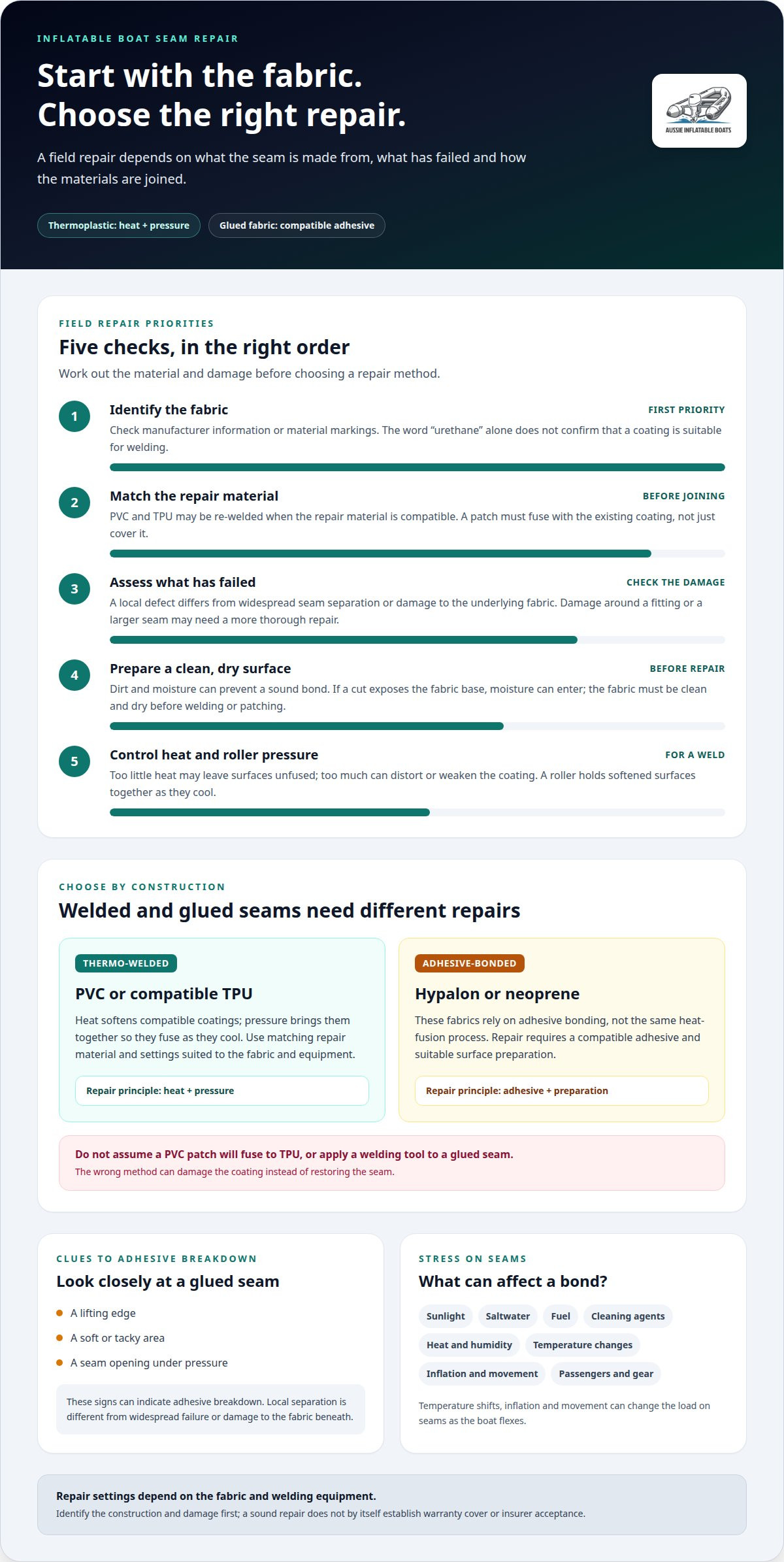
Field repair of thermoplastic seams
A field repair can re-weld compatible thermoplastic fabric or reinforce a loose fitting. The method depends on the fabric, damage and repair equipment. Knowing how to repair a boat with thermo-welded seams starts with identifying the material, not reaching for a heat tool. The main risks are heating the wrong fabric, overheating the coating or overlooking damage beyond the visible seam.
Identify the material first. PVC and thermoplastic polyurethane can be re-welded with compatible materials using a handheld welding device. Hypalon and neoprene fabrics use glued seams, so welding is unsuitable. Manufacturer information or material markings can help distinguish fabrics. The word “urethane” alone may not identify the precise coating or show whether it can be welded.
Next, assess where the damage starts and how far it extends. A small split in coated fabric differs from a seam separated along a longer section. Damage beside a fitting also calls for assessing the attachment and the forces it carries. Depending on the failure and surrounding material, a local re-weld, reinforcing patch or broader repair may be appropriate.
On compatible fabric, the repair uses heat to soften the coating and pressure to bring matching material into contact. A handheld hot-air welder directs heat along the repair, while a roller presses the softened surfaces together. As they cool, the coatings fuse. Too little heat can leave the surfaces unjoined; too much can distort or weaken the fabric. The repairer must control heat, roller pressure and movement together.
Field conditions also affect the repair. Moisture, dirt or an uneven surface can interfere with contact between the patch and boat fabric. Prepare the damaged area and select compatible material before welding. No single temperature or travel speed suits every fabric, so the material and equipment guide the method. A rushed weld can conceal a weak bond instead of resolving the leak.
Loose or broken welded fittings need attention to both the attachment and surrounding fabric. Re-welding or reinforcing the fitting can help it withstand tension and load again, but a patch placed only over the visible edge may leave the cause untouched. Check whether the fabric around it is torn or stretched and whether the fitting’s load could pull on the repaired section.
After the repair, inspect the entire area for continuous bonding, lifted edges and remaining damage. Understanding how to repair a boat with thermo-welded seams also means recognising when a field fix is unsuitable. If the material is uncertain, the separation is extensive or damage affects a loaded fitting, have the seam assessed before using the boat again.
How can I identify damage to a thermo-welded boat seam?
Start by inspecting the entire seam, not just the spot where air loss appears. On a PVC inflatable boat, look for an opening edge, split, lifted section or coating worn through. Note whether the defect is beside a fitting, panel join or area under repeated load. Its location can help distinguish local seam damage from strain in nearby fabric.
Check both sides of an accessible seam. A narrow gap on the outer surface may have a wider separation underneath, while a tear can extend into the fabric beyond the weld. Look for distortion, creasing or a rough, damaged edge around the defect. These signs do not reveal the exact cause, but help show whether the problem is confined to the joining line or involves surrounding material.
Air loss can offer another clue. In a controlled setting, inflate the boat according to its usual practice and listen for a hiss near the suspected area. Brushing a thin film of soapy water over the seam can reveal escaping air through growing bubbles. Check nearby valves and fittings too, since a leak there can be mistaken for a failed seam. Do not force extra pressure into the boat to make a leak easier to find.
- Edge lifting: a coating that peels or separates from the seam line.
- Local bubbles: air escaping through one point during a soapy-water check.
- Adjacent damage: a cut, abrasion or stressed fitting close to the weld.
- Long separation: a seam opening that continues beyond one small defect.
Record the location and visible extent before cleaning or handling the area. For example, note whether a separation starts at a fitting and runs along the join, or appears as a pinhole in the fabric beside it. This helps distinguish a seam fault from a puncture and gives a repairer useful information. Keep the boat out of use while a suspected leak remains unresolved.
Material identification matters too. A PVC seam may be suitable for re-welding, while Hypalon construction uses adhesive-bonded seams. A glossy surface, colour change or old repair patch can make the material harder to identify by sight alone. Do not apply heat or adhesive simply because a seam looks loose; the wrong method can damage the coating or conceal a larger split.
If the seam keeps leaking, separates over a wider area or sits beside a loaded fitting, arrange a proper assessment before returning the boat to use. Arrange an inflatable boat repair assessment for seam damage that needs specialist attention.
Inflatable Boats: Inflatable Boat Repairs
Inflatable Boats repairs seam separations, persistent leaks and damage around welded fittings. A repair assessment helps determine whether the affected fabric is thermoplastic and whether the damage is limited to the seam or extends into nearby material. That distinction matters: PVC or TPU may suit a re-weld, while Hypalon requires a different method. Consider a repair when a patch has lifted, a leak returns or the damaged area carries tension from a fitting. Describe where the problem appears and how it behaves, such as air loss along a seam or separation beside an attachment. This is a useful starting point for discussing the repair. Contact Inflatable Boats to discuss your boat’s seam damage.
Plan your next step with confidence
A seam issue is an opportunity to make a considered repair decision before your next outing. Understanding how to repair a boat with thermo-welded seams helps you describe the problem and have a focused conversation about what the boat needs. Keep the boat out of use while a leak or separation remains unresolved.
Inflatable Boats sells inflatable boats, accessories, spare parts and repair services. Whether you are addressing damage or planning what your vessel needs for future use, making repair and equipment decisions together can help simplify preparation.
Contact Inflatable Boats to discuss your boat’s repair needs. Take the next step towards getting back on the water with confidence.
Frequently Asked Questions
What materials and seam types are used in thermo-welded inflatable boats?
Thermo-welded seams join thermoplastic-coated fabric, commonly PVC or thermoplastic polyurethane, over a reinforcing fabric base. The coating forms the airtight surface, while the woven base provides structural support. Seam construction can vary across an inflatable boat: panel joins, tube sections and fittings may use different arrangements. Hypalon and neoprene fabrics are generally joined with adhesives, so their seams are not repaired by welding in the same way as compatible PVC seams.
Can a thermo-welded seam be repaired at home or does it require professional welding?
A home repair is suitable only when the material is positively identified, the damage is limited and the repairer can control the welding tool. A small, accessible defect in compatible PVC differs from a long separation or damage beside a loaded fitting. Larger or uncertain faults call for professional assessment. Inflatable Boats repairs damage that needs a material-specific solution rather than an improvised patch.
What tools and materials are needed to repair a thermo-welded PVC boat seam?
A PVC seam repair needs a handheld hot-air welding device, a pressure roller and a patch made from compatible thermoplastic-coated fabric. It also needs a way to prepare a clean, dry repair surface. The welder’s instructions and fabric requirements guide the operating settings. A household heat gun or adhesive alone cannot produce a controlled hot-air weld, and the wrong patch may not fuse with the boat coating.
What are the step-by-step methods for repairing a thermo-welded boat seam?
First identify the fabric and locate the full extent of the damage. Then prepare a clean, dry surface and select a compatible patch or repair piece. Use a suitable hot-air welder to soften the coating, then apply even roller pressure as the surfaces meet. Let the joined area cool before inspecting it. Settings and patch placement depend on the fabric and equipment, so follow their instructions instead of guessing temperatures.
Can thermo-welded seams in PVC and Hypalon boats be repaired the same way?
No. PVC is a thermoplastic, so compatible PVC coating can be fused with controlled heat and pressure. Hypalon seams rely on adhesive bonding and require an adhesive-based repair instead. The distinction matters even if both boats have similar-looking seams or patches. Applying heat to Hypalon as if it were PVC will not create the intended welded bond and may damage the fabric surface.
How should a repaired thermo-welded seam be tested before the boat is used?
Test the repair on shore before launching. Inflate the boat according to its normal instructions, then inspect the repaired area for lifted edges, distortion or visible separation. A soapy-water check can reveal escaping air if bubbles form at the seam. Check nearby fittings and fabric too, since a leak may come from adjacent damage. Keep the boat out of service if air loss continues or the weld shows a defect.