
Why Buy an Inflatable Catamaran? The Ultimate Guide to Stability and Performance
What if a boat that feels steadier in the chop also gives you more room to fish and places less demand on your outboard? If your current inflatable feels tippy, the deck gets crowded with gear or fuel use is a concern, it’s fair to ask: why buy an inflatable catamaran instead of a standard inflatable boat? The answer starts with stability, but it doesn’t end there.
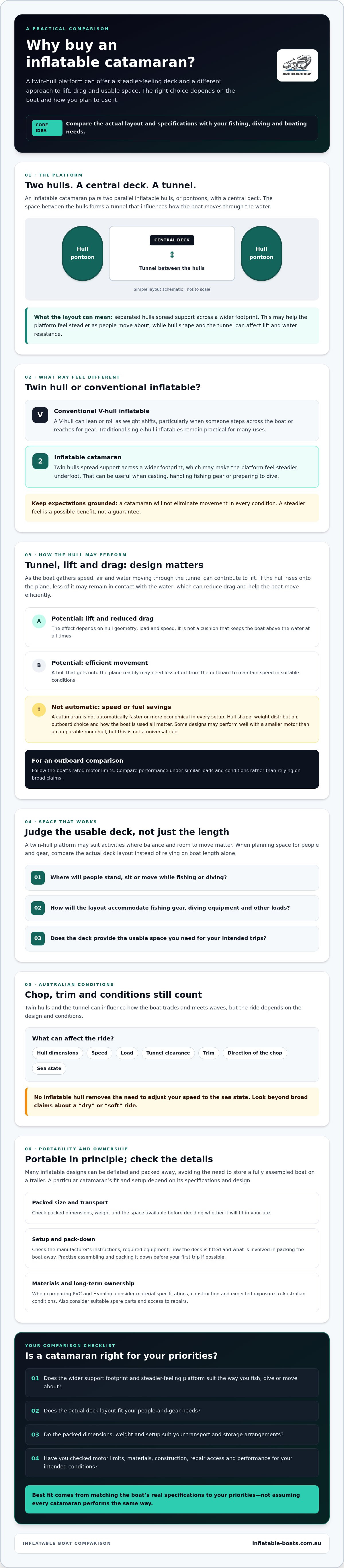
A twin-hull design creates a tunnel between the pontoons. The two hulls can help the boat feel more stable as you move about, while the hull and tunnel design can contribute to lift and reduce drag in suitable conditions. That can matter when you’re casting, diving or carrying equipment. The key is to compare the boat’s actual layout and specifications with the way you plan to use it.
This guide explains how inflatable catamarans compare with conventional inflatables, what their hull design can mean for handling and fuel efficiency, and how portability fits into the decision. You’ll also find practical checks for choosing a boat for Australian conditions, so you can make an informed comparison before heading out on the water.
Key Takeaways
- Understand how an inflatable catamaran’s twin-hull design differs from a conventional inflatable and what to check in a particular model.
- Decide why buy an inflatable catamaran by comparing its practical advantages with your fishing, diving and boating needs.
- Compare usable deck layouts rather than relying on boat length alone when planning space for people and gear.
- When comparing PVC and Hypalon, consider material specifications, construction and your expected exposure to Australian conditions.
- Use the checklist in this guide to assess whether a catamaran suits your priorities for stability, space and portability.
The Evolution of the Inflatable Catamaran
The familiar inflatable tender has evolved into a range of designs. An inflatable catamaran pairs two parallel inflatable hulls, or pontoons, with a central deck and a tunnel between them. That layout is more than a different silhouette: it affects how the boat sits on the water, how it carries people and gear, and how it responds as you move around.
Traditional single-hull inflatables remain practical for many uses, but a twin-hull platform offers a different set of trade-offs for activities such as coastal exploring, fishing and diving. The two hulls support the craft across a wider footprint, while their shape and the tunnel between them influence stability and water resistance. You can explore the fundamental principles of catamaran design to understand how this configuration differs from a monohull.
Monohull vs. Catamaran: A Different Platform
A V-hull inflatable can lean or roll as weight shifts, particularly when someone steps across the boat or moves to reach gear. Twin hulls spread support across a wider footprint, which can make the platform feel steadier underfoot. It won’t eliminate movement in every condition, but it may reduce the pronounced side-to-side sensation some boaters describe as “tippy”.
That steadier feel can be useful when you’re casting, handling fishing gear or preparing to dive. A more level working platform gives you room to move with greater confidence. It’s a practical reason to ask why buy an inflatable catamaran: not simply for a different hull shape, but for a layout that may suit activities where balance and usable deck space matter.
Portability Meets Performance
Portability is part of the appeal of inflatable craft. Many designs can be deflated and packed away, avoiding the need to store a fully assembled boat on a trailer. Whether a particular catamaran will fit in your ute depends on its packed dimensions, weight and the space available, so check the specifications before you buy.
Setup also varies by design. Before choosing, check the manufacturer’s instructions, what equipment is required, how the deck is fitted and what’s involved in packing the boat down again. If possible, practise assembling and packing it away before your first trip so you know how the components fit together.
The combination can be appealing: a portable craft with a stable-feeling platform and a hull design intended to support efficient movement through the water. For Australian boaters planning time on the coast, that may make getting afloat easier without giving up the practical performance they need. Construction, suitable spare parts and access to repairs are also worth considering as part of long-term ownership.
The Science of the Tunnel Hull: Why It Outperforms
A catamaran’s performance depends partly on the relationship between its twin hulls and the tunnel between them. As the boat gathers speed, air and water moving through this space can contribute to lift. This is better understood as an effect that may reduce how much of the hull is in contact with the water, not as a cushion that keeps the boat floating above the water at all times. The amount of lift depends on hull geometry, load and speed.
As the hull rises onto the plane, less of it may remain in contact with the water. This can reduce drag and help the boat move efficiently. However, the result depends on the design and operating conditions. A catamaran isn’t automatically faster or more economical in every setup. Hull shape, weight distribution, outboard choice and how the boat is used all matter.
Hydrodynamics and the Australian Chop
Separated hulls give a catamaran a wide support footprint, while the tunnel guides water between them. That geometry can affect how the boat holds its line, or tracks, as it moves through unsettled water. How comfortably it handles chop depends on hull dimensions, speed, load and conditions. No inflatable hull removes the need to adjust your speed to the sea state.
Compared with a flat-bottomed inflatable, a tunnel-hull design may change how the boat meets waves and manages spray. The result varies: tunnel clearance, trim and the direction of the chop all influence the ride. Look beyond broad claims about a “dry” or “soft” ride and consider how the craft is designed for your intended conditions.
Fuel Efficiency and Range
A hull that gets onto the plane readily may need less effort from the outboard to maintain speed, which can support lower fuel use in suitable conditions. Some catamaran designs may deliver useful performance with a smaller motor than a comparable monohull, but that isn’t a universal rule. Follow the boat’s rated motor limits and compare performance under similar loads and conditions.
Fuel efficiency can affect how far you can travel, how much fuel you need to carry and how much capacity remains for people and gear. That’s worth considering for longer river runs, where distance and changing conditions make range important to plan. Actual consumption depends on your speed, load, engine and water conditions, so use manufacturer guidance and monitor fuel use on the water.
If you’re comparing designs, explore the inflatable boat range and assess each craft against your intended load, outboard and conditions. The right tunnel hull is a considered match, not a shortcut around sound seamanship.
Maximising Usable Space: The Deck Advantage
A boat’s length doesn’t tell you how much room you’ll have to work with. A monohull often narrows towards the bow, leaving less practical floor area at the front. Many inflatable catamarans have a more rectangular deck between the hulls, which can make it easier to arrange people and gear. Compare the clear, usable deck footprint, not just the boat’s overall length.
That layout may help you organise an esky, tackle and dive equipment without turning the centre of the boat into an obstacle course. A clear deck is more than convenient: it gives passengers room to move and makes essential equipment easier to reach. Before choosing, check the deck dimensions and layout, then consider where each item will sit and how passengers will board.
The Ultimate Fishing and Diving Platform
For fishing, a wider working area can give anglers room to cast and handle gear without constantly negotiating around a tapered bow. The catamaran’s broad footprint can also feel more composed as people shift position. Don’t assume every model’s tubes are designed as standing surfaces. Follow the manufacturer’s guidance and use the intended deck area for movement.
Divers and swimmers should check water access, too. An open bow or unobstructed edge on some designs may make boarding from the water or a beach more straightforward, but layouts differ. Inspect the actual craft for suitable handholds and re-entry arrangements rather than relying on a general design description.
Weight Distribution and Payload
Two hulls spaced apart provide a broad buoyancy footprint, but that doesn’t mean an inflatable catamaran can carry an uneven or unlimited load. Passengers, fuel and heavy equipment still need to be distributed sensibly and kept within the vessel’s stated capacity. Keep heavier items secure and balanced, and make sure they don’t block movement or access to essential gear.
This matters particularly before considering exposed or demanding water, including a bar crossing. A wide footprint is not a guarantee of suitability or safety. Assess the boat’s design, capacity and condition, check the forecast and local conditions, and make a conservative decision about whether the craft and crew are equipped for the trip.
So, why buy an inflatable catamaran? For anglers, divers and families carrying bulky kit, its deck layout may help make better use of the available space. Compare usable floor area, access points and load limits before deciding. The right setup is one that keeps people and equipment organised without compromising safe movement.
Built for the Australian Sun: Durability and Materials
Saltwater, abrasion and strong Australian sun all test an inflatable boat over time. Material choice matters, but so do construction and care. Compare the fabric specification, seam construction and manufacturer’s maintenance guidance rather than relying on a broad label such as “heavy-duty”.
PVC and Hypalon, also known as CSM, each have strengths. Hypalon offers strong UV resistance, while modern PVC can provide a durable, practical option when it’s made and joined appropriately. Some premium inflatable boats use 1.2 mm PVC fabric, but thickness alone doesn’t tell you everything about durability. Ask how the material and seams are suited to your expected use and exposure.
Material Science: Fabric, Coatings and Seams
GSM means grams per square metre, a measure of fabric weight. It can help when comparing materials, but it isn’t a stand-alone rating of puncture resistance. Construction, reinforcement and coating also affect performance. Multi-layer fabrics combine a structural base cloth with protective coatings, which can help resist wear and exposure to salt, oil and sunlight. Check the maker’s specifications for the particular fabric.
Seams deserve close attention. Thermo-welded seams join compatible PVC surfaces using heat, while adhesive-bonded seams rely on glue. In hot conditions, adhesive can be vulnerable to deterioration. Well-executed welded seams are often favoured for PVC boats intended for demanding use, but neither construction removes the need for inspection and care.
Heat also affects internal air pressure. As a boat warms in the sun, pressure can rise, so follow the manufacturer’s inflation instructions and avoid leaving a fully inflated craft to overheat. If the boat has a pressure-relief valve, understand its purpose and care requirements. Don’t assume every valve will prevent overinflation or replace checking pressure as directed.
Maintenance and Long-Term Reliability
Good upkeep starts with following the manufacturer’s guidance for cleaning, drying, storage and pressure checks. Inspect fabric, valves and seams regularly, especially after a trip involving abrasion or extended sun exposure. Carry only spare parts suited to your boat, and know how to use them. For damage that needs professional attention, check the available inflatable boat repair service details before you head out.
Choosing a boat is only part of protecting your investment. Suitable construction, sensible maintenance and access to appropriate repairs and spare parts all support long-term reliability. To compare inflatable boat options with durability in mind, explore the inflatable boat range.
Why Buy an Inflatable Catamaran: Is It Right for You?
An inflatable catamaran may suit you if your days on the water involve moving around, carrying bulky equipment or looking for a steadier-feeling platform. Its twin hulls and open deck layout can bring together stability, usable space and efficient performance. That doesn’t make it the right choice for every trip. Your intended conditions, load, storage and transport options should guide the decision.
So, why buy an inflatable catamaran? The strongest case is for anglers, divers and explorers who value room to work and a platform that feels composed as people shift position. If your priority is simply a compact tender for occasional use, compare other inflatable designs too. The right craft is the one that suits your real boating needs, not just the one with the most appealing hull shape.
The Verdict for Fishers and Explorers
For fishing or exploring, a catamaran may be a logical option because stability and deck space can support practical tasks on board. Weigh the long-term ownership picture, not just the purchase: consider construction, care, storage, suitable spare parts and access to repairs. A monohull may still suit your use, so compare its usable space and handling with the catamaran’s features before deciding. Confidence comes from choosing a craft that matches your plans and operating it within its limits.
Use this checklist before committing:
- Does the deck layout fit your passengers and essential gear?
- Are the rated capacity and outboard limits suitable for your planned load?
- Can you transport, store, inflate and pack down the boat comfortably?
- Do the materials, seams and care requirements suit your conditions?
- Have you considered the parts and repair support you may need over time?
Next Steps for Your Boating Journey
Specifications are useful, but seeing a craft on the water can help you understand its setup and movement. Browse the available inflatable boat technical videos, then note any questions about your intended use, load or storage. If you’d like to discuss your requirements, you can contact Inflatable Boats. Share the conditions and activities you have in mind so the conversation can focus on what matters to you.
Ready to compare options? Explore the range of inflatable boats and assess each craft against your checklist. A well-matched boat, cared for properly and supported by suitable parts and repairs, can help you prepare for more time on the water.
Choose a Craft for the Water Ahead
An inflatable catamaran can bring together a steadier-feeling platform, practical deck space and efficient performance in a portable craft. Whether those advantages suit you depends on your plans, load and the conditions you intend to explore. Asking why buy an inflatable catamaran is a useful starting point: focus on how you’ll use the boat, then compare its construction, capacity and care requirements with your needs.
Long-term confidence also comes from having access to suitable spare parts and repair support. Inflatable Boats sells inflatable boats, iSUPs, accessories and spare parts, and offers professional repair services for inflatable vessels.
Ready to compare your options? Explore the inflatable boat range and consider which craft fits your next trip. With the right boat and sound preparation, you’ll be better placed to enjoy your time exploring on the water.
Frequently Asked Questions
Why is an inflatable catamaran more stable than a monohull?
An inflatable catamaran’s two hulls sit apart, creating a wider support footprint than a single-hull design. This can reduce the side-to-side rocking felt as people move around, making the deck feel more composed for fishing or handling gear. Stability still depends on the boat’s design, load and conditions. Distribute passengers and equipment sensibly, and always follow the manufacturer’s capacity and operating guidance.
Do inflatable catamarans require more maintenance?
A catamaran doesn’t automatically require more maintenance than another inflatable boat, but it does need regular care. Follow the manufacturer’s guidance for inflation, cleaning, drying and storage, and inspect the fabric, valves, seams and deck components for wear or damage. Salt, grit and prolonged sun exposure can take a toll. Address concerns promptly, using suitable spare parts or professional repair support where needed.
Can I use a smaller motor on an inflatable catamaran?
Some inflatable catamarans may achieve useful performance with a smaller outboard than a comparable monohull, but that depends on the model, load, hull design and conditions. Never choose a motor based on a general comparison alone. Check the boat’s rated motor limits and the manufacturer’s recommendations, then account for passengers, fuel and equipment. A suitable motor match supports control and performance. It isn’t simply a matter of selecting less power.
Are inflatable catamarans harder to set up and pack away?
Not necessarily. Setup and pack-down vary by design, so check the manufacturer’s instructions and understand how the hulls and deck components fit together before heading out. Practise assembling and packing the boat at home, where you can work methodically and confirm what equipment is needed. Also check the packed dimensions and weight against your available storage and transport space. A familiar routine helps avoid rushed preparation at the water’s edge.
What is the best material for an inflatable boat in Australia?
There’s no single best fabric for every Australian boat owner. Hypalon, also known as CSM, is valued for UV resistance, while quality PVC can be a durable option when its construction and seams suit the intended use. Compare the manufacturer’s material specifications, seam method and care instructions rather than judging by fabric thickness alone. Consider how often the boat will be exposed to sun, saltwater and abrasion.
How does an inflatable catamaran handle rough water and chop?
An inflatable catamaran’s twin hulls and connecting tunnel influence how it moves through chop, but performance varies with hull design, load, speed and sea conditions. Some designs can track steadily and manage spray differently from a flat-bottomed inflatable, yet no hull guarantees a dry or comfortable ride in rough water. Check the forecast, adjust speed to conditions and don’t treat a catamaran’s stability as a reason to take unnecessary risks.
Is an inflatable catamaran worth the extra cost for fishing?
It may be worth considering if fishing is a priority and you value a stable-feeling platform, open deck space and room to organise tackle, an esky and other gear. Compare the usable deck layout and capacity with the fishing setup you actually need. Also weigh construction, storage, maintenance and repair needs over the boat’s ownership, rather than focusing only on the purchase price. The best choice depends on your trips and budget.
What spare parts should I carry for an inflatable catamaran?
Carry parts and repair supplies that match your boat, and check the manufacturer’s guidance before packing them. Depending on the design, useful items may include compatible valve components and materials for a temporary puncture repair, along with the tools needed to use them. Keep instructions accessible and learn what repairs are appropriate to attempt afloat. For structural damage or uncertain repairs, seek professional help rather than relying on a temporary fix.