
Which iSUP Suits Heavy Riders and Their Skill Levels?
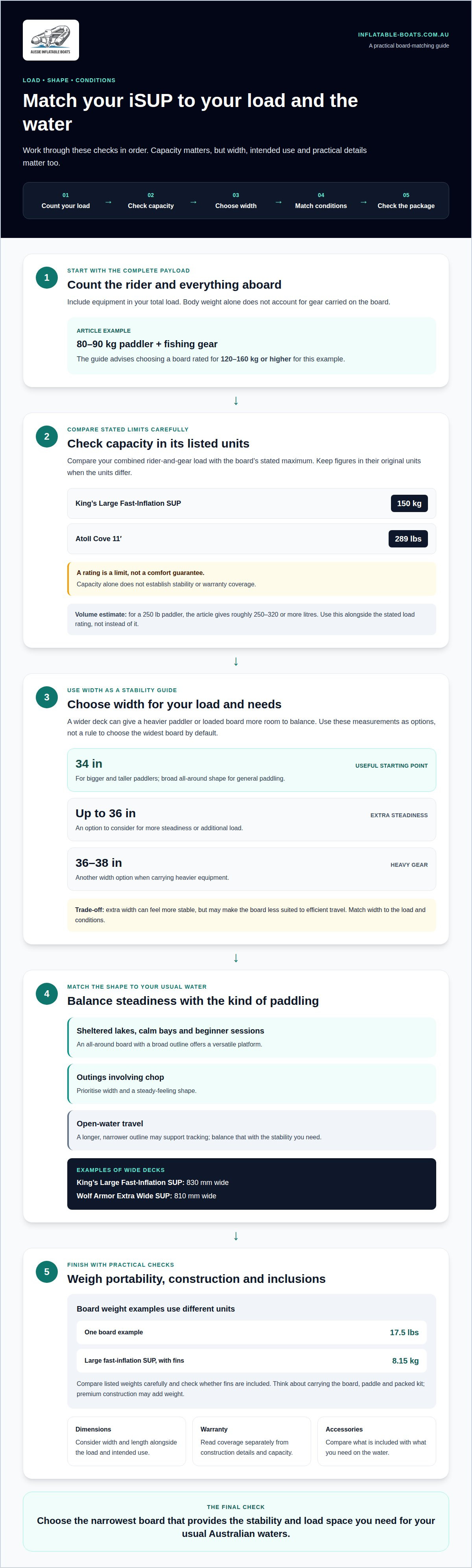
The board with the highest weight rating isn’t automatically the best fit. For the best iSUP for heavy riders in Australia, start with a stable, wide shape: 34 inches across is a useful guide, with boards up to 36 inches offering extra steadiness. Then match the board’s capacity to your weight and any gear you’ll carry.
It’s easy to focus on the capacity figure alone, but a board’s feel on the water also depends on its width, length and construction. The right match can make learning more comfortable and give experienced paddlers a steadier platform for exploring.
This guide explains how to compare capacity, stability, durability, warranty terms and package accessories. You’ll also see how skill level and intended use affect your choice, so you can weigh the practical details before deciding which inflatable paddle board is right for you.
Key Takeaways
- Choose a board by its rated capacity with your gear included, not rider weight alone.
- Use board shape and dimensions to assess how steady it may feel at your experience level and in your intended conditions.
- Balance construction and portability: a durable board still needs to be practical to carry and transport.
- Read warranty coverage alongside the board’s construction details to understand what protection applies.
- Compare the included accessories with what you’ll need on the water to judge the package’s practical value.
What makes the best inflatable stand up paddle board?
A suitable iSUP balances stability, load capacity and handling. For heavier paddlers, board width and the water conditions you’ll encounter matter as much as portability.
Board weight and portability
Board weight affects how easily you can carry an iSUP from the car to the water and manage it before inflation. One board example weighs 17.5 lbs, while another large fast-inflation SUP weighs 8.15 kg with fins. These figures use different units, so compare listed weights carefully and note whether fins are included.
A lighter board can be easier to move, but weight alone doesn’t determine suitability. Consider how you’ll transport the board, carry your paddle and handle the packed kit. Premium construction may add weight, so weigh portability against the board’s dimensions and intended use.
Width and stability for heavier paddlers
Width gives a heavier paddler or a loaded board more room to balance. A width of 34 inches is a useful starting point for bigger and taller paddlers; boards up to 36 inches can provide additional steadiness. For heavy gear, a 36-inch to 38-inch width is another option to consider.
Extra width can make a board feel more stable, but it may also affect how readily it moves through the water. Match the width to your load and conditions rather than choosing the widest board by default. A wide board may suit relaxed outings better than a narrow shape designed for efficient travel.
Water conditions help narrow your choice. For sheltered lakes, calm bays and beginner sessions, an all-around board with a broad outline offers a versatile platform. If your outings often involve chop, prioritise width and a steady-feeling shape. A board designed for open-water travel may have a longer, narrower outline, so balance tracking with the stability you need.
An all-around iSUP can suit heavier paddlers who want one board for casual paddling and varied outings. Compare its width, length and rated capacity with your total load, including equipment. The paddle matters too: a manageable paddle that supports a comfortable stroke makes the board easier to use.
| Board option | Width | Best suited to | Trade-off to consider |
|---|---|---|---|
| Broad all-around | 34 inches | General paddling and larger riders | Balance stability with portability |
| Extra-wide | Up to 36 inches | More steadiness or additional load | May feel less suited to efficient travel |
| Gear-carrying shape | 36 to 38 inches | Heavier equipment on board | Choose for load needs, not width alone |
Choose the narrowest board that provides the stability and load space you need for your usual Australian waters.
ISUP weight capacity and suitability for larger paddlers
For stated maximum loads, the King’s Large Fast-Inflation SUP is rated to 150 kg, while the Atoll Cove 11′ is listed at 289 lbs. Compare ratings in their original units, then assess board dimensions and warranty terms because capacity alone doesn’t establish stability or coverage.
Payload planning and rider suitability
Payload planning means counting the rider and everything carried aboard, not treating body weight as the total. An 80-90 kg paddler carrying fishing gear is advised to choose a board rated for 120-160 kg or higher. That gives equipment a place in the load calculation.
Compare your total load with the stated maximum, then assess the board’s dimensions and intended use. A capacity figure alone doesn’t show how a board will sit under load or feel while paddling. When choosing the best iSUP for heavy riders in Australia, include all the gear you’ll bring, not just your body weight.
Blackfin Model X capacity and features
Assess the Blackfin Model X using its published maximum load, dimensions and construction. Compare its stated capacity with your combined rider-and-gear total, then consider whether its length and width suit your intended water and skill level.
Features matter when they support your actual use. A paddler carrying fishing equipment, for example, should count that gear as part of the total load. Read the manufacturer’s capacity claim and warranty coverage as separate considerations. A carbon component or premium finish doesn’t, by itself, establish a board’s maximum load.
Maximum load capacity and stability
Inflatable SUP ratings vary: the King’s Large Fast-Inflation SUP has a stated capacity of 150 kg, while the Atoll Cove 11′ has a listed maximum load of 289 lbs. Keep those figures in their original units; don’t compare them as though the units match.
Stability depends on more than the maximum-load figure. Board width and length, along with how the load sits across the deck, all affect suitability. A rating states a limit; it doesn’t guarantee that every paddler will feel comfortable at that load.
For a 250 lb paddler, estimated board volume is roughly 250-320 or more litres. Use that estimate alongside the stated load rating, not as a replacement for it. The best iSUP for heavy riders in Australia is one whose capacity, volume and dimensions suit both rider and gear.
To compare available inflatable paddle board options, focus on stated capacity and intended use.
Stability and suitability for different skill levels
Wide decks can give heavier paddlers a more forgiving platform, while construction and capacity still matter. For Australian buyers, named wide-deck examples include the King’s Large Fast-Inflation SUP and Wolf Armor Extra Wide SUP, measuring 830 mm and 810 mm wide respectively.
Stability across skill levels
For a beginner, stability can make standing, turning and recovering balance feel more manageable. A paddler’s experience changes what matters: a newer rider may prioritise a steady deck, while a confident paddler may value manoeuvrability more. One participant described reaching the novice stage after about 40 hours of paddling, but skill develops at an individual pace.
Compare boards in the conditions you expect to paddle. Deck width, rider position and load all affect how stable a board feels. A wide outline can help with balance, but it doesn’t replace suitable weight capacity or good technique. Notice how extra gear changes your stance and the board’s response.
Atoll Outrider capacity and stability
Assess the Atoll Outrider by comparing its stated capacity with your combined rider-and-gear load. Then consider its deck width and length, since capacity alone doesn’t tell you how stable the board will feel. These criteria distinguish load suitability from on-water balance.
When comparing the Atoll Outrider, treat the manufacturer’s capacity claim as a maximum load, not a measure of comfort at that load. Review the warranty’s duration and conditions separately. A warranty period doesn’t change the board’s capacity or make an unsuitable load appropriate.
Reinforced construction and wide decks
The King’s Large Fast-Inflation SUP measures 3200 x 830 x 150 mm when inflated; the Wolf Armor Extra Wide SUP measures 3200 x 810 x 150 mm. These dimensions identify broad decks, but width alone doesn’t establish reinforced construction or confirm a brand’s Australian origin.
Compare the construction description with the board’s dimensions. A drop-stitch core helps an inflatable board hold its shape when inflated; assess reinforcement details separately. Look for clear descriptions of the materials and reinforced areas, then weigh them against capacity, intended use and warranty conditions.
For a fair stability comparison, keep the rider, gear and water conditions consistent. A board that feels steady on calm water may respond differently in chop. Width is particularly relevant in unsettled conditions, while length also affects how the board tracks across the water.
Choose a board that matches your current skill and likely load, rather than selecting by capacity alone. A wide deck may help a beginner feel settled; an experienced rider may prefer a different balance of stability and handling. Construction, weight capacity and warranty each address a separate part of the decision.
Durability and warranty coverage
Durability depends on construction, care and transport. Before choosing an inflatable SUP, compare its material and seam descriptions, then read the warranty terms. A board described as lightweight may be easier to carry, but weight alone doesn’t establish durability. Clear construction details can help beginners understand what they’re buying.
Start with a practical inspection checklist. Look for information about the outer material, seams, valve, fin attachment and carry handles. These areas affect inflation, setup, handling and transport, so their construction matters in everyday use. For example, a board repeatedly lifted by its handle needs a securely integrated carrying point, not just an attractive deck.
Pay close attention to seam construction. Inflatable boards use seams to join sections of their outer shell, while drop-stitch construction helps the inflated deck retain its shape. Product descriptions should explain the construction clearly. Don’t infer reinforcement from a premium label or a high weight capacity; these describe different characteristics.
Care also affects how long a board remains usable. After a session, rinse away residue, dry the board and store it according to its care instructions. Avoid dragging it over rough ground, and keep sharp equipment from rubbing against the deck. These straightforward steps help limit avoidable wear without changing the board’s design or warranty coverage.
Warranty coverage is another comparison point. Read the terms for covered components, exclusions, the claim process and any care requirements. The warranty period alone doesn’t explain what qualifies for a claim. For example, a manufacturing fault and damage during transport may be treated differently under the written terms.
- Construction: compare the material, seams and reinforcement details provided.
- Use: consider how the board will be inflated, carried and stored.
- Warranty: identify coverage, exclusions and the stated claim process.
For a heavier paddler, consider durability alongside the stated weight capacity. The board needs to suit the rider and equipment, and its construction should match the demands of regular use. A stable deck can help beginners feel confident, but it doesn’t remove the need to follow care instructions or respect the load rating.
Make the final comparison in sequence: assess construction, consider your transport and storage routine, then read the warranty conditions. This separates physical durability from after-purchase coverage. A durable board with clear care guidance may suit frequent outings, while a lightweight option may be easier to carry between home and the water.
Included accessories and package value
A package offers value when its accessories suit your paddling plans, not simply because it contains more items. Compare the board, stated capacity and included equipment together. For heavier riders, accessories should support setup and use without distracting from the main question: does the board suit the rider and total load?
There’s no single Australian price for every high-capacity iSUP package. Costs depend on the board and package contents, so compare prices in A$ only when listings cover comparable boards and accessories.
Read each package inventory line by line. A paddle is essential for propulsion, and a pump is needed to inflate the board. Manual and electric pumps serve the same purpose in different ways: consider the effort and transport involved, then decide which suits your routine. Don’t assume a pump is included unless the package says so.
- Paddle: check whether one is included and suitable for your use.
- Pump: note whether the package lists a manual or electric option.
- Fin: check whether the required fin is part of the supplied kit.
- Leash: see whether one is included for your intended paddling.
- Carry bag: consider how it affects storage and transport.
Treat these as comparison points, not a promise that every package contains them. A package listing a board and paddle, for example, may still leave you needing to source a pump separately. That affects practical value and setup effort, even if the board itself appears suitable.
Brand names don’t replace an itemised comparison. If you’re considering a Thurso package, assess its listed accessories using the same steps as any other option. Compare the actual inclusions rather than assuming a particular brand or premium label means the setup is complete.
For standing balance, prioritise the board’s suitability over the accessory count. A useful package should support the way you plan to paddle, and its stated capacity must suit your load. Accessories can add convenience, but they can’t compensate for a board that doesn’t suit your weight or intended conditions.
Judge package value in this order: match the board to your rider-and-gear load, identify what’s included, then account for anything essential that’s missing. This is clearer than counting accessories or choosing the largest bundle. It also helps distinguish useful equipment from extras that may not suit your outings.
To compare available inflatable paddle board options, focus on the stated board capacity and package inventory before deciding.
The package total depends partly on whether essentials such as a pump are included; a board-and-paddle bundle may require you to buy a pump separately.
Inflatable Boats
Inflatable Boats can help when your decision leads to questions about related inflatable watercraft, equipment or upkeep. After comparing iSUP capacity, stability and package contents, consider what support you may need for the rest of your time on the water.
The range includes inflatable boats, accessories and spare parts, alongside repair services for inflatable vessels. These offerings can support your boating setup or help repair an inflatable craft. They don’t replace the board-selection criteria above; use those to judge whether an iSUP suits your weight, experience and planned outings.
For help with your next step, contact Inflatable Boats.
Make your next paddle a considered choice
Choosing the best iSUP for heavy riders in Australia is a starting point, not the end of the journey. Think about the water you want to explore, how you’ll transport your equipment and what you may add to your setup over time. Making your board decision with those plans in mind can help you prepare for more confident days on the water.
For related watercraft and equipment, Inflatable Boats offers inflatable boats, accessories and spare parts. These may be relevant when your plans extend beyond selecting a paddle board and you’re considering a broader inflatable boating setup.
Ask Inflatable Boats for advice as you consider your next step. Take your time, choose equipment that suits your needs, and look forward to getting out on the water.
Frequently Asked Questions
Are inflatable SUPs worth it?
Yes, an inflatable SUP can be worthwhile if compact storage and transport suit your routine. It packs down for storage between outings and can be inflated when you’re ready to use it, making it a practical alternative to storing a rigid board. The trade-off is setup: you’ll need to inflate it before paddling and pack it away afterwards. Consider where you’ll store it, how you’ll carry it and how often you plan to paddle.
What is the maximum rider weight for popular inflatable SUPs sold in Australia?
Published figures include a 289 lb maximum load for the Atoll Cove 11′ and a 150 kg stated capacity for the King’s Large Fast-Inflation SUP. These are maximum-load figures, not necessarily rider-only limits. Include carried gear in your total, and keep each board’s figure in its original unit. A board’s maximum rating doesn’t tell you how comfortable it will feel under that load.
What board length, width, thickness, and volume suit a heavy rider?
For a 225-275 lb paddler, the guidance is an 11′6″-12′ board; at 275 lb and up, consider 12 feet or longer. For a 250 lb paddler, estimated volume is roughly 250-320 or more litres. Treat these as starting points, not a complete specification: match the board’s weight capacity to rider and gear, and consider width for balance. Choose thickness and volume as part of the board’s overall design.
How do Australian iSUPs compare on real-world load capacity, rigidity, and stability?
Compare the manufacturer’s load rating with how the board behaves under a realistic rider-and-gear load. A participant reported that a 10'6 C4 board only just floated him with forward momentum, illustrating why a rating alone can’t describe on-water feel. Rigidity also depends on inflation: the cited guidance recommends inflating to the board’s maximum rating, usually 12-15 PSI. Width and load distribution affect stability.
How much do high-capacity iSUPs cost in Australia, including package deals?
What are the best iSUPs for heavy riders available in Australia in 2026?
The King’s Large Fast-Inflation SUP and Wolf Armor Extra Wide SUP are wide-deck examples; they measure 830 mm and 810 mm wide respectively. The Atoll Cove 11′ has a listed maximum load of 289 lbs. Match capacity, dimensions and intended use to your total load and skill level.