
What Motor for Inflatable Catamaran Tenders? 2026 Guide
Bolting the biggest outboard onto your transom won't make your tender fly; it will likely ruin the ride. If you are wondering what motor for inflatable catamaran hulls delivers the right balance, standard monohull charts will steer you wrong. It's frustrating to watch an agile tunnel hull bog down from tail-heavy trim, ventilate the propeller in light chop, or strain under excessive stern weight. You want clean, reliable thrust that complements twin sponsons, giving you prompt lift without compromising stability or overloading your transom.
This 2026 guide shows you how to calculate the ideal horsepower, shaft length, and transom weight to select the perfect outboard for your vessel. We'll unpack tunnel ventilation dynamics, compare lightweight four-stroke petrol against modern electric systems, and help you rig your craft for total confidence across Australian waters.
Key Takeaways
- Dual sponsons and aerated tunnel lift dramatically reduce hydrodynamic drag, allowing catamarans to plane cleanly with lower horsepower than traditional monohulls.
- Adhering strictly to your vessel's maximum hull plate rating protects transom integrity and ensures compliance with state marine regulations and insurance policies across Australia.
- Setting the correct shaft length, typically a standard 15-inch short shaft, prevents turbulent tunnel wash from aerating the propeller and causing loss of grip.
- Determining what motor for inflatable catamaran setups best serves your voyages requires balancing the extended range of four-stroke petrol against the lightweight simplicity of modern electric drives.
- Centring the mounting bracket and verifying transom load limits prevents asymmetric steering pull, guaranteeing balanced trim in coastal chop.
Inflatable Catamaran Hydrodynamics: Why Outboard Selection Differs from Monohulls
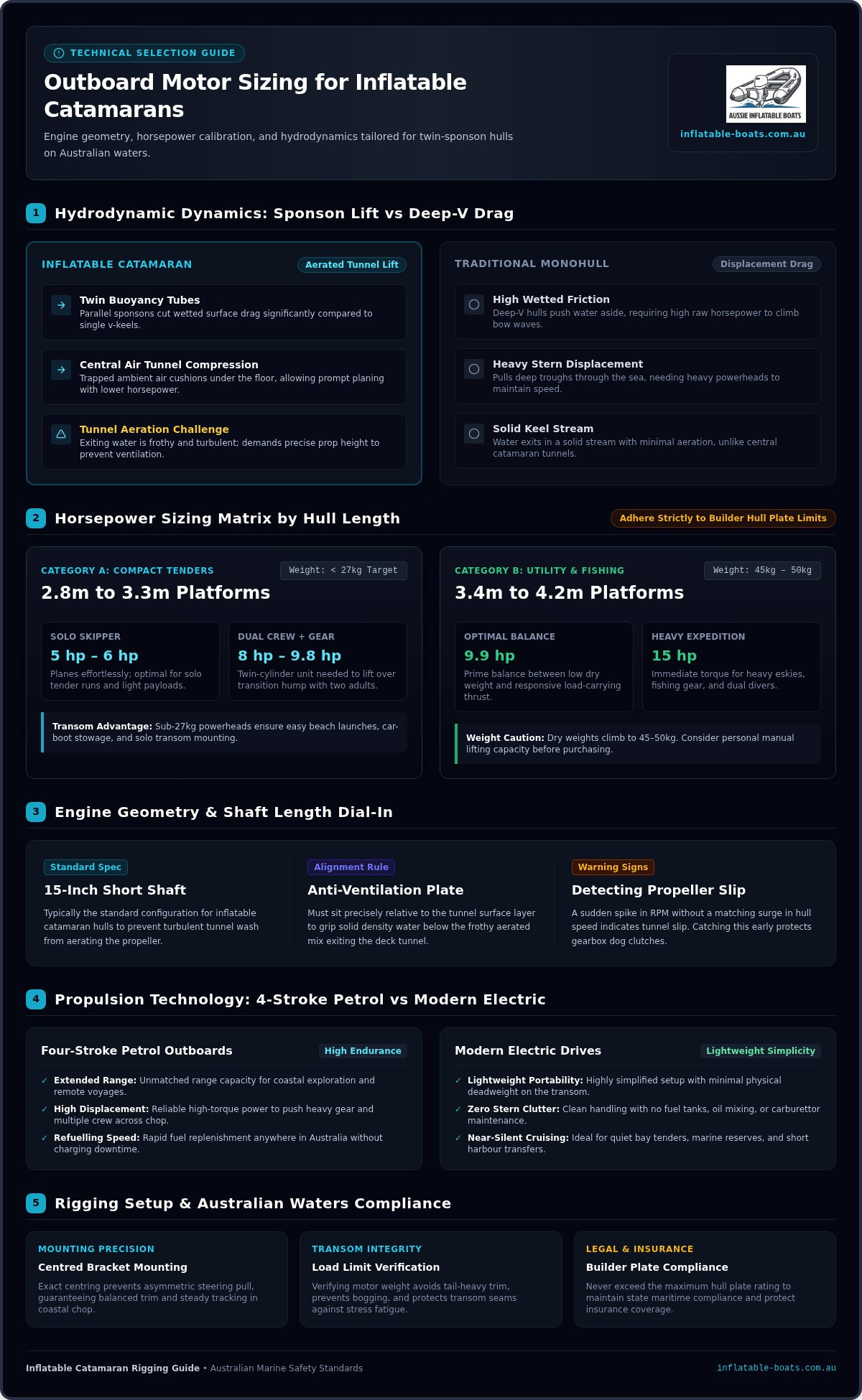
Twin hulls change everything. Conventional deep-V dinghies rely on brute displacement to slice through swells, requiring significant thrust simply to push water aside. Inflatable catamarans take a fundamentally different approach. Parallel sponsons carry the load on two slender buoyancy tubes, dramatically cutting wetted surface drag. When planning your vessel setup and deciding what motor for inflatable catamaran transoms works best, traditional monohull power equations no longer apply.
Trapped between the twin pontoons, the central air tunnel creates dynamic, aerated lift as speed increases. Air packs beneath the raised deck, acting like an aerodynamic cushion that lifts the vessel higher out of the water. Because hull friction drops significantly, an inflatable catamaran gets on plane with far less throttle. However, mounting a standard outboard motor directly behind that rushing tunnel introduces distinct hydrodynamic challenges. Water exiting an enclosed catamaran tunnel is frothy, aerated, and turbulent, unlike the clean, undisturbed stream exiting a single keel. Selecting an incorrect unit can lead to severe cavitation, porpoising, or stern swamping in following seas.
Twin-Sponson Lift vs Monohull Drag Dynamics
Gliding on parallel tubes eliminates hydrodynamic suction. Monohulls pull deep troughs through the sea, demanding raw muscle to climb over their own bow waves. Catamarans avoid that barrier entirely. The hull pack compresses ambient air beneath the floor, creating high running stability across choppy coastal waters. Because total surface drag is exceptionally low, small-displacement powerheads match the sprint speeds of much heavier single-hull setups.
Understanding Tunnel Aeration and Propeller Slip
Air-rich water spells danger for conventional propellers. When froth rushes into the prop arc, the blades lose hydrodynamic bite, spinning through aerated water rather than solid density. Knowing what motor for inflatable catamaran tenders prevents this issue comes down to vertical alignment and propeller grip:
- Height alignment: The engine's anti-ventilation plate must sit precisely relative to the tunnel surface layer to catch solid water below the frothy air-water mixture.
- Slip indicators: A sudden spike in engine RPM without a matching surge in hull speed reveals severe tunnel slip.
- Gearbox protection: Catching slip early prevents damaging engine over-revving and preserves gearbox dog clutches under load.
Balancing these hydrodynamic forces ensures your tender tracks true without blowing out in turns or dragging unnecessary deadweight across the bay.
Horsepower Sizing Guide: Matching Motor Capacity to Catamaran Length
Matching displacement to tube length demands precision. Exceeding the builder plate rating strains the engine board, stresses tube seams, and instantly voids your marine insurance policy. Operating overpowered craft also breaches state maritime compliance, making familiarity with Australian boating safety rules critical before purchasing an outboard. Determining what motor for inflatable catamaran hulls delivers optimum speed depends on matching your typical crew payload to the hull length category.
For a detailed breakdown on matching hull builds with planned offshore uses, check our sibling guide, The Rugged Guide to Choosing Your First Inflatable Boat in 2026. Selecting the right propulsion bracket keeps your stern light and your vessel tracking straight.
Lightweight Tenders: 2.8m to 3.3m Platforms
Solo skippers plane effortlessly using a compact 5hp to 6hp outboard. However, ferrying a second adult and day packs requires the extra displacement of an 8hp or 9.8hp twin-cylinder unit to lift over the transition hump. Keeping motor weight under 27kg ensures easy beach launches, straightforward car-boot stowage, and manageable solo transom mounting.
Mid-Sized Utility and Fishing Craft: 3.4m to 4.2m
Between 3.4 and 4.2 metres, a 9.9hp engine strikes the ideal balance between low dry weight and responsive, load-carrying thrust. Upgrading to a 15hp unit provides immediate torque when carrying heavy eskies, fishing gear, and dual divers, but dry weights climb towards 45kg to 50kg. Consider your personal lifting capacity before committing to heavier powerheads, ensuring you can still muscle the unit onto the transom clamp safely.
Expedition and Commercial Inflatables: 4.3m and Above
Heavy exploration hulls demand genuine muscle. A 20hp motor powers through rough coastal inlets while carrying bulky fuel reserves and camp gear without losing plane. When dialing in what motor for inflatable catamaran transoms in this class, consider these practical setup rules:
- Load dispersion: Position fuel tanks and primary gear forward to counteract heavier stern engines.
- Hydrodynamic trim: Bolt-on hydrofoil fins prevent high-angle bow rise when accelerating under heavy payloads.
- Plate verification: Always confirm the maximum hull plate load and transom thickness before hanging high-torque outboards.
Before rigging your craft, browse our durable Collections to find purpose-built hulls, reinforced fittings, and matching gear. Choosing a properly matched rig ensures safety, sharp handling, and lasting performance every time you venture offshore with reliable gear from Inflatable Boats.
Shaft Length and Transom Height: Dialling In Engine Geometry
Twin buoyancy tubes sit higher in the water column than a single deep-V keel. Because buoyant sponsons elevate the static waterline, hanging an outboard without verifying engine height invites trouble. When evaluating what motor for inflatable catamaran tenders best suits your rig, shaft length requires careful alignment. Most inflatable catamarans feature a transom height around 15 inches (380mm), engineered precisely for a standard short-shaft motor. Clamping a 20-inch long-shaft engine onto that board drops the gearcase too deep, throwing up massive plumes of spray, dragging your transom down, and causing sharp steering pull.
Conversely, mounting a short shaft on a transom that sits even slightly too tall starves the propeller of clean flow. Air rushing through the central tunnel gets sucked straight into the prop blades, causing aggressive ventilation. Worse still, if the engine rides too high, the cooling water pick-up will suck in aerated foam, putting the powerhead at immediate risk of thermal lockup.
Measuring Transom Height to Anti-Ventilation Plate
Measure vertically from the top edge of the transom board down to the underside plane of the sponsons. The motor's horizontal anti-ventilation plate should rest completely flush with, or roughly 25mm below, the lowest line of the tubes. Once launched, verify the cooling water tell-tale stream immediately. A solid, uninterrupted jet confirms the lower unit intake is submerged in dense, bubble-free water rather than tunnel spray.
Curing Propeller Cavitation and Tunnel Blow-Out
Tunnel aerated wash often leads to propeller blow-out during hard cornering or chop navigation. If your blades lose grip unexpectedly, consider these mechanical adjustments:
- Trim pin adjustment: Shifting the manual tilt pin in by one hole tucks the lower unit under, pushing the prop into cleaner sub-surface water.
- Cupped propeller upgrade: Installing a cupped alloy or stainless prop increases blade bite and holds water tenaciously against tunnel froth.
- Anti-cavitation plate extensions: Adding an aftermarket hydrofoil plate seals the water stream above the prop, preventing aerated tunnel spray from breaking surface tension.
Dialling in engine geometry transforms your craft from a sluggish, aerated headache into a razor-sharp tender. Take the time to measure your hull before deciding what motor for inflatable catamaran hulls to clamp down for your next journey.
Outboard Technology Comparison: 4-Stroke Petrol vs Modern Electric Drives
Choosing between liquid fuel and battery propulsion reshapes your entire boating routine. When deciding what motor for inflatable catamaran hulls suits your adventures, the choice centres on raw touring range versus quiet convenience. Petrol delivers exceptional energy density for remote coastal exploration, while modern electric systems provide effortless portability and clean handling. Because tunnel hulls glide with minimal hydrodynamic friction, both power plants punch well above their weight.
Four-Stroke Combustion Engines: Range, Weight, and Power
Combustion power remains the undisputed choice for long-range cruising. A portable four-stroke outboard paired with a compact fuel caddy lets you explore remote estuaries without battery anxiety. Modern EFI units sip unleaded fuel efficiently, but their mechanical complexity adds noticeable bulk to your transom. A portable 9.9hp to 15hp engine commonly weighs between 38kg and 50kg, which demands careful trim adjustment on lightweight tenders. Four-stroke outboards also require strict resting orientations during transport in vehicles or lockers to prevent crankcase oil from pooling into the cylinders. Regular servicing of fuel filters, spark plugs, and raw-water impellers is essential to keep them running smoothly in harsh marine environments.
Integrated Electric Outboards: Silent Cruising on Efficient Hulls
Electric outboards pair naturally with low-drag catamarans. Twin sponsons slice through current with almost no surface resistance at displacement speeds, allowing a 1kW direct-drive electric motor to sip minimal amp-hours while holding a steady cruise. Instant low-end torque pops light hulls onto an efficient glide without mechanical vibration, exhaust smoke, or oily bilges. This near-silent operation makes them exceptional tools for sneaking into shallow fishing flats and exploring sensitive marine parks.
Portability is where electric drives truly shine. Most units decouple in seconds, letting you carry the motor shaft and the lithium battery separately up the boat ramp. However, running at wide-open throttle drains battery capacity rapidly. Pushing for continuous planing speed will shorten your runtime substantially, requiring onboard solar replenishment or a mothership generator to recharge for the next leg.
When selecting what motor for inflatable catamaran tenders best serves your plans, weigh remote fuel access against easy maintenance. If you need mounting hardware, accessories, or transom gear to finish your rig, browse the marine-grade equipment at Inflatable Boats to prepare your craft for the water.
Rigging, Transom Setup, and Safe Operation on Australian Waters
Rigging your craft correctly ensures every ounce of thrust translates into clean, predictable handling. Before clamping any propulsion unit in place, thoroughly inspect the structural integrity of your marine-ply or composite transom board. Stress fractures, delamination, or loose fittings compromise safety when pushing through coastal chop. Verify manufacturer-specific maximum transom plate load ratings prior to final installation, ensuring your hull handles the combined engine weight and acceleration forces without flexing. To see practical mounting setups in action, explore our tender demonstrations on the Video Page.
Step-by-Step Transom Mounting and Securing Procedure
Centring the motor along the transom pad is essential. Positioning an engine even slightly off-centre introduces persistent asymmetric pull, quickly fatiguing your arm on the tiller during longer passages. Hand-tighten both clamp screws firmly until they seat squarely against the mounting pad, and recheck them after ten minutes of running. For reliable peace of mind, fit a marine-grade clamp lock across the handles. Always secure a rated, high-tensile safety wire connecting the outboard bracket to the hull's transom eyes to protect against accidental engine loss if clamps loosen under load.
Trimming the Outboard for Optimal Running Attitude
Manual pin adjustment governs hull attitude across varying sea states. Start with the tilt pin positioned so the motor shaft stands perpendicular to the water surface once the hull reaches cruising trim. Setting the pin inward drops the bow, cutting cleanly through steep chop while marginally increasing sponson drag. Tilting the pin outward raises the bow, reducing hull contact to increase open-throttle speed. Deciding what motor for inflatable catamaran voyages provides peak control requires dialling in this dynamic trim angle to match your passenger and fuel load.
Pre-Launch Safety and Maintenance Protocols
Rigid tubes maintain structural integrity across the entire vessel platform. Before sliding down the boat ramp, complete these fundamental pre-launch checks:
- Tube pressure: Check chamber pressures with an accurate marine gauge; correct sponson firmness prevents transom flex and hull distortion under power.
- Safety gear: Clip the emergency kill-switch lanyard directly to your lifejacket before starting, and pack spare spark plugs and drive pins in your toolkit.
- Hardware checks: Confirm fuel lines are primed and steering friction nuts are set to prevent sudden engine kick in heavy chop.
For technical mounting advice, transom pads, or replacement hardware, Contact our experienced marine team, or explore the proven watercraft and gear available nationwide through Inflatable Boats.
Rig Your Tender for Peak Confidence on the Water
Selecting the right powerhead unlocks the full performance designed into your tunnel hull. Twin sponsons and dynamic air lift mean you don't need heavy displacement to achieve rapid planing speeds. Settle on a standard 15-inch short shaft, keep your transom load well within plate limits, and align your anti-ventilation plate with clean water to prevent cavitation slip. Whether you prioritise the long-distance touring range of a four-stroke petrol engine or the silent, modular convenience of an integrated electric drive, knowing what motor for inflatable catamaran setups matches your load profile makes all the difference.
Every journey improves when your equipment is built tough and rigged properly. As a dedicated national specialist, we supply premium inflatable watercraft, performance accessories, genuine spare parts, and factory-grade repair services across Australia. When you're ready to dial in your setup, explore inflatable boats and performance rigging gear to get out and explore open waters with total peace of mind.
Frequently Asked Questions
Can you put any regular outboard motor on an inflatable catamaran?
Yes, standard outboards mount directly onto an inflatable catamaran transom, but matching weight, shaft length, and bracket height is critical. Tunnel hulls ride higher on twin sponsons, so an engine with an improper lower unit profile will ventilate easily. Always confirm the motor's total dry mass stays within the manufacturer's transom capacity before clamping it down.
What size motor do I need to plane an inflatable catamaran?
A 5hp to 6hp motor easily planes a solo skipper on a lightweight 3-metre hull. If you carry two adults plus coastal fishing gear, an 8hp to 9.9hp outboard provides the extra displacement required to jump onto the plane cleanly. Larger hulls above 4 metres generally require 15hp to 20hp to overcome heavy touring payloads without bogging down.
Is a short shaft or long shaft motor better for an inflatable catamaran?
A standard 15-inch short shaft motor is almost always better for inflatable catamarans. Most tunnel hulls are built with a 380mm transom height. Fitting a 20-inch long shaft submerges the gearcase too deeply, creating severe underwater drag, bow lift, and excessive spray. Always measure vertically from the top mounting pad to the sponson bottoms to confirm your hull's geometry.
Why does my outboard motor ventilate or rev out on a catamaran hull?
Outboards ventilate when aerated water rushing through the central tunnel enters the propeller arc. If you are troubleshooting what motor for inflatable catamaran hulls eliminates slip, your engine's anti-ventilation plate may be mounted too high. Adjusting your trim pin one hole inward, adding a cupped propeller, or lowering the mounting bracket ensures the blades grip dense, non-aerated water.
Are electric outboards powerful enough for twin-hull inflatable tenders?
Direct-drive electric outboards excel on twin-hull tenders for displacement cruising and short harbour transfers. Because catamarans produce minimal wetted surface friction, a 1kW electric motor moves the hull smoothly with near-zero drag. However, if you plan to plane with passengers or cross open coastal bays against strong tides, a higher-output petrol engine remains essential for sustained speed and range.
What happens if you overpower an inflatable catamaran transom?
Overpowering an inflatable catamaran strains the transom plate, tears tube bonding seams, and voids both manufacturer warranties and Australian marine insurance. Excessive engine weight creates severe tail-heavy squatting, making the bow fly dangerously high in choppy water. Rigging within hull plate limits keeps your transom rigid and preserves factory handling across coastal swells.
How do hydrofoil fins affect performance on an inflatable catamaran?
Hydrofoil fins bolted to the anti-ventilation plate generate rapid stern lift and help suppress tunnel air blow-out. They flatten high-angle bow rise during initial acceleration, allowing smaller motors to pop heavy hulls onto the plane faster. For skippers weighing what motor for inflatable catamaran cruising balances best, foils provide valuable trim stability when carrying shifting passenger loads.