
Tender towing bridle setup for choosing length and capacity
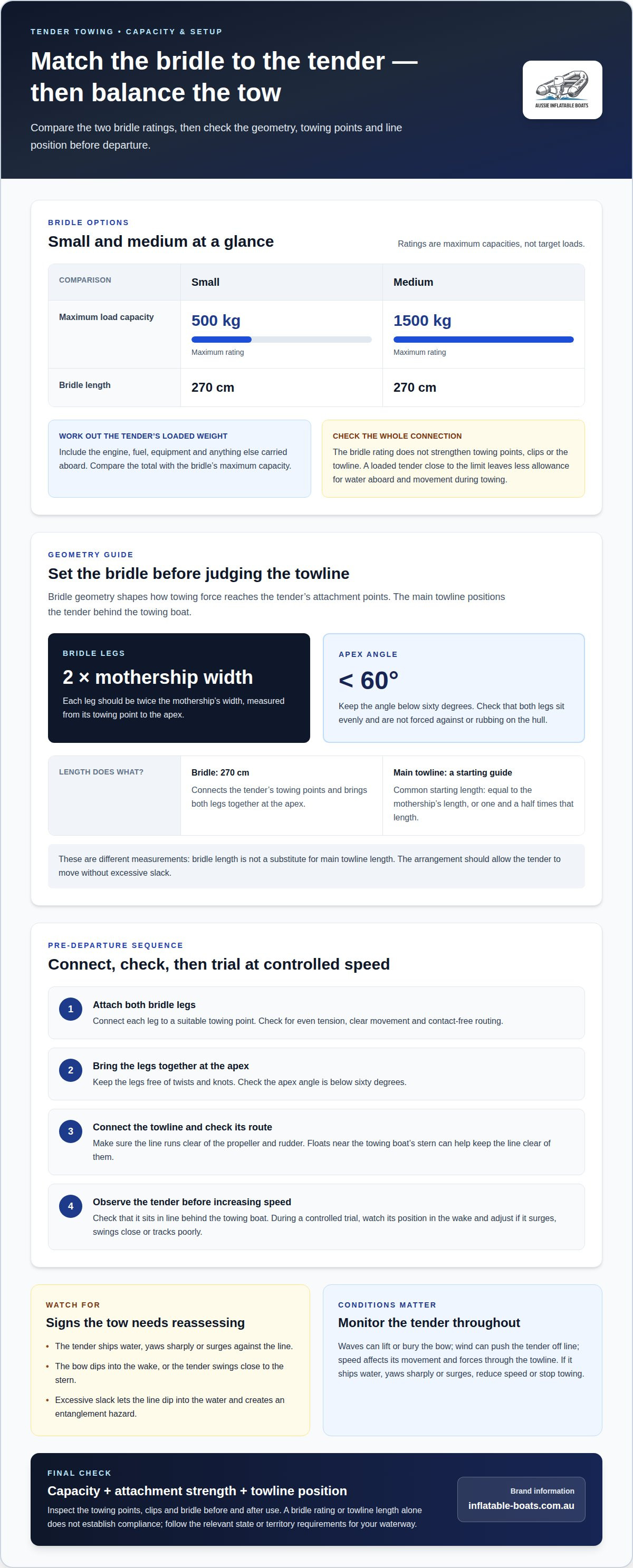
Strength alone won’t keep a tender tracking cleanly behind the boat. A tender towing bridle setup to help prevent swamping starts with matching the bridle’s capacity to the tender’s weight, then setting its length and tow points so the load is shared rather than concentrated at one attachment. Small and medium bridle options have maximum load capacities of 500 kg and 1500 kg respectively.
It’s easy to focus on the towline and overlook the bridle geometry. Yet the length of each leg, the angle at the apex and the strength of the tender’s towing points all affect how the load travels through the setup. A line that’s too short or poorly arranged can also affect how the tender follows in changing water.
This guide explains how to match bridle capacity to tender weight, choose a suitable length, distribute load across towing points and inspect the setup before departure. You’ll also see how small and medium bridle specifications differ, helping you make a considered choice and arrange a steadier tow.
Key Takeaways
- Choose a bridle capacity that suits the tender’s weight: the small option is rated to 500 kg, while the medium option is rated to 1500 kg.
- Use bridle length and geometry to help the tender track steadily, including keeping the apex angle below sixty degrees.
- Spread towing force across suitable attachment points rather than relying on a single point.
- Inspect the towing points, clips and bridle before and after use, and consider whether the setup suits the conditions.
- Compare small and medium bridle specifications to understand which details matter for your tender and towing arrangement.
Choosing a bridle by tender weight and load capacity
To build a tender towing bridle setup to prevent swamping, start with the tender’s fully loaded weight. Include the engine, fuel, equipment and anything carried aboard, then compare the total with the bridle’s maximum load capacity. The small tender towing bridle has a maximum capacity of 500 kg; the medium option has a maximum capacity of 1500 kg.
Those ratings are limits, not target loads. A loaded tender close to its bridle’s maximum leaves less allowance for water aboard and movement during towing. A tender towing bridle setup to prevent swamping must also account for the towing points, clips and towline, because the bridle rating cannot strengthen the other parts of the connection.
Tow a tender when carrying it aboard isn’t practical and the conditions and towing arrangement suit the trip. Carrying it aboard avoids a trailing tow, but requires suitable space and secure stowage on the mothership.
For Australian recreational boating, the applicable maritime rules depend on the jurisdiction and circumstances. Follow the relevant state or territory requirements for your waterway. A bridle rating or towline length alone doesn’t establish compliance.
Waves can lift or bury the tender’s bow, while wind can push it off line. Speed affects how the tender moves and the forces transmitted through the towline. If the tender starts shipping water, yawing sharply or surging against the line, reduce speed or stop towing.
Rig the connection in sequence: attach each bridle leg to a suitable towing point, bring both legs together at the apex, then connect the towline. Before moving, check the clips, confirm the legs are clear and make sure the tender sits in line behind the towing boat.
A common starting length for the main towline is equal to the mothership’s length, or one and a half times that length. This gives the tender room to follow the wake while helping keep it clear of the stern. The arrangement should let the tender move without excessive slack.
A towline that leaves the tender too close may let it surge towards the stern as the boats slow. Excessive slack can let the line dip into the water and create an entanglement hazard. Floats near the towing boat’s stern can help keep the line clear of the propeller or rudder.
Test the arrangement at a controlled speed and observe the tender’s position in the wake. Adjust the line if the tender surges, swings close to the boat or tracks poorly. Capacity, attachment strength and towline position all contribute to a sound towing setup.
Consider capacity, attachment strength and towline position together. A successful tow doesn’t prove that the setup is suitable. Experience provides context, but doesn’t replace checking the tender’s fully loaded weight, the bridle limit and every connection in the towing system. Conditions and handling can differ, so choose a setup with an appropriate margin and monitor the tender throughout the tow.
Bridle length
Bridle geometry determines how its legs meet and how towing force reaches the tender’s attachment points. For a setup intended to help limit swamping, assess leg length, apex angle and towline position together.
Setting Bridle Geometry
Measure each leg from its towing point to the apex, where the two legs meet. A shipboard tender bridle’s legs should each be twice the mothership’s width, and its apex angle should remain below sixty degrees. These measurements establish a starting geometry, but the tender’s attachment points and the installed bridle’s shape still matter.
A broad apex can pull the attachment points towards each other, while a narrow apex brings the legs together more directly. Don’t force the legs into position or let either one rub against the hull. Check that both sides sit evenly when the bridle is connected and the line is under light tension.
Choosing Towline Length to Reduce Swamping
The towline positions the tender relative to the towing boat, while the bridle shapes the connection at the tender. A suitable arrangement gives the tender room to move through the wake without letting it surge towards the stern. Watch how its bow rises and settles as the towing boat moves through the water.
Keep the bridle legs free of twists and knots before connecting the towline at the apex. A twisted leg can shorten the effective span on one side and pull the tender unevenly. Once connected, check that the towline runs clear of the propeller and rudder, especially near the towing boat’s stern.
Small and medium tender towing bridles are both 270 cm long. Compare that fixed bridle length with the spacing of the tender’s towing points and the mothership’s beam. The length of the bridle and the length of the main towline serve different purposes, so don’t treat one measurement as a substitute for the other.
Use this sequence to assess the geometry before departure:
- Measure the mothership’s width and use twice that measurement as the guide for each bridle leg.
- Connect both legs and check that the apex angle is below sixty degrees.
- Look for equal tension, clear movement and contact-free routing at each attachment point.
- Assess the tender’s position behind the towing boat before increasing speed.
During a controlled trial, watch whether the tender tracks centrally or pulls to one side. If its bow dips into the wake or it swings close to the stern, stop and reassess the bridle and towline arrangement. Aim for a balanced connection that lets the tender follow without abrupt surges.
If you’re planning the craft and towing setup together, explore the inflatable boating range as part of your equipment decisions.
Load distribution across towing points
A bridle shares towing force across the tender instead of concentrating it at one attachment. The right connection depends on the tender’s available towing points and how they’re constructed.
Attaching a Bridle to an Inflatable Tender
For an inflatable tender with two bow tow lugs, attach one bridle leg to each lug, then connect the main towline at the bridle’s apex. Check both lugs, their fittings and the surrounding structure before loading them. A fitting that looks secure doesn’t show how well its load is supported.
Some tenders have one or two central towing points instead. Where the layout combines a central point with two bilateral bow lugs, a three-point tow can share the pull across those connections. Tenders or chase boats with a displacement over one tonne are suited to a Y or Y-Y towing layout.
Positioning the Towline for Safe Tracking
Attach the main towline to the bridle apex, not to one side of the tender. With port and starboard lugs, this lets the bridle legs carry force from both sides towards a shared connection. Keep the towline aligned with the tender’s centreline so it can follow behind the towing boat.
For a tender with a central towing point, use that point only as part of a suitable arrangement. Position the towline to keep the pull centred, with the bridle legs clear of the inflatable tubes and fittings. Check the connection under light tension before towing.
Inspect the attachment structure, not just the rope and clips. Towing points should be supported by the tender’s structure; one reported example used backing plates more than 2 feet square. That example isn’t a universal plate-size specification. The load path and the tender’s construction determine whether an attachment can handle the forces.
Use this sequence to assess load distribution:
- Identify whether the tender has central towing points, bilateral bow lugs or both.
- Connect bridle legs symmetrically to appropriate points, keeping each fitting seated correctly.
- Bring the legs together at the apex and attach the main towline there.
- Apply light tension and check for uneven pull, movement or strain at each fitting.
If one leg tightens before the other, or a lug shifts under tension, stop and correct the arrangement before towing. A bridle can distribute force across its connected points, but it can’t compensate for a damaged fitting or inadequate structural support. Reassess the setup whenever the tender’s load or towing arrangement changes.
For a tender over one tonne, the Y or Y-Y layout is a practical configuration to consider. For lighter tenders, the available points and their support still guide the layout. Aim for an even, centred pull through sound attachments, rather than simply adding more connection points.
Pre-tow checks
A tender towing bridle setup to prevent swamping starts with an inspection before departure. Check the bridle, towline, clips and attachment points for wear, damage, movement or corrosion. Inspect the towing system again after each use, and arrange a full system inspection once a year by a qualified technician.
An attached outboard changes the tender’s weight and can affect its movement in the wake. Check that the motor is secure and positioned appropriately, and watch whether its lower unit dips into the water as the tender pitches. A shifting motor or altered trim can affect tracking and increase strain on the towing connection.
Carry safety equipment suited to the boat, people aboard and conditions. Keep the emergency release accessible to the crew managing the tow, and make sure they understand how to operate it before departure. Don’t reach across a loaded line to release or adjust it.
Before moving, check the tender towing bridle setup to prevent swamping as a complete arrangement, not just a rope connection. Confirm the bridle capacity suits the loaded tender, then inspect the towing points and clips. Make sure each leg and the towline run clear of the hull, propeller and rudder.
- Bridle: Look for fraying, cuts, flattened sections or damaged stitching.
- Clips and connections: Confirm each clip closes fully and sits correctly on its attachment.
- Towing points: Look for cracks, looseness or signs that a fitting has shifted.
- Towline: Check for chafe and ensure it stays clear of the propeller.
- Tender: Check its trim and secure loose gear that could shift during the tow.
Pay close attention to the towline near the towing boat’s stern. Floats fitted there can help keep the line clear of the propeller or rudder, reducing the risk of entanglement. Ensure the line can’t snag on fittings or run across a sharp edge.
Assess the conditions before setting off. Wind can push the tender off line, while waves can cause it to surge or take water over the bow. Begin at a controlled speed and watch its behaviour. Stop and reassess if it swings sharply, ships water or pulls unevenly.
Agree on a response if the tow becomes unsafe. The crew should know who controls the towing boat, where the emergency release is and how to operate it. Keep hands and feet clear of tensioned rope, which can move suddenly if a connection fails.
Record damage or changes after use, then address them before the next tow. If a clip no longer closes or a towing point moves under load, don’t use that connection. A yearly inspection complements, but doesn’t replace, checks before and after every use.
Small and medium bridle specifications
Small and medium bridles differ in capacity, mass and application, not just in their labels. Compare each specification with the tender’s loaded weight, towing points and complete line arrangement.
Both options are 270 cm long. The small bridle weighs 1.5 kg and has a maximum load capacity of 500 kg. The medium bridle weighs 1.95 kg and has a maximum capacity of 1500 kg. Treat these figures as bridle specifications, not as a rating for every component in the towing system.
For either option, the bridle consists of two legs of double-braid polyester mooring line. Double-braid describes the rope’s construction; it doesn’t establish the capacity of the tender’s towing lugs, clips or backing. Those connections must also suit the load.
Other proposed arrangements use two 25-foot lengths of 5/8-inch double-braided nylon rope, with a 100-foot section of 3/8-inch Dyneema towline. These are distinct rope dimensions and materials, not a direction to combine them with every 270 cm bridle. Match the line components and attachment fittings as a system.
For knots and shackles, use terminations and hardware suited to the rope, attachment points and intended load. A poorly tied knot or incompatible shackle can compromise a connection. No single knot or shackle specification applies to every tender.
Compare these details before selecting a configuration:
- Capacity: Keep the tender’s loaded weight within the bridle’s maximum load capacity.
- Bridle length: Both small and medium options measure 270 cm, so assess fit against the tender’s towing-point spacing.
- Rope construction: The bridle uses two legs of double-braid polyester mooring line.
- Towline material: Twelve-strand Dyneema with a high-modulus polyethylene core is the stated primary towline material.
- Connection hardware: Check that each fitting seats correctly and works with the rope and towing point.
The primary towline and the bridle have different roles. The bridle joins the tender’s towing points and shares the pull; the towline connects the bridle to the towing boat. A specified rope material or diameter alone doesn’t establish the capacity of the complete setup.
Use the small option only when its 500 kg maximum capacity suits the tender’s loaded weight and the entire connection is appropriate. The medium option’s 1500 kg maximum gives a higher stated capacity, but it doesn’t strengthen an unsuitable towing point. Select by the weakest relevant part of the complete arrangement, not by bridle size alone.
For compatible inflatable boat equipment, explore the available range and match your selection to your tender’s towing setup.
The small and medium tender towing bridles ship within 2 - 5 working days from invoice payment. Allow for that stated dispatch window when planning the arrangement; it does not alter the need to check the bridle and every connection against the tender’s loaded weight and towing points.
Compare those listed prices alongside the stated capacity and the fit of the complete towing system.
Inflatable Boats
Inflatable Boats can help you choose the right next step when your tender, towing equipment or boat needs attention. If you’re assembling a towing setup, suitable Inflatable Boat Accessories and Spare parts can support the equipment you’re working with. If damage affects the boat or its fittings, Inflatable Boat Repairs address the craft itself, not the towing arrangement.
Bring the tender’s weight, towing-point layout and any worn or damaged components into your decision. That context helps you focus on the boat, accessories, spare parts or repairs relevant to your setup, without treating a bridle rating as a guarantee of safe towing.
For help with your inflatable boat needs, contact Inflatable Boats.
Set up for your next outing
Before your next trip, consider how the tender, towing equipment and conditions work together. A tender towing bridle setup intended to prevent swamping is one part of the broader task of keeping your inflatable boat and its equipment ready for the water. The final arrangement should suit your craft and towing points, rather than relying on one component alone.
Inflatable Boats offers inflatable boats, accessories and spare parts to support your boating needs. If your next step is replacing equipment or considering a different craft, these options can help you prepare for future outings. Choose the parts and equipment that fit your needs and how you use your boat.
Ready to explore your options? Discuss your inflatable boating needs with Inflatable Boats, and take the next step towards a well-prepared day on the water.