
Rubber Boats for Fishing, Diving and Family Use
The floor can matter as much as a boat’s length. Rubber boats commonly range from 2 to 7 metres, and the right setup for fishing, diving or family outings depends on your plans and what you need to carry. Air-floor and wood-floor designs bring different trade-offs in portability, assembly and underfoot feel.
It’s easy to focus on size alone, but comfort and practicality on the water also depend on the floor, usable space and planned activity. Anglers need room for tackle and movement; family outings add passengers and day-trip gear to the equation.
This guide covers what to consider for fishing, diving and family outings, then compares air-floor and wood-floor options. Use these practical points to weigh your priorities and choose rubber boats suited to the way you plan to spend time on the water.
Key Takeaways
- Match the boat’s layout and carrying capacity to your plans, whether that means fishing gear, diving equipment or family essentials.
- Compare air-floor and wood-floor designs by considering how you’ll transport, assemble and use the boat.
- Understand the main inflatable boat types available in Australia before narrowing your options by construction and intended use.
- Compare PVC and Hypalon as materials, and consider how each fits your boating conditions and priorities.
- Use the article’s price examples as a guide to how size, floor construction and material can shape the cost of a boat.
Fishing, diving and family use
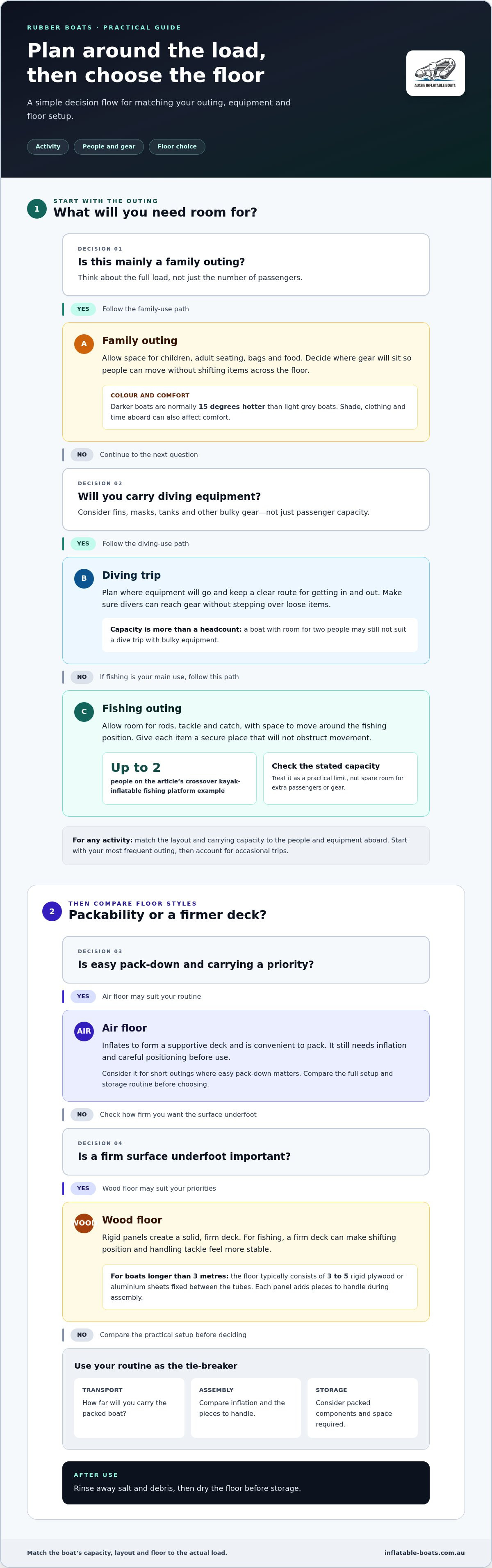
Choose an inflatable boat around the activity, not just its appearance. A crossover kayak-inflatable boat is described as a fishing platform for up to 2 people. That example suits a compact outing where anglers need room for themselves and essential tackle. Before selecting a model, compare its stated capacity with the people and equipment you plan to carry. Capacity is a practical limit, not spare space for extra passengers or gear.
Fishing calls for a stable-feeling working area and a layout that keeps rods, tackle and catch organised. Picture heading out with a rod, tackle box and landing net: each needs a secure place that won’t obstruct movement. The boat should also suit your launch point and the distance from your vehicle to the water. A portable setup can make carrying easier, while a firmer floor may feel more supportive when you shift position. The right balance depends on your routine.
Diving changes the priorities. Fins, masks, tanks and other equipment take up space, so plan where each item will go. Keep the entry area clear and arrange gear so divers can reach it without stepping over loose equipment. A two-person fishing platform, for example, may not suit a dive trip with bulky equipment, even if the passenger count seems adequate. Consider both the load and how people will move around the boat.
Family outings need a different layout again. A child’s space, adult seating, bags and food all compete for room, so consider the complete load rather than counting passengers alone. Darker boats are normally 15 degrees hotter than light grey boats, a point worth considering for sunny Australian days. Shade, clothing and time aboard can also affect comfort. For a family picnic, decide where bags will sit and whether everyone can move safely without shifting gear across the floor.
Use a simple activity check before narrowing your options:
- Fishing: allow room for rods, tackle and movement around the fishing position.
- Diving: plan storage and a clear route for getting in and out.
- Family use: account for each passenger’s space, plus bags and day-trip supplies.
These examples show why one boat may not suit every outing equally well. Rubber boats can work for fishing, diving or family use when their capacity, layout and floor match the actual load. Start with your most frequent activity, then account for occasional trips. If one boat must cover all three, prioritise usable space and freedom of movement over length alone.
Air-floor and wood-floor options
An air floor inflates to form a supportive deck, while a wood floor uses rigid panels. This affects setup, portability and underfoot feel. Consider how often you’ll assemble the boat and where you’ll use it. An air floor is convenient to pack; wood panels provide a firm surface underfoot.
For inflatable boats longer than 3 metres, the floor typically consists of three to five rigid plywood or aluminium sheets fixed between the tubes. Wood-floor models use this panel construction. Each panel adds pieces to handle during assembly, but creates a solid deck. An air floor avoids separate rigid floorboards, although it still needs inflation and careful positioning before use.
For fishing, a firm deck can make shifting position and handling tackle feel more stable. For short outings where easy pack-down matters, an air floor may better suit your routine. Compare the packed components, assembly steps and storage space required, not just the material. After use in marine conditions, rinse away salt and debris, then dry the floor before storage.
What safety equipment and boating rules apply to rubber boats in Australia? Requirements depend on the waterway, vessel and use, so carry safety equipment suited to your trip and conditions. Registration rules differ between states and territories and may depend on the vessel, its motor and how it’s used.
What size rubber boat and outboard motor do you need? Choose a boat for the people and equipment aboard, then match the outboard to the boat’s rated motor capacity. Inflatable boats commonly use outboards rated from 2.3 to 300 horsepower, so that broad range isn’t a recommendation for every boat.
How do you inflate, launch, clean and store a rubber boat? Follow the boat’s inflation sequence and pressure guidance, check the fittings, then launch from a suitable spot. After use, rinse off salt and dirt, dry the boat and floor, and store them away from sharp objects and prolonged exposure to the elements.
How do you repair a puncture or maintain a rubber boat? Clean the damaged area, then use a repair method compatible with the boat’s material and the manufacturer’s guidance. Regularly inspect seams, valves, floor panels and fittings for wear or damage.
What are the main risks and limitations in Australian waters? Punctures, overloading, changing weather and unsuitable conditions can compromise a trip. An inflatable boat’s suitability depends on its design and the waterway, so plan for conditions and stay within its rated capacity. To compare floor styles alongside other inflatable boat options, consider how each setup fits your launch and storage routine.
What types of rubber boats are available in Australia?
Australian buyers can compare inflatable boats by hull design, floor construction and intended use. Common options include compact inflatables, rigid inflatable boats (RIBs), and boats with air or wood floors. Each configuration affects handling, pack-down and equipment capacity. Start with the waterway and typical load, then compare the construction that suits those needs.
A basic inflatable dinghy has buoyant tubes around an open interior. This layout can suit short trips, tender duties or sheltered-water outings where a straightforward craft is useful. Consider where passengers will sit and where bags or fishing gear will go. An open layout gives you flexible space, while the boat’s length and rated capacity determine how much usable room it offers.
Floor type is another important distinction. Air-floor models use an inflatable deck; wood-floor models use rigid panels. An air floor may appeal when portability and fewer rigid components matter, while wood panels create a firmer platform beneath occupants. Compare each option with your storage space and launch routine instead of treating the floor as a minor accessory.
RIBs combine inflatable tubes with a rigid hull or base. The rigid structure changes the boat’s profile and gives it a more defined bottom than a soft-floor dinghy. Some PVC RIB configurations use an aluminium rigid base, with examples spanning 2.3 to 3.65 metres. That construction is worth considering when you want the tube’s buoyancy alongside a solid hull structure. The trade-off is handling more rigid equipment during transport and storage.
Size also helps distinguish the available types. Inflatable boats commonly measure between 2 and 7 metres, from compact models to larger craft with more room aboard. Examples in the market include boats measuring 3.30 metres, 3.45 metres and 3.50 metres, as well as a 5.50-metre model. These sizes illustrate the range, not a universal fit. The right dimensions depend on the number of occupants, equipment and launch conditions.
Use these distinctions to narrow the field:
- Open dinghy: consider it for simple, flexible use and straightforward storage.
- Air-floor model: compare it when portability and pack-down matter.
- Wood-floor model: consider the firmer deck for regular movement aboard.
- RIB: assess its rigid base when hull structure is a priority.
A sheltered-water tender and a fishing boat carrying gear have different space and floor requirements. Match the design to your usual trip, then check the boat’s capacity and motor rating before deciding.
How much do rubber boats cost in Australia?
The cost of an inflatable boat depends on its size, construction and included equipment. A compact 2-metre model has different material and storage needs from a 3.65-metre craft. Floor type also matters: an air floor and rigid floor panels involve different components. Compare boats with similar dimensions and layouts to understand what drives the difference.
Start by defining the boat’s role. A tender for short transfers may need a simpler layout than a fishing boat carrying an outboard, seats and equipment. A family setup may require more room for passengers and bags. For example, compare the space and construction needed for a 2.3-metre boat with a larger model, rather than treating length as the only cost factor.
Construction materials also influence price. PVC and Hypalon are different fabric options, while a rigid base adds a separate structural component. Floor construction matters too: air floors inflate, while wood floors use rigid panels. Compare similar boats by material, floor and hull design before drawing conclusions from two listings.
Included equipment can change the total cost. An outboard, oars, seating or a pump may come with the boat or be purchased separately. An electric pump is an additional purchase, so distinguish essential equipment from optional upgrades. Check what each package includes and note what you’ll still need for your planned outings.
Use this comparison checklist when reviewing options:
- Size: compare 2-metre and 3.65-metre models against your passenger and storage needs.
- Floor: distinguish an air floor from wood panels or an aluminium base.
- Fabric: compare PVC and Hypalon construction.
- Equipment: identify whether a pump, oars or outboard are included.
- Use: match the layout to fishing, diving or family trips.
A larger craft can involve more material and a different floor structure, while a simpler configuration may have fewer components. That explains why comparing only the headline length can mislead. A 2.9-metre air-floor boat and a 2.9-metre wood-floor boat share a length, but their floor construction differs. Assess the complete specification, not one feature in isolation.
When buying in Australia, compare the complete setup you need, not just the hull. List your intended passenger load, floor preference, fabric and equipment, then compare boats with matching configurations. This gives a more useful picture of value than choosing the shortest or longest model alone. Keep the boat’s stated capacity and motor limits central to your decision.
Standard air-floor models offer a direct comparison across sizes from Inflatable Boats.
These listings show how prices vary across the air-floor range. Check whether each boat suits your passenger, storage and equipment needs rather than choosing by price alone.
How do inflatable PVC and Hypalon rubber boats compare?
PVC and Hypalon are different materials used in inflatable boat construction. PVC is polyvinyl chloride, while Hypalon is a familiar name for another type of inflatable-boat fabric. Neither label alone tells you which craft will suit your Australian boating plans. Compare the full specification, including fabric, hull design, floor, capacity and intended use.
Start with the construction details. PVC and Hypalon boats may differ in how their fabric sections and seams are joined. The method depends on the design and manufacturer, so don’t assume every boat made from the same material has identical construction. Compare seam details and care guidance for boats of similar size instead of relying on the fabric name alone.
Next, consider the conditions you expect. A boat used occasionally in sheltered water has different demands from one that is regularly transported, launched and packed away. Sun exposure, handling abrasion and contact with rough surfaces all affect fabric care. Material choice is one part of the decision, alongside intended use and maintenance requirements.
Repair compatibility matters. Adhesives and patches must suit the boat’s fabric; don’t assume a product intended for PVC is suitable for Hypalon, or vice versa. Keep the material details with the care instructions so you can choose compatible repair materials. For a puncture or seam issue, follow the manufacturer’s specified method rather than applying a generic patch.
Use this comparison when assessing two models:
- Fabric identification: confirm whether the specification names PVC or Hypalon.
- Construction: compare how seams and fabric panels are assembled.
- Care: follow cleaning and storage guidance for the named material.
- Repair: match patches and adhesives to the fabric.
- Whole-boat fit: assess capacity, floor and intended water conditions too.
For rubber boats, the material label is a starting point, not a complete comparison. Check the boat’s specifications and care information to understand its construction. Distinguish fabric from other features too: a rigid base, for instance, describes a structural component, not a fabric type.
There’s no universal winner based on the material label alone. Match the fabric to your intended use, then compare construction and care requirements. To explore inflatable boat options, compare the full specifications of the rubber boats you’re considering.
Inflatable boats also have a long history. In 1840, Thomas Hancock designed inflatable craft using rubber vulcanisation methods. Alain Bombard sailed across the Atlantic Ocean in an inflatable boat in 1952. Those milestones provide context, but they do not replace a model-by-model check of fabric, construction and care guidance when comparing PVC and Hypalon boats.
Practical comparisons can also include price, inflation equipment and intended role. Inflatable offshore racing boats can reach 100 km/h, showing how widely inflatable designs can differ in purpose. Rescue operations can involve specific safety considerations for inflatable boats. These details are not direct measures of PVC versus Hypalon performance; consider them alongside the specifications and care instructions for the particular boat.
Inflatable Boats: Inflatable Boats
Once you’ve weighed activities, floor styles and fabric, Inflatable Boats can help you compare options. Its range includes inflatable boats, accessories and spare parts, so you can explore the craft and supporting components together. For an existing boat, spare parts can address replacement needs, while accessories can support your chosen setup. Keep your intended use, carrying requirements and preferred construction in mind as you compare.
For a practical next step, explore the range and consider which configuration best fits your time on the water. You’re welcome to visit Inflatable Boats online.
Set your next outing up for success
Choosing rubber boats is a practical decision, and the right option should suit how you want to spend time on the water. Before deciding, picture a real outing from packing at home to returning after a day afloat. Consider where the boat will be stored, how it will be transported and what you’ll need before launch. This mental run-through can reveal whether a setup fits your routine, not just your ideal plans.
It also helps to separate regular use from occasional adventures. Decide which compromises you can accept and which would make an outing less enjoyable. A clear set of priorities makes comparisons more purposeful and keeps the focus on a boat that suits your plans.
For advice as you narrow down your choice, contact Inflatable Boats for advice. Bring your questions and intended use, then move towards your next day on the water with a considered decision and a sense of adventure.
Frequently Asked Questions
What safety equipment and boating rules apply to rubber boats in Australia?
Carry safety equipment suited to the trip and conditions, and stay within the boat’s rated capacity. Rules depend on the waterway, vessel and use.
What are the best rubber boats for fishing, recreation, and tenders in Australia?
For fishing, the Island KA396 crossover kayak inflatable boat is described as a platform for up to two people. For tenders or sheltered-water recreation, consider an open dinghy; an air floor is easier to pack, while a wood floor provides a firmer deck.
Which rubber boat brands and models are sold in Australia?
Listed models include the Island KA396, Island air-floor and wood-floor boats, Island PVC RIBs and Island TRO230 Hypalon; Aurora Reef Rider CL350, Aurora Cat 330 and Aurora Adventure V 380 Skeleton Console; and the special AB DLX 17.