
Questions to ask before choosing a used iSUP
Buying a used iSUP comes down to asking about its history and checking what comes with it, not just judging the deck from a photo. The key questions to ask when buying a used iSUP cover the included accessories, any warranty and registration, where and how it has been used, and the condition of its deck pad and tail. A well-maintained, good-quality paddleboard can last 5–10 years, so clear answers and a close inspection help you judge whether this board still has life in it.
A second-hand board can be a practical way to get on the water, but wear, missing parts or an unclear history can affect whether it’s a good deal. Look beyond the asking price and find out how the board has been used and cared for.
This guide gives you a straightforward set of questions to use before deciding. You’ll learn what to ask about accessories, warranty coverage, the seller’s use and care of the board, plus the deck pad’s grip and the tail’s condition.
Key Takeaways
- Match the board’s length, width, thickness and outline to the water you plan to paddle and the stability you need.
- Ask which accessories are included, then inspect their condition and compatibility before treating them as part of the deal.
- Clarify the warranty’s coverage and whether it can transfer to a new owner, along with any registration details.
- Ask why the seller is parting with the board and how it has been used, stored and maintained.
- Look closely at deck-pad grip and coverage, plus the tail and leash attachment, for signs of wear or damage.
1. Want Answers to Anything Stand Up Paddle Boarding and Inflatable SUP?
Start with the board’s dimensions and the kind of paddling you plan to do. For an all-round inflatable SUP, a length of 10 feet 6 inches to 10 feet 9 inches suits many paddlers; longer boards generally track and glide better, while shorter boards are easier to manoeuvre. A width around 32 inches balances stability with speed and responsiveness. The useful all-round range is 30 to 34 inches, depending on the paddler and the board’s proportions.
Thickness affects how a board sits on the water and supports its paddler. Five inches is a common all-round option; a comparable 5-inch board is generally more stable and performs better than a 6-inch board in normal conditions, but has less weight capacity. Many mass-market boards are 6 inches thick, and a board at that thickness should generally be 33 to 34 inches wide for reasonable stability. Match the board’s recommended capacity to your combined load, including any gear.
Board shape matters too. A broader, rounded nose and tail suit relaxed, all-round paddling, while a narrower, more pointed shape favours glide and tracking. These distinctions are useful, but they don’t replace checking how the board feels under your weight. Ask the seller what conditions they paddled in and whether the board suited those conditions.
Inflatable and epoxy boards involve different trade-offs. An inflatable packs down for storage and transport, while a rigid epoxy board keeps its shape and can feel more direct underfoot. On an inflatable, inspect the seams, valve, fin box, handles and D-rings for lifting, separation or patches. Check for peeling on the deck pad, then ask the seller to inflate the board to its marked pressure. Never exceed the printed maximum.
For a water test, inflate the board correctly and paddle in sheltered conditions with the seller’s permission. Check whether it holds pressure, tracks as expected and feels stable. Stop if you notice a leak or structural concern.
Australian safety requirements vary by state or territory and waterway, so check the relevant local maritime authority’s rules before launching. Carry suitable emergency communication, such as a whistle or radio, for your outing.
Age, brand, model and condition all affect resale value. A sought-after model with sound seams, a working valve and complete fittings may retain value better than a worn or repaired board. Compare similar boards, then weigh visible wear against how much useful life remains.
Private sales can involve misleading photos, hidden damage or payment scams. Inspect the actual board before paying, ask clear questions about repairs and use, and avoid rushed payment or collection arrangements. These are practical questions to ask when buying a used iSUP, alongside a close inspection and test paddle.
2. Checking included accessories and their condition
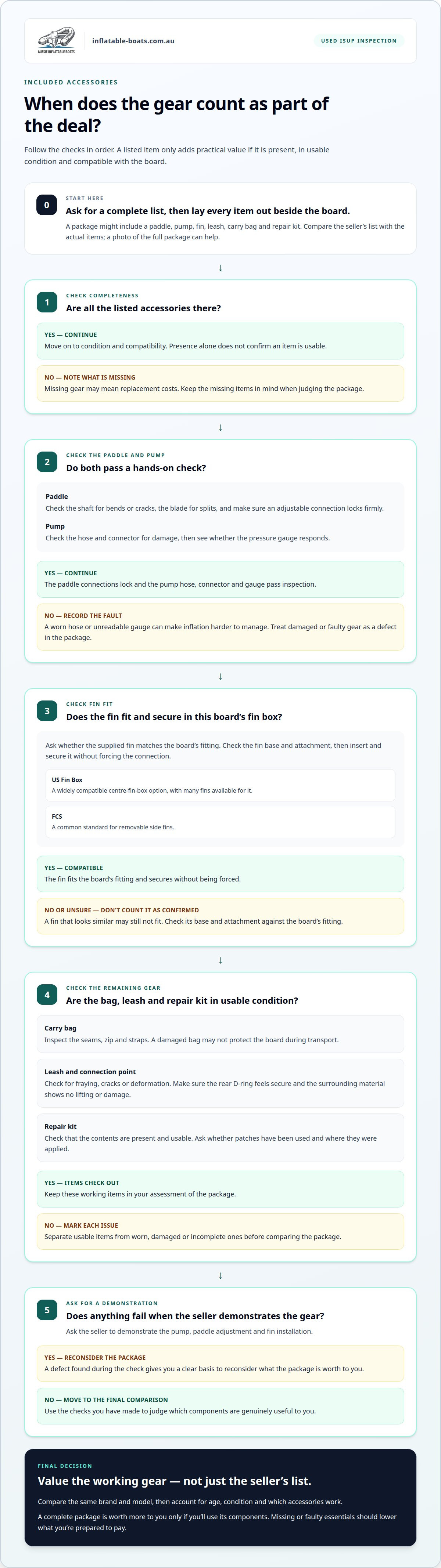
Ask the seller for a complete list of what comes with the iSUP, then lay every item out beside the board. A package might include a paddle, pump, fin, leash, carry bag and repair kit. A photo of the full package can help you compare the seller’s list with the actual items. Missing gear may mean extra replacement costs, while worn or incompatible accessories may offer little practical value.
Inspect the paddle section by section. Check the shaft for bends or cracks, examine the blade for splits, and make sure any adjustable connection locks firmly. Check the pump hose and connector for damage, then see whether the pressure gauge responds. A worn hose or unreadable gauge can make inflation harder to manage. Open the carry bag and inspect its seams, zip and straps. A damaged bag may not protect the board during transport.
Fin and fitting compatibility matters. Ask whether the supplied fin fits the board’s fin box, then insert and secure it without forcing the connection. A US Fin Box is a widely compatible centre-fin-box option, with many fins available for it. FCS is a common standard for removable side fins. Don’t assume a fin will fit because it looks similar. Check its base and attachment against the board’s fitting.
Check the leash and its connection point for fraying, cracks or deformation. A SUP leg rope usually attaches to a D-ring at the board’s rear, so make sure the ring feels secure and the surrounding material shows no lifting or damage. Check that the repair kit’s contents are present and usable. Ask whether the seller has used any patches and where they were applied.
There isn’t one fair used-iSUP price for every Australian sale. Compare the same brand and model, then account for age, condition and which accessories work. A complete package is worth more to you only if you’ll use its components. Missing or faulty essentials should lower what you’re prepared to pay.
Before agreeing, ask the seller to demonstrate the pump, paddle adjustment and fin installation. Finding a defect during that check gives you a clear basis to reconsider the package. If you need a replacement or compatible item, explore inflatable boat accessories to see what may suit your setup.
3. Checking warranty coverage and registration
A warranty can add confidence, but coverage for a used board depends on the written terms and ownership conditions. SUP manufacturers have different warranties, return policies, shipping policies and customer support. Ask the seller for the original warranty document, purchase receipt and any registration confirmation. These records can help establish the board’s model, purchase date and original owner.
Start by asking what the warranty covers. Seams, valves, deck pads and accessories may have different terms, so don’t assume one promise applies to every component. Look for clauses about manufacturing faults, wear, accidental damage and repairs. A seam separation, for example, may be treated differently from a puncture caused during use.
Next, ask whether coverage transfers to a second owner. Some warranties are tied to the original purchaser or require registration; others have different conditions. The written policy should explain whether a transfer is allowed and what proof the next owner needs. If the seller registered the board, request a copy of the confirmation and any transfer instructions.
Compare the registration details with the board itself. Check the model name and identifying information on the paperwork against labels or markings on the iSUP. Ask whether the seller has made a warranty claim, what fault was reported and what repair was completed. A replaced valve or patched seam doesn’t, by itself, tell you the board’s current condition, but it provides useful history.
Find out how a future claim would work. Ask which documents are needed, where to submit a claim, and whether the owner must pay shipping or provide photos. Manufacturer shipping policies and customer support vary, so record the relevant instructions before you buy. A vague verbal assurance is less useful than a policy that clearly explains the process.
Use warranty status to inform your decision, not replace a physical inspection. Look for wear, repairs and damage even if the paperwork appears complete. If coverage has expired, cannot transfer or excludes the fault you’re concerned about, assess the board on its current condition and repair history. Don’t pay extra for warranty protection unless the terms and transfer status support its value.
Before agreeing to buy, keep copies of the receipt, warranty terms, registration record and messages about repairs. If the seller can’t provide a document, don’t count on the warranty when deciding what to pay. Clear paperwork helps you understand what protection remains and what responsibility will be yours after the sale.
4. Asking why the seller is selling
Ask why the owner is selling, then follow up about storage, use and repairs. Find out where the board was kept, how often it was paddled, and whether it has been patched or professionally repaired. Specific answers, such as “stored indoors and used on a local lake”, give you a clearer history than “hardly used”.
The reason for selling can add context, but it doesn’t prove the board is in good condition. A move, changing hobbies or an upgrade may explain the sale without raising concerns. If the seller mentions a leak, poor tracking or a repair, ask when it happened, where the fault appeared and how it was fixed.
Ask where and in what conditions the iSUP has been used, including whether it has seen saltwater, rivers or shallow launches. Salt, grit and repeated contact with rough surfaces can leave wear around fittings and seams. Ask how the board was rinsed and dried after paddling, then look for signs that match the answer, such as residue, scuffs or discolouration.
Storage habits matter. Ask whether the board was stored inflated or rolled, and whether it was kept in direct sun, a hot vehicle or a damp space. Ask the seller how they prepared it for storage. A board rolled while wet, for example, may have an odour or marks that warrant a closer look.
Ask for details of every repair, including its location, cause and materials used. Find out whether the seller has receipts, pre-repair photos or messages from the repairer. A small patch and an unexplained seam repair are not the same evidence. Inspect the repaired area closely and compare it with the seller’s account.
Listen for consistency throughout the conversation. If the seller says the board was used on calm lakes, then describes frequent rocky river trips, ask for clarification. That difference doesn’t prove there’s damage, but it helps focus your inspection on the underside, fin box and exposed fittings. Don’t treat a confident tone as a substitute for clear answers.
Before paying, summarise the board’s history in writing: the seller’s reason for selling, known repairs, storage habits and included items. Keep the messages and repair records with your purchase documents. Clear answers help you judge the board’s past alongside its visible condition. Unanswered questions are a reason to pause, not rush the decision.
5. Deck-pad grip, coverage and tail features
A deck pad should feel secure underfoot and stay bonded to the board. Run your hand over it to find smooth, worn patches, then press along the edges to check for lifting or bubbles. Pay close attention to the standing area, where repeated foot movement can polish the texture or loosen the adhesive. A small mark is different from an edge that keeps peeling away.
Check how much of the deck the pad covers and whether the layout suits your stance. A pad extending towards the tail can provide grip when you move back; a shorter pad may leave that area bare. Look for gaps, splits and compressed sections, especially where your heels or toes would land. If the seller permits, stand on the inflated board and shift your weight gently. Notice whether the pad feels even or slippery.
Ask whether the pad has been repaired or replaced, and whether any lifting returns when the board is inflated. A repair can still be serviceable, but its edges should lie flat and remain bonded. Check the surrounding material for discolouration, tackiness or marks that could be adhesive residue. Compare the seller’s account with what you see rather than judging the repair by appearance alone.
Inspect the tail from above and underneath for cuts, deep abrasion, exposed fabric or a distorted shape. Pay close attention to the seam where the deck and underside meet, because damage there can affect the board’s structure. Check the tail’s edge for separation and the nearby fin fitting for cracks or movement. These areas can be knocked during transport, storage and launching.
Some boards have a raised tail pad, often called a kick pad, which gives the paddler a reference point for stepping towards the rear. Check that it’s firmly attached and its edges aren’t curling. If the board has a flat rear deck instead, inspect the pad coverage and tail surface for wear where your feet would move. Match the design and condition to how you plan to paddle.
Find the rear D-ring and examine its attachment closely. A SUP leg rope usually connects to a D-ring at the back of the board. Check that the ring isn’t bent, loose or pulling away from the surrounding material, and inspect that material for cracks or separation. Ask whether the seller has ever replaced or repaired the ring.
These checks reveal whether the deck and tail remain fit for your intended use. If inspection shows damage that needs attention, explore inflatable equipment options before deciding on your next setup.
Inflatable Boats
Inflatable Boats can help when your inspection raises questions about inflatable watercraft, fittings or possible repairs. The business sells inflatable boats, accessories and spare parts, and offers repairs. If a used board has a damaged valve, loose fitting or visible patch, describe what you found and how it affects your decision. This gives you a practical starting point for asking about suitable parts or repair options without assuming every mark needs attention.
Keep the board’s model details, repair history and inspection notes together. They’ll help explain the issue clearly, whether you’re weighing up a repair or considering other inflatable equipment. For questions about your inspection or the available support, contact Inflatable Boats.
Make your next move with confidence
A used board is a good fit only if its condition and history make sense for how you plan to paddle. Be prepared to walk away if the seller’s answers or your inspection leave important concerns unresolved. The right decision lets you focus on the water, not uncertainty about your equipment.
The questions to ask when buying a used iSUP can point to practical next steps if the board needs attention. Inflatable Boats sells inflatable boats, accessories and spare parts, offering options to consider as you plan your setup or address an equipment need.
For guidance on your next step, contact Inflatable Boats. Take your time, choose carefully and look forward to getting out on the water with equipment that suits your plans.
Frequently Asked Questions
Want Answers to Anything Stand Up Paddle Boarding and Inflatable SUP?
For your first paddle, choose sheltered water and conditions suited to your experience. Check the local forecast and launch access before setting out, and tell someone your plan if you’re paddling alone. After each outing, wash the board and paddle, dry the iSUP fully, then deflate and roll it for storage. This routine helps you spot changes to the surface, fittings or seams before your next session.
Want Expert Advice on Choosing an Inflatable SUP Board?
Start by matching the board to your paddling plans, then consider how you’ll transport and store it. A board for relaxed sessions on sheltered water may handle differently from one intended for longer-distance paddling. Write down your intended use, typical gear load and any storage constraints. These details make it easier to assess product specifications and identify the trade-offs that matter most for your time on the water.
What questions should I ask the seller when buying a used inflatable SUP in Australia?
Ask for the board’s make and model, how it has been used, and whether it has had faults or repairs. Before paying, clarify what the sale includes, the agreed price and the collection arrangements. Request current photos of the board and its fittings, not just old promotional images. Keep the seller’s answers and final agreement in writing so you can refer back to the board’s described condition and included items.
How can I check a used iSUP for leaks, punctures, delamination, and repairs?
Inflate the board to the pressure printed on its label, then inspect it closely in good light. Look for punctures, patches, bubbles, lifted material and irregular areas along the seams. Listen for escaping air around suspect spots and the valve. If you find a concern, ask the seller about its history and see whether the board holds pressure during the inspection. Don’t exceed the marked maximum pressure.
How do I inspect the seams, valve, fin box, and inflation valve on a used iSUP?
Run your fingers and eyes along the seams, checking for separation, uneven patches or exposed material. Look for cracks or movement around the fin box, then check that the fitting accepts the fin without force. Before pumping, the valve pin should be up so air can enter without escaping; it should be down when deflating. Check the valve cap and surrounding area for damage, then make sure the cap fits securely.
What should be included with a used iSUP: pump, paddle, fins, leash, and repair kit?
There’s no universal package, so agree on every included item before purchase. Ask the seller to demonstrate that the pump works, the paddle adjusts and locks, and each fin fits the board. Confirm whether the leash and repair kit are included, then inspect their condition and contents. Write the agreed accessory list in your sale messages. This makes it clear whether an item was excluded or simply overlooked at collection.
What is a fair price for a used iSUP in Australia compared with a new one?
There isn’t one fair used-iSUP price for every Australian sale. Compare the same brand and model, then factor in age, condition and which accessories work. Missing or faulty essentials should lower what you’re willing to pay.