
Overcoming Fear of Falling Off a Paddle Board With More Confidence
Falling off is part of learning to paddleboard, not a sign you’re doing it wrong. Overcoming fear of falling off a paddle board starts with practising in calm water, learning to fall away from the board and rehearsing a steady remount near the centre handle. Knowing what to do next can make a wobble feel manageable.
It’s natural to tense up when the board shifts beneath you, especially if you’re unsure how you’ll climb back on. You don’t need to force yourself into anything uncomfortable. Build familiarity at your own pace and let practice replace guesswork.
This guide explains how to fall more safely, approach the board and pull yourself back onto the deck, then regain your balance before standing. You’ll also find practical ways to settle your nerves and prepare for changing water conditions, so you can spend less time anticipating a fall and more time enjoying your paddle.
Key Takeaways
- Practise remounting in calm, shallow water so the steps feel more familiar before you need them.
- Approach from the side near the centre handle, then use your arms and legs to help pull yourself back onto the board.
- After climbing aboard, pause on your knees and regain your balance before standing.
- Build confidence gradually with relaxed breathing and simple balance practice, without pushing past your comfort level.
- Treat an occasional fall as part of learning, and focus on responding calmly rather than trying to avoid every wobble.
1. Getting back onto the board near the centre handle
Before heading out, learn how to fall away from the board, resurface carefully and remount near its centre handle. Practise those steps in calm, shallow water, and wear a personal flotation device and leash. Check the forecast and choose conditions suited to your experience, so you can focus on building practical recovery skills.
Get comfortable with immersion before practising a remount. In shallow water, enter gradually or deliberately get fully wet, then pause and notice how the water feels. This can make an unexpected splash less startling. Keep your board close, and practise only where you can stay clear of hazards and control your position.
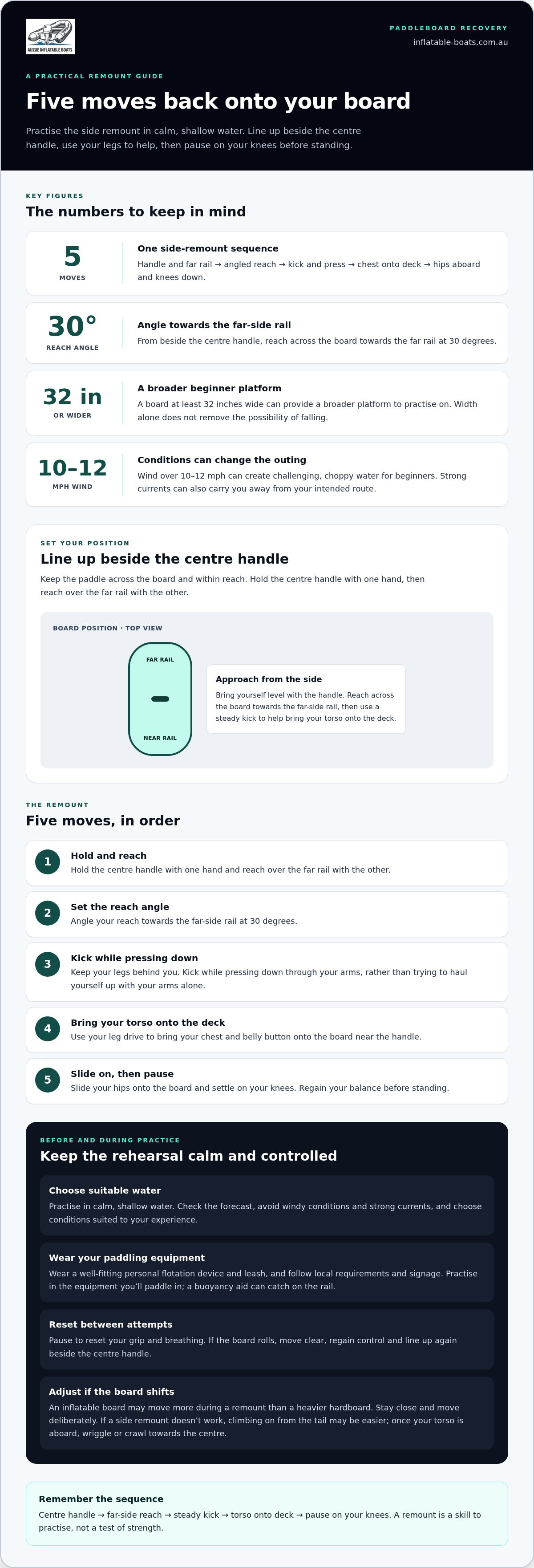
To remount from the side, first bring the paddle across the board so it stays within reach. Line up beside the centre handle, then follow this sequence:
- Hold the centre handle with one hand and reach over the far rail with the other.
- Angle your reach towards the far-side rail at 30 degrees.
- Keep your legs behind you, then kick while pressing down through your arms.
- Use that leg drive to bring your chest and belly button onto the deck near the handle.
- Slide your hips onto the board, then settle onto your knees before standing.
Keep your legs moving behind you as your chest comes up. If your legs slip underneath the board, it can be harder to get your torso onto the deck. Kick steadily instead of trying to haul yourself up with your arms alone. A buoyancy aid can also catch on the rail, so practise the movement while wearing the equipment you’ll paddle in.
Repeat the remount in calm, shallow water until each movement feels familiar. Take a short pause between attempts to reset your grip and breathing. If the board rolls during practice, move clear, regain control and line up again beside the centre handle. Repetition helps you learn where to place your hands and how much leg drive the movement needs.
Some paddlers find an inflatable board moves more during a remount than a heavier hardboard. A board that shifts around can make it harder to time the kick and pull, so stay close and move deliberately. If a side remount doesn’t work, some paddlers may find climbing on from the tail easier. Once your torso is aboard, wriggle or crawl towards the centre.
Getting back on safely is a skill to practise, not a test of strength. Start with the centre-handle method, pause on your knees once aboard, and stand only when you feel steady. A calm rehearsal gives you a clear sequence to follow if you fall during a paddle.
2. Accepting falls as part of paddling
Beginners and experienced paddlers alike can fall. Treating a fall as a possibility helps you prepare rather than brace against every small wobble. Before launching, choose calm water, keep your board close, and decide how you’ll pause and recover if you end up swimming.
For beginners, a board at least 32 inches wide can provide a broader platform to practise on. Width alone doesn’t remove the possibility of falling, so focus on balance and recovery skills too. Wear a properly fitting personal flotation device, particularly in deep or moving water, and use a leash to avoid becoming separated from your board.
Australian life-jacket and leash rules can depend on the waterway and circumstances. As a practical safety baseline, wear a well-fitting personal flotation device and leash, and follow local requirements and signage where you launch. Check the fit before setting off, since a flotation device that shifts or restricts movement can complicate a swim or remount.
Wind, waves and currents can turn a manageable outing into a demanding one. Wind over 10-12 mph can create challenging, choppy water for beginners; strong currents can also carry you away from your intended route. Check the forecast, avoid windy conditions and strong currents, and choose calm, flat water while you’re learning.
A sheltered lake or still bay can offer a calmer practice setting than exposed water. Choose a place with a simple route back to shore and enough room to fall clear of rocks and heavy boat traffic. Conditions can change, so plan your exit before launching and keep your intended landing point in mind.
Accepting the possibility of a fall doesn’t mean ignoring risk. Choose conditions where a fall is easier to manage, then prepare for what to do immediately afterwards. If you feel uneasy, stay on your knees or end the session. You don’t need to push yourself into water or conditions beyond your comfort.
Make your first practice session about familiarity, not distance. Paddle close to shore, notice how the board responds to small shifts, and take a break if fatigue affects your control. If you fall, focus on your position, your board and the route back to safety instead of judging the moment as a failure.
Once you’re comfortable in calm, shallow water, make recovery practice part of your session. You can practise intentional falls to get used to pushing away from the board and resurfacing slowly. Keep the aim simple: notice the movement, then focus on returning to the board and shore rather than trying to avoid every splash.
Practising falls can help you learn how your board reacts and build confidence in recovery techniques. Treat this as a gradual skill, not a test of bravery; pause whenever you feel uncertain or tired. The aim is to make the response less unfamiliar, so if an unplanned fall happens, you’ve rehearsed how to separate calmly from the board, surface and begin recovering.
3. Building confidence and avoiding overthinking
Confidence grows through small, repeatable actions, not by forcing yourself to stand through every wobble. Start close to shore in calm water, and practise one manageable skill at a time. For example, move from kneeling to standing, pause, then return to your knees. Familiar movements give you something practical to focus on.
Keep your gaze on the horizon or a fixed point ahead instead of watching your feet. Looking down can shift your posture and make each change in the board feel more dramatic. Choose a landmark on shore, such as a tree or building, and rest your eyes there as you paddle. Keep your knees soft and your muscles loose.
When nerves rise, take a slow, deep breath and release tension from your shoulders and hands. Illawarra Shoalhaven Local Health District notes that deep breathing can help calm you and reduce stress. Try a simple pattern: breathe in gently, breathe out slowly, then notice whether your grip has relaxed. Repeat while kneeling if standing feels too demanding.
If you panic or feel unsafe, stop trying to progress, lower yourself onto your knees and steady your breathing. Keep the board close, assess the water and your route back to shore, then end the session if you can’t settle. A safe return matters more than completing a planned paddle.
Practise moving between kneeling and standing while the board is still and conditions are calm. Move deliberately: place your hands down, bring one foot forward, then the other, and rise only when your weight feels centred. Reverse the sequence to kneel again. Repeating this movement builds muscle memory, so you have a familiar response when the board wobbles.
You can also learn how the board moves by deliberately stepping or jumping away into the water during controlled practice. Do this only in clear, deep water where you won’t strike the bottom, and check the space around you first. Notice how far the board drifts and how it responds. This can reduce uncertainty without turning practice into a test.
Set one modest aim for each session, such as staying relaxed through a short paddle or completing a few kneeling-to-standing transitions. If tension returns, reset with a breath and decide whether to continue, kneel or head in. Don’t pressure yourself to practise a fall or any movement that feels uncomfortable. Gradual practice lets you control the pace.
4. Pushing away from the board when falling
To fall safely from a stand-up paddleboard, check your surroundings and move away from the board as you enter the water. Aim to land flat or on your side, rather than feet first, because submerged objects may be hidden below. Protect your head with your arms, and never dive headfirst to avoid the board.
A controlled fall begins before you lose your balance. If the board tips and you have time to react, push away from its rail instead of grabbing it and pulling yourself underneath. Keep your arms near your head as you enter the water. This creates space between you and the board, reducing the chance of striking its deck or rail.
Check for hazards before practising. Scan for rocks, other paddlers, boats and shallow areas, then choose open water deep enough to avoid hitting the bottom. Don’t practise deliberate falls in shallow water. In murky water, check the depth with your paddle before entering, since the bottom may conceal obstacles.
Pay attention to your paddle too. If you’re holding it as you fall, let the blade or handle enter the water first instead of landing flat. A blade landing flat can slap the surface and change direction suddenly. Keep the paddle from swinging towards your face or another paddler, and let it go if holding it prevents you from moving clear.
Once submerged, surface slowly and look around before lifting your head fully. Check where your board has drifted and whether another board or paddler is nearby. In a group, take a moment to locate everyone before moving towards your board. If it has moved, approach deliberately rather than swimming blindly beneath or around it.
Practise the sequence in deep, calm water where you can avoid the bottom: check the space, move away from the board, protect your head, then surface and locate the board. Rehearsing each action separately can make the response more familiar. Stop if conditions become choppy or other water users enter your practice area.
Distance matters, but so does control. Pushing away doesn’t mean launching yourself far from the board; it means creating enough clearance to avoid contact as you fall. After surfacing, keep the board in sight and approach from a clear side. Calm, deliberate movements help turn an unexpected fall into a manageable recovery.
The She SUPs author recommends checking for hazards before falling away from the board. The page also advises protecting your head with your arms and trying to land in the water feet first. These recommendations focus attention on the decisions around a fall: assess the space, move clear of the paddleboard and guard your head as you enter the water.
5. Falling as a normal part of learning to paddle board
A fall isn’t proof that you lack balance or shouldn’t be on the water. Even experienced paddlers can take a dip, including an instructor who describes falling from a 17-foot SUP. The useful question isn’t whether you stayed dry; it’s what the moment showed you about your balance, timing or conditions.
Learning to paddleboard rarely follows a straight line. You might stand comfortably in calm water, then wobble when a wake reaches the rail or you turn to look behind. That change doesn’t erase your progress. It gives you a specific detail to work on, such as keeping your gaze forward or adjusting your stance before turning.
After a fall, take a moment to identify what happened without criticising yourself. Was your weight shifting towards one rail? Did you look down while changing your foot position? Was your paddle out of reach when the board moved? Naming one cause gives your next attempt a clear focus. Trying to fix several things at once can make the movement harder to understand.
Make your learning visible. After each session, note the conditions, the movement before a wobble and what helped you recover. For example, record that a turn felt unstable when you looked over your shoulder, then practise turning your torso while keeping your gaze ahead. The point isn’t to catalogue mistakes. It’s to notice patterns and recognise what’s improving.
Keep your next practice goal small and specific. If a quick turn unsettled you, practise a slower turn in calm water before adding speed or distance. If standing felt uncertain after kneeling, repeat the transition while focusing on a fixed point. Stop, rest or return to shore whenever fatigue affects your concentration. Progress also means knowing when to pause.
A fall can also reset unrealistic expectations. Staying upright for an entire paddle isn’t the only measure of skill. Noticing a wobble, responding deliberately and resuming when ready matter more than avoiding every splash. Experienced paddlers still face changing balance demands, so a dip doesn’t cancel the judgement and control you’ve built.
Use each session to practise a response, not to prove you’re fearless. Choose one movement to improve, reflect on what happened and carry that lesson into your next paddle. Over time, the board’s movement can become information rather than an immediate reason to tense up. That’s the practical shift: accept that a fall may happen, prepare to respond and keep learning at a pace that suits you.
Inflatable Boats: Inflatable Boats
Inflatable Boats can help if your time on the water leads you to consider an inflatable boat alongside paddleboarding. Explore inflatable boats and accessories for your boating setup, or find spare parts and repairs when an inflatable vessel needs attention. These offerings support boat ownership and maintenance, while paddleboard confidence still comes from practising safe falls, recovery and balance skills.
For questions about inflatable boats, accessories, spare parts or repairs, visit Inflatable Boats online.
Take your next paddle one step at a time
Confidence on the water isn’t about eliminating every wobble. It comes from trusting your preparation, responding calmly and choosing a pace that lets you enjoy the experience. Let each outing teach you something useful, whether that’s how your board reacts or which conditions help you feel settled. Overcoming fear of falling off a paddle board can begin with one small decision: heading out with a clear plan and room to turn back.
If your interest extends to inflatable boating, Inflatable Boats offers inflatable boats, accessories and spare parts. These products can suit you when you’re exploring boating equipment or need parts for an inflatable vessel.
Contact Inflatable Boats for help with your inflatable boating needs. Then take your next paddle at a pace that feels right, and keep building confidence with every session.
Frequently Asked Questions
How can beginners overcome fear of falling off a paddle board?
Build familiarity gradually, starting with a short session in calm, sheltered water. Set a small goal, such as kneeling comfortably or paddling a short stretch, and decide beforehand when you’ll head back to shore. If the thought of falling makes you tense, pause and breathe instead of forcing yourself to continue. Overcoming fear of falling off a paddle board is about trusting your preparation, not proving you can stay upright.
How do you get back onto a paddleboard after falling in?
First, surface carefully and locate your board and paddle before swimming towards them. If the paddle has drifted away, keep the board close while you decide whether retrieving it is safe. Approach beside the centre handle instead of trying to climb over the nose, and use a controlled kick to help lift your torso onto the deck. Once aboard, pause on your knees and check your surroundings before moving on.
How can a beginner build confidence standing up on a paddleboard step by step?
Begin kneeling with the board steady, then place your feet parallel on either side of the carry handle, about shoulder-width apart. Bend your knees slightly, keep your back straight and rise without rushing. Once standing, paddle gently and rotate your torso with each stroke to help distribute your weight. If you feel unstable, lower yourself back to your knees and reset before trying again.
What paddleboard, leash and personal flotation device are safest for beginners in Australia?
For beginners, choose a paddleboard at least 32 inches wide. Wear a leash and a well-fitting personal flotation device, especially in deep or moving water, and follow local requirements and signage.