
Outboard Size for a 3m Inflatable: Australian Guide
What if the outboard that looks right for a 3m inflatable is too powerful, too heavy or poorly suited to your load? Boat length alone won’t tell you. If you’re asking what size outboard for 3m inflatable, start with the manufacturer’s maximum outboard rating, then consider how you’ll use the boat and what you’ll carry.
Horsepower is only part of the decision. Motor weight, passengers and gear all affect the complete setup, so begin with the boat’s capacity information rather than guessing based on length.
This guide explains how to check the rating and capacity details, compare motor options with your intended use and total load, and confirm shaft length and fit before buying or fitting an outboard. Use these checks to narrow your options and verify the setup is appropriate for your boat before heading out.
Key Takeaways
- There’s no one-size-fits-all answer to what size outboard for 3m inflatable. Check the exact boat’s maximum rating and instructions first.
- Assess passengers, equipment and motor weight together to understand how your real-world load may affect handling and performance.
- Compare lower- and higher-output motors only within the boat’s approved rating, keeping practical use and portability in mind.
- Before choosing a motor, confirm the boat rating, total load, intended use, motor fit and operating guidance.
- Start with an inflatable boat suited to your plans, load and transport needs, then check its specifications before selecting an outboard.
What size outboard suits a 3m inflatable? Start with its rating
There’s no universal horsepower recommendation for every 3m inflatable. Start with the manufacturer’s maximum outboard rating and operating instructions. These specifications set the limits for that particular hull and transom. Don’t choose a motor simply because its horsepower is common for boats of this length.
Boat length alone cannot determine a safe outboard size. Horsepower describes a motor’s power output, not its weight or the boat’s carrying capacity. These are separate specifications, and each matters when assessing a complete setup. A general overview of outboard motors can explain the motor type, but your inflatable’s own documentation is the authority on its limits.
Where to find the inflatable’s outboard rating
Look for a capacity plate on the boat, then check the owner’s manual and the manufacturer’s specifications for the exact model. The documents may list maximum engine power separately from passenger or load limits. Read the operating guidance too, as it may include instructions that affect how the boat should be set up and used.
Treat maximum horsepower as a ceiling, not a default recommendation. It sets the upper limit, but a motor at that limit may not suit every outing. If the plate is missing, the paperwork is unclear or the information conflicts, pause your motor search and ask the boat manufacturer to confirm the rating. Don’t infer it from the boat’s length or appearance.
Why a 3m boat does not have one standard horsepower answer
Inflatables of the same length can differ in hull design, transom construction and intended use. Those differences affect the manufacturer’s approved rating and how the boat is designed to perform. A rating confirmed for one model cannot automatically be applied to another, even if both are described as 3m inflatables.
Maximum permitted horsepower is only one part of the decision. It sets the upper boundary; the right setup also depends on the outing and the boat’s instructions. The most powerful motor allowed isn’t automatically the best match for your needs. To answer what size outboard for 3m inflatable, identify the exact boat and verify its rating before comparing motor options within that limit.
Does a 3m inflatable need a bigger outboard? Match power to the load
No. More horsepower isn’t automatically better or suitable. A higher-output motor may provide stronger performance, but it can also add weight at the transom. That weight can affect how the boat sits and handles, so consider it alongside the manufacturer’s power rating and loading instructions.
Assess the complete loaded setup against the manufacturer’s instructions. Look beyond the motor to include passengers, fuel, safety equipment and other gear. Even a motor within the horsepower limit may be a poor match if its weight or the total load doesn’t suit the boat’s guidance.
How passengers and gear change the setup
Start with a realistic picture of a typical outing, not a best-case scenario. Note how many people will usually be aboard and what you’ll bring, such as fuel, safety gear, bags or fishing equipment. Include the outboard’s weight and a battery if your setup uses one.
Compare that complete load with the boat’s stated capacity and loading instructions. Check the manufacturer’s documentation to see what the capacity figures cover. Don’t assume you can combine the maximum number of passengers with all your gear without considering their total weight. Stay within the stated limits and distribute people and equipment as the operating guidance directs.
When to prioritise manageable weight over extra power
Consider the whole ownership routine. A lighter motor may be easier to carry, mount and store, while a more powerful option may add weight as well as output. Your priorities may differ depending on whether the inflatable is mainly a tender for short transfers or is used for regular recreational trips with more people and equipment.
Don’t choose based on assumed speed, fuel economy or planing performance. These outcomes depend on the specific boat, motor and load. Look for relevant manufacturer guidance rather than relying on a general rule. If you’re still weighing up what size outboard for 3m inflatable, use your likely load and intended use to narrow the options while keeping within the boat’s rating.
Good preparation matters as much as motor choice. The NSW Government’s safe and responsible boating guidance is a useful reference. Check the rules and guidance that apply where you’ll be operating. If you’re comparing boats before settling on a motor, browse inflatable boat options and review the specifications for the exact model.
Small outboard options compared: performance, weight and practical use
Compare motors only after confirming the inflatable’s approved outboard rating. A lower-output motor may be easier to lift, mount and store. A higher-output option may provide more power but can add weight. Neither is automatically the better choice. The boat’s rating, motor fit and your practical needs determine which options are worth considering.
| Use case | Rating check | Weight | Practical trade-offs |
|---|---|---|---|
| Short trips or tender use | Confirm the motor is within the boat’s approved rating. | Check the motor’s stated weight and consider who will lift and fit it. | A lighter option may be simpler to transport and store, but may not suit every load or performance need. |
| More demanding use | Consider higher output only if the boat is specifically rated for it. | Compare the motor’s weight with the transom guidance and your handling needs. | More output may add weight and complexity. It doesn’t guarantee a particular speed or handling result. |
| Electric propulsion | Check the boat and motor manufacturers’ compatibility guidance. | Assess the complete setup, including the motor and any battery. | Electric output labels aren’t directly equivalent to petrol horsepower ratings. Compare each motor using its manufacturer’s specifications. |
Choosing between lighter and higher-output motors
Think about transport as well as time on the water. If one person will regularly carry, mount and store the motor, its weight may be a deciding factor. A higher-output motor is relevant only if the inflatable’s documentation permits it. The added power may not justify the handling demands for a simple tender or short recreational trip.
Choose for the outing you actually plan, rather than defaulting to the largest motor within the rating. Compare the manufacturer’s stated motor weight and operating guidance. Don’t assume a particular setup will plane, use less fuel or handle in a specific way without evidence for that boat and motor combination.
Check shaft length and transom compatibility
The motor’s shaft must suit the height of the boat’s transom. A mismatch can affect the propeller’s position in the water and the motor’s performance. Check the boat and outboard manufacturers’ fit instructions together, including any guidance on propeller clearance. Don’t rely on a general “short” or “long” shaft label alone.
If compatibility, clearance or handling remains uncertain, seek advice from a qualified marine professional before fitting or operating the motor. To answer what size outboard for 3m inflatable, consider approved output, motor weight, propulsion type and correct fit together, rather than treating each as a separate guess.
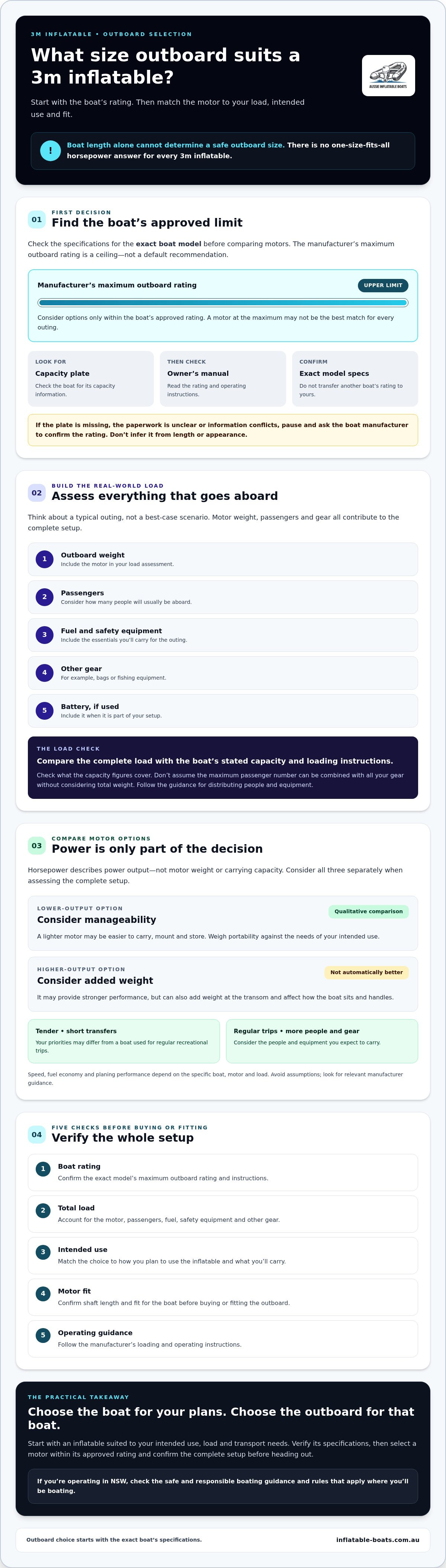
How to choose an outboard for a 3m inflatable: five checks before buying
Before comparing motors, confirm the details for the exact inflatable model you own or plan to buy. Use five checks to build a shortlist: the boat’s rating, your total load, intended use, motor fit and operating guidance. This turns “what size outboard for 3m inflatable” into a compatibility check, not a guess based on length.
A pre-purchase checklist for boat and motor compatibility
- Boat rating: Read the capacity plate, manual and manufacturer’s specifications. Record the maximum horsepower, load capacity and any stated motor-weight limit.
- Total load: Account for passengers, outboard, fuel, any battery and the equipment you’ll carry. Check the complete setup against the boat’s capacity and loading instructions.
- Intended use: Consider how you’ll use the inflatable and what you’ll typically carry. Choose a motor that suits those needs while staying within the boat’s limits.
- Motor fit: Check the transom height, required shaft length and any motor-mount limitations in both the boat and outboard manuals.
- Operating guidance: Read the instructions for both boat and motor, including advice about fitting, loading and operation.
Confirm horsepower, motor weight and shaft fit together before buying. A motor can meet the horsepower limit and still be unsuitable if it exceeds a weight restriction or doesn’t match the transom. If a specification is missing or unclear, ask the boat manufacturer to confirm it rather than relying on assumptions.
If you’re still choosing a boat, start with its intended use, capacity and outboard requirements. Our choosing your first inflatable boat resource can help you consider those priorities alongside the available inflatable boat options.
Safety and operating checks before heading out
Check current Australian Maritime Safety Authority guidance and the relevant state or territory boating authority for the rules that apply where you’ll operate. Requirements can depend on location and circumstances, so confirm local vessel, safety equipment and lifejacket requirements before departure. Carry and use equipment as directed by the applicable guidance.
For a new setup, follow the manufacturers’ instructions and make a cautious first test in suitable conditions, with a manageable load and room to assess how the boat responds. If the fit or handling raises concerns, stop and seek qualified advice before going further.
Ready to compare boats against your intended use and motor requirements? Explore inflatable boats and check each model’s specifications before selecting an outboard.
Choose an inflatable boat that works with your outboard
Choose the boat around your plans first, then find a motor that matches its confirmed specifications. Consider where and how you intend to use it, the people and gear you’ll carry, and how you’ll store and transport the inflatable. The answer to “what size outboard for 3m inflatable” depends on that specific boat’s rating and your real-world requirements, not length alone.
Use the manufacturer’s information to compare models. Check the stated capacity, maximum outboard rating and transom specifications, then consider construction, intended use and practical handling. Don’t assume two boats of the same length have matching limits or motor compatibility.
What to compare when browsing inflatable boats
- Capacity and rating: Find the manufacturer’s passenger or load guidance and maximum outboard rating.
- Transom details: Check the transom specifications and any instructions about motor fit.
- Construction and intended use: Compare each model’s confirmed details with the conditions and activities you have in mind.
- Storage and transport: Consider how you’ll move, store and handle the boat and its equipment.
If a rating, capacity or transom detail isn’t provided, confirm it with the manufacturer or retailer before buying a motor. Don’t rely on assumptions or specifications from a different model.
Where to go next if the right match is unclear
When comparing an inflatable, check its published specifications and ask about any details you can’t confirm. Inflatable Boats offers inflatable boats, accessories, spare parts and repair services for issues such as punctures, valve problems and structural components. Outboard sales aren’t listed, so use the boat specifications to assess motor compatibility and source an outboard separately.
Before asking a boat-related question, have the exact model name or listing ready, along with its capacity and outboard rating if available. Include how you plan to use the boat and what you expect to carry. This makes it easier to identify which specification needs checking. For questions about the boats, use the inflatable boat contact page.
Once you know what you need, explore the inflatable boat collections and compare the published details for each option. Confirm the exact boat’s rating and transom information before selecting a motor. A well-matched setup starts with a boat suited to your plans, load and transport needs.
Make your next outboard choice with confidence
The right answer to what size outboard for 3m inflatable starts with the exact boat, not a general horsepower rule. Check its manufacturer rating and instructions, then consider motor output alongside the complete load, intended use, motor weight and shaft fit. A good match stays within the boat’s limits and suits the way you’ll transport and use it.
Before buying, confirm the boat’s capacity and outboard specifications, and check the relevant boating guidance for where you’ll be operating. Compare the details for each model rather than assuming that boats of the same length share the same rating.
Ready to choose an inflatable around your plans and outboard requirements? Explore inflatable boats and review the specifications for the model you’re considering.
Frequently Asked Questions
What size outboard do I need for a 3m inflatable?
There’s no single outboard size for every 3m inflatable. Check the capacity plate, manual or manufacturer’s specifications for that exact boat’s maximum horsepower and operating instructions before comparing motors. Then consider your typical passengers and gear, the outboard’s weight, how you’ll use the boat and whether the motor fits the transom. The right choice stays within the boat’s limits and suits your complete setup.
Can you put a 10 hp outboard on a 3m inflatable?
Only if the manufacturer approves that power for the exact inflatable model and the motor also meets its weight and fit requirements. Boat length alone can’t confirm whether 10 hp is suitable. Check the capacity plate and documentation, including any motor-weight limit and transom guidance. If the rating is missing or unclear, ask the boat manufacturer to verify it before buying or fitting the outboard.
Is a bigger outboard better for a 3m inflatable?
No. More horsepower isn’t automatically better or suitable. A higher-output motor can add weight, which affects the overall setup and must be considered alongside the boat’s capacity and manufacturer’s instructions. Choose higher output only if the specific inflatable is rated for it and the motor suits your intended use. Don’t assume a bigger motor will deliver a particular speed, handling result or fuel economy.
How do I find the maximum horsepower for my inflatable boat?
Check the capacity plate, owner’s manual and manufacturer’s specifications for the exact model. Look for the stated maximum outboard power, and read any related instructions about motor weight, loading or operation. Treat maximum horsepower as a limit, not a recommended default. If the plate is missing, the documents are unclear or the information conflicts, contact the boat manufacturer for confirmation before choosing a motor.
Does the weight of an outboard matter on a 3m inflatable?
Yes. Motor weight contributes to the load and can affect handling, balance and how practical the boat is to transport. Include the outboard, passengers, fuel, any battery and other equipment when reviewing the manufacturer’s capacity and loading guidance. Check whether the boat specifies a motor-weight limit as well as a maximum horsepower rating. A motor within the power limit may still be unsuitable if its weight exceeds the boat’s guidance.
What shaft length do I need for an outboard on an inflatable?
The correct shaft length depends on the boat’s transom height and the motor manufacturer’s fit guidance. Some inflatables use short-shaft motors, but don’t assume that applies to your model. Check both the boat and outboard manuals, including instructions on propeller position and clearance. An incorrect fit can affect performance. If you’re unsure about shaft length, propeller clearance or handling, seek advice from a qualified marine professional.
Do I need to register a 3m inflatable with an outboard in Australia?
It depends on the state or territory and the vessel’s circumstances, so check the current rules with the relevant maritime authority before heading out. For example, NSW registration applies when a vessel is capable of 10 knots or more; Queensland requires registration for vessels with engines over 3 kW; and WA requires registration for recreational vessels that can be mechanically propelled. These are not the only requirements, and rules can change.