
Oars for an Inflatable Dinghy: Length and Materials
The lightest oars aren’t automatically the best choice: they still need to suit your dinghy’s beam and give you effective leverage. For a boat with a beam of 120-135 cm, a useful starting point is a pair of 220-235 cm oars. Choosing the right oars for an inflatable dinghy also means weighing portability against stiffness, durability and the effort needed to row.
When choosing the right oars for an inflatable dinghy, weigh up how they’ll be carried and stored as well as how they’ll perform on the water. One-piece oars avoid a join in the shaft, while two-piece oars pack down more compactly. The right fit and construction help make each stroke feel controlled.
Match oar length to your dinghy, then compare materials, construction, blade shape and weight with your rowing style. These practical checks can narrow your options, whether you’re heading out for a short tender trip or rowing regularly.
Key Takeaways
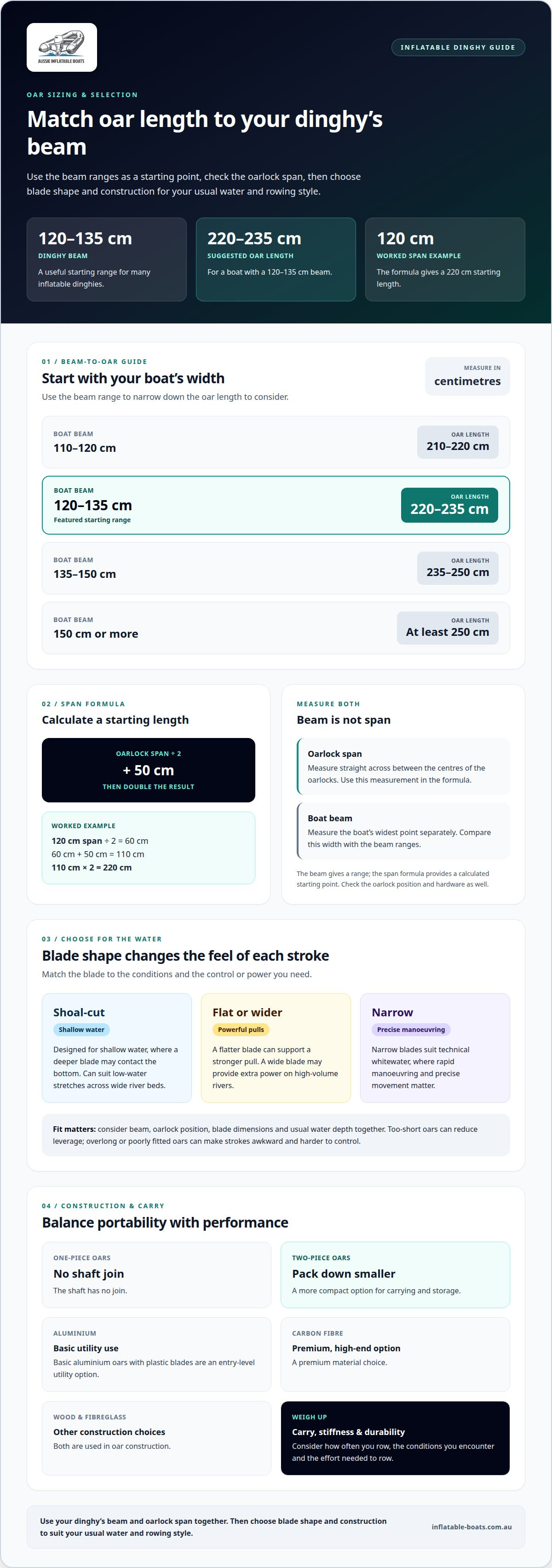
- Match oar length to your dinghy’s beam: boats 120-135 cm wide suit a starting range of 220-235 cm.
- For shallow water, consider how blade shape and size affect clearance and control.
- Choose shaft material and construction to suit how often you row and the conditions you encounter.
- Balance a lighter carry with the stiffness and durability you need for effective strokes.
- Let your rowing style guide blade choice, from broader blades for powerful strokes to narrower blades for precise manoeuvring.
Shoal-cut blades for shallow water
Oars that are too short can reduce leverage, while overlong or poorly fitted oars make strokes awkward and harder to control. In shallow Australian waterways, blade shape and length also affect clearance. Choose for both your dinghy and the conditions you usually row in.
Shoal-cut blades are designed for shallow water, where a deeper blade may contact the bottom. They can suit low-water conditions across wide river beds. Consider the water you row through most: a shoal-cut blade may work well on shallow stretches, while deeper water may allow a different shape. Match blade size and oar length to the dinghy rather than treating the blade as a separate choice.
Blade area changes how a stroke feels. A flatter blade can provide a stronger pull when you need extra power to move the dinghy, but that power depends on effective blade placement and control. A wide blade may suit high-volume rivers, where extra power helps rowers move through waves and holes. In shallow water, balance power against the clearance and control your route requires.
Consider oar length alongside blade size. An oar that is too short can limit leverage and force an uncomfortable stroke; one that is too long can be difficult to position and manoeuvre. Poor fit can also affect control, particularly when the blade catches or moves through the water at an awkward angle. Before choosing, consider your dinghy’s beam, oarlock position, blade dimensions and usual water depth. These factors work together: the oar must be long enough for the blade to enter and leave the water cleanly.
Blade shape and rowing stroke
Blade shape affects how the oar engages with the water. Flat blades can support stronger pulls, while shoal-cut blades are designed for shallow water. Decide whether your usual route calls for power, clearance or a balance of both. A blade suited to your conditions makes each pull more deliberate and reduces the need to compensate with awkward positioning.
Narrow blades for precision
Narrow blades suit technical whitewater, where rapid manoeuvring and precise movement matter. They serve a different purpose from wide blades, which can provide extra power on high-volume rivers. If your rowing involves close adjustments in changing water, prioritise control and accurate blade placement. Pair the blade with an oar length suited to your dinghy’s beam so each stroke remains manageable.
Use your regular waterway as a practical guide. For low-water river beds, consider shoal-cut blades; for technical whitewater, narrow blades can support precise manoeuvring. If stronger pulls matter most, consider flat or wider blades, especially on high-volume rivers. Then assess oar length and blade size together. Choosing for the conditions you actually row in helps avoid awkward strokes, poor clearance and compromised control.
Oar length recommendations by boat beam
Choose oar length based on your dinghy’s beam and the distance between its oarlocks. When choosing the right oars for an inflatable dinghy, start by measuring that span from lock to lock, then compare it with the sizing formula and beam ranges below.
Oar sizing formula
For a quick calculation, divide the oarlock span in centimetres by two, add 50 centimetres, then double the result. With a 120 cm span, that gives 220 cm: 120 divided by two is 60, plus 50 is 110, doubled to 220. Use the result as a starting length, not a substitute for checking your boat’s dimensions.
The formula uses the lock-to-lock span, not the dinghy’s overall length. Measure carefully, because an inaccurate span changes the calculated oar length. Use the same unit throughout and measure between the centres of the oarlocks for a consistent result.
Matching oar length to boat beam
A wider beam generally calls for longer oars to provide useful reach across the boat. Use these beam ranges to narrow down your options:
- 110-120 cm beam: consider oars 210-220 cm long.
- 120-135 cm beam: consider oars 220-235 cm long.
- 135-150 cm beam: consider oars 235-250 cm long.
- 150 cm or more: consider oars at least 250 cm long.
For example, a dinghy with a 133 cm beam falls within the 120-135 cm range, suggesting a starting length of 220-235 cm. A listed inflatable boat with a 133 cm width provides a useful comparison, but your own boat’s beam and oarlock position determine the fit. Beam and oarlock span are related measurements, not interchangeable ones.
Measuring the dinghy for oars
Identify the centres of both oarlocks, then measure straight across from one centre to the other. This is the oarlock span used in the formula. Measure the boat’s widest point separately to establish its beam, and label both measurements in centimetres so you don’t mix them up.
Compare the beam with the ranges above, then calculate a length from the span. If the guides suggest different lengths, use them as complementary checks: the beam gives a range, while the span formula provides a calculated starting point. Account for the oarlocks and their hardware too, since the oar must seat and pivot properly for the chosen length to work.
A practical part of choosing the right oars for an inflatable dinghy is comparing the calculated length with the beam range and the dinghy’s oarlock arrangement. This gives you a more informed basis for selecting inflatable dinghy equipment that suits your boat.
Oar materials and construction
The best material depends on how often you row and the demands of your boating. Aluminium suits basic utility use, while carbon fibre is a premium, high-end option. Wood and fibreglass offer other construction choices.
Aluminium, wood and carbon fibre
Basic aluminium oars with plastic blades are an entry-level option for utility use. Wood, fibreglass, carbon fibre, plastic and aluminium are all used for rafting oars, but the material affects how an oar suits regular use. Carbon fibre is at the premium end and comes with a steep price jump. Compare intended use and construction, not just the material name.
For a dinghy used occasionally for straightforward trips, a basic aluminium shaft and plastic blade may meet the task. More frequent or demanding rowing puts durability higher on the list. Plastic and aluminium oars can suffer in durability compared with higher-performance materials, so consider how often the boat will be out and the conditions involved. Wood is another option, but it needs upkeep: timber oars may need varnishing about every 4 years.
Consider fibreglass alongside wood and carbon fibre when comparing rafting-oar materials. The right choice balances intended use, durability and construction. A premium material isn’t automatically necessary for occasional utility rowing, while frequent use can make resilience more important.
Selecting shaft materials
Start with the shaft, the main structure you handle through each stroke. Choose according to how often you’ll use the oars and the demands of your boating. For occasional utility use, basic aluminium is an entry-level option; for higher-performance needs, compare wood, fibreglass and carbon fibre. Assess the whole oar, including its blade and fittings.
Construction details affect how well the shaft stands up to wear. An oar wrap sheaths the shaft from near the blade, past the stop, helping protect it from wear and damage where it contacts hardware. When assessing a wrapped shaft, check how far the sheath extends and whether it covers the areas exposed to friction.
Use this practical sequence: match the material to your regular use, weigh durability against the demands of your trips, then inspect shaft protection and blade construction. For example, an occasional tender outing may not require premium carbon fibre, while frequent rowing makes the durability trade-off worth closer thought. Timber also brings a maintenance task, with varnishing about every 4 years. Build that care into your choice, rather than judging the oar by its material alone.
No single material suits every inflatable dinghy. A utility setup may favour basic aluminium, while a high-performance application may justify comparing carbon fibre, fibreglass or wood. Let frequency of use, durability and shaft protection guide your decision, then check that the construction suits the way you boat.
Matching oars to boat and rowing style
Start with how you use the boat. When choosing boat oars, check whether they suit your dinghy’s layout and the water you row most often. A calm-water tender trip places different demands on oars than regular river rowing. Let your typical outings guide the balance between reach, control and power.
Consider your main boating style before settling on an oar setup. For rafting, the rivers you use more than 50% of the time are a practical basis for choosing. That keeps the decision grounded in the conditions you actually encounter, rather than a rare trip. For an inflatable dinghy used mainly for short transfers, prioritise an arrangement that feels manageable from its rowing position.
Assess how the oars work with the boat. The oarlocks set the pivot point, while the boat’s width and seating position affect how far the handles travel. A cramped setup can restrict the stroke; handles that sit too far apart can make control awkward. Consider the full rowing movement, from blade entry to the finish, rather than judging the oars by length alone.
Rafts and drift boats have a specific proportion to consider: a recommended setup places one-third of the oar inside the oarlock and two-thirds outside it. This is a reference for those boat types, not a universal measurement for every inflatable dinghy. For a dinghy, check the oarlock position and space for the handles to move freely without clashing with the boat or rower.
Match blade choice to your regular route. A high-volume river may call for wide blades that help generate power through waves and holes, while technical whitewater favours narrow blades for rapid manoeuvring. These serve distinct priorities: power through turbulent water or precision in complex passages. If your trips include both, consider which conditions you encounter most.
Finally, consider redundancy on extended outings. A rowing raft on a multi-day trip should carry at least three oars, so a broken oar doesn’t leave the crew without a spare. That recommendation applies to rafts, not every dinghy outing. For your boat, plan around trip length, rowing demands and whether you can carry a spare. Choose a setup that suits your route and boat arrangement, not an abstract ideal.
Lightweight oars for inflatable dinghies
Lighter oars are easier to carry, stow and position aboard an inflatable dinghy. But low weight alone doesn’t make an effective setup: the oar still needs suitable length, blade area and construction for your conditions. Judge the whole oar, not just its shaft material.
Balance carry weight with rowing feel
Think about the whole trip, from carrying gear to making repeated strokes on the water. Lightweight oars are easier to handle between the launch point and dinghy, while suitable blade dimensions help deliver the pull you need. A very light oar with a blade poorly matched to your route may be less useful than a slightly heavier, better-suited option.
Check how the oar behaves at the oarlock. Lift it and move it through the rowing arc, noting whether the handle feels manageable and the blade can be placed cleanly. An oar that’s easy to carry but awkward to control can make precise adjustments harder. Your dinghy’s beam, oarlock position and usual water conditions all affect how it feels.
Compare construction choices
Basic aluminium oars with plastic blades are an entry-level option for utility use. They can suit straightforward outings where practicality matters more than premium construction. For frequent rowing, consider durability as well as weight: plastic and aluminium oars may be less durable than higher-performance options.
Carbon fibre is a premium, high-end construction with a steep price jump. Its appeal is low weight, but weigh that benefit against how often you’ll use the oars. Wood and fibreglass are other materials used for rafting oars. Compare complete oars, including blade and shaft, rather than assuming the material name alone determines performance.
Oars, paddles and Australian boating requirements
Oars and paddles suit different setups. Oars pivot from oarlocks, while paddles are handled directly, so don’t choose between them by weight alone. Match the equipment to your dinghy’s arrangement and how you intend to propel it.
Oar weight doesn’t replace applicable Australian state or territory boating requirements. Requirements depend on where you launch and how you use the vessel, so follow the rules that apply locally. Consider this separately from choosing a lightweight pair.
Use a simple decision sequence: prioritise easy handling, compare construction against how often you row, then assess the complete oar in your dinghy’s rowing position. If you’re weighing up equipment for your setup, explore inflatable boat options alongside these considerations.
Inflatable Boats
Inflatable Boats offers inflatable boats, accessories, spare parts and repairs to help with choosing and maintaining your dinghy. The measurements in this guide can help you narrow down the oar length and setup suited to your boat. Explore the accessories and replacement parts when equipping or maintaining an inflatable vessel, or arrange a repair when the boat needs attention.
For assistance with an inflatable boat, accessory, spare part or repair, contact Inflatable Boats.
Set up your next outing with confidence
Choosing the right oars for an inflatable dinghy is one part of preparing for time on the water. Bring your boat, intended use and preferred rowing feel together to make the decision. Think beyond the equipment alone: a setup suited to your plans can make launching, handling and packing away more straightforward.
If you’re ready to make that decision, discuss your dinghy and oar requirements with Inflatable Boats about your oars. A clear conversation about how and where you row can help you move forward with a setup that fits your boating plans.
Choose carefully, then get out and enjoy the water.
Frequently Asked Questions
Are One-Piece or Two-Piece Oars Better?
Neither design is automatically better; the right choice depends on storage and transport. One-piece oars avoid a join in the shaft, while two-piece oars separate for more compact stowage. If your dinghy travels in a small vehicle or has limited storage space, a split design may be convenient. If you’ll keep the setup assembled, one-piece oars keep things simple.
Can I Use Any Oar with My Inflatable Boat?
No. Oars must suit the boat’s dimensions and fittings. Check that the length works with the beam and oarlock position, and that the shaft sits securely in the rowlock or oarlock. A blade that’s too large for your usual conditions can also be harder to control. Treat fit as a combination of boat layout, hardware and rowing conditions.
Is it worth buying used rowing oars?
Used oars can be worth considering if their condition and fit suit your boat. Inspect the shaft for cracks, bends, loose joins or signs of repair, then check the blade and handle for damage. Make sure any moving or connecting parts work properly. A low purchase price offers little value if the oar needs repair or doesn’t fit your hardware.
What oar length suits different dinghy widths and sizes?
Wider dinghies generally need longer oars, but boat width alone doesn’t settle the choice. Use the beam ranges in this guide as a starting point, then compare them with the oarlock span and seating position. If your boat is near the edge of a range, the oarlock layout and available handle movement can help determine which length is more practical.
What oar blade shapes and sizes work best for dinghy rowing?
Choose blade shape for the water and control you need. A shoal-cut blade is designed for shallow water, while a narrower blade can suit precise manoeuvring in technical whitewater. Flat or wider blades can provide stronger pulls where power matters. Consider how the blade enters and clears the water during your usual stroke, rather than choosing by appearance alone.
How do I check oarlock, rowlock and oar compatibility on an inflatable dinghy?
Compare the oar’s shaft and fittings with the boat’s existing hardware before using it. Confirm that the shaft seats correctly, pivots without binding and stays in place throughout the rowing motion. Check whether the setup uses a pin-style rowlock or another fitting arrangement, as different fittings may need different oar ends. A short, controlled movement through the stroke can reveal an obvious mismatch.
Should I choose one-piece or two-piece oars for an inflatable dinghy?
Choose one-piece oars if you prefer a straightforward, assembled setup and have room to carry them. Two-piece oars separate for storage and transport, which can suit compact packing. Check that the joined section feels secure and locks firmly before rowing. For a dinghy carried in a packed vehicle, portability may matter more than keeping the oars assembled.
Can replacement oars be used with common inflatable dinghy brands and models in Australia?
Replacement oars can work across brands when their length, shaft fit and end fittings match the dinghy’s hardware. A familiar brand name alone doesn’t establish compatibility, since boat layouts and fittings differ. Compare the existing oar or fitting arrangement with the replacement’s dimensions and connection type. This is especially useful when replacing one damaged oar in an otherwise serviceable pair.