
ISUP Feels Soft? Check Its Pressure and Find Air Leaks
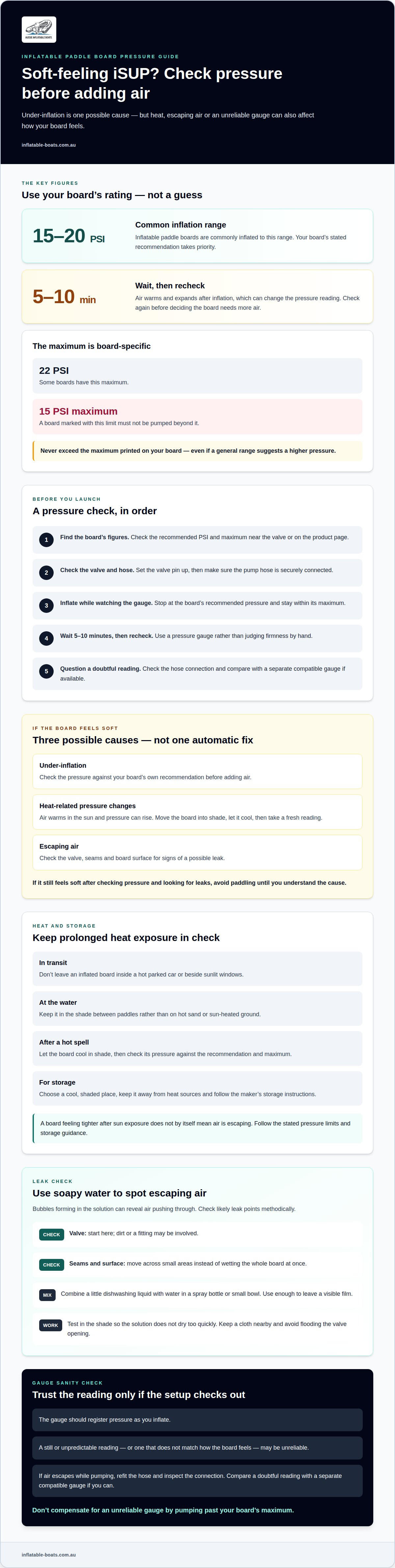
A soft-feeling iSUP often needs more air: inflatable paddle boards are commonly inflated to 15-20 PSI, but your board’s recommended pressure takes priority. If you’re wondering what to do if your iSUP feels soft, check its pressure with a gauge and don’t exceed the maximum printed on the board. Recheck after 5-10 minutes, as air warms and expands.
An iSUP that feels less firm underfoot can make paddling feel uncertain. The cause may be under-inflation, heat-related pressure changes or escaping air, so adding air is not always the right fix. This guide explains how to check the correct pressure, account for heat and storage, and use soapy water to find a possible leak. These checks help you decide whether the board is ready for your next paddle.
Key Takeaways
- Use the pressure recommended for your board; inflatable paddle boards are commonly inflated to 15-20 PSI, but never exceed the board’s stated maximum.
- Recheck pressure after 5-10 minutes, as air warms and expands after inflation.
- Keep your iSUP out of prolonged direct sun and extreme heat, including a hot car, to help manage pressure changes.
- Soapy water can help reveal escaping air around the valve, seams or surface.
- If the board still feels soft after checking pressure and looking for leaks, avoid paddling until the cause is understood.
Recommended inflation pressure and checking pressure before paddling
A soft-feeling iSUP may be under-inflated, but adding air without checking the board’s limits can over-pressurise it. Read the recommended pressure and maximum before inflating or heading out.
Checking recommended inflation pressure
The recommended inflation pressure is the PSI level stated by the board’s manufacturer, usually near the valve or on the product page. Inflatable paddle boards are commonly inflated to 15-20 PSI, but the board’s own specification takes priority. Some boards have a maximum of 22 PSI; a board marked with a 15 PSI maximum must not be pumped beyond it. Correct pressure helps the board feel firm and perform as intended.
Before paddling, use a pressure gauge rather than judging firmness by hand. Check the reading against your board’s stated recommendation, not a general range or another board’s rating. For example, one iSUP’s recommended pressure is 15-18 PSI, while another model may have a different limit.
Testing pump and gauge accuracy
A working pump should deliver air through a secure hose connection, and its gauge should register pressure as you inflate. Check that the hose is firmly attached and the gauge responds as pressure rises. If the reading stays still, jumps unpredictably or doesn’t match how the board feels, treat it as unreliable. Compare it with a separate compatible gauge if you can.
Check the valve before pumping: its pin should be in the up position to let air in without escaping. If the pin is down, air may leave through the valve. If air escapes while pumping, refit the hose and inspect the connection. These checks help distinguish a pump or fitting problem from an issue with the board.
Use this sequence before launching:
- Find the recommended PSI and maximum pressure printed near the valve or stated on the product page.
- Set the valve pin up, connect the pump securely, then inflate while watching the gauge.
- Stop at the board’s recommended pressure. Never exceed its stated maximum, even if a general range suggests a higher figure.
- Wait 5-10 minutes, then recheck the pressure. Air warms and expands after inflation, changing the reading.
- If the gauge reading seems unreliable, check the hose connection and compare it with a second compatible gauge.
If the board still feels soft after inflation, check the pressure again. A mismatch between the board’s stated limit and the pump’s reading matters more than how firm the surface looks. Don’t compensate for an unreliable gauge by pumping past the board’s maximum. Confirm the pressure, then use the reading and how the board feels to decide whether it’s ready for the water.
Storage and heat-related care
An Australian summer can expose an iSUP to intense sun, especially beside the water or inside a parked car. Don’t leave the board in a hot car or direct sun for a long time. Heat warms the air inside, raising pressure and placing extra strain on the board’s materials. A board that feels firm in the shade may feel different after sitting in the sun.
Prepare your gear in a shaded spot. If you inflate the board before travelling, keep it out of a hot car interior and away from sunlit windows. At the beach, leave it in the shade between paddles rather than on hot sand. These steps limit prolonged heat exposure while you’re out for the day.
Storage matters after a paddle, too. Don’t leave the board in a hot shed, near a heat source or where afternoon sun falls directly on it. A cooler, shaded storage area helps limit repeated heating. Before packing the board away, follow the maker’s storage instructions, including any guidance about inflation and valve position.
If the board has been exposed to heat, assess it before setting off again. Move it into the shade and let it cool before judging how firm it feels. Then compare its pressure with the recommended range and maximum. Don’t release air just because the surface feels tighter after sun exposure; follow the stated limits and storage instructions. A heat-related pressure change is different from air escaping through a leak.
Use this routine around a hot day:
- Before loading: keep the inflated iSUP out of direct sun while organising transport and gear.
- During travel: avoid leaving it inside a parked car, where the interior can bake.
- At the water: store it in shade between paddles, not on sun-heated ground.
- After exposure: let the board cool in shade, then assess its pressure before launching.
- For longer storage: choose a cool, shaded place and follow the board maker’s instructions.
Keep the pump and pressure gauge out of direct sun as well. A hot pump left beside the board can be uncomfortable to handle and complicate checks before paddling. Once the board has cooled, take a fresh reading rather than relying on how it felt in the heat. For other inflatable watercraft options, consider how transport and storage conditions affect equipment between outings.
Using soapy water to find escaping air
Soapy water can reveal escaping air: bubbles form where air pushes through the solution. Test the inflated iSUP, checking likely leak points methodically. Start at the valve, where a slow leak may be caused by dirt or a fitting that needs attention. Next, check the seams and board surface, moving across small areas instead of wetting the whole board at once.
Mix a little dishwashing liquid with water in a spray bottle or small bowl. Use enough solution to leave a visible film, not a thick coating. Keep a cloth nearby to wipe each area after testing, and work in the shade so the surface doesn’t dry too quickly. Avoid flooding the valve opening or letting soap pool around fittings.
- Inflate the board: Bring it to its recommended pressure, then disconnect the pump and secure the valve cap. This gives escaping air pressure to push against the solution.
- Test the valve: Dab or spray soapy water around the valve’s outer edge and cap. Watch for bubbles that keep appearing in one spot, rather than foam created by brushing.
- Inspect the seams: Apply a thin layer along the seam line in short sections. Pause at each section and look for bubbles growing from the same point.
- Check the surface: Work across the top, sides and underside, including areas near fittings. Small punctures can be hard to see, so follow the surface systematically.
- Mark the location: If bubbles repeatedly form at one point, dry the area and mark it gently. A clear marker helps you find the suspected leak after cleaning.
Tell fresh leak bubbles apart from leftover foam. A leak creates new bubbles in the same spot after the solution settles. Foam from application tends to spread or collapse without repeatedly forming again. If bubbles appear around the valve, remove visible dirt and check that the valve is seated correctly. A slow leak may mean the valve needs cleaning or tightening. Follow the board maker’s instructions before adjusting it.
After testing, wipe off the solution with a clean, damp cloth and dry the board. Keep any suspected leak location visible for inspection. Don’t launch if the board keeps losing air or still feels soft after inflation. A puncture or valve issue may need repair, and bubbles across several areas can help pinpoint where to investigate. Before deciding what to do next, record the location and what you observed, such as bubbles at the valve edge or along a seam.
How do you check whether an iSUP pump or pressure gauge is working?
A pump or gauge problem can make an iSUP seem soft if air isn’t entering properly or the pressure reading is inaccurate. Check the pump’s connections, air delivery and display separately. This helps distinguish an equipment issue from a board that isn’t holding air.
Disconnect the pump from the board before inspecting it. Check the hose, connector and seals for visible damage, looseness or trapped grit. Reconnect the hose firmly, then make a few steady strokes and listen for escaping air near the joint. If the connection hisses or shifts, reseat it before continuing. A loose fitting can waste air and make inflation feel ineffective.
Watch the gauge as you pump. Its reading should respond as air enters the board, not remain fixed or move erratically. If the needle doesn’t rest at zero when disconnected, or a digital display behaves inconsistently, don’t rely on it. Check the pump instructions for gauge setup or reset guidance. Keep the board’s pressure limit in view throughout.
- Check the valve connection: Confirm the hose is attached securely and the valve pin is positioned for inflation.
- Inspect the hose: Look for cracks, loose fittings or damaged seals that could let air escape.
- Observe the gauge: Note whether its reading changes smoothly as you pump, then returns to its resting position when disconnected.
- Compare readings: Use a separate compatible gauge on the same board. A clear difference suggests one reading may be unreliable.
- Assess air delivery: If the board gains little firmness despite repeated pumping, inspect the hose and valve connection again.
Compare the pump gauge with a separate compatible gauge under the same conditions. For example, if the pump display doesn’t change but the second gauge registers pressure, the pump gauge may be faulty. If neither gauge shows rising pressure, check the hose, connector and valve before concluding that the board has a leak. A pressure reading alone can’t identify the faulty part.
After comparing readings, disconnect the pump and listen near its hose and fittings. Air escaping from the pump connections suggests a fit or equipment issue; bubbles at the board’s valve or surface call for a separate leak check. Don’t compensate for a questionable gauge by pumping beyond the board’s stated maximum. Use a reliable reading to decide whether the iSUP is ready for the water.
When should you stop using a soft iSUP and contact the manufacturer?
Stop using the iSUP if it won’t hold its recommended pressure, loses firmness or shows damage. A board that flexes noticeably underfoot can feel unstable, especially in choppy water. Don’t launch to see whether the problem improves on the water. First identify what changed and inspect the board. If pressure loss or visible damage remains, contact the manufacturer.
Inspect the valve, seams and outer surface closely. Bubbles that repeatedly form in one place during a soapy-water test indicate escaping air. Also look for seam separation, a visible puncture, distortion or a damaged-looking valve. Even without an obvious leak, a soft board needs attention if its pressure drops after inflation. Record what you find instead of repeatedly topping it up and paddling.
Before attempting a repair, seek the manufacturer’s guidance if the damage is near a seam, valve or fitting. These areas affect how the board holds pressure, and an unsuitable repair could complicate later assessment. Follow the care and repair instructions supplied with the iSUP. Don’t use adhesives, tools or replacement parts unless the manufacturer’s directions support that approach.
Before contacting the manufacturer, gather useful details:
- Board identification: Note the model name and any identifying information shown on the board or purchase documents.
- Pressure observations: Record the pressure reading after inflation and whether the board later feels softer.
- Leak location: Describe whether soapy water showed bubbles at the valve, a seam or another surface area.
- Visible condition: Photograph damage, distortion or a suspected leak point in clear light.
- Recent handling: Explain relevant circumstances, such as storage in direct sun or transport in a hot car.
Clear records help the manufacturer understand the issue more accurately than a description such as “it feels soft”. Note the pump or gauge reading and explain how you checked it. Include whether you tested another gauge. Record any repair work and cleaning details factually, including products applied to the board. Document the original leak location before making changes that could hide it.
Don’t paddle while the board keeps losing air, has a confirmed leak or shows structural damage. Wait for the manufacturer’s advice and until the board can maintain its proper pressure. A suspected defect, valve fault or seam problem needs attention on shore, not assessment during a trip.
Inflatable Boats: Inflatable Boats
Inflatable Boats is a practical next step when inspection points to damage or a part that needs attention. If an inflatable board or boat continues losing air, Inflatable Boat Repairs can help address repair needs; Inflatable Boat Spare parts and Inflatable Boat Accessories support equipment upkeep. The right next step depends on what you found, such as a suspected puncture, valve issue or damaged component. Keep your pressure readings and the leak location handy when describing the problem. This gives useful context about the equipment and what you’ve already checked. For inflatable equipment that needs repair or replacement parts, visit Inflatable Boats to explore the available options or get in touch.
Make your next launch a confident one
When deciding what to do if your iSUP feels soft, let your checks guide you rather than rushing to top it up. A consistent pre-launch routine helps you notice changes and provides useful details if the board needs attention. Keep a simple record of pressure readings, storage conditions and anything that changes. This makes it easier to distinguish a one-off change from a recurring issue.
When the cause points to a repair or equipment concern, take the next step on shore before planning another paddle. Share what you observed and where the issue appeared. Clear details help move the conversation from guesswork towards a practical way forward.
Contact Inflatable Boats to discuss your inflatable equipment needs. Then get back to preparing for the open water with a clearer plan and confidence in your gear.
Frequently Asked Questions
What PSI should I inflate my board to?
Inflate your board to the pressure recommended for its specific model. Inflatable paddle boards are commonly inflated to 15-20 PSI, but that range doesn’t override the board’s stated limit. For example, if the board’s maximum is 15 PSI, stop at that pressure even if another iSUP takes more. Treat the recommended pressure and maximum as separate instructions, and don’t inflate beyond the maximum.
What PSI should an inflatable SUP be inflated to?
Many inflatable SUPs use a pressure within 15-20 PSI, while some boards have a maximum of 22 PSI. The correct figure depends on the individual board, so use its manufacturer’s recommendation rather than choosing a pressure based on another model. A board with a 15 PSI maximum must not be inflated above that level. PSI means pound-force applied to one square inch.
How can you check the recommended pressure for an iSUP?
Find the recommended pressure near the valve or on the product page for your board. Match the model carefully, as pressure limits vary between boards. Check whether the figure is a recommended pressure or a maximum, and follow both instructions as written. If you’re deciding what to do if your iSUP feels soft, start with the correct pressure for that exact model.
How do you find and repair a leak in an inflatable SUP?
Apply soapy water to the inflated board and watch for bubbles repeatedly forming in one spot. Check around the valve, seams and surface, then mark any suspected leak location. A slow leak may be caused by a valve that needs cleaning or tightening. Small punctures can often be repaired, but follow the board maker’s repair instructions, especially for damage near a seam or valve. Don’t paddle while the board continues losing air.
Can temperature changes make an iSUP feel soft?
Yes. Air inside the board warms and expands in heat, then contracts as it cools, which can change how firm the iSUP feels. A board left in direct sun or a hot car may feel tighter while warm, then softer after cooling. Keep it out of prolonged heat, let it cool in the shade, and reassess its pressure before paddling instead of judging firmness immediately after exposure to temperature changes.
Is it safe to paddle an underinflated iSUP?
No. Don’t launch if the board feels soft, flexes noticeably or won’t hold its recommended pressure. Knowing what to do if your iSUP feels soft means keeping it ashore if pressure loss persists, not testing it on the water. Under-inflation can make an iSUP feel unstable or sluggish. Check the pressure reading and inspect for air loss before paddling.