
ISUP Buying Guide: Choose the Right Inflatable Paddle Board in Australia
The longest iSUP isn’t automatically the right one. Your paddling experience, the load you’ll carry and where you plan to explore all matter. Choosing by length alone can leave you with a board that doesn’t suit your plans.
It’s easy to get stuck comparing dimensions, weight limits and PSI ratings, especially when product descriptions don’t spell out what’s included. Start with your paddler profile and intended use, then compare the construction details that affect performance and portability.
This guide explains how to compare board size, capacity and construction, and which specifications deserve a closer look. We’ll use the Talamex 7.6 Wave and 10.6 Original as examples, then cover what to confirm about the board, included equipment and safety requirements before ordering or heading out. A considered choice helps you prepare for the conditions and outings you have in mind.
Key Takeaways
- Match your board to where and how often you expect to paddle, and who’ll join you.
- Compare an isup by its dimensions and stated weight guidance, not length alone.
- Check what the construction and inflation specifications tell you, and follow the manufacturer’s instructions.
- Confirm exactly which equipment is included before ordering. Don’t assume a package contains particular items.
- Check the safety requirements for your state or territory and the waterway you plan to paddle.
Is an iSUP right for your paddling plans? Start with the board’s intended use
An iSUP, or inflatable stand-up paddle board, is inflated for use and deflated for storage and transport. That portability can suit people who want to pack a board away between outings rather than store a rigid board. Stand-up paddleboarding covers a range of activities, from recreational flat-water paddling to other styles. First, consider the kind of time on the water you have in mind. Learn more about stand-up paddleboarding.
Think about your usual launch spot, how often you’ll paddle and who’ll come along. A short outing on sheltered water with a child is different from regular solo paddles or longer explorations with gear on board. These plans affect the size and weight guidance to check. Length matters, but it doesn’t tell the whole story: paddler ability, total load and the board’s intended use also help determine whether a model suits your plans.
What does an inflatable paddle board suit?
Recreational paddling is a common use for an inflatable board, but the product specifications and instructions should guide your expectations. Deflated, an iSUP can be packed away, which may help if storage space or transport is a consideration. The collection description says the boards are designed for convenient setup and packing into a carry bag. Check the individual product listing to confirm whether a bag or any other accessory is included.
If you’re comparing an iSUP with an inflatable boat, start by distinguishing the activities. A paddle board is propelled with a paddle while standing or kneeling, while an inflatable boat is a different craft with different intended uses. Choose according to the experience you want, then check the relevant product specifications.
What should first-time iSUP buyers consider?
Be realistic about your confidence on the water. A board description can indicate its intended paddler profile, but it can’t guarantee that you’ll find it easy to control or suitable for every outing. Consider whether you’ll paddle alone, with children or with other adults, and include the people and gear you expect to carry when checking weight guidance.
Storage and setup matter too. Consider where you’ll keep the deflated board and whether you’re comfortable following its inflation and care instructions. Before each trip, assess the water conditions and your ability to manage them. An appropriate board doesn’t make unsuitable conditions safe. Check the safety requirements for your waterway, including any requirements for flotation equipment.
Once you’ve worked out your plans, compare the inflatable paddle board collection with the confirmed specifications and package details for each model. That’s a more useful starting point than choosing by length alone.
How to compare iSUP size, thickness and weight guidance
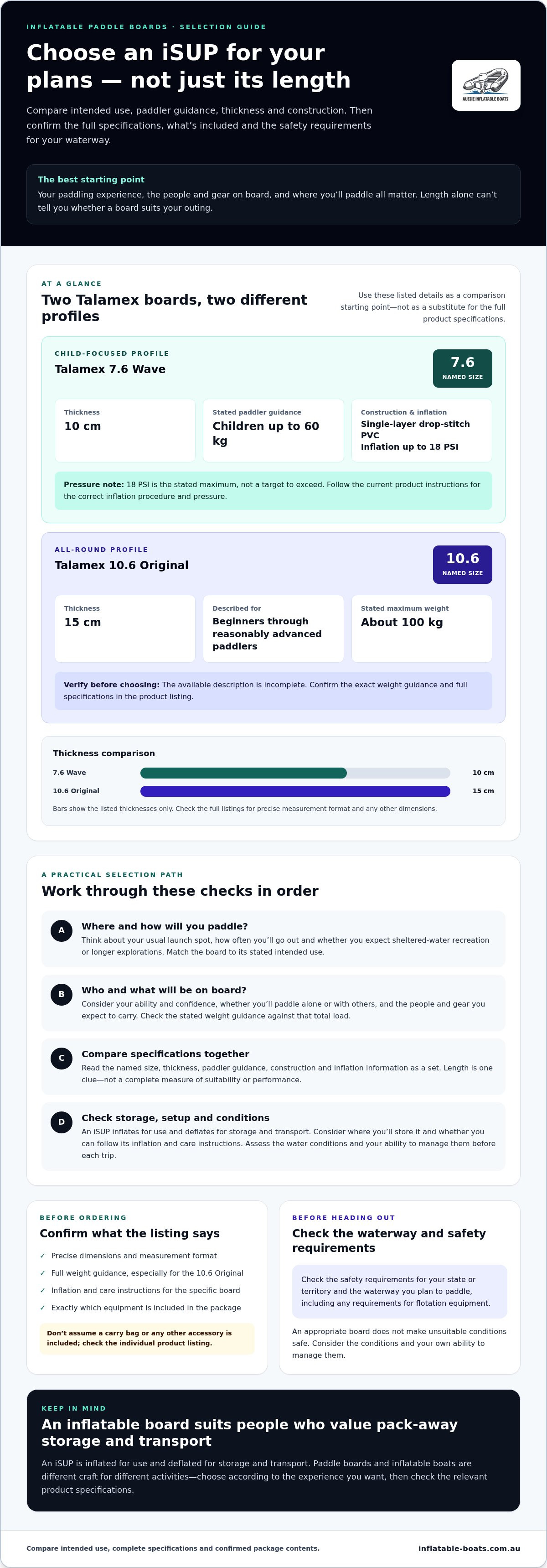
Compare the figures together, not in isolation. Length is one clue, while thickness and the stated paddler guidance add context. The available Talamex details describe two different board profiles, so don’t assume the models suit the same paddler.
| Model | Length as named | Thickness | Stated paddler guidance |
|---|---|---|---|
| Talamex 7.6 Wave | 7.6 | 10 cm | Designed for children up to 60 kg |
| Talamex 10.6 Original | 10.6 | 15 cm | Beginners through reasonably advanced paddlers; maximum weight stated as about 100 kg |
The product names provide the length figures, but check the full listings for their precise measurement format and any other dimensions. The 7.6 Wave is child-focused, while the 10.6 Original is described as an all-round board for a broader range of experience. That distinction is more useful than treating one as simply a shorter or longer version of the other.
Talamex 7.6 Wave: a child-focused board profile
The available guidance describes the 7.6 Wave for children up to 60 kg. It’s listed as 10 cm thick and made with single-layer drop-stitch PVC, with inflation up to 18 PSI. Treat that PSI figure as the stated maximum, not a target to exceed. Check the current product instructions for the correct inflation procedure and pressure before use.
Talamex 10.6 Original: an all-round board profile
The 10.6 Original is described as a 15 cm thick all-round board for beginners through reasonably advanced paddlers. Its stated maximum weight is about 100 kg, but the description available here is incomplete. Confirm the exact weight guidance against the full specification before choosing. Don’t infer capacity or performance beyond the information provided.
Quick read: The listed details include the named sizes, thicknesses and stated paddler guidance above. Verify the precise dimensions, the Original’s exact weight limit and each board’s full specifications before ordering. The Australian training standard also identifies selecting equipment suitable for conditions as a paddling competency. See the official equipment selection standards.
Use these specifications as a starting point, then compare the Talamex iSUP options with your paddler and load requirements. A model description is guidance, not a personal suitability guarantee.
Which iSUP features deserve attention before you choose?
Technical details are more useful than broad claims such as “high performance” or “built for adventure”. Check the specifications and care instructions for the exact board you’re considering. Construction, inflation pressure and package contents affect how you set up, use and look after an iSUP. Don’t assume features listed for one model or brand apply to another.
Construction, inflation pressure and care
Drop-stitch construction uses many threads to connect the board’s upper and lower surfaces. When inflated, those threads help the structure hold its shape. The Talamex 7.6 Wave is described as single-layer drop-stitch PVC. That identifies its stated construction, but it isn’t enough to compare it directly with boards made using different materials or construction methods.
The supplied maximum inflation figure for the Wave is 18 PSI. That figure applies to this model, not every board. Follow the product manual for inflation, use and care, and don’t exceed the pressure specified by the manufacturer. If the listing and instructions differ or leave a detail unclear, confirm the correct information before inflating the board.
Check the complete package and product details
Product descriptions don’t always make package contents clear. Before ordering, check whether the listing confirms each item you need:
- Is a pump included, and what type is it?
- Does the package include a paddle, fin, leash or carry bag?
- What valve type and fin arrangement does the board use?
- Where are the setup, care and repair instructions provided?
These are items to verify, not assumed inclusions. Check the current product listing, especially if an accessory is essential to your plans. The collection description mentions packing boards into a carry bag, but only the individual listing can confirm what comes with that model.
For a visual guide to setup, browse the store’s setup and product videos. Use demonstrations alongside the instructions supplied for your specific board, not as a substitute for them.
Once you’ve compared construction, operating instructions and confirmed package contents, browse the inflatable paddle board collection to compare available options with your needs.
How to match an iSUP to your ability, weight and routine
Use a simple sequence before choosing: identify who’ll paddle, work out the people and gear you expect to carry, check the board’s current specifications, confirm the package contents, then consider whether the conditions suit your experience. This keeps the decision grounded in your plans rather than one appealing feature. An iSUP description can help narrow your options, but it isn’t a personal guarantee of fit or safety.
A practical checklist for choosing between the two listed boards
- Start with the paddler. Is the intended paddler a child who fits the Talamex 7.6 Wave’s stated guidance of up to 60 kg, or someone whose experience better aligns with the 10.6 Original’s stated beginner-to-reasonably-advanced audience?
- Account for the load. Check the full current specifications for the paddler and anything else being carried. The available description gives the Original a maximum weight of about 100 kg, but the exact guidance needs verification. If you’re close to a stated limit, confirm the manufacturer’s complete advice before purchasing.
- Match the board to your routine. Consider where you plan to paddle, how often and with whom. Check that the board’s documented intended use and instructions align with those plans.
- Confirm the package and prepare for safe use. Verify included equipment, setup instructions and relevant safety guidance. A suitable board still needs to be used according to its instructions and in conditions you can manage.
The Wave and Original have different stated paddler profiles, but that doesn’t make either a guaranteed recommendation for an individual. If a specification is incomplete or your weight is near the stated guidance, ask for clarification through the store’s product contact page before ordering.
Common iSUP buying mistakes to avoid
Don’t choose on length or appearance alone. Avoid applying a PSI recommendation from another brand to a Talamex board. Use the instructions for the exact model. Photos and general package descriptions also don’t confirm that a pump, paddle, fin, leash or carry bag is included, so check the individual listing.
Finally, treat broad marketing phrases as a starting point, not evidence of capacity or suitability for particular water conditions. Compare specific product guidance with your paddling plans, and pause if essential details remain unclear.
Ready to compare the listed models with your paddler profile? Explore the Talamex iSUP options and check each product’s current specifications before choosing.
Choose your Talamex iSUP and prepare for your first paddle
The available Talamex product details describe two inflatable paddle boards, each with a different stated paddler profile. Use these details to guide your comparison, not as a promise that either board will suit every person or outing. Product descriptions are incomplete, so confirm the current listing and specifications before ordering. The product information refers to a three-model range but provides details for only two products. Check the live collection rather than assuming a third model is available.
At a glance: the two Talamex models
- Talamex 7.6 Wave: the listed child-focused option, described for children up to 60 kg. The available details state that it is 10 cm thick, uses single-layer drop-stitch PVC and can be inflated up to 18 PSI. Follow its product instructions for inflation.
- Talamex 10.6 Original: the listed all-round option, described for beginners through reasonably advanced paddlers. It is stated to be 15 cm thick, with a maximum weight of about 100 kg. Because the description is incomplete, verify the exact weight guidance in the full specification.
This comparison covers only the two products described above. Their intended audiences differ, so compare the current manufacturer guidance with the paddler, total load and plans for use. Don’t infer capacity, included accessories or suitability for particular conditions from a model name or general description.
Before you head out on the water
Start preparation with the board’s own instructions. Read the guidance for inflation pressure, assembly, use and maintenance, and check that the board and any required equipment are ready before launching. Confirm package contents against the live product listing. Don’t assume accessories shown or mentioned elsewhere are included.
Then check the rules and safety guidance that apply to your state or territory and intended waterway. Requirements can vary by location and conditions. Choose suitable safety equipment, assess the weather and water, and be realistic about your experience. No checklist makes every trip appropriate, and sometimes the right decision is to wait for safer conditions.
Once you’ve matched the listed specifications to your needs, browse the inflatable paddle board collection. Check the live product details, current inventory and included equipment before ordering, then head out with a clear understanding of your board and the conditions ahead.
Choose your board, then prepare for the water
A confident iSUP choice starts with your paddling plans, not length alone. Consider who’ll use the board, the total load and your experience, then check the model’s construction, inflation instructions and confirmed package contents. Specifications are useful when they match the product you’re ordering.
The available range details distinguish the child-focused Talamex 7.6 Wave from the all-round 10.6 Original, which is described for beginners through reasonably advanced paddlers. Their model-specific thickness and paddler guidance provide a starting point for comparison, but the descriptions are incomplete. Verify the full specifications, the Original’s exact weight guidance and included equipment on the live product listing.
Before your first paddle, read the board instructions and check the safety requirements and conditions for your chosen waterway. A suitable board is one part of a well-prepared outing.
Compare the Talamex iSUP options and review the current product details before ordering. Choose with care, prepare well and enjoy getting out on the water.
Frequently Asked Questions
What does iSUP stand for?
iSUP stands for inflatable stand-up paddle board. It’s inflated for use and deflated for storage or transport, which can suit paddlers who need to pack their board away between outings. Check the specific model’s instructions for inflation, care and storage, and confirm whether a carry bag is included rather than assuming every board comes with one.
Which iSUP is best for beginners?
The right iSUP for a beginner depends on the paddler’s weight, plans and the board’s stated guidance. The Talamex 10.6 Original is described as an all-round board for beginners through reasonably advanced paddlers, but that doesn’t guarantee personal suitability. Check the full specifications, weight guidance, included equipment and instructions, then consider whether the intended water conditions match your experience.
Can children use an inflatable paddle board?
Children can use an inflatable paddle board when the specific board’s guidance suits the child and the outing is appropriate. The Talamex 7.6 Wave is described as designed for children up to 60 kg. Verify the full product details before choosing it. Consider the child’s confidence, adult supervision, suitable safety equipment and local waterway requirements. A child-focused description doesn’t mean every child or condition is automatically suitable.
How much weight can an iSUP hold?
An iSUP’s weight guidance varies by model, so check its current manufacturer specifications rather than relying on a general figure. The available information describes the Talamex 7.6 Wave for children up to 60 kg and gives the 10.6 Original a maximum weight of about 100 kg. Confirm the Original’s exact limit against its complete specification. Check how the manufacturer defines load and allow for anything carried.
What PSI should I inflate an iSUP to?
Inflate an iSUP to the pressure specified in the instructions for that exact model. The available details give the Talamex 7.6 Wave a maximum inflation figure of 18 PSI. This is model-specific, not a universal target for inflatable boards, and a maximum shouldn’t be exceeded. Follow the manufacturer’s inflation procedure and check the product manual if the listing or instructions are unclear.
What accessories come with an iSUP?
Included accessories depend on the individual board and package. Before ordering, check the live product listing to see whether a pump, paddle, fin, leash or carry bag is included. Don’t assume an item shown in a photograph or mentioned in general collection information comes with your chosen model. Confirm the valve type and fin arrangement too, and check which setup, care and repair instructions are supplied.
Is an iSUP suitable for every water condition?
No. An iSUP isn’t automatically suitable for every water condition or paddler. Consider your experience, the board’s stated intended use, and the weather and water conditions before setting out. Check the applicable rules and current safety guidance for your state or territory and waterway, as requirements can vary. Use appropriate safety equipment and don’t launch if conditions exceed your ability or the board’s instructions.