
Inflatable Yacht Tenders: Australian Buying Guide
If you’re searching for an “inflatable tender for yacht Australia”, start with how the tender will fit your vessel, crew and storage arrangements. A model that looks ideal in a listing can become impractical if it’s hard to launch, recover or stow.
Dimensions and carrying capacity matter, but so do the everyday details. Can your crew manage the tender comfortably? Where will it be secured, and how will its construction, floor and propulsion suit the trips you make? A tender should make the passage between yacht and shore simpler, not create new compromises.
This guide gives you a practical way to compare options. Match size and capacity to your vessel and crew, then weigh durability, portability and performance against available storage and intended use. You’ll also find details to consider when choosing accessories, spare parts and repair support. Australian registration and safety requirements can vary between states and territories, so factor in the rules that apply to your use. The aim is a shortlist based on how you’ll actually use the tender, not headline specifications alone.
Key Takeaways
- Start with how you’ll use the tender, then match its capacity to your usual passengers and gear.
- Measure available storage and consider launching and recovery before settling on a tender’s dimensions.
- Compare construction, floor, propulsion and portability by how each affects setup, handling and ongoing care.
- Use this inflatable tender for yacht Australia buying guide to weigh inflatable and rigid options against your yacht’s needs.
- Factor in state and territory requirements, plus the accessories, spare parts and repair support that can help with ownership.
Why an inflatable tender for your yacht needs more than the right dimensions
A tender carries people, provisions and other gear between your yacht and shore. Choosing by passenger capacity or length alone can leave you with a boat that’s awkward to stow, launch or recover. The right inflatable tender for yacht Australia use depends on how it fits your vessel, crew, typical trips and handling arrangements.
What jobs will the tender need to handle?
Start with the trips you make most often. For routine shore transfers, list the usual passengers and the gear they take. If you regularly carry extra provisions or equipment, include those too, while keeping the total load within the tender’s stated capacity.
Write down the typical passenger count and load, then separate everyday requirements from occasional plans. Choosing around a rare use can result in a tender that’s unnecessarily difficult to handle on ordinary trips. For a broader framework for weighing your needs, see choosing your first inflatable boat.
How does your yacht shape the choice?
Measure the available storage and identify where the tender will sit and how it can be secured underway. An inflatable model may be stowed differently from one with a rigid hull. A Rigid-hulled inflatable boat (RHIB), for example, combines a rigid hull with inflatable tubes, so its shape and storage requirements are part of the yacht-fit decision.
Then map out the full launch and recovery process. Consider where the tender will be lifted or moved from, who will handle it and whether there’s enough room to manoeuvre safely. A tender may fit on paper but still be cumbersome if it’s difficult to reach or secure in its stowed position.
The right balance depends on your yacht’s layout, your crew’s capabilities and the trips you plan to make. Compare options with your actual setup, rather than an idealised arrangement. Aim for a tender that carries your usual passengers and gear and remains manageable before, during and after each trip.
Which inflatable tender features matter most for yacht use?
Features work together. When comparing an inflatable tender for yacht Australia use, assess the complete setup rather than focusing on one material, floor or propulsion choice. Consider how each option affects preparation, handling, storage and care, then weigh those trade-offs against your yacht and intended trips.
| Feature | What to compare | Why it matters aboard |
|---|---|---|
| Construction | Material, seams and the maker’s care guidance, including whether the fabric is PVC or Hypalon. | These details help you understand how to maintain the tender and whether its construction suits your planned use. |
| Floor | The floor design and whether it’s integrated or removable, as described for the specific craft. | Consider the setup involved and how the floor arrangement affects packing and storage. |
| Portability | How the tender is carried, moved, packed or stowed. | A manageable tender is easier to handle within the limits of your yacht’s layout and crew. |
| Propulsion | Whether the intended method is manual or motorised, and what equipment it requires. | Propulsion affects preparation, storage and operation, as well as the demands of launch and recovery. |
| Storage | Stowed dimensions, shape and how the tender can be secured aboard. | Check the actual storage position and handling route, not just the tender’s measurements. |
How should you compare tender construction and floor types?
PVC and Hypalon are material options to compare, not a verdict on the whole boat. Read the construction details and care instructions alongside the material name. For floors, compare the maker’s description and setup requirements instead of relying on generic rankings. The value of each feature depends on the complete craft and how you plan to use, handle and store it.
What should you consider when choosing propulsion and handling?
Decide how you expect to propel the tender, then account for the equipment and storage that method requires. If you’re considering an outboard, check that the tender has a transom and consult its capacity plate or manufacturer’s specifications for compatible motor limits, weight and shaft length. Don’t infer a transom or motor compatibility from appearance alone.
Think through the full handling sequence: moving the tender from storage, preparing it, launching it and recovering it after a trip. The effort depends on the craft and your yacht’s arrangement, so consider who will do each task. Comparing these steps makes the practical demands clear before you choose. Browse inflatable boats and related equipment while weighing your options.
Inflatable tender versus other yacht tender options: compare the real trade-offs
The best tender format depends on the space aboard your yacht and what you expect the tender to do. An inflatable tender may suit an owner who values adaptable storage. A rigid tender may be a better fit if its fixed shape works with the yacht’s stowage and handling arrangements. Neither is right for every situation. Compare the practical demands of each option against your routine before deciding.
When can an inflatable tender be a practical yacht choice?
If storage space is limited or serves several purposes, an inflatable design that can be deflated and packed away may offer useful flexibility. That benefit depends on the specific tender and whether your routine allows time and space for packing, inflation and setup. If it stays assembled or is secured externally, its shape and stowage position still matter.
Handling depends on the craft, crew and yacht setup. Consider how the tender will move from its storage position to the water, and who will manage launching and recovery. A design that’s convenient to carry or stow can still be awkward if the route aboard is restricted. For an inflatable tender for yacht Australia, assess the whole routine rather than assuming portability is an automatic benefit.
What trade-offs should you weigh against a rigid tender?
A rigid tender keeps its shape, so consider whether your yacht has room to store and secure it that way. An inflatable model may offer more storage flexibility if it can be packed down, but packing and setup become part of regular use. Both formats need appropriate care. Compare their construction and maintenance guidance rather than assuming one is always easier to own.
A rigid-hulled inflatable boat (RIB) is a distinct option, combining a rigid hull with inflatable tubes. Its fixed hull affects stowage and handling differently from a tender that can be deflated. Assess its dimensions against your yacht’s available space and lifting arrangements. Stability and handling depend on the particular craft and conditions, not simply the category name.
“Choose portability over other criteria when flexible stowage is central to your yacht routine, not simply because an inflatable tender sounds easier to handle.”
Before settling on a format, weigh your priorities:
- Storage: Can the tender be secured aboard in its intended form?
- Routine: Does setup or packing fit the way you use your yacht?
- Handling: Can your crew launch and recover it with the arrangements available?
- Care: Are you prepared to follow the maintenance needs of its construction?
Use the rigid inflatable boat guide as a reference when comparing RIBs with other tender types.
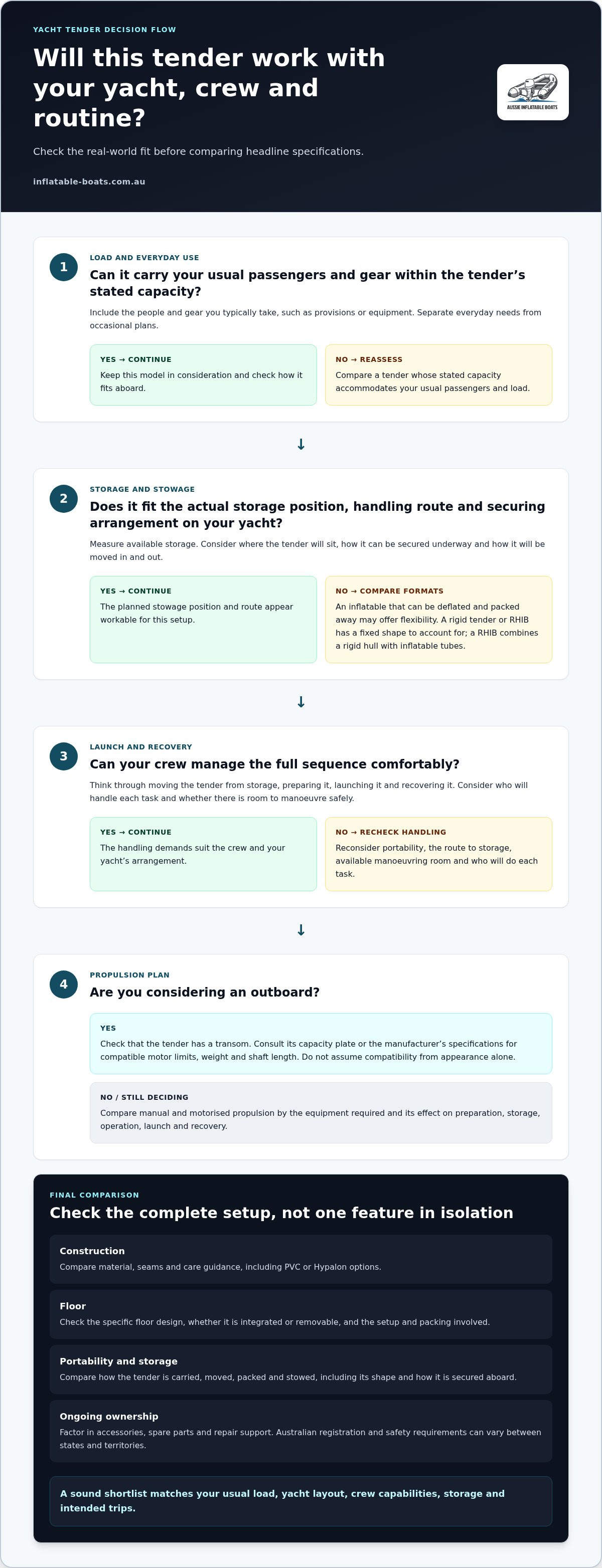
Use this yacht-fit checklist before choosing an inflatable tender in Australia
Write a practical brief based on your routine aboard before comparing models. This helps you assess an inflatable tender for yacht Australia against real passenger, storage and handling needs, rather than relying on headline dimensions alone.
- Define the usual trips. Note whether you’ll mainly make shore transfers or also carry provisions and other gear. Separate regular use from occasional plans.
- Record passengers and load. Write down your usual passenger count and the gear carried on a typical trip. Compare these needs with the tender’s stated capacity and manufacturer information.
- Measure storage and access. Record the available stowage space, then consider the route from storage to the launch point. Allow for the tender in its intended stored or secured arrangement.
- Plan handling aboard. Identify how the tender will be secured, moved, launched and recovered, and who will manage each task. Match these steps to your yacht’s actual layout and crew.
- Review the complete specification. Check the manufacturer’s stated dimensions, capacity, construction, floor and propulsion compatibility against your intended use. Don’t assume a feature or limit that isn’t stated.
- Plan for ownership and care. Consider suitable accessories, replacement parts, routine inspection and the care guidance for the tender’s construction.
What should you measure and plan before buying?
Measure the space where the tender will be stored, and note any access constraints that could make moving it difficult. Consider how it will be secured underway and how it will reach the water. Then compare your usual passengers and carried gear with verified product information. A tender that suits the load still needs to fit the yacht and your crew’s handling arrangements.
How should you plan for care and ownership?
Include ongoing care in your decision. Routine inspection helps you notice changes such as punctures, valve concerns or issues with structural components. These may need professional inflatable boat repair. Accessories and spare parts are also part of practical ownership. Browse inflatable boat collections as you compare options for your yacht.
Use your completed checklist to narrow the field to tenders whose documented features match your vessel and routine. Explore inflatable boats and accessories as you compare those requirements.
Choose your yacht tender with a clear plan and ongoing support
A confident choice follows a clear order: confirm the yacht fit, define the tender’s intended use, assess handling, compare construction and plan for ongoing care. Keep those priorities in view when reviewing an inflatable tender for yacht Australia use. This helps keep a persuasive feature or headline specification from distracting you from what will work aboard your vessel.
What should a confident shortlist include?
Separate essential requirements from preferences before comparing individual options. Use the table to keep your shortlist focused, then assess each tender against its product information and your yacht’s actual setup.
| Decision area | Must-have | Preference or trade-off |
|---|---|---|
| Yacht fit | Fits available storage and can be secured as planned. | Extra stowage flexibility, if useful to your routine. |
| Use | Stated capacity suits your usual passengers and carried gear. | Capacity for less frequent trips, if it doesn’t compromise everyday handling. |
| Handling | Your crew can manage the intended moving, launch and recovery process. | A setup that makes routine preparation simpler. |
| Construction and care | Product details and care guidance suit your ownership plans. | Material or floor preferences that fit your priorities. |
Rule out options that miss a must-have, even if they appeal on a preference. For the remaining contenders, compare documented dimensions, capacity, construction and propulsion information. Use the manufacturer’s stated details to judge compatibility rather than filling gaps with assumptions.
Where can you explore tender options and support?
Ownership continues after purchase. Suitable accessories and spare parts support routine use, while professional inflatable boat repairs can address punctures, valve issues and structural components. Include inspection and care in your ownership routine, and keep the tender’s maintenance guidance close at hand.
Browse inflatable boat collections as you narrow your options. For foundational advice, read the guide to choosing your first inflatable boat.
When you’re ready to compare options, explore inflatable boat options.
Choose a tender that’s ready for your yacht routine
The right choice starts with your yacht, not a headline specification. Match the tender to your usual passengers and gear, available storage, and the way your crew will launch and recover it. Then compare construction, propulsion and care requirements using the product information. That’s a practical way to shortlist an inflatable tender for yacht australia use without losing sight of the trips you actually make.
Plan for more than the initial purchase. Inflatable boats, accessories and spare parts all play a part in ownership, while professional repair services can address punctures, valve issues and structural components. A clear plan for fit, handling and ongoing care helps you choose a tender that works with your routine.
Ready to take the next step? Explore inflatable boat options and find a tender that suits your yacht and the way you use it.
Frequently Asked Questions
Is an inflatable tender suitable for every yacht?
No. Suitability depends on your yacht’s storage, launch and recovery arrangements, as well as the passengers and equipment you expect to carry. A tender that works aboard one vessel may be impractical on another. Compare the craft’s dimensions, capacity and other specifications with your yacht’s layout and intended trips. Choose for the complete use case, not a single measurement or feature.
How do I choose the right size inflatable tender for my yacht?
Start by noting your usual passenger numbers and the gear you carry on a typical trip. Then assess where the tender will be stored and how your crew will move, launch and recover it. Choosing an inflatable tender for yacht use in Australia means matching the craft’s stated dimensions and capacity to your yacht and planned trips. Length alone doesn’t establish suitability, so avoid generic size or load recommendations.
Can an inflatable tender be stored on a yacht?
Yes, if the tender’s dimensions and storage arrangement work with the space available aboard your yacht. Consider more than the final stowage position: can the tender pass along the route to it, be secured appropriately and be retrieved when needed? Compare the specific tender’s measurements with the space available aboard. Those details determine whether it will fit your setup.
What is the difference between an inflatable tender and a RIB?
A RIB, or rigid inflatable boat, has a rigid hull with inflatable tubes, while inflatable tenders can vary in construction. This distinction affects the form you need to store and handle, but it doesn’t make one type universally better. Compare each craft’s details with your yacht’s stowage, launch and recovery arrangements, crew and intended use. The best fit depends on the complete setup.
Do I need an outboard motor for an inflatable yacht tender?
Not necessarily. The right propulsion depends on how you’ll use the tender and what the specific craft supports. Consider how propulsion equipment affects storage, preparation and handling, as well as your yacht’s routine. If you’re considering an outboard, use the tender’s specifications to assess compatibility. Don’t assume a motor size, speed or fit based on the tender’s length or appearance alone.
How should I maintain an inflatable tender?
Follow the craft’s care guidance and inspect it regularly for visible damage, valve concerns and other changes. The maker’s instructions should guide cleaning, storage and routine care, since maintenance needs can vary between designs. Suitable accessories and spare parts can support ownership. Punctures, valve problems or damage to structural components may call for professional inflatable boat repair to help maintain the tender’s condition.