
Inflatable watercraft prices and options for fishing and diving
There isn’t one price for an inflatable watercraft. Cost depends on its format, floor construction and whether a motor-mount setup is included. A kayak, soft-floor inflatable boat and rigid-base RIB suit different uses, so compare configurations as well as purchase prices.
Choosing a craft often means balancing portability with stability, capacity and access to your preferred fishing or diving spots. Start with how you plan to use it, then compare practical differences between boat types and motor-mount options.
This guide compares inflatable boat and motor-mount prices, explains options for fishing and diving, and outlines the differences between kayaks, rigid-base RIBs and yacht tenders. Use these practical criteria to identify the features that matter for your outings and narrow your choices.
Key Takeaways
- Compare boat configurations and motor-mount options to understand what shapes the overall purchase cost.
- Match your fishing or diving plans to the craft’s size, floor type and propulsion setup.
- Consider an inflatable kayak for exploring narrow creeks and other hard-to-reach waterways.
- See how an aluminium rigid base changes the RIB format and its place in the range of options.
- Understand when an inflatable tender can help you travel between a larger vessel and shore.
Inflatable boat and motor-mount prices
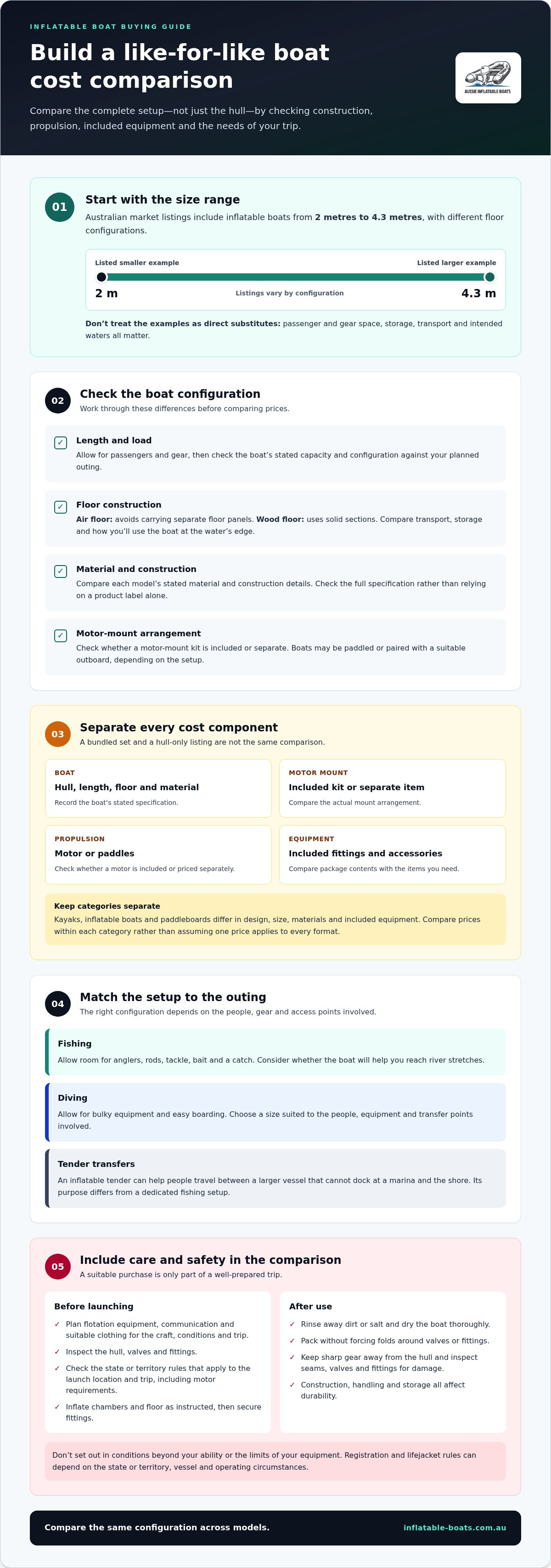
Compare the complete setup, not just the hull. An inflatable boat’s price depends on its length, floor construction, material and included equipment. Some setups have a separate motor-mount kit, and a motor or accessories can add further costs. Compare like with like: hull, propulsion and included fittings.
Length gives a practical starting point. Australian market listings include inflatable boat sizes from 2 metres to 4.3 metres, with different floor configurations. A 2-metre craft with an air floor and a 4.3-metre craft with a wood floor are not direct substitutes. Consider passenger and gear space, storage, transport and intended waters before comparing models.
Construction also matters. If you’re considering a Hypalon inflatable boat series, compare each model’s stated material and construction details rather than relying on the label alone. Floor type matters too: an air floor and a wood floor are different configurations. Review the full specification, including the motor-mount arrangement.
Accessories can make a setup more useful, but what’s included varies. Distinguish equipment supplied with the boat from accessories bought separately. An inflatable boat set may combine several components, so compare its contents with the individual items you need. That way, you won’t mistake a bundled package for a hull-only listing.
For a useful budget comparison, list the boat, motor-mount arrangement, motor and required accessories separately. Then compare the same configuration across models. Costs for inflatable kayaks, boats and paddleboards depend on design, size, materials and included equipment. Compare each category separately rather than assuming one price applies to every format.
Plan flotation equipment, communication and suitable clothing for the craft, conditions and trip. Before launching, inspect the hull, valves and fittings. Don’t set out in conditions beyond your ability or the limits of your equipment.
Australian registration and lifejacket rules can depend on the state or territory, vessel and operating circumstances. Before departure, check the rules that apply to your launch location and trip, including requirements for the craft’s motor setup.
Inflate the chambers and floor according to the craft’s instructions, then secure the fittings before launching from a suitable access point. After use, rinse away dirt or salt, dry the boat thoroughly and pack it without forcing folds around valves or fittings.
Durability depends on construction, handling and storage. Keep sharp gear away from the hull, clean and dry the craft after use, and inspect seams, valves and fittings for damage. Inflatable Boat Repairs can address punctures and worn components, while Inflatable Boat Spare parts support replacement needs.
Costs vary by design, size, materials and included equipment, so compare kayaks, boats and paddleboards within their own categories. For boats, account separately for the hull, motor-mount arrangement, motor and required accessories.
Inflatable boats for fishing and diving
For fishing or diving, choose a boat for the trip, not just the price. A river fishing outing may need room for anglers, rods and tackle, while a diving trip also needs space for equipment and easy boarding. Compare the boat’s length, floor type and intended load before choosing a model. Depending on the setup, an inflatable boat can be paddled or paired with a suitable outboard motor.
Australian listings show a broad choice of sizes and floor configurations.
These figures make it easier to compare sizes and floor types, but they don’t mean every model is interchangeable. For a compact fishing trip, consider the space rods, bait and a catch need alongside passengers. For diving, allow for bulky equipment and getting in and out. Match your planned load and activity to the boat’s stated capacity and configuration.
An air floor and a wood floor represent different construction choices. Think through transport, storage and how the boat will be used at the water’s edge. An air floor avoids carrying separate floor panels, while a wood floor uses solid sections. The 4.3-metre wood-floor example costs more than the listed air-floor models, but it is also longer, so the price difference cannot be attributed to floor material alone.
Inflatable boats can serve as tenders for larger vessels that cannot dock at a marina. They can also help anglers reach river stretches and divers travel between a larger boat and shore. For either use, choose a size suited to the people, equipment and transfer points involved. A tender serves a different purpose from a dedicated fishing setup, even when both have an inflatable hull.
Before buying in Australia, compare listings by length, floor type, intended activity and included equipment. Check whether the quoted configuration includes a motor or whether propulsion is separate, then account for accessories needed for your particular outing. A suitable outboard or paddles are two possible ways to propel a boat. Explore inflatable boat options to compare configurations for fishing, diving or tender use.
Inflatable kayaks
An inflatable kayak suits trips where carrying the craft matters as much as paddling. Deflated, it packs for transport; inflated, it lets paddlers explore waterways beyond walking access. On Australian creek trips, it can help reach quiet bends and short stretches that are difficult to access on foot. Choose your route first, then consider the kayak’s intended use and the gear you’ll carry.
Compared with a hard-shell kayak, an inflatable model is easier to transport and store when packed, while a rigid hull keeps its shape without inflation. Hard-shell designs can feel more direct under paddle strokes; an inflatable kayak trades rigid construction for packability. Compared with a larger inflatable boat, a kayak is a narrower, paddle-focused option rather than a platform for broader loads. Choose the format to suit the journey, not a single feature.
Start with the waterway. A sheltered creek with a simple launch may suit a compact paddling trip, while a longer outing requires planning for distance, conditions and return access. Check how the launch point connects to the route and whether you can carry the packed kayak comfortably. If you’ll walk to a creek, for example, portability becomes a key consideration.
Next, consider what you’ll take. A solo paddle with light day gear needs less space than a trip with fishing equipment or supplies for a longer route. Organise the load so it doesn’t obstruct paddling or make entry and exit awkward. Before setting off, read the kayak’s instructions and follow its inflation, loading and care guidance.
With an inflatable kayak, the trade-off is straightforward: portability can make remote access easier, but you need to inflate and prepare the craft before use. A hard-shell kayak is ready as a rigid hull, but transport and storage require room for its full shape. An inflatable boat is another option when a trip calls for a wider craft, a motor option or tender use. Compare these roles rather than treating all inflatable watercraft as interchangeable.
Use this quick decision sequence before choosing:
- Route: Identify the launch, landing and distance between them.
- Transport: Consider the walk from vehicle to water and packed storage at home.
- Load: Account for paddlers and trip equipment, then compare with the model’s stated capacity.
- Setup: Allow for inflation, assembly and packing after the paddle.
These steps can help you distinguish a creek-exploration kayak from a boat suited to carrying more gear or serving another purpose. Prioritise your route and intended load, then compare the formats that fit.
PVC inflatable RIBs with aluminium rigid bases
A rigid base changes how an inflatable watercraft is built and used. Its aluminium floor provides a firm surface, while PVC inflatable tubes form the buoyant sides. This differs from a soft-floor design, which has an inflatable floor. The construction affects the feel underfoot and how the components fit together. Compare the complete hull configuration, not just the words “PVC” or “RIB” in a listing.
Australian listings show four standard PVC inflatable RIB sizes with aluminium rigid bases:
These examples show prices increasing with model length across this range. They don’t isolate the cost of the aluminium base, because each listing is for a complete RIB of a different length. Compare models in the same construction category before drawing conclusions about price differences.
Length is a useful first filter, but the right size depends on the planned load and use. A 2.3-metre RIB may suit a different outing from a 3.65-metre model. Consider the people, equipment and intended route, then compare those needs with the model’s stated capacity. Don’t assume that a longer hull automatically suits every launch point or storage arrangement.
An aluminium base creates a rigid floor rather than a flexible air floor. That distinction matters when planning how you’ll step aboard, arrange equipment and move around the boat. Before choosing, compare the floor construction with the tubes, overall length and included components. A rigid-base RIB is a distinct format, not simply another name for every inflatable watercraft.
Use a consistent process to compare the four listed sizes:
- Start with length: Compare 2.3, 2.7, 3.1 and 3.65 metres against your intended use.
- Check the floor: Confirm the listing describes an aluminium rigid base.
- Review the package: Separate the boat configuration from any motor or accessories.
- Match the load: Compare passenger and equipment needs with stated capacity.
For example, someone comparing the 2.7-metre and 3.1-metre models should assess the extra space against storage, transport and trip requirements, not price alone. Use each listing’s full specifications to make a like-for-like decision.
Tender use for cruisers and yachts
A tender connects a cruiser or yacht with shore when the larger vessel can’t reach a marina berth or landing point. An inflatable boat can carry people and essential gear between the anchored vessel and shore. Its role differs from a fishing boat’s: the priorities are practical access, boarding and stowage aboard the larger craft.
Start with the mothership. Work out where the tender will be stored, how it will be launched and how it will return aboard. A tender that fits the available storage but is awkward to handle can complicate every shore trip. Compare its dimensions and floor construction with the cruiser’s storage space, access points and handling arrangements.
Then plan a typical transfer. Consider how many people will travel together and what they’ll carry, such as day bags or provisions. Compare the load with the tender’s stated capacity instead of judging space by hull length alone. A short trip between a yacht and a nearby landing calls for a different setup from repeated runs with passengers and equipment.
Floor choice also affects a tender’s practical use. Air-floor and wood-floor models differ in how they feel underfoot and pack away. For example, an inflatable boat with a wood floor has rigid floor panels, while an air-floor model has an inflatable floor. Consider how each configuration fits the larger vessel’s storage and handling routine, then compare the complete boat setup.
Propulsion is another consideration. A tender can be paddled or set up with a suitable outboard motor. Choose an arrangement that suits the distance, the people operating the craft and the mothership’s launch and recovery process. Keep the equipment consistent with the tender’s stated configuration and capacity. Don’t assume every boat listing includes a motor-mount option.
Before choosing a model, work through this sequence:
- Measure storage: Compare the tender’s packed or assembled dimensions with the space aboard.
- Define the transfer: Note passenger numbers, gear and landing conditions for typical trips.
- Compare construction: Assess air-floor and wood-floor arrangements against storage and use.
- Plan propulsion: Decide whether paddling or a suitable outboard matches the intended journey.
- Review capacity: Match people and equipment with the model’s stated limits.
A yacht tender is a working link between vessel and shore, so storage, loading and recovery deserve equal attention. Compare inflatable boat configurations with the actual layout and transfer routine aboard your cruiser. Explore inflatable boat options as you narrow down a tender setup for your vessel.
Inflatable Boats: Inflatable Boats
Inflatable Boats can help you compare craft types and choose an inflatable boat for your plans. Consider intended use, floor construction, size and propulsion together, whether you’re choosing a fishing boat, diving option or tender. This practical approach can help you narrow down the configurations that suit your needs.
For a complete setup, Inflatable Boat Accessories can complement your boat. Inflatable Boat Spare parts and Inflatable Boat Repairs are useful when maintaining or restoring an inflatable vessel. These offerings support different stages of ownership, from equipping a craft to addressing wear or damage.
Use the specifications and intended use to guide your decision. To discuss inflatable boats, accessories, spare parts or repairs, contact Inflatable Boats or visit inflatable-boats.com.au.
Choose a setup for your next outing
Picture a specific day on the water as your next step. Think about where you’ll launch, who’ll come along, what equipment you’ll carry and how you’ll transport the craft afterwards. This practical picture can turn a broad choice of inflatable watercraft into a shortlist shaped around your plans.
Then compare the details that affect how you’ll use the craft: storage space, floor and hull configuration, and whether paddling or a motor suits the trip. Priorities differ for fishing, diving and tender duties. Keep your intended use at the centre of the decision instead of choosing based on one specification alone.
Inflatable Boats can help with the next step, whether you’re considering a boat, accessories or spare parts. If you’re ready to explore your options, contact Inflatable Boats. Choose a setup that fits your plans, prepare carefully and enjoy the freedom of getting out on the water.
Frequently Asked Questions
What types of inflatable watercraft are available in Australia?
Australian buyers can choose from inflatable boats, kayaks, rigid-base RIBs, yacht tenders and stand-up paddleboards. Each format has a different purpose: kayaks suit paddle-led outings, while tenders carry people between a larger vessel and shore. RIBs combine inflatable tubes with a rigid base. To narrow your options, consider whether you need paddling, motor compatibility, compact storage or a craft for transferring passengers and gear.
Which inflatable watercraft is best for fishing, touring or recreation?
The right fit depends on your route, transport and intended load. For fishing, allow space for rods, tackle and movement; for touring, prioritise paddling needs and the demands of the full route. A recreational creek outing may suit a kayak that’s easier to carry to the launch point. Note your activity, expected load and storage needs, then compare craft designed for that use.
What are the weight, capacity and motor limits of popular inflatable watercraft?
Weight, passenger capacity and maximum motor ratings vary by model, so use the manufacturer’s specifications for each craft as your reference. Distinguish the boat’s own weight, which affects transport and storage, from its permitted load. Include passengers, equipment, the motor and fittings in your setup. For example, fishing tackle contributes to the total load, and the motor must remain within the model’s stated rating.
How much do inflatable kayaks, boats and paddleboards cost in Australia?
Costs vary by design, size, materials and included equipment, so compare kayaks, boats and paddleboards within their own categories.