
Inflatable SUP Cost: Compare Price, Durability and Value
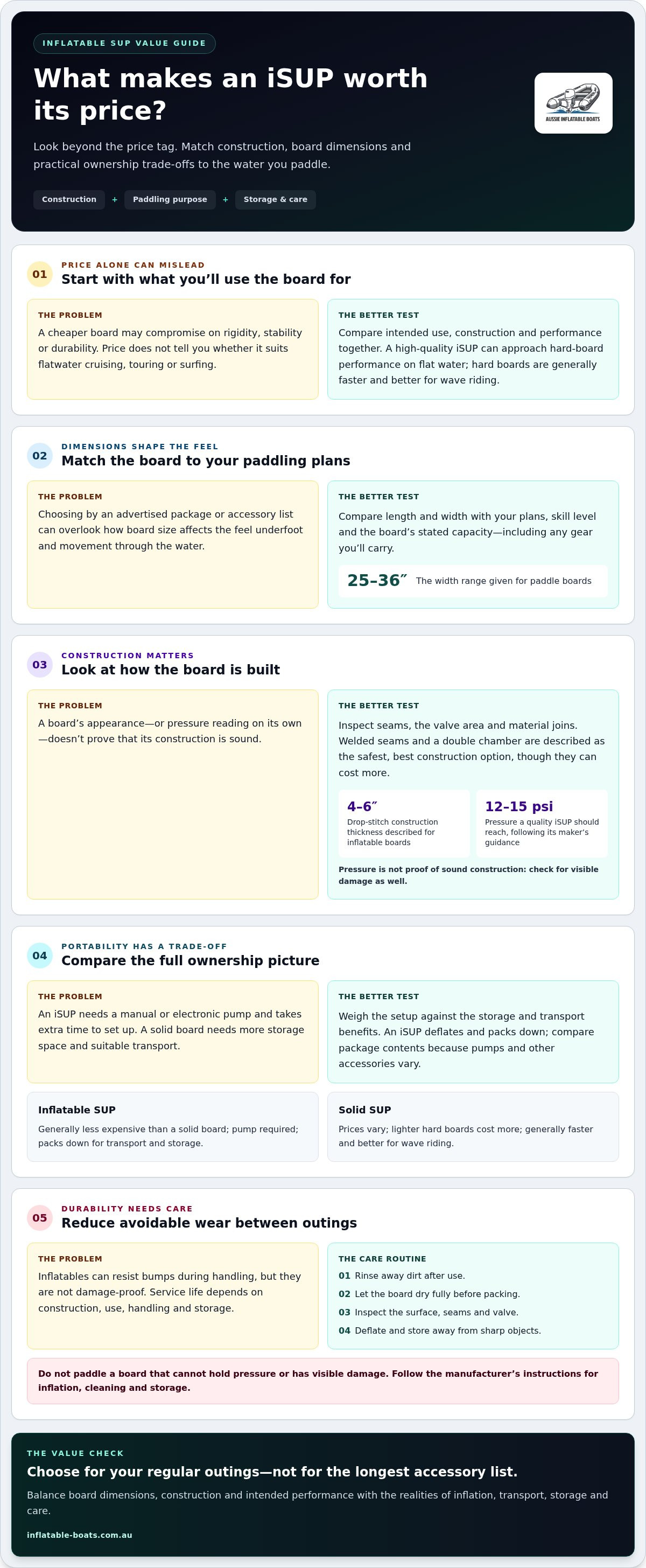
The cheapest inflatable SUP can cost more in the long run if it compromises on rigidity, stability or durability. Knowing how to justify the cost of a good iSUP means weighing its construction and features against your paddling, storage and transport needs, rather than judging it by price alone. A well-made iSUP can deliver near-hard-board performance on flat water, though hard boards generally remain faster and better for wave riding.
It’s reasonable to ask whether a higher-priced board will make a real difference. Consider how confidently it supports you on the water and how well it stands up to the knocks of transport and handling. Portability also has practical value: a board that packs down is easier to store and carry.
This guide compares the factors that shape an inflatable SUP’s value, including construction, stability, useful features and resistance to damage. You’ll find a practical way to match board qualities to your plans, so you can choose for the water you’ll paddle and the gear you’ll rely on.
Key Takeaways
- Judge an iSUP by how its construction, stability and features suit your paddling plans, not by the price tag alone.
- Compare board dimensions and intended use to find a balance between easy handling, steady footing and efficient paddling.
- Consider how a board packs away and travels; portability can make regular outings more practical.
- Weigh resistance to bumps and scrapes against the care and repair needs that come with your chosen board.
- For inflatable watercraft care, Inflatable Boats offers accessories, spare parts and repair services.
Comparing boards by price, features and specifications
Before buying an iSUP in Australia, compare its price in A$, intended use, dimensions, construction and included features. Check the board’s stated capacity and operating pressure, then consider whether its size and inflation method suit your skill level, transport and storage needs.
Price makes more sense when weighed against performance. Inflatable paddle boards are generally less expensive than solid boards, while lighter hard boards can cost more. But price alone won’t tell you whether a board suits flatwater cruising, touring or surfing. High-quality iSUPs can approach hard-board performance on flat water, but inflatable boards generally don’t perform as well overall. Hard boards are usually faster and better for wave riding.
Compare length and width against your plans, not just the advertised package. Paddle boards range from about 25 to 36 inches wide, so dimensions affect how the board feels underfoot and how easily it moves through the water. Check the stated capacity against the paddler and any gear carried aboard. A board’s intended use and your skill level matter more than a long list of accessories.
| Option | Price and weight | Performance | Storage and transport |
|---|---|---|---|
| Inflatable SUP | Generally less expensive than a solid board; includes a pump requirement | Can approach hard-board performance on flat water | Deflates for compact storage and transport |
| Solid SUP | Prices vary; lighter hard boards cost more | Generally faster and better for wave riding | Needs more storage space and suitable transport |
Inflation is part of the ownership trade-off. An iSUP needs a manual or electronic pump. Connect it to the valve, inflate the board to its stated pressure, then close the valve securely. After paddling, open the valve to release the air, then roll or fold the deflated board for storage. Setup takes extra time, but a packed board is easier to transport and store than a rigid shell.
Thickness deserves context. Inflatable paddle boards are described with 4-6 inches of drop-stitch construction, where two layers of material are joined by thin threads. That internal structure helps the inflated board hold its shape. For flatwater, compare rigidity and the board’s intended use; for surfing, remember hard boards generally offer stronger wave performance. Don’t choose thickness in isolation.
To understand how to justify the cost of a good iSUP, weigh its construction, paddling purpose and practical storage advantages together. Choose a board whose performance and transport requirements match your regular outings.
Construction quality and durability
Construction affects how an iSUP holds its shape, handles impacts and performs over repeated outings. Compare the seams, chambers and care requirements, not just the board’s appearance.
Construction and damage resistance
Welded seams and a double chamber are described as the safest, best construction option, though they can make an iSUP more expensive. The design choices matter: seams join the board’s sections, while a separate chamber provides another layer of structure. Compare these details with the board’s intended use and the demands of travel, storage and launching.
For a practical inspection, examine the seam lines, valve area and material joins before use. Follow the maker’s inflation guidance; a quality inflatable paddle board should reach 12-15 pounds per square inch and feel very rigid when fully inflated. Never treat pressure alone as proof of sound construction. Check the board for visible damage before each outing.
Australian iSUP packages vary in the accessories they include. A pump may be manual or electronic, and buying one separately adds a cost that depends on its type and features. Compare the package contents with the equipment you’ll need, rather than assuming every kit includes the same items.
Durability and safety
An iSUP’s flexible construction can resist damage from bumps and dragging during handling, unlike a hard board that can be damaged while moving between storage and water. This makes an inflatable paddle board lightweight and convenient to transport, but it still needs careful use. Welded seams and a double chamber offer a different construction approach from a basic single-chamber design.
There’s no fixed lifespan for every quality iSUP. Service life depends on construction, frequency of use, handling and storage. A carefully used and well-maintained board can remain useful longer than one repeatedly dragged, poorly stored or paddled with damage. Inspect the seams and valve to catch issues before they affect an outing.
Protect your investment with a consistent routine: rinse away dirt after use, let the board dry fully, then deflate and store it away from sharp objects. Avoid packing it while damp, and inspect the surface before rolling. Follow the manufacturer’s care instructions, especially for inflation, cleaning and storage. These steps reduce avoidable wear, though no board is damage-proof.
Durability supports safe use, but it doesn’t replace sound judgement on the water. Inflate the board to its stated pressure, check for leaks or visible damage, and don’t paddle a board that can’t hold pressure. Repairs may be needed if damage affects the material or seams; inflatable watercraft equipment and support can help owners maintain their gear.
Beginner suitability and stability
For beginners, stability can make early sessions more controlled and less tiring. An inflatable paddle board’s softer surface can suit beginners and SUP yoga, although an inflatable can be less stable than a solid board and less efficient to paddle. Compare dimensions, intended use and weight capacity together. A board that feels steady underfoot is useful, but it must also suit the paddler and conditions.
Width is a practical starting point for stability. For SUP yoga, consider a board at least 31 inches wide. A wider platform gives you more room to adjust your stance and move between positions. Width alone doesn’t decide suitability, though. Length, volume, board shape and load all affect how the board sits and moves on the water.
Length helps narrow the choice by activity. Boards under 10 feet suit surfing and/or kids, while medium boards from 10 to 12 feet suit all-round use and SUP yoga. Boards 12 feet 6 inches and above are suited to fast paddling and long-distance touring. A beginner focused on calm-water practice may value an all-round board more than a longer touring shape built for covering distance.
Volume and capacity help connect board size with paddler weight. Most full-sized paddle boards have a volume of 170 to 280 litres, but volume isn’t a substitute for checking the stated weight capacity. For example, the King’s Large Fast-Inflation SUP measures 3200 x 830 x 150 mm when inflated, weighs 8.15 kg with its fins, and has a 150 kg capacity. Those specifications give a concrete comparison, not a universal template.
Thickness also affects how a board feels. Inflatable paddle boards use drop-stitch construction, and a quality board should feel very rigid when fully inflated to its stated pressure. For a beginner, rigidity supports a more consistent platform, but it doesn’t erase the difference between inflatable and solid boards. The softer inflatable surface can be more comfortable for kneeling or yoga, while solid boards generally offer greater stability.
Use a simple match-up before choosing:
- Yoga or general practice: compare a width of at least 31 inches with the board’s capacity and intended use.
- Surfing or a child paddler: consider boards under 10 feet.
- Touring: compare boards 12 feet 6 inches and above, then assess whether the length suits your handling and transport needs.
For beginners, the best value comes from a board that suits their weight, balance and planned activity. A durable, stable platform can build confidence, but choosing the right dimensions matters more than simply buying the widest or longest option.
Inflatable SUP value and affordability
An inflatable SUP’s value depends on what it enables, not just its purchase price. In Australia, compare options in A$ and weigh the board against how often you’ll use it, where you’ll paddle and what ownership involves. A board used regularly for flatwater outings may justify a greater investment in construction and fit. For occasional use, a simpler board suited to the activity may be a better match.
Consider the full ownership decision. Include the pump, carrying and storage needs, routine care and potential repairs in your comparison. A lower initial price doesn’t automatically mean better value if the board’s performance or construction doesn’t suit your use. Equally, expensive features add little if they don’t improve the activities you actually plan. Match the board and package to your needs instead of paying for extras by default.
Transport can change a board’s real-world value. An inflatable board deflates and packs down, making it easier to transport by car without a roof rack. That convenience may matter more than outright speed if you paddle in different locations or have limited storage. A solid board has different trade-offs: it needs more room and a suitable transport setup. Compare those practical demands with your routine before deciding.
Repairs also belong in the affordability calculation. An inflatable SUP can be damaged, and repairs may involve sending the board away. By comparison, a hard board can be repaired at home with limited knowledge, and shops that repair dings may be easier to find. Consider how each option fits your storage, repair and transport needs. Value includes the inconvenience of keeping a board serviceable, not just its performance on the water.
There’s a difference between buying a board and getting lasting use from it. Follow care guidance, avoid dragging it across rough ground and store it dry. These habits help protect your investment, whether you choose an inflatable or solid board. Keep your choice tied to your intended activity: a hard board performs better for wave riding, while an inflatable suits compact carrying and storage.
In a survey linked by Blue Planet Surf, 65% of inflatable paddleboard owners strongly agreed they’d buy another iSUP and/or recommend one to a friend. That finding offers a useful signal about owner satisfaction, but your value calculation still depends on your own priorities. Use this checklist to make the comparison practical:
- Set your use case: name the water and activity you expect to paddle most.
- Compare ownership demands: consider carrying, storage, transport and repair alongside the purchase.
- Prioritise useful features: choose construction and equipment that support your outings, not a longer feature list.
- Assess the trade-off: select an inflatable for compact handling, or a solid board for speed and wave performance.
A good-value board is one you can transport, maintain and use for the paddling you enjoy. That’s the clearest way to judge affordability beyond the initial A$ price.
Damage resistance
A paddle board can take knocks before and after launching. Carrying it past rocks, setting it down on rough ground or bumping a hard edge can expose weak points. Inflatable boards can resist bumps and dragging during handling, making them practical for launches involving uneven access. That resilience isn’t immunity: a sharp object or damaged seam can still compromise the board.
Use the board’s intended conditions to assess durability. Inflatable paddle boards can be durable in rough conditions such as whitewater paddling, where contact with obstacles is part of the activity. That doesn’t make every board suitable for every river or remove the need to assess conditions. For surfing, a hard board generally performs better, but its composite coating can chip over time. The right choice depends on the balance between performance and likely impacts.
Compare damage risks across the board’s full routine, not just its time on the water. A hard SUP can be damaged while being moved from storage to the launch, and composite coatings can chip with repeated use. An inflatable can handle bumps and dragging better during handling, but still needs protection from sharp edges. Consider the route from storage to water, the launch surface and how you’ll carry the board.
A simple inspection helps catch problems early. Before inflating, scan the surface for cuts, punctures and worn areas. Check the seams and valve, then inflate the board and confirm it holds pressure. After paddling, look for fresh scrapes or impact marks. If damage affects a seam or the board can’t retain pressure, don’t take it out until the issue is addressed.
Access to repairs is another part of the durability comparison. A hard board can be repaired at home with limited knowledge, and ding-repair shops may be easier to find than reputable iSUP repairers. Some inflatable SUP repairs may require sending the board away. This can affect how long your equipment is unavailable, so weigh repair practicality alongside resistance to knocks.
Accessories can help prevent avoidable damage during transport and storage. Keep sharp items separate from an inflatable board, and avoid dragging it across rough ground on the way to the water. Handle a hard board carefully between storage and launch to reduce impact damage. These habits won’t prevent every mark, but they reduce common sources of wear.
Choose based on your likely contact with obstacles: an inflatable may suit rougher handling, while a hard board favours surfing performance. For help with inflatable watercraft care and repair, explore inflatable watercraft support.
Inflatable Boats: Inflatable Boats
Inflatable Boats can help with choosing watercraft and maintaining inflatable equipment. Its range includes inflatable boats, accessories, spare parts and repair services for gear that needs attention or a replacement component. For an iSUP owner, consider whether damage, worn parts or maintenance needs could affect future outings. Professional repair support is available when an inflatable vessel needs attention, while accessories and spare parts support equipment upkeep. Choose an iSUP whose construction and intended use match your paddling plans, and explore Inflatable Boats’ range if you need related equipment or repairs.
For questions about inflatable watercraft or repairs, contact Inflatable Boats.
Choose gear that gets you on the water
The best buying decision is the one that helps turn your plans into regular time on the water. Before choosing, picture a typical outing: where you’ll launch, who’ll paddle with you, and how you’ll carry and care for your gear afterwards. This keeps the decision grounded in your needs, rather than features that may never leave the car park.
Knowing how to justify the cost of a good iSUP means deciding what dependable equipment is worth for your own adventures. Take the time to choose carefully, then focus on building confidence through preparation and responsible paddling. The right equipment should support the experience you want, from a quiet session on sheltered water to exploring somewhere new.
For your next step with inflatable watercraft, explore Inflatable Boats. Get ready to make your next day on the water count.
Frequently Asked Questions
Are Inflatable SUPs worth it?
Yes, an iSUP can be worthwhile if easy storage and transport help you paddle more often. Someone with limited storage space, for example, may find a board that packs away easier to use than a rigid board that needs more room. Consider how you’ll get it to the water, where you’ll keep it between outings and what kind of paddling you enjoy. These everyday factors determine whether its convenience fits your routine.
What is the average price of a good inflatable SUP in Australia?
There isn’t one useful average price for a good iSUP, because cost varies with construction, dimensions, capacity and included equipment. For a fair comparison in A$, compare boards intended for similar activities and paddlers. Then assess what the price includes and whether each feature serves a real need. A touring board and one intended for casual sessions aren’t necessarily like-for-like choices, even if both are inflatable.
What features make a premium iSUP worth the extra cost?
Features earn their keep when they solve a specific problem. A paddler carrying extra gear, for example, should pay close attention to capacity, while someone expecting frequent handling may value robust construction. Welded seams and a double chamber are described as a strong construction option. Consider how each feature supports your planned outings, rather than treating a premium label or longer feature list as proof of better value.
How much do budget, mid-range and premium iSUPs cost in Australia?
There’s no dependable A$ price range that defines all three tiers, because board design, construction and package contents affect cost. Use the labels as comparison groups instead: consider what the entry option prioritises, which practical upgrades appear in the middle, and whether a premium board’s construction suits your use. Compare similar boards by intended activity and supplied equipment before deciding whether the extra spend delivers a benefit you’ll use.
How do premium iSUPs compare with cheaper boards for stability and performance?
A well-constructed iSUP can feel more rigid and perform near a hard board on flat water, though an iSUP generally doesn’t match a hard board’s overall performance. Stability also depends on dimensions and load, not price alone. Compare the board’s width and capacity with your paddling plans. For instance, a beginner practising on calm water may prioritise a steady platform, while a surfer may prefer a hard board’s wave performance.