
Inflatable or Rigid Paddle Board: Which One Fits Your Needs
Choosing an inflatable paddle board vs rigid board depends on where you paddle and how you’ll transport and store it. Choose an inflatable if you travel, have limited storage, paddle rivers or want a more forgiving deck for beginners and dogs. A rigid board is a better fit when speed, straight-line tracking and surf performance matter most.
It’s easy to focus on how a board feels on the water, but getting it there matters too. An inflatable packs down for carrying and storage, while a rigid board is ready to launch and generally glides more efficiently. Neither suits every paddler.
This guide compares portability, construction, inflation pressure and performance for different paddling uses, so you can match a board to your routine and conditions. It also explains the trade-offs, from setup time to flex on the water, to help you spend less time handling gear and more time exploring Australia’s waterways.
Key Takeaways
- Choose an inflatable board if easy transport, compact storage or a forgiving surface matters most.
- A rigid board generally glides and tracks more efficiently, especially when speed or surf performance is a priority.
- Compare construction and recommended inflation pressure, as stiffness affects how an inflatable feels underfoot.
- Match your board to your usual water and paddling style, from relaxed flatwater outings to choppier conditions.
- Weigh the whole routine: carrying, storing and setting up your board are part of the decision too.
Inflatable vs Hard SUP: Which is the Better Choice for Your Water Adventures?
On calm flatwater, either board can work well. A rigid board generally glides faster and tracks straighter, while an inflatable is easier to handle on shore.
In Australia, lifejacket and registration requirements depend on your state or territory, waterway and how you use the board. Local rules determine whether you must carry or wear a lifejacket and whether registration applies.
Inflatable boards can be used on oceans, rivers and in surf, but suitability depends on conditions, board design and paddler ability. A rigid board generally performs better in breaking surf or rough water, while an inflatable’s impact resistance can be useful on rivers.
On flatwater, a rigid board’s efficient glide helps you cover distance with fewer strokes. Its shape and solid construction support straight tracking, making longer outings feel more direct. An inflatable can also handle a lake or sheltered bay, though flex may reduce speed and make the board feel less stable underfoot.
Board shape matters when waves or chop arrive. A surf-oriented outline is designed to respond to turns and moving water, while a touring shape favours efficient travel in a straight line. In choppy conditions or wind, an inflatable may feel less controlled than a rigid board. Match shape and construction to the water you actually paddle, not just the launch site.
Fibreglass boards have a foam core covered with fibreglass, and some include carbon fibre. This solid construction supports strong on-water performance, but hard boards can chip, crack or dent if knocked against hard surfaces. For example, carrying a rigid board through a tight garage creates more opportunity for accidental impacts than handling it on open sand.
Flex affects stability and paddling efficiency. An inflatable that bends underfoot can feel wobbly and lose speed, while a rigid board’s solid deck provides a more consistent platform. Modern inflatable designs with carbon rails have narrowed the stiffness gap, but construction still affects how each board responds under load.
| Option | Flatwater | Surf and chop | Key trade-off |
|---|---|---|---|
| Rigid board | Efficient glide and straight tracking | Generally stronger performance | Can chip, crack or dent |
| Inflatable board | Suitable, with possible flex | Can be less controlled in rough conditions | Portable, but needs inflation |
Choose a rigid board for speed, distance and surf performance. Choose an inflatable when portability and impact resistance matter more.
Who should buy an inflatable paddle board?
An inflatable board suits paddlers who value easy handling between the car and water, or expect knocks during outings. Its softer construction can take everyday bumps that might mark a rigid board, making it a practical choice for river trips, beginners and paddlers bringing a dog.
For beginners and recreational paddling, an inflatable is often the more forgiving option. Its softer deck is gentler on knees and more comfortable for a child who falls while learning. A rigid board may be a better fit when efficient glide or surfing performance matters more than impact resistance.
Heavy-duty PVC and drop-stitch construction help an inflatable withstand bumps, drops and contact with rocks. That resilience is useful on a riverbank, where stones, shallow launches or awkward carries can bring the deck into contact with hard surfaces. It isn’t puncture-proof: sharp edges and concentrated force can still damage the outer skin.
Imagine a dog stepping aboard at a beach launch. The softer surface is less unforgiving than a hard deck, and the board’s flexible structure can tolerate incidental knocks during handling. An inflatable can also be durable in rough whitewater conditions, but the route and paddler’s skill still matter. Durability doesn’t replace sound judgement about water conditions.
Use these checks to judge whether an inflatable suits your routine:
- Look at the build: PVC and drop-stitch construction support the board’s shape when inflated.
- Match thickness to use: a 5-inch all-round board can feel more controlled and natural for many adult recreational paddlers than an overly thick 6-inch design.
- Consider likely impacts: rocky river access and frequent loading favour a board that handles bumps better than a rigid shell.
Thickness affects more than appearance. An overly thick board can have excess volume for an adult recreational paddler, while a thinner design may flex more. For surfing, that flexibility is a trade-off: a thinner inflatable may suit wave use, but flex can affect control underfoot.
Choose an inflatable if your outings involve river access, travel, dogs, beginner practice or rough handling on shore. Choose a rigid board if surf performance and efficient paddling matter most. The best match is the one suited to your usual launch, handling needs and time on the water.
Inflatable board portability and storage
An inflatable board suits paddlers who need to carry their gear beyond a nearby car park. Deflated and rolled, it fits into a carry bag, making transport simpler for apartment dwellers, boat owners and travellers. A rigid board stays full-sized, so carrying it through a narrow hallway or storing it in a small unit can be difficult.
For weight, inflatable boards are generally lighter and easier to lift than rigid boards. Rigid boards can be around 10 to 11 feet long, creating more awkwardness when loading, carrying or turning them through tight spaces. Actual handling depends on board design and the distance from your vehicle to the launch.
Transport depends on the board type. A rigid board usually needs roof racks or a trailer, plus enough room to load and secure its full length. An inflatable packs into a bag and doesn’t require car racks. That can simplify a river trip in a small car or when combining paddling with other gear.
Storage involves similar trade-offs. A deflated inflatable takes up less space than a full-sized board, so it can fit in a cupboard or a boat’s storage area. Keep it clean and dry when packed, away from sharp objects that could damage its outer material. If you paddle frequently and have a suitable place to store it, leaving an inflatable partly or fully inflated can reduce repeated setup.
Plan your routine before choosing. For a quality board, consider these practical steps:
- Measure your storage route: check doorways, stairs and the space where a rigid board would sit.
- Think through transport: include the vehicle, roof-rack setup or trailer, and the walk to the water.
- Account for packed volume: leave room for the rolled board and its carry bag alongside other equipment.
- Consider your launch: a longer walk across a riverbank or beach makes an easier-to-carry package more useful.
Setup time is part of portability. An inflatable needs to be unpacked and inflated before paddling, then deflated, dried and packed afterwards. A rigid board is ready to launch, but still needs transport and storage space between outings. Choose the routine you’ll manage consistently, not just the one that looks easiest on purchase day.
If compact transport is central to your decision, explore the inflatable board options alongside your storage and vehicle requirements. For regular outings, compare the packed volume of the board and bag with the space available at home, on your boat or in your car.
In short, inflatable boards favour compact storage and flexible transport; rigid boards suit paddlers with room to store and carry a full-sized shape. A small car, apartment or remote river launch can make the packed format especially practical. Dedicated storage and roof racks remove some of the logistical drawbacks of a rigid board.
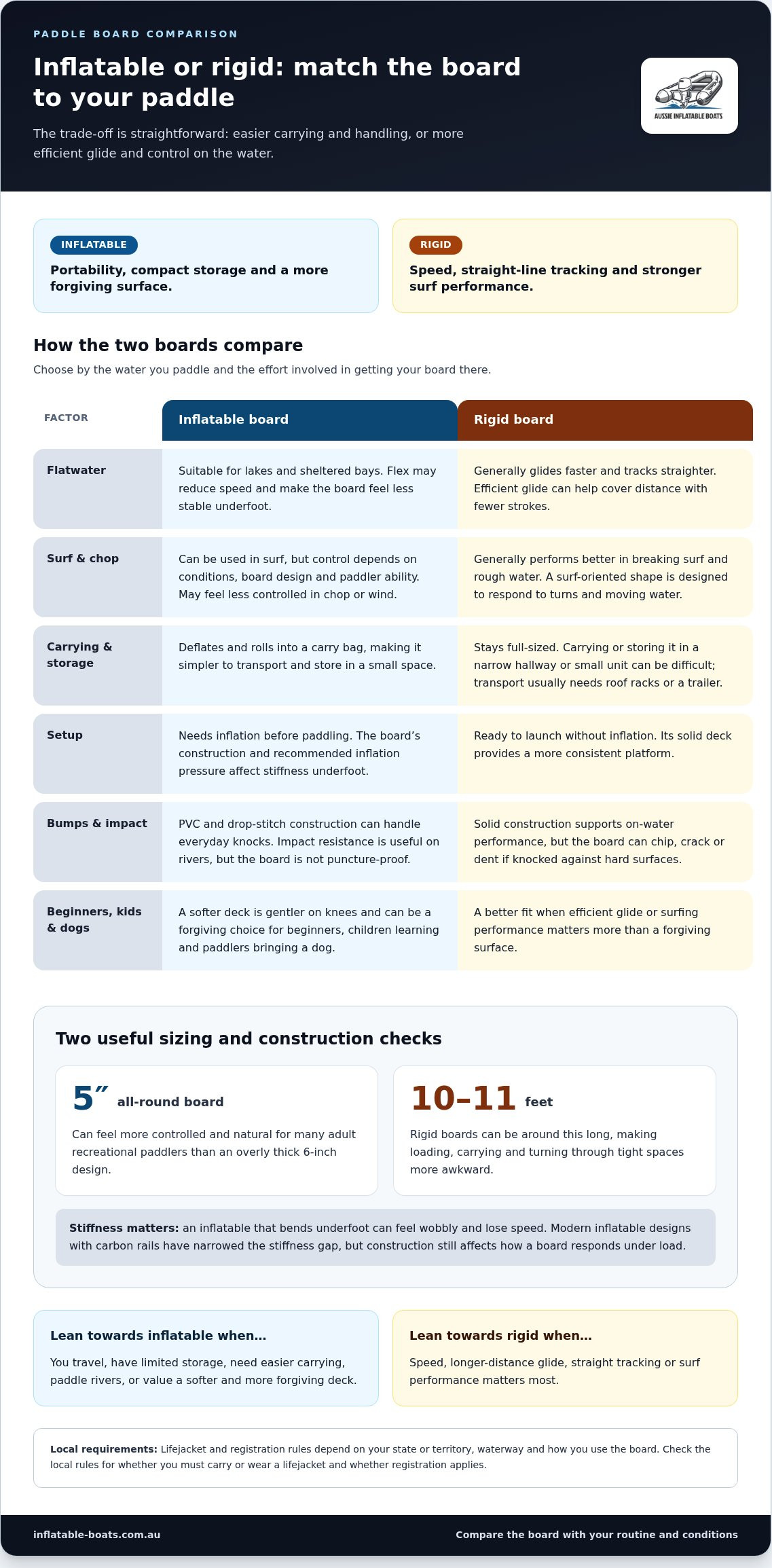
Inflatable versus hard-board suitability by paddling use
Choose based on your main use: inflatable SUPs suit river access, beginners and varied recreation, while hard boards favour surfing and efficient distance paddling. If your outings span several conditions, prioritise the water you use most and how you’ll transport the board.
Inflatable board suitability by use
An inflatable suits recreational paddlers who want one board for sheltered water, rivers and occasional trips with children or dogs. Its softer surface and ability to handle bumps make it practical when launching over uneven ground. Compared with a hard board, it needs inflation and may flex more, making it less suitable for paddlers who prioritise speed or precise response in surf.
For example, choose an inflatable for relaxed lake outings followed by a rocky riverbank launch. Beginners may also appreciate its forgiving deck while learning to stand and balance. Match the board’s design to the activity: a general-purpose shape won’t feel like a board designed specifically for surfing or touring.
Hard SUP suitability by use
Hard boards suit paddlers who regularly surf, cover distance or want efficient paddling without inflation setup. Their solid construction supports a direct, responsive feel, which can help with turns on a wave or maintaining pace on a longer route. Compared with an inflatable, a hard board is less convenient when storage, carrying or transport is difficult.
Consider a paddler who launches from a beach and keeps roof racks fitted to their car. A hard board is ready to use at the water’s edge, making it a practical match for frequent surf sessions. For touring, a longer board can support faster paddling, but its full-sized shape requires room at home and during transport.
Hard plastic SUP weight and construction
Hard plastic SUPs can be very large and heavy, so consider handling before choosing one. Their rigid construction provides a solid platform, but carrying one from a vehicle to the water can be more demanding than handling an inflatable. A roof rack or trailer also needs to suit the board’s size and the vehicle’s transport setup.
Compare the whole routine, not just time on the water. For a short surf session near a vehicle, a hard plastic board’s ready-to-launch construction may outweigh the carrying demands. For a river outing with a longer walk to the launch, an inflatable’s packed format may be easier to manage. Storage space and lifting ability are key considerations.
To choose, note your main activity, launch conditions, transport method and storage space, then select the board that best fits those four demands.
Inflatable board construction and inflation pressure
Drop-stitch construction and correct inflation pressure shape an inflatable board’s stiffness, feel and useful life. Compare its construction with your paddling needs, then follow the manufacturer’s pressure guidance.
Inflatable drop-stitch construction
Heavy-duty PVC forms the outer skin, while drop-stitch construction connects the board’s upper and lower surfaces. Thousands of internal threads help the inflated board hold its shape under pressure. This creates a firm platform, though an inflatable can still flex more than a hard SUP. Construction quality and board thickness both affect how rigid it feels beneath your feet.
Inflation pressure and pumping
A quality inflatable SUP is designed for 12-15 PSI, according to market guidance. Follow the manufacturer’s recommended pressure for your board, rather than assuming a higher figure means better performance. Some manufacturers advertise 20 or 25 PSI, but higher pressure isn’t automatically better. Use a SUP pump with a compatible valve connection and pressure gauge. Inflation time depends on board volume and pump type; deflation means releasing air before rolling the board.
Pressure matters because an under-inflated board can feel soft and flex more underfoot. A thin inflatable may still flex even above 20 PSI, so pressure alone doesn’t determine stiffness. Board thickness and reinforcement, such as a stringer, also affect how rigid the board feels. Compare construction and recommended pressure together, rather than choosing by PSI alone.
Heat also affects useful life. In hot climates, heat can degrade PVC and glue more quickly than in temperate climates. Avoid leaving an inflatable exposed to prolonged heat during travel or storage. Follow the manufacturer’s handling and storage instructions to help protect the materials and bonded seams between outings.
A foam-top board has different construction: its foam core provides buoyancy beneath the outer surface. If the surface is punctured, water entering the core can increase an 18-pound board’s weight to 30 pounds. That change can make carrying and handling more difficult. An inflatable relies on its sealed outer skin to retain air, so damage to that skin affects inflation and needs attention.
Before a trip, follow this simple sequence: inspect the outer skin and valve, connect a compatible pump, inflate to the manufacturer’s recommended PSI, then check the board’s firmness. After paddling, release the air and roll the board for transport. These steps help you spot visible damage and avoid judging inflation by feel alone.
Compare inflatable board construction options and choose a design whose pressure guidance and materials suit your paddling routine.
Inflatable Boats: Inflatable Boats
Inflatable Boats can help when your time on the water extends beyond paddleboarding to boating. Its range includes inflatable boats, accessories and spare parts, as well as repair services for inflatable boats. Explore these products and services when you need equipment or parts for an inflatable boat, or when an existing boat needs repair.
For a paddle board decision, focus on your own use: paddling conditions, transport, storage and preferred performance. For boating needs, explore Inflatable Boats’ relevant products and repair services.
For enquiries about inflatable boats, accessories, spare parts or repairs, contact Inflatable Boats.
Make your next outing your guide
The right board supports the way you want to spend time on the water. Before deciding, picture your next few outings: where you’ll launch, what you’ll carry, and whether you want a relaxed paddle or a performance-focused session. That real-world picture can make the choice clearer than comparing specifications in isolation.
The inflatable paddle board vs rigid board decision doesn’t have to define every future adventure. Your paddling habits can change as you explore new waterways, build confidence or take up different activities. Start with your current conditions and routine, then choose equipment that makes getting out on the water practical and enjoyable.
If your plans also include inflatable boating, you can explore the range and find information relevant to your next step. Visit Inflatable Boats to get in touch and keep your next water adventure moving.
Frequently Asked Questions
What are the main differences between inflatable and rigid paddle boards?
The inflatable paddle board vs rigid board decision usually comes down to transport, storage and on-water performance. An inflatable packs away for carrying, while a rigid board provides a solid platform that’s ready to launch. For example, an inflatable may suit someone using public transport, while a rigid board may suit a paddler with vehicle racks and dedicated storage. Each construction also requires different care.
How do inflatable and rigid paddle boards compare in speed, stability and manoeuvrability?
Rigid boards generally glide efficiently and track straight, which can help on calm-water journeys. Inflatable boards may flex more underfoot, affecting speed and how stable they feel. In an inflatable paddle board vs rigid board comparison, manoeuvrability also depends on shape and intended use. A surf-oriented outline turns differently from a touring shape, so match the design to waves, sheltered water or distance paddling.
How durable are inflatable paddle boards compared with rigid boards?
Inflatable boards generally handle routine bumps better, while rigid boards can chip, crack or dent after impact with hard surfaces. An inflatable’s outer skin can still be punctured by a sharp object, so avoid dragging it across jagged rocks or storing it beside sharp tools. A rigid board also needs careful handling during loading and storage. Durability depends on construction and how the board is used, carried and maintained.
What are the typical prices of inflatable and rigid paddle boards in Australia?
There isn’t one useful typical price for either type because construction, design and package contents affect the total. Compare Australian-dollar prices for boards with similar intended uses, then account for included items such as a paddle, pump or carry bag. Also consider what your setup requires: a rigid board may need transport and storage solutions, while an inflatable needs a pump and space for its packed gear.
What maintenance and repair do inflatable and rigid paddle boards require?
Rinse either board after paddling, remove grit and let it dry before storage. For an inflatable, inspect the valve and outer skin, and follow the manufacturer’s inflation and storage instructions. For a rigid board, check the shell for chips or cracks after impacts and protect it during transport. Small surface marks differ from structural damage; avoid paddling a board with damage that affects its integrity.
How long does it take to inflate and deflate a paddle board, and what pump is needed?
Using an inflatable board involves preparation before paddling and packing it away afterwards. A typical package includes a pump.