
Inflatable dinghies for sale in Queensland
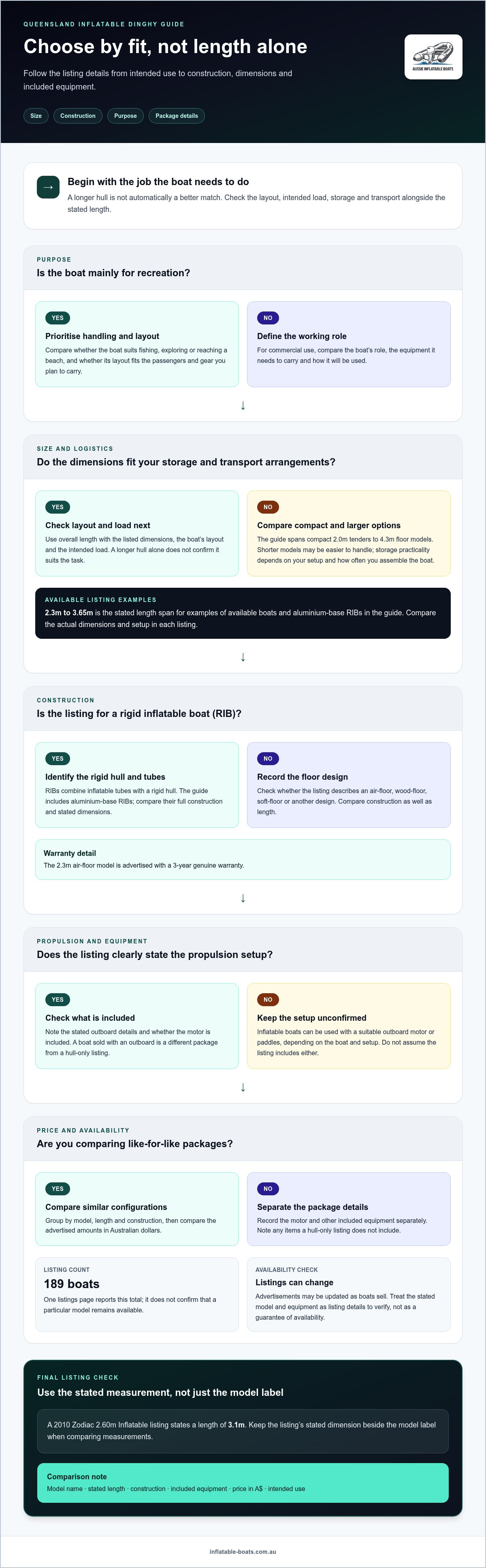
The right inflatable dinghy is a balance of size, floor design and intended use. In Queensland, listings range from compact 2.0m tenders to 4.3m floor models, with options including air-floor boats, wood-floor boats, aluminium-base RIBs and used tenders.
Choosing by length alone can leave you with a boat that doesn’t suit your storage space, passengers or time on the water. Compare dimensions, construction and listing details to get a clearer picture before deciding.
This guide explains what to look for in an inflatable dinghy for sale in Queensland, how to compare new and used options, and which measurements matter when selecting a compact tender or a larger boat. You’ll also find practical points for weighing availability and condition, so you can narrow the field with confidence and choose a setup that fits your plans.
Key Takeaways
- Compare hull and floor construction to narrow your options around how you’ll use and store the boat.
- Read listing details closely, especially the stated condition, included equipment and motor pairing.
- Assess a used tender by its condition and suitability for your larger boat, not just its listed age.
- For compact models, weigh portability and storage needs against the space required on board.
- Use overall length alongside the boat’s layout and intended load when comparing dimensions.
Inflatable boats and dinghies for sale in Queensland
Available listings cover compact tenders and larger rigid inflatable boats, backed by nationwide delivery across Australia. Examples span lengths from 2.3m to 3.65m, giving buyers a practical size range to compare. Length is only one part of the decision. Match the stated dimensions and layout to where you’ll use the boat, how you’ll transport it and what you need to carry.
Recreational buyers might prioritise easy handling for fishing, exploring or reaching a beach. Commercial buyers may focus on the boat’s working role, the equipment it needs to carry and how it will be used. In either case, compare the intended load and operating conditions with the specifications in each listing. A longer hull alone doesn’t mean a boat suits a particular task.
Rigid inflatable boats, or RIBs, combine inflatable tubes with a rigid hull. Our range includes RIBs with aluminium bases in lengths from 2.3m to 3.65m. Compare those with soft-floor and air-floor boats by considering the complete construction, not just the overall measurement. The rigid hull and inflatable tubes are useful distinctions to understand when narrowing your options.
Sport and adventure use can mean different things to different buyers. You might want a compact boat for short trips or need more space for equipment and passengers. Use the listed dimensions, floor type and motor details to assess your priorities. Depending on the boat and setup, inflatable boats can be used with a suitable outboard motor or paddles.
Convenience matters, too. An inflatable boat can be deflated for storage, while a shorter model may be easier to handle. Practicality depends on your storage space, transport arrangements and how often you’ll assemble the boat. Compare each listing’s setup and storage details rather than assuming every inflatable boat packs or stows the same way.
Use this comparison when reviewing our available watercraft:
- Length: Compare the stated measurement with storage and intended use.
- Construction: Note whether it’s a RIB, air-floor model or another design.
- Propulsion: Look for stated outboard details or a paddling setup.
- Purpose: Match the layout and equipment to recreational or commercial needs.
For example, compare a 2.3m RIB with a 3.65m RIB, then consider the space each requires and the use planned. Their shared aluminium-base construction doesn’t make their sizes interchangeable. Compare the dimensions with the room needed aboard and your transport arrangements. This gives your search for an inflatable dinghy for sale a practical starting point before you assess individual listings.
The 2.3m air-floor model is advertised with a 3-year genuine warranty.
Inflatable boat listing prices and availability
Compare Australian listings by currency, length, construction and included equipment. In Australia, safety equipment and registration requirements vary by vessel and operating area, so identify the rules that apply to your boat and where you’ll use it.
Listing Prices in Australian Dollars
Check the currency shown on each Australian listing before comparing advertised amounts. Keep prices in A$ and note what each listing includes. A boat sold with an outboard is a different package from a hull-only listing. Record the included equipment separately, then compare boats with similar configurations. This makes your shortlist more useful without treating different setups as equivalent.
Featured Boat Prices and Lengths
Organise your comparison by each listing’s model name and stated length. Then review the construction and included equipment alongside the advertised price. Compare a listing that includes an outboard with a similar package. For a hull-only boat, note any equipment you’ll need separately. This clarifies what each advertised setup includes, beyond its headline price.
Boat Sizes and Prices
First compare boats with similar lengths and configurations. A compact tender and a longer inflatable boat differ in storage and use, so their advertised prices aren’t directly comparable. Check dimensions, floor construction and included items together. Once you’ve grouped similar setups, compare the listed amounts within each group. This gives you more useful context than ranking boats by price alone.
Reading Listing Prices
Make a comparison note with the model name, stated length, construction, equipment and price in A$. An air-floor model, wood-floor boat and aluminium-base RIB have different configurations. Keep those details beside each listing rather than relying on length alone. Record any included motor or other items as part of the package. That gives you a clearer basis for comparing similar setups.
Availability and Listing Details
Listings can change as boats sell and advertisements are updated. One listings page reports 189 boats in total, but that count doesn’t indicate whether a particular model remains available. Narrow your options using model details and equipment, then focus on listings relevant to your plans. For a practical next step, compare available boat designs by construction and intended use.
A 2010 Zodiac 2.60m Inflatable listed in Australia has a stated length of 3.1 m, so use the listing’s stated dimension rather than assuming the model label gives the comparable measurement. Keep their lengths and aluminium-base construction alongside the advertised prices when comparing these listings.
Group the air-floor listing separately from the wood-floor listings, then compare the wood-floor options by their stated lengths and prices. This keeps construction and size visible as you review availability and decide which listings merit closer attention.
Used inflatable dinghies and tenders for sale
Used listings can suit buyers looking for a tender or compact boat. One example is a 2007 Caribe DL11 inflatable hard-bottom boat. Its year and hull type help identify the listing, but they don’t establish its present condition. Compare the stated length, construction, included equipment and intended role. Then assess whether the boat suits your storage, transport and launching arrangements.
Inflatable boats can serve as tenders for larger boats that can’t be docked at a marina. For a yacht tender, consider how it will be stored, launched and carried alongside the larger vessel. A jet tender is another configuration to compare by its stated propulsion and layout. Focus on the details of each listing rather than assuming every tender handles or fits the same way.
An aluminium-hull tender differs in construction from a soft-bottom inflatable. Compare the hull type, overall dimensions and how the boat will be stowed or transported. Also consider the complete advertised setup. For example, a listed PVC tender is paired with a Yamaha 6 hp four-stroke outboard. This makes the motor part of the combination to assess, rather than treating the boat and propulsion as unrelated choices.
Before buying a used inflatable dinghy, inspect it methodically. Check the tubes, seams, valves, transom, floor and fittings for visible wear or damage. See whether the boat holds its shape when inflated, and compare each component’s condition with the seller’s description. Inspect any included motor separately, including its stated make and type. A careful examination helps you assess the whole package, not just the hull.
Common risks include leaks, punctures, worn seams and damage to the transom or floor. Clean and dry the boat after use, inspect vulnerable areas, and store it to limit avoidable wear. A repair can address damage in an affected area, but it doesn’t replace checking the boat’s overall condition before purchase.
Use this checklist to compare used listings:
- Condition: Inspect tubes, seams, valves, floor, transom and fittings.
- Configuration: Identify whether it’s an inflatable, hard-bottom or aluminium-hull tender.
- Included items: Record any stated motor and its make and type.
- Purpose: Match the tender’s dimensions and layout to your larger boat or storage space.
For a yacht tender, consider how its dimensions work with your vessel’s storage and launching arrangement. Compare the listing’s condition and included equipment with your intended use. A motor pairing, such as the Yamaha 6 hp four-stroke setup, is one part of that assessment. Review the boat, floor, fittings and propulsion together to judge whether the complete configuration meets your needs.
Compact Dinghy and Roll Up models
A compact inflatable can make sense when storage space and handling matter. A 2m air-floor tender is one example to compare. Its stated length gives you a starting point, not a complete measure of suitability. Check the boat’s packed dimensions, floor arrangement and intended load against your available storage and how you plan to use it.
“Roll-up” describes a practical storage approach, but listings may use the term differently. Read each model’s description to understand how its floor and tubes stow. An air-floor model and a wood-floor model, for example, won’t necessarily pack down in the same way. Consider where each component goes during transport and whether the packed boat will fit your storage space.
A 2m tender is a useful compact reference, while a 2.9m air-floor model offers a longer alternative. Compare their stated lengths with your intended carrying space and the room needed aboard. A larger model may provide a different layout, but length alone doesn’t tell you how much usable space it offers. Check the listing’s dimensions and floor type together.
Floor construction is another key comparison. Available ranges include air-floor and wood-floor examples, spanning 2.9m and 3.65m models. An air floor and a wood floor involve different components to handle when assembling, packing and storing the boat. Review the specific listing for its floor description, then consider how that construction suits your usual launch and pack-down routine.
Consider the full setup, not just the folded boat. Inflatable boats can be used with a suitable outboard motor or paddles, depending on the boat’s design and intended use. Compare the listed motor details with the model’s specifications, or assess whether paddles suit your planned outings. Don’t assume a compact boat’s propulsion setup from its length alone.
Use these steps to compare compact models:
- Measure storage: Compare the available space with the boat’s stated packed dimensions.
- Identify the floor: Note whether the listing describes an air floor or wood floor.
- Compare length: Set the 2m tender beside longer 2.9m examples.
- Plan transport: Account for the boat, floor components and any listed equipment.
- Match propulsion: Review whether the intended setup uses a suitable outboard or paddles.
For a tender kept aboard a larger vessel, storage and handling should guide the shortlist. For a boat transported between outings, consider how its components pack and move. Compare the 2m tender with longer models, then choose according to your space, floor preference and setup needs. This direct comparison helps distinguish a genuinely suitable compact option from one that is merely shorter.
Dinghy lengths and dimensions
Length gives you a useful starting point when comparing dinghies, but it isn’t the whole fit. Listings include models from 2.30 metres to 3.50 metres, giving you a clear range to assess. Compare the stated length with your available storage, intended use and transport arrangements. If you’re using a trailer, consider the boat and its packed components alongside the trailer’s usable space.
The Zodiac Cadet 230 Aero is listed at 2.30 metres long. The SUR Easy 270 is listed as 2.70 metres, while the SUR Easy 290 is 2.90 metres. Those named examples let you compare successive size choices. Treat each measurement as a guide to overall length, then examine the boat’s layout and other stated dimensions before deciding which one suits your setup.
Model numbers don’t always match the exact stated length. The SUR Easy 320 listing gives its length as 3.00 metres, while the SUR Easy 290 is listed at 2.90 metres. Compare the published measurement rather than relying on the model name alone. That small step helps keep your shortlist accurate, particularly when several listings use similar model numbers.
Other listings offer useful reference points. The Aurora Cat 330 is listed at 3.30 metres, and the Aurora Adventure V 380 Skeleton Console measures 3.45 metres. The Aurora Reef Rider CL350 is listed at 3.50 metres. Compare these stated lengths with the room needed for passengers, gear and the boat’s intended role. A larger measurement alone doesn’t establish how much usable interior space the design provides.
Make a practical measurement check before choosing:
- Storage: Measure the space available for the boat and its components.
- Transport: Compare the packed boat with your vehicle or trailer storage area.
- On-water use: Assess the listed length alongside layout and intended use.
- Model identity: Record the stated length, not just the model number.
For example, a 2.30-metre Zodiac Cadet 230 Aero and a 3.50-metre Aurora Reef Rider CL350 differ by more than a metre in listed length. That comparison can help narrow your choices, but check each model’s full dimensions. Length doesn’t provide the beam, internal layout or packed measurements needed to judge every fit.
Build your shortlist from the measurements that matter to your use. Record each model name, stated length, storage requirements and trailer fit. Then compare the full specifications of available inflatable boat designs before settling on a size.
Inflatable Boats: Inflatable Boats
Inflatable Boats sells inflatable boats for buyers comparing hull type, floor design and intended use. Its range also includes accessories and spare parts for equipping or maintaining your vessel. If a boat needs attention, Inflatable Boats provides repairs to address damage and support continued use. Once you’ve narrowed your shortlist, explore a suitable boat, the components you need or repair support for your inflatable vessel.
For your next step, visit Inflatable Boats online to explore its inflatable boat range.
Make your next move with confidence
Before choosing, picture how you’ll use the boat. Consider where it will be stored, how it will get to the water and what you need aboard. These practical details can clarify which trade-offs matter most, whether you prioritise portability, a particular hull construction or a setup suited to regular use.
The right inflatable dinghy for sale is one that fits your plans and available space. Match the boat’s specifications to your intended use, then consider which accessories or spare parts may support your setup over time. A considered choice can make every trip from storage to launch more straightforward.
Inflatable Boats can help you explore boat options, accessories and spare parts. Explore inflatable boats and take the next step towards your time on the water.
Frequently Asked Questions
Where can I buy an inflatable dinghy in Australia?
Buy an inflatable dinghy from Inflatable Boats, which sells inflatable boats to customers across Australia. First decide whether you need a tender, fishing boat or family craft, then compare the model’s layout and specifications with that use. Inflatable Boats also offers accessories, spare parts and repairs, supporting both your boat purchase and ongoing ownership needs.
What size inflatable dinghy is best for a tender, fishing, or family use?
The right size depends on how many people and how much gear you need aboard, as well as your storage and transport limits. For a tender, prioritise a fit with the larger vessel and convenient handling. For fishing, consider room for equipment and movement. For family outings, assess the seating and space for everyone’s gear. Compare the manufacturer’s capacity information and internal layout, not just the overall length.
How do PVC and Hypalon inflatable dinghies compare?
Listings include PVC tenders and Hypalon RIBs with aluminium bases, but these are different configurations. Compare the stated construction, dimensions and included equipment rather than treating them as equivalent; for example, a listed Highfield Ultralite 260 PVC tender comes with a Yamaha 6 hp four-stroke outboard.
Which inflatable dinghy brands and models are popular in Australia?
Australian listings include models from Zodiac, Aurora, SUR, Achilles, Island, MIARCO, Highfield and Caribe. Examples include the Zodiac Cadet 230 Aero, Aurora Reef Rider CL350, SUR Easy 320, Achilles LSI 290 Airdeck and Island inflatable RIBs.