
Inflatable Catamaran for Sale in Australia: How to Choose the Right Boat
The most portable boat isn’t automatically the best choice for your plans. If you’re searching for an inflatable catamaran for sale australia, start with the trips you want to take, the people and gear you’ll carry, and how you’ll transport the boat to the water.
It’s easy to focus on pack-down size or headline capacity, but hull design, layout and construction all affect how a boat will suit you. Think through transport, setup and care before you buy. The right fit should make getting afloat straightforward, not turn every outing into a compromise.
This guide compares inflatable catamarans with other inflatable boats, then helps you match capacity and specifications to your plans. You’ll also find a practical checklist for assessing construction, portability, upkeep and purchase details, so you can make a considered choice and prepare for ownership.
Key Takeaways
- Start with the trips you plan to take and the passengers and gear you expect to carry, then shortlist designs that suit those needs.
- Compare hull arrangement, deck layout and construction together. Comfort, stability and handling depend on the complete design and the conditions.
- When weighing an inflatable catamaran against other inflatable boat layouts, consider onboard space, transport and setup as well as intended use.
- Use documented dimensions, capacity, materials and included equipment to compare options with confidence.
- Plan for storage, upkeep and ongoing ownership, including accessories, spare parts and repair support to help keep an inflatable boat ready for the water.
Is an Inflatable Catamaran the Right Boat for Your Australian Adventures?
An inflatable catamaran has two separate inflatable hulls running side by side, joined by a deck or frame that supports the occupants and gear. This twin-hull layout distinguishes it from a conventional inflatable boat built around one main hull. The design alone doesn’t guarantee how a particular boat will perform.
The right boat depends on what you’ll actually do on the water. Think about who’s coming along, what you’ll carry and where you expect to launch and boat. A vessel for relaxed outings in sheltered water may have different requirements from one intended for more demanding conditions. Suitability depends on the individual boat’s documented specifications, condition and intended use.
How does an inflatable catamaran differ from other inflatable boats?
A catamaran has two hulls set apart, with the deck or supporting structure spanning the space between them. A single-hull inflatable boat instead has one main hull beneath its floor. This difference shapes the boat’s layout and the space available for people and equipment, but doesn’t establish which boat is more comfortable, stable or manageable. Those qualities depend on the complete design and the conditions on the day. For a broad overview of the principles, see Catamaran design and stability.
Compare actual layouts, dimensions and stated capacity rather than relying on hull type alone. Check how the deck is arranged, where passengers can sit and whether your usual gear can be carried without crowding the available space. These details turn a general design comparison into a useful shortlist.
What sort of boating plans might suit a catamaran?
Start with your regular outings. Are you planning calm-water recreation, exploring suitable waterways, or taking passengers and equipment on longer trips? Write down the people and gear you expect to carry, then compare those needs with each boat’s published capacity and layout. A boat that fits your usual crew may be more practical than one selected for an occasional, ambitious plan.
Be clear-eyed about conditions, too. Sheltered-water use and more exposed or challenging outings place different demands on a boat, its equipment and the person operating it. Don’t assume a catamaran layout makes a craft suitable for every setting. Match the intended use to the manufacturer’s guidance and the boat’s specifications. Consider how you’ll transport, set up, pack down and store it between trips.
If you’re comparing an inflatable catamaran for sale australia, let your real plans lead the decision. Passenger needs, operating conditions and ownership practicalities all matter alongside hull arrangement. A grounded shortlist makes it easier to compare inflatable boats without being swayed by a layout that sounds appealing but doesn’t suit the way you’ll get on the water.
How Inflatable Catamaran Design Shapes Comfort, Stability and Handling
Hull arrangement is only the starting point. An inflatable catamaran’s comfort, stability and handling depend on how its hulls, connecting structure, deck and fittings work together, as well as the conditions and load on the water. No single feature tells you how the whole boat will feel underway.
Judge the design against your intended use, then compare documented specifications and construction details. Don’t assume one feature guarantees a particular result. This keeps your comparison grounded. Inflatable catamarans can differ in layout and construction, so look beyond broad design labels when considering a boat for sale in Australia.
Which construction details deserve a closer look?
Read the manufacturer’s information for the specific boat. Note the stated hull material and construction, how seams are made, and what’s documented about valves and structural components. These details help you understand how the craft is assembled and which areas may need attention during ownership. General information about inflatable boat safety standards and construction can also explain why construction deserves careful consideration.
Material names alone don’t establish overall quality or predict a boat’s service life. Construction methods, component integration and care all matter. Claims about a material’s properties shouldn’t be treated as proof of how a particular boat will perform. Compare like with like by using the manufacturer’s specifications, care guidance and information for the actual craft, rather than applying claims from another model.
How should you assess layout and onboard comfort?
Picture your usual crew aboard. Check the stated passenger capacity, then use the manufacturer’s measurements to understand how much deck space is available and where seating is positioned. Capacity is a limit to compare against, not a complete measure of comfort. A boat may accommodate the expected number of people on paper but still feel crowded once bags, safety equipment and other essentials are aboard.
Think through movement as well as seating. Where will passengers sit? Can people reach the items they need without obstructing one another? How much room remains for personal gear? Sketching the arrangement or reviewing clear layout diagrams can reveal practical pinch points before purchase. Don’t estimate usable space from exterior length alone. Dimensions, floor arrangement and seat placement all affect how the interior works.
Assess handling as part of the whole-boat picture. The load’s position, the assembled structure and prevailing conditions can affect how a craft behaves, so a specification sheet can’t guarantee a particular experience. Read the operating guidance and assess the boat for its intended use. For a broader look at inflatable boats and boating equipment, consider how the craft’s design fits with the gear you expect to carry.
Inflatable Catamaran or Other Inflatable Boat: Compare the Trade-offs
A twin-hull layout is one option among inflatable boats, not a universal upgrade. Compare it with a conventional single-hull inflatable by considering how each boat’s arrangement suits your passengers, gear, launch routine and storage space. Use the table as a starting point. Dimensions, capacity, materials and construction vary by boat, so check them against product information for the specific craft.
| Consideration | Inflatable catamaran | Other inflatable boat layouts |
|---|---|---|
| Intended use | Consider whether the twin-hull arrangement and deck suit your planned outings and passenger needs. | Consider whether a single-hull layout better fits the activities and conditions you expect. |
| Onboard arrangement | Compare the space between and across the hulls, seating and access to carried equipment. | Compare the available floor or deck area, seating positions and how gear can be arranged. |
| Transport and storage | Check packed dimensions and component arrangement in the product information, then compare them with your vehicle and storage space. | Use the same checks. The packed footprint depends on the particular boat and its components. |
| Setup | Review the manufacturer’s assembly and inflation instructions, including any separate parts or connections. | Review the specified setup steps and equipment for the boat’s particular design. |
The table doesn’t rank one layout above another. A catamaran may suit you if its documented arrangement fits your crew and typical gear. Another inflatable boat may be a closer fit if its layout better serves your outings or is easier for you to transport and set up. Don’t infer capacity, ease of assembly or performance from the category name alone.
When might a different inflatable boat layout be a better fit?
Think about your usual passenger group and activity. If you mainly need a compact arrangement for straightforward outings, compare the available space and packed dimensions of different inflatable boats. If you regularly carry several people or equipment, check how each layout accommodates that load within its stated capacity. Before narrowing your options, consider your planned outings, transport and storage space, and each boat’s documented specifications.
Which trade-offs should buyers weigh side by side?
Separate essentials from preferences. Suitable passenger capacity, manageable packed size and a setup routine you can complete are practical requirements. Extra deck space or a preferred seating arrangement may improve convenience, but shouldn’t outweigh core needs. For each boat, record the manufacturer’s stated dimensions, capacity, construction details and setup instructions. If a figure or material claim isn’t documented for that particular boat, don’t use it to make a direct comparison.
When comparing an inflatable catamaran for sale australia, weigh verified details against how you’ll use and store the boat rather than searching for a single “best” layout. The right choice is the one whose real-world trade-offs match your priorities.
Use This Checklist to Choose an Inflatable Catamaran for Sale in Australia
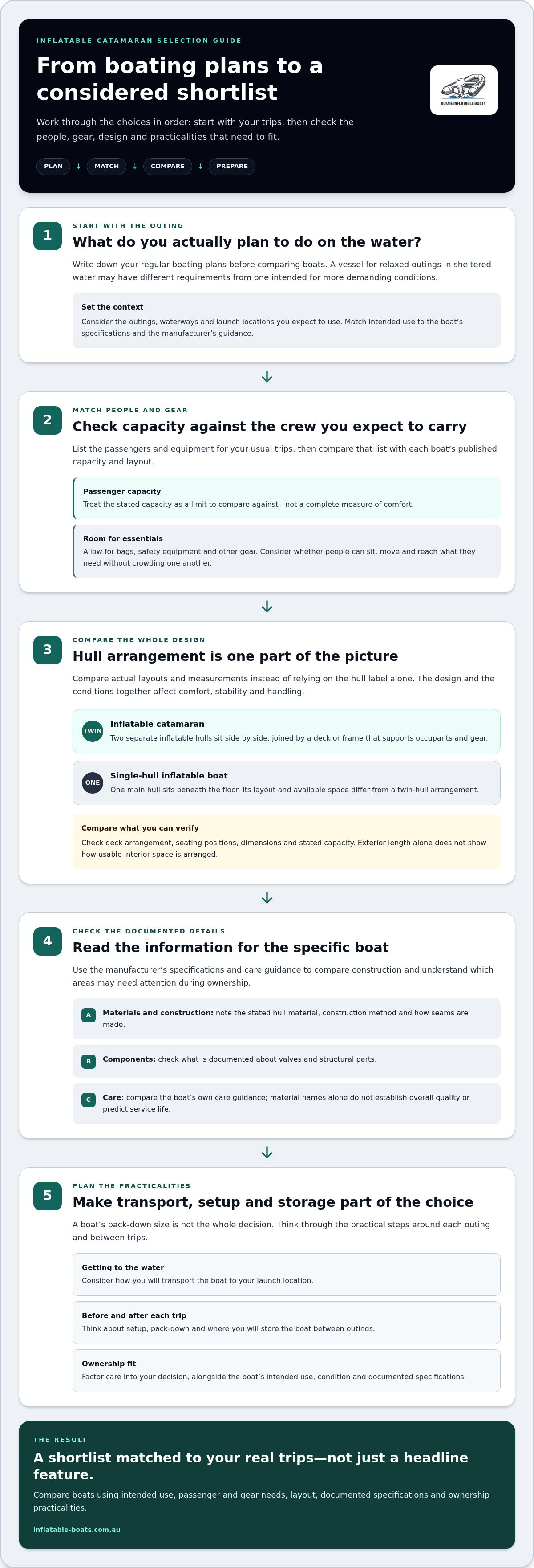
A sound purchase starts with your actual boating routine, then tests each candidate against clear, documented details. Use these steps to compare inflatable catamarans without relying on assumptions about capacity, construction or what’s included.
- Define your outings. Note where you expect to boat, the activities you have in mind and the conditions you plan to encounter. Keep regular trips at the centre of your decision instead of choosing solely for an occasional scenario.
- Set your passenger and gear requirements. Consider who’ll usually come aboard and what you’ll carry. Compare that expected load with the manufacturer’s stated capacity, and consider how people and equipment will fit within the layout.
- Compare dimensions and arrangement. Review published boat dimensions, deck layout, seating and access. Don’t use exterior size alone to estimate usable room. Look for measurements and diagrams that show the onboard space.
- Read the construction details. Compare the documented materials, seams, valves and structural components for each specific boat. Note care instructions, and don’t assume a material label alone tells you how the whole craft is built.
- Check what’s included. Review the equipment list and identify anything you’ll need to acquire separately. If considering a motor, rely on boat-specific information for compatibility and operating limits rather than making assumptions based on appearance or hull type.
- Plan transport, setup and upkeep. Check packed dimensions against your vehicle and storage space. Read the assembly and maintenance instructions, and consider whether the setup routine and care requirements suit the way you’ll use the boat.
Quick comparison rule: shortlist boats by intended use and passenger load, then compare verified capacity, dimensions, construction, included equipment and ownership requirements side by side.
Which specifications should you compare before buying?
Use the manufacturer’s information for the exact boat, not figures from a similar-looking craft. Record its stated capacity, dimensions, construction details and included equipment, then assess whether the layout suits your planned outings. For an inflatable catamaran for sale australia shortlist, don’t replace missing or unclear information with a guess, particularly for motor compatibility or operating limits.
How do transport, storage and upkeep affect your decision?
Picture the full routine: moving the packed boat, carrying its components, setting it up, drying and storing it, then preparing it for the next trip. Make sure your storage location suits the boat and its care instructions. Ownership can also involve maintenance. Inflatable Boats provides repair support for inflatable boats, including punctures, valves and structural components.
With your requirements written down, browse inflatable boats and compare relevant options against the checklist. A clear match between your plans and the documented details is a stronger basis for choosing than a feature that sounds impressive on its own.
Find Your Next Inflatable Boat and Plan the Purchase with Confidence
A confident purchase comes down to fit. Let your planned activities, passenger needs and preferred boating conditions guide the layout you choose. Current, product-specific specifications help you judge whether a boat suits those plans. Add transport, storage, setup and ongoing care to the decision, and you’ll have a clearer picture of ownership beyond launch day.
Before choosing, settle the practical details that will shape your shortlist:
- Regular use: Identify the outings you expect to take most often, rather than choosing around a rare or aspirational trip.
- People and equipment: Think about your usual passengers and gear, then compare these needs with the boat’s published capacity and layout.
- Ownership routine: Consider how you’ll transport, prepare, clean, dry and store the boat between outings.
- Comparison priorities: Decide which requirements are essential and which features would simply make boating more convenient.
Use current information for the specific boat you’re considering. Product dimensions, capacity, construction, included equipment and motor guidance should come from its documentation, not assumptions based on another inflatable craft. This matters when comparing an inflatable catamaran for sale australia, as boats with similar general layouts may still have different specifications and ownership requirements.
What should you have settled before choosing a boat?
Know where and how you expect to boat, who’ll usually be aboard and what needs to fit on deck. Measure the relevant vehicle and storage space, and consider whether the setup and care routine will work with your available time and facilities. Then compare boats using the same priorities, so a compelling feature doesn’t distract from a basic mismatch with your plans.
The inflatable boat collections offer a place to explore options. Use the product information to assess each boat on its own terms and keep your shortlist tied to documented details.
How can you prepare for ownership after the purchase?
Think beyond the boat itself. Depending on the chosen craft and its intended use, you may need suitable accessories or spare parts as part of your ownership setup. Follow the manufacturer’s care guidance, and build regular inspection and maintenance into your routine. If the boat needs attention, Inflatable Boats provides inflatable boat repair support, including help with punctures, valves and structural components.
Good preparation makes every outing easier to plan. Keep the boat’s documentation and care instructions accessible, organise the equipment you’ll carry, and make sure your storage plan suits the craft. With those practicalities in view, you can focus on choosing a layout and specifications that serve the boating you genuinely intend to do.
Explore inflatable boats and boating essentials to compare options and prepare for ownership with confidence.
Get Ready for Your Next Day on the Water
Before settling on a boat, picture your first few outings from start to finish: packing at home, getting to the launch point, setting up, carrying what you need and packing away afterwards. This practical rehearsal can reveal whether a promising option fits your routine, not just your boating ambitions. Keep your shortlist tied to how you’ll genuinely use the craft, and use current product specifications as your reference.
For an inflatable catamaran for sale australia, Inflatable Boats is a national retailer of inflatable watercraft, accessories and spare parts. Planning for ownership also means considering ongoing care. Professional inflatable boat repair services are available for punctures, valves and structural components.
Take the next step: explore inflatable boats and boating essentials, then compare the options against your plans.
Frequently Asked Questions
Is an inflatable catamaran suitable for a first-time boat owner?
It can suit a first-time owner if the setup, operating guidance and upkeep feel manageable. Inflatable catamarans can vary in layout and assembly, so read the manual for the specific boat before deciding. Practise inflation, assembly and pack-down on land first, then build confidence in calm, familiar conditions. Plan how you’ll launch, retrieve and carry the boat safely.
Can an inflatable catamaran be used in saltwater?
Many inflatable boats are used in saltwater, but follow the care instructions for your particular boat and its fittings. After a saltwater outing, rinse salt from the boat and components with fresh water, paying attention to valves and places where salt may collect. Let everything dry thoroughly before packing it away. Inspect seams, fittings and surfaces regularly, and follow the manufacturer’s guidance if you notice wear or damage.
How should I store an inflatable catamaran between trips?
Clean and dry the boat before storing it, and follow the manufacturer’s directions on whether it should be packed or kept inflated. Choose a dry, sheltered place away from prolonged direct sun, sharp objects and chemicals. Avoid placing heavy items on top of the boat or its components. Keep smaller parts together so they’re easy to find when you prepare for your next outing.
Can an inflatable catamaran be repaired after a puncture?
A puncture may be repairable, though the appropriate method depends on its location, size and the boat’s construction. Stop using the craft if it’s losing air, and don’t rely on a temporary patch for damage that affects a seam or structural component. Inflatable Boats provides professional inflatable boat repairs, including support for punctures, valves and structural components. Follow the repair guidance relevant to your boat.
What motor can I use with an inflatable catamaran?
Use only a motor that the manufacturer specifies as compatible with the particular boat. Check the boat’s documentation for its permitted motor type, power and mounting arrangement, along with any stated load or operating limits. Don’t select a motor based on another catamaran’s setup or appearance. If the product information doesn’t clearly explain compatibility, don’t fit a motor until you have reliable, boat-specific guidance.
What should come with an inflatable catamaran when I buy it?
Included equipment varies, so compare the product’s current inventory with what you’ll need to assemble, transport and operate the boat. Check whether the listing includes the required structural or deck components, seats, carry bag, pump, oars and repair items rather than assuming they’re standard. Review the manual and care instructions as well. Make a separate list of accessories and safety equipment you’ll need for your planned outings.
How do I know whether an inflatable catamaran will fit in my vehicle?
Compare the boat’s packed dimensions and component list with your vehicle’s usable cargo space, including the opening you’ll use to load it. Measure with seats in the position you expect to use, and allow room for other gear. Check the packed weight too, so you can judge whether lifting and loading are practical. Don’t rely on the boat’s inflated length to estimate its packed footprint.