
Inflatable boat safety with kids: Queensland rules and safe habits
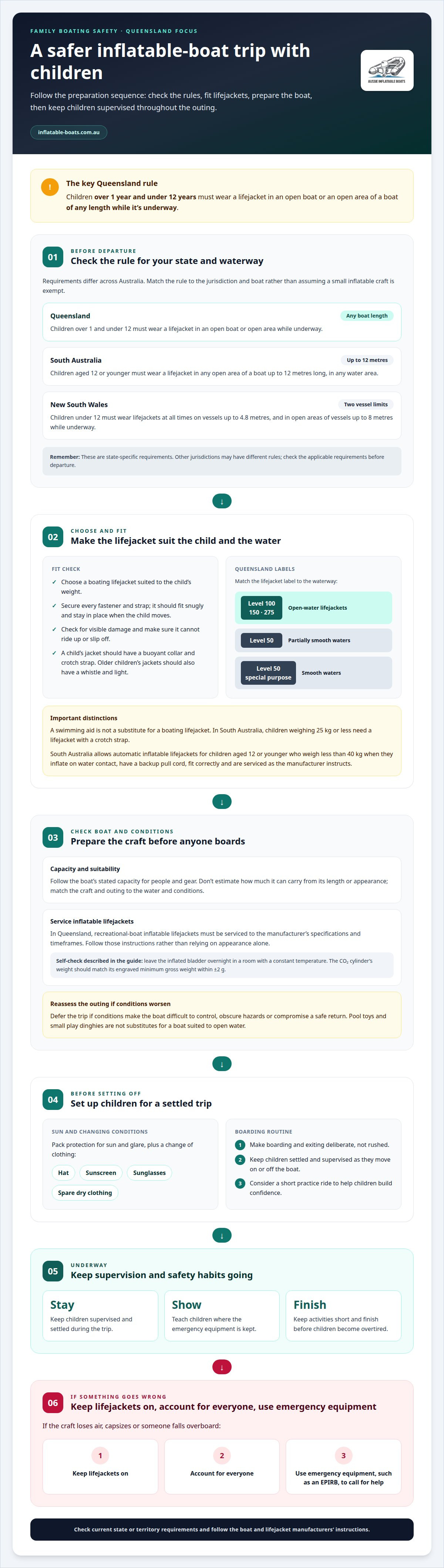
A family boating trip can feel relaxed and still demand firm safety habits. Good inflatable boat safety with kids starts with knowing Queensland’s lifejacket rule: children over one year and under 12 years must wear a lifejacket in an open boat or an open area of a boat of any length while it’s underway.
A correctly fitted lifejacket is essential, but it is only one part of keeping young passengers safe. How children board, where they sit and how adults prepare all affect the trip.
This guide explains Queensland’s child lifejacket requirements, including the rules relevant to boats up to 12 metres, and covers practical habits for the water. You’ll also learn how to prepare for sun and changing conditions, make boarding safer and build routines that help children stay settled and alert. A little preparation makes more room for the adventure.
Key Takeaways
- Check Queensland’s current lifejacket requirements before taking children on a boat, and make sure they wear a suitable lifejacket while underway.
- Choose a child’s lifejacket to suit their weight and ensure it sits securely; Queensland lifejackets must meet the current Australian Standard AS4758 by 1 September 2025, according to Maritime Safety Queensland.
- Plan for sun, glare and changing conditions by packing hats, sunscreen, sunglasses and spare dry clothing.
- Make boarding and exiting a deliberate routine, with children settled and supervised as they move on or off the boat.
- Build confidence with a short practice ride, teach children where emergency equipment is kept and finish the trip before they become overtired.
1. Queensland lifejacket requirements for children on boats
When boating with children, understanding local regulations is essential for peace of mind. In Queensland, children over one year and under 12 years must wear a lifejacket in an open boat or an open area of a boat of any length while underway. According to Maritime Safety Queensland, lifejackets must meet the current Australian Standard AS4758 by 1 September 2025. When purchasing equipment from Inflatable Boats, always choose a jacket suited to the child’s weight and make sure it fits securely.
Do children need lifejackets on inflatable boats in Australia? Yes, whenever the applicable state or territory rules require them. In Queensland, the rule applies to children over one year and under 12 years in an open boat or open area while underway. South Australia requires children aged 12 years or younger to wear one on any open area of a boat up to 12 metres long, in any water area.
What are the Australian boating rules for children by state or territory? Requirements vary across the country. Queensland’s child rule covers open boats and open areas while underway; South Australia’s rule covers open areas on boats up to 12 metres. New South Wales requires children under 12 years to wear lifejackets at all times on vessels up to 4.8 metres, and in open areas of vessels up to 8 metres while underway. Other jurisdictions may have different requirements.
Automatic inflatable lifejackets need particular care for children. South Australia allows them for children aged 12 years or younger and weighing less than 40 kg when they inflate automatically on water contact, have a backup pull cord, fit correctly and receive regular servicing as the manufacturer instructs. Queensland also requires recreational-boat inflatable lifejackets to be serviced according to manufacturer specifications and timeframes.
What size and type of inflatable boat suits children? Choose a vessel whose stated capacity accommodates everyone and their gear, then match the outing to the water and conditions. How many people and how much weight can it safely carry? Follow the boat’s stated capacity; do not estimate from its length or appearance. The right choice depends on the specific craft's capacity and intended use.
How much do child lifejackets and essential boat-safety equipment cost in Australia? Prices depend on the item, lifejacket type and fit, so compare the complete safety needs rather than choosing on price alone. In South Australia, children weighing 25 kg or less need a lifejacket with a crotch strap. A swimming aid is not a substitute for a boating lifejacket.
For children’s fishing, try bobber fishing in calm, shallow water, where they can watch the float and stay involved. Keep the activity short and finish before children become overtired. If the craft loses air, capsizes or someone falls overboard, keep lifejackets on, account for everyone and use emergency equipment such as the EPIRB to call for help.
2. Lifejacket requirements for boats up to 12 metres
A boat’s length matters differently across Australian jurisdictions, so match the rule to the state and waterway. In Queensland, the child lifejacket rule applies to open boats and open areas of boats, regardless of length. Section 24 (6) of the Transport Operations (Marine Safety) Regulation 2016 defines those terms. An inflatable boat’s layout can affect whether a space counts as open, so don’t assume a small craft is exempt.
South Australia uses a specific length threshold: children aged 12 years or younger must wear a lifejacket in any open area of a boat up to 12 metres long, in any area of water. This is a state-specific rule, not a national length limit. Check the applicable jurisdiction’s requirements before departure, particularly when a trip crosses state waters or uses different types of waterways.
For children, choose a lifejacket that matches their weight range, fits securely and cannot ride up or slip off. A child’s jacket should include a buoyant collar and crotch strap; older children’s jackets should also include a whistle and light. In Queensland, open-water lifejackets are labelled Level 100, Level 150 or Level 275. Level 50 is intended for partially smooth waters, while Level 50 special purpose is intended for smooth waters. A swimming aid is not a substitute for a boating lifejacket.
What lifejacket type and fit is safest for children on an inflatable boat? Select a boating lifejacket suited to the child’s weight and the waterway, then secure every fastener and strap. Before launch, make sure it fits snugly, stays in place when the child moves and has no visible damage. Also check the boat and required safety equipment.
Queensland requires recreational-boat inflatable lifejackets to be serviced according to the manufacturer’s specifications and timeframes. Follow those instructions, rather than relying on appearance alone. For a self-check, leave the inflated bladder overnight in a room with constant temperature. The CO2 cylinder’s weight should match its engraved minimum gross weight within plus or minus 2 g.
What weather, wind and water conditions are unsafe? Defer the outing if conditions make the boat difficult to control, obscure hazards or compromise a safe return. Pool toys and small play dinghies aren’t a substitute for a boat suited to open water. For suitable craft, browse inflatable boats and choose according to the intended water and outing.
In South Australia, children must wear a lifejacket on a paddleboard or surf ski in protected waters, such as the River Murray. In NSW, children are strongly recommended to wear a lifejacket at all times on the water. If an infant is too small to wear a lifejacket in NSW, it is strongly recommended that a parent wears one and holds the infant at all times.
Infant lifejackets should have head support and a collar to help keep the infant’s airway clear. In NSW, infants must wear an approved lifejacket suited to their weight and fitted snugly and securely so they cannot slip out. A child wearing a manual-inflating lifejacket in NSW may forget how to activate it in an emergency.
3. Warm clothing and sun protection
Pack for sunshine and getting wet. Damp clothing in a breeze can make children uncomfortable, so bring spare dry clothes and light jackets. Keep them in a dry bag or another protected place, ready after spray, a swim or a change in conditions. A light layer is easier to put on before a child gets cold and unsettled.
Use a simple sun routine before leaving shore. Put sunscreen on exposed skin, then reapply it every 90 minutes during the outing. Make reapplication part of a planned stop, such as a break for water or a snack. Keep the sunscreen accessible rather than buried beneath bags, and help children cover areas that are easy to miss, including the backs of their necks and ears.
Give each child a hat, sunscreen and sunglasses. A secure-fitting hat is less likely to blow away, while sunglasses help reduce glare and make it more comfortable to look across the water. Pack a spare hat in case the first gets wet or is lost. Keep sunglasses within reach without shifting gear or leaving a child unsupervised.
Choose clothing for the day’s plans, not just the conditions at launch. Before boarding, dress children in comfortable clothes that let them move safely around the boat. Add a light jacket if needed, and keep the dry change separate from wet gear. If a child gets splashed, change them into the spare clothes and add a layer for warmth.
- Before departure: apply sunscreen, fit each child’s hat and sunglasses, and stow spare clothes and light jackets.
- During the trip: reapply sunscreen every 90 minutes, check that hats and sunglasses remain secure, and keep dry clothing protected.
- After spray or a swim: change damp clothes and use a light jacket if the child feels cool.
Keep the routine calm and easy to follow. Tell children when sunscreen is being reapplied and explain the next steps: put the hat back on, adjust the sunglasses, then return to the activity. A simple kit for each child saves searching through shared bags. For example, keep that child’s spare clothes and jacket in one dry bag, with sunscreen within an adult’s reach.
Sun protection works best as a repeated habit, not a one-off task at the ramp. Build the 90-minute sunscreen reminder into the day, and check clothing after each swim or spell of spray. Those small preparations help children stay comfortable and ready to enjoy the time afloat.
4. Boarding and exiting safely
Make boarding a controlled transfer, not a leap from the bank or pontoon. Secure the boat before a child steps aboard, and have an adult take responsibility for supervising them. Keep other children back from the edge while one person boards. This prevents a crowd from shifting to the same side and gives the supervising adult a clear view.
Choose a low, stable entry point where the child can step aboard without climbing over gear. Ask them to face the boat, hold a suitable handhold and move one step at a time. An adult can offer a hand, but should not pull a child by one arm or let them jump onto an inflatable tube. Keep bags, fishing rods and loose items clear of the entry area.
Once aboard, direct children to their assigned places before the boat moves. Show them where to sit and which surfaces are safe to hold. Keep weight low and evenly distributed instead of letting everyone gather at the bow or on one side. Help any child who needs to settle before the operator prepares to depart.
Use the same deliberate routine when returning to shore. Bring the boat alongside a suitable landing point and keep it steady before anyone steps out. An adult should supervise each child’s exit, one at a time; everyone else should remain seated until their turn. Don’t let children jump onto a slippery bank, rocks or a moving pontoon.
- Before boarding: clear the entry point, secure the boat and nominate the supervising adult.
- As each child boards: offer a hand, ask them to step carefully and direct them to their seat.
- Before departure: check that every child is settled and loose equipment is stowed.
- At the landing: steady the boat, supervise each exit and keep others seated.
Practise the sequence while the boat is stationary alongside. Give children simple instructions, such as “wait here”, “hold this handhold” and “sit in your spot”. Show them the route from the entry point to their seat, then repeat it at the landing. Clear words work better than several instructions given at once.
Plan for small changes, too. If a child drops a hat or toy while boarding, pause and retrieve it only when the boat is secure. If the landing becomes crowded, wait until there is room to step off safely. A calm, repeatable routine helps children know what to do at every stage, from boarding to stepping ashore.
5. Building safe boating habits
Children learn boating routines through repetition, not a single safety talk at the ramp. Building inflatable boat safety with kids starts with a short briefing before departure. Explain where each person will sit, what they may hold and when they must wait for an adult. Keep instructions consistent so children know what to do if the boat changes speed or direction.
How can you prevent falls overboard and keep children safe while underway? Keep children in a designated safe space, supervise them closely and explain that they must stay seated while the boat is moving. A portable car seat or portacot can provide a secured space for a young child; on a bunk, use a lee cloth. Even a 12-inch wake can destabilise a young child who isn’t braced and expecting it.
Practise before the main outing. Take children on a short ride near shore before a fishing trip so they can get used to the motor’s sound and the boat’s movement. Rehearse simple instructions, such as staying in their place and waiting for an adult before moving. Keep the first trip manageable, then build familiarity gradually.
Include emergency equipment in the children’s safety briefing. Show them how to put on their lifejacket, then point out the EPIRB, fire extinguishers, grab bag and first-aid kit. Explain what each item is for and where it is stored. Keep the explanation age-appropriate, and make clear that children should alert an adult rather than handle emergency equipment themselves.
Strong inflatable boat safety with kids also depends on active supervision around water. An adult should be in the water with children, even if they can swim well. On board, nominate an adult to watch the children rather than assuming everyone is keeping an eye on them. If that adult needs to operate the boat or attend to another task, another capable adult should take over supervision.
Plan to finish before children become overtired. Tiredness can make it harder for them to follow instructions or stay settled, so don’t wait for distress before heading back. A fishing trip can end after a short spell, a change in mood or fading attention. Aim to finish while children can still follow the return routine calmly.
Keep these habits consistent from one outing to the next: brief near-shore practice, a clear adult supervision role, and a child-friendly equipment briefing. For a craft suited to your family’s plans, explore inflatable boat options before planning the next trip.
Make the equipment briefing a calm, repeated practice. Teach children to put on their lifejacket and locate the EPIRB, fire extinguishers, grab bag and first-aid kit. Ask them to show where each item is kept and explain what they would do if they needed help. Stay beside them as they learn, and revisit the routine on later outings so they recognise the equipment without being expected to manage an emergency themselves.
Inflatable Boats
Inflatable Boats can help when you’re choosing a craft for family outings or maintaining a boat already in use. Its range includes inflatable boats, accessories and spare parts, as well as repair services for inflatable vessels. Match your choice to the boat’s stated capacity, intended water and the safety routines your family can maintain.
For child-focused boating, the right equipment and a well-maintained boat support the habits covered in this guide. If you’re planning a family trip or need help with an inflatable boat, contact Inflatable Boats.
Plan your next family outing with confidence
Use your next trip to build on the routines your children have practised. Before choosing a destination, consider what you want them to learn, the water you’ll travel on and the equipment the outing requires. Treat inflatable boat safety with kids as part of the whole trip, from preparation through the return to shore. A familiar routine can help children take an active role in staying safe.
For the boat and its ongoing care, Inflatable Boats offers inflatable boats, accessories and spare parts. Its repair services can help when an inflatable vessel needs attention. These options support different needs, whether you’re planning a family setup or maintaining a boat already in use.
Have a question about what could suit your plans? Contact Inflatable Boats for advice. With thoughtful preparation and steady habits, your family can look forward to many rewarding days afloat.
Frequently Asked Questions
What safety equipment is required on an inflatable boat in Australia?
Required equipment depends on the state or territory, vessel and waterway. For a family outing, match the equipment to the specific trip rather than assuming every inflatable boat has identical requirements. Make sure children have compliant lifejackets where required, and that adults can locate the boat’s emergency gear, such as an EPIRB, fire extinguisher, grab bag and first-aid kit. Keep these items accessible, not buried under bags.
How many people and how much weight can an inflatable boat safely carry?
Follow the boat’s stated capacity for people and load. Do not estimate its safe capacity from its length or appearance.