
How to transport an inflatable SUP by roof rack or backpack
An inflated kayak isn’t always the easiest craft to move. Knowing how to transport an inflatable kayak starts with choosing between carrying it on a roof rack and deflating it for its travel backpack. If it won’t fit safely in your vehicle, deflate it completely rather than bending it to squeeze it inside; bending requires reducing its pressure to less than 1 PSI.
A roof rack lets you transport an inflated kayak ready to launch, while a travel backpack makes a deflated kayak easier to carry and store. Either way, protect it from rubbing, shifting and excess pressure.
This guide explains when to deflate your kayak, how to secure it on a roof rack and what to consider when carrying multiple kayaks. You’ll also learn how to lift a kayak by its centre handle and carry a deflated one in its travel backpack, so you can choose a practical setup for your trip.
Key Takeaways
- Choose between roof-rack transport and a travel backpack based on your vehicle and trip, and deflate the board completely rather than bending it to fit.
- Position an inflated SUP securely on the roof rack and tighten its straps until snug, not tight enough to deform the board.
- When carrying several boards on a trailer, arrange fixed fins in alternating nose-to-tail directions to help keep the load centred and flat.
- Use the centre handle for a balanced carry, with the paddle tucked between the board and your carrying arm to leave a hand free.
- Protect a packed SUP from abrasion by keeping its folded edges off hard ground when it’s outside its travel bag.
When to deflate an inflatable SUP instead of carrying it on the roof
- Deflate the board completely when it won’t fit securely inside your vehicle. Don’t bend an inflated SUP to squeeze it into a car, as bending requires reducing its pressure to less than 1 PSI. A shaped board can be inflated again at your destination; a 12VDC electric car pump takes a negligible amount of extra time compared with inflating it from 1 PSI. The best way to decide how to transport an inflatable SUP is to consider the vehicle space and whether the board can travel without bending or shifting.
- Use a truck bed if you don’t have a roof rack and the board can lie securely inside. Remove sharp or abrasive items before loading to prevent punctures and scuffs. Secure the board with straps through its handle or a towing D-ring, and limit movement to prevent bouncing. If it extends beyond the bed, attach a fluorescent flag to the exposed end so following drivers can see it.
- When transporting an oversized SUP on Australian roads, secure the load without blocking the driver’s view, vehicle lights or number plate. Make any exposed end conspicuous. Requirements can vary by road jurisdiction and how far the load extends, so plan a setup that stays secure and visible throughout the trip.
- For flights within Australia, baggage limits and fees for an inflatable SUP vary by airline, route, and the packed bag’s dimensions and weight. Include the SUP, paddle and pump when assessing the packed load, and plan for the airline’s oversized or sports baggage category.
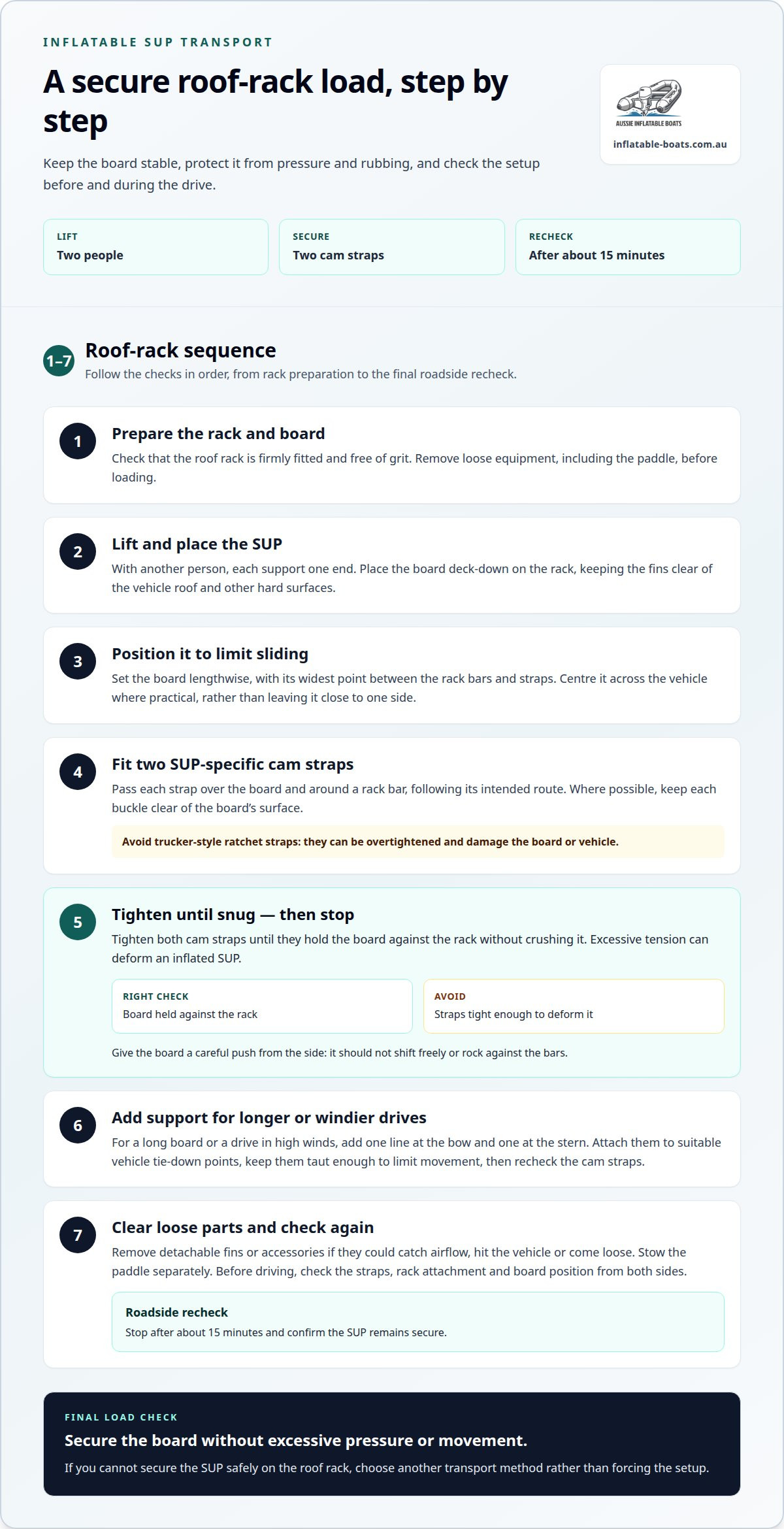
- Choose a roof rack if you want to travel with the SUP inflated and your vehicle has suitable rack bars. With two people, lift one end each and place the board deck-down on the rack. Position its widest point between the two cam straps to help prevent forward or backward sliding. A roof rack isn’t suitable if you can’t secure the board without excessive pressure or movement.
- Protect the board from heat and abrasion before setting off. On hot days, release a little air through the valve to allow for pressure increases as the air inside warms. If the SUP will sit in direct sunlight, cover its deck pad or turn it away from the sun to help prevent colour fading. Keep it away from sharp edges and rough surfaces while loading. Knowing how to transport an inflatable SUP also means choosing a method that protects it from damage in transit.
Strapping an inflated SUP to a roof rack
- Before loading, check that the roof rack is firmly fitted and free of grit. With another person, lift the SUP, each of you supporting one end. Place it deck-down on the rack, with the fins clear of the vehicle roof and other hard surfaces. A controlled lift helps prevent the board from scraping across the rack bars.
- Position the board lengthwise, with its widest point between the two rack bars and straps. This helps limit forward and backward movement during travel. Centre it across the vehicle where practical, rather than leaving it precariously close to one side. Remove the paddle and any loose equipment before strapping the board down.
- Use two SUP-specific cam straps to secure the board across the roof rack. Avoid trucker-style ratchet straps, which can be overtightened and damage the board or vehicle. Pass each strap over the board and around the rack bar, following the strap’s intended route. Where possible, keep the buckle clear of the board’s surface.
- Tighten each cam strap until snug, then stop. Excessive tension can deform an inflated SUP, even if it appears secure. Check that both straps hold the board against the rack without crushing it. Give the board a careful push from the side: it shouldn’t shift freely or rock against the bars.
- For a long board or a drive in high winds, add one line at the bow and another at the stern. Attach each to a suitable vehicle tie-down point, not a loose accessory. Keep the lines taut enough to limit movement without pulling the board out of position. Recheck the cam straps after fitting the lines.
- Remove detachable fins and accessories if they could catch the airflow, hit the vehicle or come loose. Leave a fin attached only if it stays clear of the roof and rack and remains secure. Stow the paddle separately instead of leaving it loose on the board, where airflow could move it.
- Before driving, check the straps, rack attachment and board position from both sides of the vehicle. Stop after about 15 minutes and check that the SUP remains secure. Roof-rack transport can be ready in a few minutes once the board and straps are positioned. If you’re preparing for more time on the water, explore the inflatable watercraft range.
Transporting multiple SUPs
- Choose how to carry your SUPs based on their number and condition, and on your vehicle. A trailer may provide more room than a roof rack for several inflated boards. A roof setup is suitable only if the rack and vehicle can support the combined load. Include the boards and other roof cargo when assessing that load, rather than considering each board on its own.
- Arrange boards on a trailer so they lie flat and their weight stays centred. If they have fixed fins, alternate their nose-to-tail orientation. For example, place one board nose-forward, then turn the next around. This makes room for the fins and helps keep the stack flat.
- Use the trailer crossbars as support points, positioning each board across them. Consider the distance between the crossbars and the length of each SUP so the boards rest securely instead of flexing over unsupported space. If a board’s fins interfere with the next layer, alternate its direction rather than forcing the boards together.
- Separate stacked boards with suitable padding to reduce rubbing in transit. Keep fins, handles and other raised parts from pressing into another board. Centre the stack evenly across the trailer, then secure it to prevent sideways, forward or backward movement. Straps should hold the load in place without crushing an inflated board.
- When carrying several SUPs on a roof rack, arrange them so each board is supported and can be secured firmly. Don’t add another board just because it fits on top. The combined weight and stack height affect how the load sits, while exposed edges can move in the airflow. Keep paddles and loose accessories separate from the boards.
- Before departure, walk around the vehicle or trailer and inspect every board. Check that no fin presses into another SUP, that the stack stays centred, and that straps don’t loosen when the boards move slightly under hand pressure. After setting off, stop after about 15 minutes to check the load again. Recheck following a significant change in road conditions or a stop where straps may have shifted.
For a trailer load of inflated SUPs with fixed fins, alternate the boards’ nose-to-tail orientation to keep the weight centred and the stack as flat as possible. Check the whole arrangement to make sure fins aren’t pushing neighbouring boards apart.
Once the stack is in place, check that the boards are supported across the trailer crossbars and secured without being crushed. Walk around the trailer to spot uneven placement or contact between raised parts before setting off.
Carrying a SUP by its centre handle
- Clear the route before lifting the board. Check the ground between your vehicle and launch point for rocks, branches, gates and other obstacles. The centre handle places the board’s weight near your hand, but you still need enough room to pass through narrow spaces. Move loose equipment out of the way first.
- Stand beside the board and find its centre handle, usually near its balance point. Turn the board so the deck faces your body and the fins point away from your legs. This helps keep the fins clear as you walk. Check that no paddle leash or loose strap is caught around the handle.
- Bend your knees slightly, grip the centre handle firmly and lift the board’s edge. Keep your back comfortable and bring the board alongside your body instead of reaching across it. If it tilts sharply or feels difficult to control, set it down and adjust your grip before continuing.
- Carry the board at your side, with the handle near your hip. Keep it level enough to avoid dragging the nose or tail on the ground. Take shorter steps around corners, doorways and uneven paths. At a narrow gate, pause and carefully turn the board through rather than forcing it past the frame.
- Tuck the paddle between the board and your carrying arm to leave one hand free. Hold it securely, positioning the blade and shaft so they won’t catch on nearby objects. If the paddle shifts as you walk, stop and reposition it. Don’t rely on a loose accessory strap to hold it in place.
- Watch the board’s edges and fins when passing vehicles, fences or other boards. Leave enough clearance to keep the fin from hitting a hard surface. If a strap buckle or other fitting protrudes near the handle, turn it away from your body to prevent it rubbing against your clothing.
- For a longer walk, pause on stable ground and lower the board under control before changing hands. Don’t drop it onto concrete or let the fins take the impact. If the path is steep, crowded or difficult to manage with the paddle, make a separate trip for the paddle instead of carrying both awkwardly.
Transporting a deflated SUP in a travel backpack
- Deflate the board fully and fold it according to the manufacturer’s instructions. Work on a clean, dry surface, such as a garage floor or grass cleared of sticks. Dirt or grit folded into the material can rub against it inside the bag. Keep the valve clear as you fold so the board lies flat.
- Put the folded SUP in its travel backpack before loading other gear. Arrange the bundle so its weight is even, rather than pressing heavily against one side. Keep the paddle, pump and removable fin in their designated compartments or separate protective sleeves. Hard accessories loose beside the board can rub against or press into its material during the trip.
- Close the backpack without forcing the zip or seams. If it won’t close easily, reopen it and adjust the folded board or accessories. Wait until the load sits neatly inside before tightening external compression straps. A ratchet strap can’t replace the backpack closure, and excess tension can compress the bundle unevenly.
- Carry the backpack by its intended shoulder straps or handles, keeping the load close to your body. Before loading it into a vehicle, clear the space of sharp tools, loose metal and other abrasive objects. Place the bag where it won’t slide into hard edges during travel, and keep it away from anything that could puncture or crush it.
- If you need to move the folded SUP outside its travel backpack, lay it flat and keep its folded edges off the ground. This is especially important on concrete and other hard surfaces, where edges can abrade. For example, place the board on a clean mat while rearranging vehicle cargo instead of directly on a driveway.
- Keep the backpack away from prolonged direct sunlight and hot surfaces during stops. Heat can affect the board and its internal air pressure once inflated, so don’t leave it beside a hot vehicle or on a sunlit surface. Before unpacking, check the bag’s exterior and the board for grit, sharp debris or signs of damage.
- At your destination, unpack the SUP on a clean surface and separate the paddle, pump and fin before inflation. This gives you space to unfold the board without dragging it across gravel or concrete. For equipment to support your time on the water, explore inflatable watercraft options.
Inflatable Boats
Inflatable Boats is a useful next step when your transport plans raise questions about inflatable watercraft, equipment or maintenance. A suitable carrying setup depends on the board, vehicle and journey, while worn or damaged equipment may need attention before the next trip. Inflatable Boats offers inflatable watercraft, accessories and spare parts, alongside repairs for inflatable vessels. These options can help when you’re preparing equipment for time on the water or addressing a repair need. For questions about available equipment or repairs, contact Inflatable Boats.
Make your next launch easier to plan
A well-planned transport setup helps make your day on the water smoother. Before your next outing, consider what will make the journey practical: your vehicle, the space available for gear and how you’ll handle the board at your destination. A considered setup leaves more attention for paddling, conditions and the place you’ve come to explore.
Stay flexible. A setup that works for a short drive may not suit a longer trip or another vehicle. With experience, you’ll learn which details matter most to your routine and adjust your preparation accordingly. The key to learning how to transport an inflatable SUP is to choose a method that suits both the board and the outing, rather than forcing the same approach every time.
If you’re considering inflatable watercraft or need parts or accessories for your next trip, contact Inflatable Boats. Then get your gear ready and look forward to your next session on the water.
Frequently Asked Questions
How do you pack an inflatable SUP for transport?
Deflate the SUP, remove detachable parts and fold it according to the board’s instructions. Clear sand and grit from the board before packing, as debris caught in the folds can rub against the material. Put the folded board in its travel bag, then pack the pump, paddle and fin separately or in designated compartments. In a car, keep hard accessories from pressing against the board.
What size bag is needed to transport an inflatable SUP?
Choose a bag that fits the SUP in its recommended folded configuration. Packed dimensions depend on the board and folding method, so follow the manufacturer’s packing guidance rather than choosing a bag based on the inflated board’s length. If you’ll carry a pump, paddle or fin in the same bag, leave room for them without forcing the zip or pressing hard edges against the board.
Can you transport an inflatable SUP in a car boot or on a roof rack?
Yes. A deflated SUP can travel in a car boot if it fits without being bent to force it into place. An inflated board can travel on a roof rack if the rack supports it and suitable straps secure it. For example, use the boot and travel bag if your vehicle has no suitable rack, or the roof rack if you want to carry the board inflated.
How do you secure an inflatable SUP on a roof rack safely?
Use two SUP-specific cam straps across the board and roof rack, positioning the board so its widest point sits between them. Tighten each strap until snug, not so hard that it deforms the board. Keep loose paddles and accessories stowed separately. Before driving, check the board and rack for movement, then stop after about 15 minutes to inspect the load.
Can an inflatable SUP be transported inflated on a roof rack?
Yes, you can carry an inflated SUP on a roof rack if it sits securely and the rack is suitable for the load. On hot days, release a little air through the valve to allow for pressure increases as the air warms. If the board can’t be secured firmly or your vehicle has no suitable rack, deflate it and carry it in its travel bag.
How should you transport an inflatable SUP on a plane in Australia?
Check the airline’s baggage limits and fees for your route, using the packed bag’s dimensions and weight. Include the SUP, paddle and pump when assessing the load, and plan for the airline’s oversized or sports baggage category.