
How to Handle an Inflatable Boat in Choppy Water
Powering through steep chop can feel like the quickest way to stay on course, but it may make the ride harsher and harder to control. Knowing how to handle an inflatable in choppy water starts with reading the waves, not fighting them. Their direction and spacing can change quickly, so a measured adjustment to speed or course is often wiser than holding the throttle steady.
Pay attention to passenger comfort, stability and how the boat responds to impacts. Keep everyone seated and balanced, watch for changes in the ride, and be ready to adjust your plan as conditions shift.
This guide explains how to read wave angles, make calm speed and steering adjustments, and recognise when turning back is the safer call. It also covers why your boat’s condition and suitability for the intended use matter before you launch. Choppy water doesn’t always mean the trip must end, but knowing your limits helps you decide before the ride becomes difficult.
Key Takeaways
- Assess wind, wave direction and visibility before setting out, then keep checking as conditions change.
- Match your course to the waves’ direction and make gradual adjustments, guided by how the boat responds.
- For how to handle an inflatable in choppy water, use a measured cycle: observe, ease your speed, assess control and reassess.
- Notice when steering becomes harder or conditions worsen, and be prepared to change plans or head back early.
- Consider the boat’s intended use, condition, load and your experience, and consult current official Australian maritime safety advice for local requirements.
Before taking an inflatable boat into choppy water, assess the conditions
Preparation and conservative decisions matter more than trying to overpower waves. Before departure, check a current marine forecast for the area and the full time you expect to be out, then compare it with what you can see on the water. Conditions can shift during a trip: wind may strengthen, visibility may deteriorate, and a manageable outward run may become more demanding on the way back.
Uncomfortable chop is not automatically beyond your limits, but conditions that challenge your control, experience or boat’s intended use are a reason to turn back. There’s no single wave height that makes every outing safe or unsafe. Consider the waterway and keep judging conditions as they develop.
What makes choppy water challenging for an inflatable?
Short, steep waves can make the ride sharp and jarring. Waves arriving from different directions may move the boat unpredictably, unsettling passengers and making it harder to stay balanced or hold a steady course. Wind is the air moving across the water; wave direction is where the wave pattern is travelling from; your heading is the direction the bow points. These can differ. An inflatable boat can vary in design and use, so handling also depends on its condition, how it’s loaded and the skipper’s experience.
Decide whether to go, continue or turn back
Think beyond the conditions at the launch point. A sheltered stretch may feel calm while more exposed water or the return route presents a different challenge. Before leaving, set a conservative limit based on the boat’s intended use and condition, the people aboard and your confidence operating it. If you’re still building experience, choose conditions and a route that leave room to turn around without pressure.
- Before departure: Review the forecast, wind and visibility, and consider whether conditions are expected to change during the trip. Look at the route out and back, including exposed sections and practical ways to return.
- At the water: Observe the wave pattern rather than relying on the forecast alone. If it looks more confused, steep or demanding than expected, delay or cancel. A sound boat doesn’t make unsuitable conditions safe.
- While afloat: Keep reassessing visibility, wind, waves, passenger comfort and your ability to steer. If conditions worsen, passengers feel unsafe or control becomes difficult, turn back early while you can still do so calmly.
Choose a boat for the trip you intend to take, rather than letting the boat dictate the plan. If you’re comparing options, the inflatable boat collections are a starting point for considering suitability. Check current official Australian maritime safety advice for equipment and requirements that apply to your location. A measured go-or-no-go decision is part of handling the boat well.
Read the waves and choose a controlled course in an inflatable boat
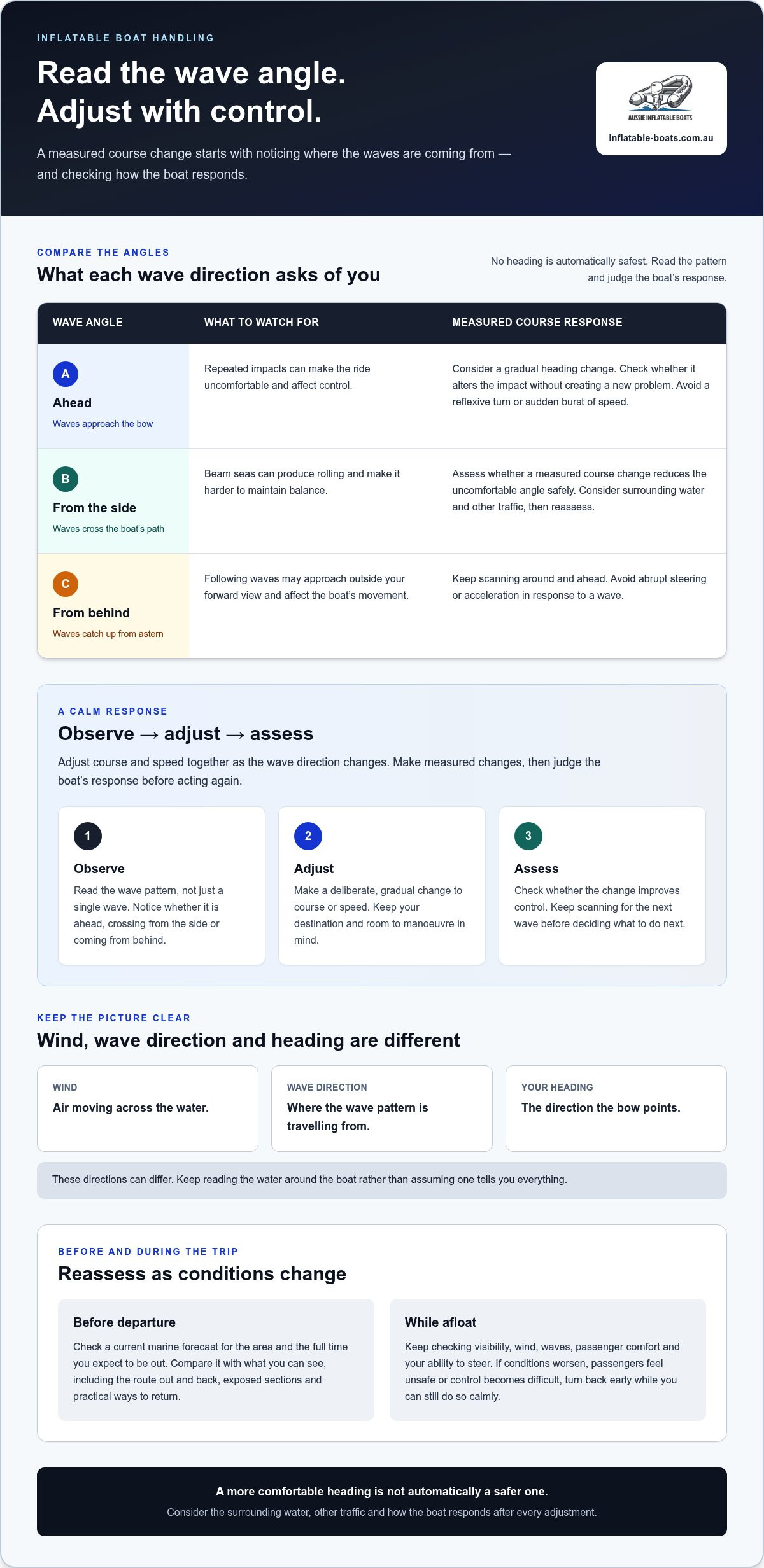
Once afloat, read the pattern rather than reacting to a single wave. Note whether waves are approaching the bow, crossing the boat’s path from the side, or catching up from behind. Each angle can change the ride and the demands on the skipper, but no heading is automatically safest in every situation. The right response depends on the wave pattern, the waterway and how your boat behaves.
| Wave direction | What to watch for | Course consideration |
|---|---|---|
| Ahead | Repeated impacts may make the ride uncomfortable and affect control. | Consider whether a gradual change in heading alters the impact without creating a new problem. |
| From the side | Beam seas can produce rolling and make balance harder to maintain. | Assess whether a measured course change reduces the uncomfortable angle safely. |
| From behind | Following waves can approach from outside your forward view and affect the boat’s movement. | Keep looking around and ahead; avoid abrupt steering or acceleration in response to a wave. |
When waves approach from ahead or behind
Waves ahead may bring repeated impacts, while waves from behind can be harder to anticipate because they approach from astern. Neither direction calls for a reflexive turn or sudden burst of speed. Make a deliberate adjustment, keep scanning the water in front and around the boat, then check whether the new heading improves control. Don’t let attention to one wave obscure the next.
When waves arrive from the side
Waves crossing the boat’s beam may cause an uncomfortable rolling motion, so pay close attention to how passengers and the boat respond. A gradual change in course may reduce the time spent at an awkward angle, but zig-zagging is not always the answer. Consider the surrounding water and other traffic, then reassess after each adjustment.
Adjust course and speed together as wave direction changes, making measured changes and judging the boat’s response before acting again. This is the practical heart of how to handle an inflatable in choppy water: observe, adjust, assess. A heading that feels more comfortable for a moment may expose the boat to a different wave angle or make it harder to maintain a controlled route. Keep your destination and room to manoeuvre in mind.
For another general perspective on preparation and responses to rough conditions, see these rough water boat safety tips. If you’re considering a boat for a particular use, comparing the inflatable boat options can help you weigh suitability against the conditions you expect to encounter.
Set speed and balance to handle an inflatable in choppy water
Throttle is a control, not a tool for forcing a boat through every wave. Powering through chop may increase impacts and make it harder to respond smoothly; it isn’t a reliable way to maintain control. There’s no universal minimum speed that suits every inflatable, load and wave pattern. Aim for a pace that lets you steer deliberately, see what’s ahead and respond without being thrown off balance.
How should you adjust throttle in waves?
Use a simple cycle: observe, ease your input, assess the boat’s response, then reassess. Watch the wave pattern and how the hull meets it. Make a smooth throttle adjustment rather than accelerating or decelerating sharply, then check whether the boat feels more controlled and the impacts are manageable. Conditions can change quickly, so don’t assume one setting will remain suitable throughout the crossing.
Maximum speed isn’t a safety rule. More speed can mean harsher impacts, while slowing too much may also affect how your particular boat responds. Don’t rely on a fixed speed, engine setting or wave-height limit as a guarantee of safe handling. The useful measure is whether you can maintain control and make calm decisions. If the boat continues to pound, feels difficult to steer or the ride unsettles passengers, adjust progressively and consider whether the conditions are beyond your capability.
For how to handle an inflatable in choppy water, avoid abrupt reactions to individual waves. A sudden throttle change can add to an already unsettled ride. Make one measured adjustment, allow time to feel its effect, and keep scanning for the next wave and changes in direction. If measured inputs aren’t restoring control, don’t keep increasing power in the hope that it will solve the problem.
Keep passengers and gear settled
Balance matters. Arrange passengers in line with the boat’s design and instructions, distributing their positions so the load isn’t concentrated on one side or end. If someone moves suddenly across the boat, the shift in weight may alter how it sits and responds. Secure loose items so they can’t slide or roll as the boat moves, and avoid rearranging the load when conditions make movement difficult.
Give passengers clear instructions before the ride becomes uncomfortable. Ask them to stay seated or in a secure position when moving about could affect their balance or the boat’s handling. If someone needs to change position, choose a calmer moment where practical and make the change deliberately. Watch for shifting bags, people leaning to one side or anyone struggling to remain stable. These are cues to reassess, not to demand that passengers brace harder while you power on.
Loading and throttle work together. A well-arranged load can support balanced handling, but it doesn’t make a boat immune to chop or remove the need for careful speed control. Follow the boat’s instructions, make small adjustments and judge the result in real time. The boat’s response is your guide.
Use this practical checklist as conditions change
Conditions can shift while you’re underway, so make observation part of the trip rather than waiting for the ride to become uncomfortable. Use a repeatable check: scan the water and weather, check the people and gear aboard, assess how well you’re controlling the boat, then decide what to do next. A steady routine helps you respond to small changes before they become difficult to manage.
A simple repeatable check while underway
At regular intervals, look across the water for changes in the wave pattern, wind and visibility. Then check the boat’s response: is it tracking as intended, and can you steer without straining or making abrupt corrections? Take in the whole picture, not just the wave immediately ahead. If you’re focused on steering, pause your assessment until you can safely look around.
- Scan conditions: Look for strengthening wind, a more confused wave pattern or visibility that’s becoming less reliable.
- Check people and gear: Make sure passengers remain secure and loose items haven’t shifted. Keep essential gear accessible without creating a reason to move around in an awkward moment.
- Assess control: Notice whether steering and throttle inputs still produce a manageable response, or whether the boat is becoming harder to control.
- Choose the next action: Continue cautiously, adjust your route, head for suitable shelter or return by a safe route, depending on what conditions allow.
Keep communication clear. Tell passengers what you’ve observed and what you plan to do, using calm, direct instructions. For example, explain that you’re changing course or heading back, then ask everyone to stay securely positioned. Clear communication helps prevent sudden movement and stops people being surprised by a change in plan.
When continuing is no longer the prudent option
Reassess promptly if visibility worsens, the wind strengthens, steering becomes increasingly difficult or passengers are distressed. A modest change can matter when several warning signs appear together. If your responses are no longer restoring control, don’t treat persistence as proof that the situation is manageable.
Choose a safe route back or suitable shelter where possible, taking account of the changing water rather than assuming the way you came is still the easiest option. Returning early is sound judgement, not failure. If you’re uncertain about equipment or local requirements, consult current official maritime safety advice for the state or territory where you’ll be boating. Requirements can vary by jurisdiction, so use local guidance rather than relying on general advice.
Good decisions afloat begin with a boat suited to its intended use and maintained in sound condition, but readiness never replaces ongoing judgement. If you’re considering an inflatable boat for your plans, explore inflatable boats for your intended use as part of preparing thoughtfully for time on the water.
Prepare your inflatable boat and know when to head back
A capable skipper starts making decisions before leaving shore. Match the outing to the inflatable boat’s intended use, its condition, the load aboard and your own experience. A boat in sound condition is essential, but it doesn’t make every sea state suitable. If the forecast or water looks more challenging than your skills or the boat’s intended use allow, choose a more sheltered plan or postpone the trip.
Match boat choice and condition to the trip
When comparing boat types, consider the conditions you expect to encounter rather than assuming every inflatable is suited to the same water. The inflatable boat collections can help you explore different options. Before setting out, check the boat’s overall condition, including its valves and components, and follow its care and operating instructions. A previous comfortable outing doesn’t guarantee the next one will feel the same.
Loading is part of suitability, too. Consider the people and gear for the planned trip, and arrange the load in line with the boat’s instructions. The skipper’s familiarity with the boat matters just as much: knowing how it responds in calm water is different from managing it confidently when conditions become unsettled. If you’re new to the boat or still gaining experience, keep the outing conservative.
Finish with a conservative plan
Make the decision in stages. First assess the forecast and conditions at the launch point. Then consider whether your intended route and return remain manageable. Once afloat, choose a controlled course, adjust speed smoothly and keep reassessing how the boat responds. If wind or waves build, visibility worsens, control becomes difficult or you no longer feel capable of managing the conditions, head back early where it’s safe to do so.
There’s no shame in changing the plan. Turning back while you still have the capacity to make a calm decision is good seamanship, not a failed outing. Before each trip, consult current official Australian maritime safety advice for the equipment and requirements that apply to your state or territory. Requirements can vary, so use guidance relevant to the waterway where you’ll be boating rather than relying on assumptions.
Preparation brings confidence, but sound judgement remains the skipper’s most important tool. Choose conditions that suit your experience, monitor the boat and passengers, and be ready to cut the trip short. If you’re planning an outing, browse the inflatable boat range with your intended use in mind.
Make your next outing a confident one
Build experience deliberately. Choose outings that suit your current skills, and take note afterwards of how the boat, its load and the changing water felt. Those observations can help you plan more effectively next time, including recognising when a route or set of conditions calls for a more conservative choice. Confidence on the water comes from sound judgement, not from pushing past your limits.
Knowing how to handle an inflatable in choppy water also means having equipment that’s ready for its intended use. Inflatable Boats sells inflatable boats, accessories and spare parts, and provides professional inflatable boat repair services, including repairs for punctures, valve issues and structural components.
When you’re planning your next outing, take time to consider which boat best fits the trips you have in mind. Explore inflatable boats for your next adventure, and make measured decisions on the water.
Frequently Asked Questions
Is an inflatable boat safe in choppy water?
An inflatable boat may be suitable for some choppy conditions, but no boat is safe in every sea state. Suitability depends on the boat’s intended use and condition, how it’s loaded, the conditions and the skipper’s experience. A sheltered stretch with small, regular waves presents a different challenge from exposed water with steep, confused chop. Follow the boat’s operating guidance and use current local safety advice when deciding whether to launch.
How should you steer an inflatable boat in choppy water?
Steer with gradual inputs, adjusting your heading to the wave pattern and the space around you. A useful principle for how to handle an inflatable in choppy water is to change course deliberately, then observe how the boat responds before making another adjustment. Avoid sharp turns that could unsettle passengers or bring you into conflict with nearby traffic. Keep scanning beyond the next wave, especially when the pattern is changing.
Should you slow down in choppy water?
Often, a measured reduction in speed can make impacts more manageable, but slowing down isn’t an automatic rule for every boat or condition. Aim for a pace at which you can steer and respond calmly, without harsh jolts or feeling that the boat is difficult to control. Make a modest throttle adjustment and assess the result. If handling remains uncomfortable or uncertain, don’t assume more throttle will solve it.
Can an inflatable boat capsize in choppy water?
Yes. An inflatable boat can capsize, and its inflatable construction doesn’t make it immune to rough conditions. Risk can increase if steep or crossing waves combine with an unsuitable heading, abrupt manoeuvres, an unbalanced load or people moving suddenly. Keep the boat within its intended use and loading guidance, and treat worsening control as a serious signal. If conditions exceed your ability to manage them, prioritise a safe return rather than pressing on.
What should passengers do when an inflatable boat is bouncing in waves?
Passengers should stay in a secure position and avoid moving around while the boat is bouncing. Sudden movement can affect balance and distract the skipper. Keep bags and other loose items from sliding, and follow clear instructions from the person at the helm. If someone needs to change position, wait for a calmer moment where possible. Everyone aboard should use appropriate safety equipment in line with current local maritime advice.
When should you turn back in choppy water?
Turn back when the boat is becoming difficult to control, conditions are worsening or anyone aboard feels unsafe. You don’t need to wait until steering becomes impossible or a passenger is distressed. For example, if reduced visibility makes it hard to judge your route, or the return journey now looks more demanding than the trip out, reassess promptly. Choose a safe route back or suitable shelter where possible, and don’t let the destination dictate the decision.
Does a better-maintained inflatable boat make rough conditions safe?
No. Good maintenance supports reliable boat condition, but it can’t make conditions safe if they exceed the boat’s intended use or the skipper’s experience. Before heading out, follow the manufacturer’s care and operating guidance, and don’t ignore damage or a component that isn’t working as expected. A boat that appears ready still needs a conservative go-or-no-go decision based on the forecast, the waterway, the load and your ability to manage the trip.