
How to deal with a warped iSUP caused by humidity or heat
Heat, damp storage and tightly fastened straps can all contribute to a warped iSUP. Dealing with a warped iSUP starts with drying the board after use, keeping it out of direct sunlight and avoiding excess strap pressure. If your board is already warped, check for persistent distortion or damage before taking it back on the water.
It’s frustrating to unpack your board and find a twist or uneven shape where you expected a reliable platform. Dealing with a warped iSUP means considering how it was stored, transported and exposed to heat, since each can affect its shape.
This guide explains how to identify possible causes and choose a sensible next step. You’ll learn how to dry and store your board, limit heat exposure, secure it carefully and recognise when visible damage needs professional attention. Practical habits can help protect your equipment and prepare you for your next paddle.
Key Takeaways
- Dry your board thoroughly after paddling, especially after saltwater use, before packing it away.
- Choose a cool, shaded storage spot to limit uneven expansion from heat and prolonged sun exposure.
- Secure the board for transport without overtightening straps or pressing hard against its surface.
- Look for lasting twists, seam changes or leaks to help distinguish damage from temporary distortion.
- If the board appears damaged, avoid using it until the problem has been assessed and any needed repair is complete.
Humidity and damp storage
Is it safe to paddle an iSUP that is warped? Not until you’ve checked its shape, seams and valve. A persistent twist, visible seam separation or pressure loss can affect how the board handles on the water, so keep it ashore if you find any of these signs.
When should a warped iSUP be repaired or replaced? Arrange a repair assessment if the distortion remains after drying or appears alongside a leak or seam damage. Replacement may be appropriate when structural damage cannot be repaired reliably. Don’t paddle a board with unresolved damage.
- Rinse the board after each paddle. Use fresh water, especially after saltwater use, to remove salt and surface residue. Pay attention to the deck, rails and areas around the valve, where water or grit can remain after a quick rinse.
- Remove water before packing. Wipe the board with a clean, absorbent cloth, then inspect the fin box, handles and seams. A damp fold can hold moisture against the material during storage, so open the board fully before drying it.
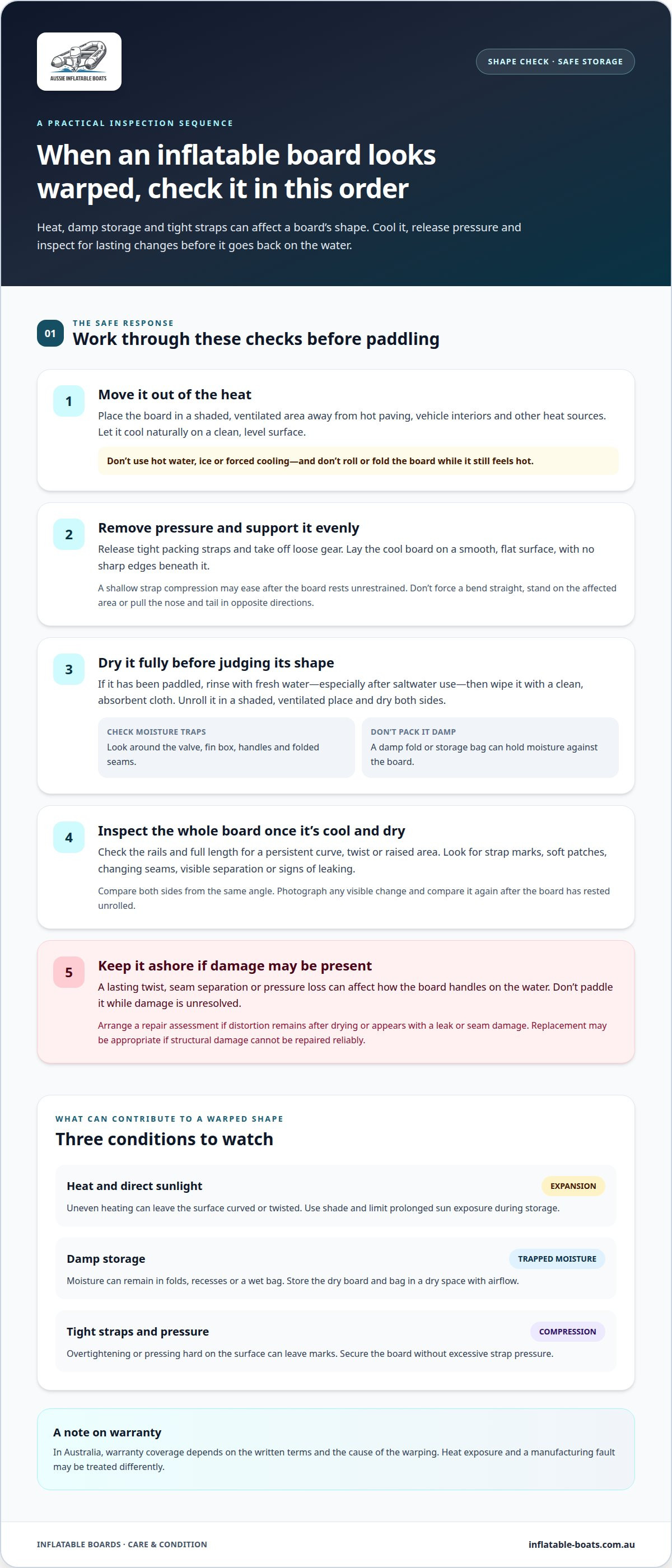
- Let both sides dry properly. Keep the board unrolled in a ventilated, shaded place until its deck and underside feel dry. Turn it over to expose areas that rested on the ground, rather than assuming the visible side tells the whole story.
- Check familiar moisture traps. Look beneath removable fins, around the valve cap and inside folded seams. If water remains in a recess, blot it instead of forcing the board into its bag while damp.
- Choose dry storage. Store the dry board away from persistently damp floors, wet gear and standing water. A dry indoor space with airflow is preferable to a closed bag left beside wet paddling equipment.
- Keep the storage bag dry too. If the bag is wet, turn it inside out and allow it to air-dry before packing the board. Putting a dry iSUP into a damp bag can undo the care taken during rinsing and drying.
- Inspect the board before rolling it. Look for a lasting curve, twist, soft patch or seam change while the surface is clean and dry. Photograph any visible change, then compare it after the board has rested unrolled.
- Respond to persistent changes. If a distortion remains after careful drying, or you see bubbling, separation or leaking, stop using the board and arrange a repair assessment. Drying can remove moisture; it won’t correct structural damage.
Heat and direct sunlight exposure
Move a sun-heated paddle board into the shade and let it cool before assessing its shape. In Australia, warranty coverage depends on the written terms and the cause of the warping. Heat exposure and a manufacturing fault may be treated differently.
Check heat and sunlight exposure
Check where the inflatable board was left and how long it sat in direct sunlight. Heat can make board materials expand unevenly, leaving the surface curved or twisted instead of straight. A board left on a hot car roof, beside a sunlit window or on exposed sand may show more distortion than one stored in the shade.
- Move it out of the sun. Place the paddle board in a shaded, ventilated area, away from hot paving, vehicle interiors and other heat sources. Don’t roll or fold it while the surface still feels hot.
- Let the board cool naturally. Keep it on a clean, level surface and avoid rapid temperature changes. Hot water, ice and forced cooling can create further uneven temperature changes across the material.
- Inspect the full shape once cool. Look along the rails and length of the board for a twist, raised area or persistent curve. Compare both sides from the same angle, rather than judging the shape while the board remains warm.
- Reduce future UV exposure. Use shade when the board is ashore and limit prolonged direct sunlight during storage. A 303 protectant is recommended for helping protect an inflatable SUP from UV rays and stains; follow its product directions.
Straighten the iSUP safely at home
Lay the cool board on a smooth, flat surface and let its shape settle without forcing it. Don’t use a heater, hairdryer, hot water or heavy objects to bend the board straight. Concentrated heat or pressure can worsen the distortion.
- Remove anything pressing on the board. Take off loose gear and release tight packing straps. Keep the board supported evenly, without sharp edges beneath the surface.
- Give it time at a stable temperature. Leave it undisturbed in shade, then inspect whether the bend changes as the material cools. Avoid trying to reshape it by standing on the affected area or pulling the nose and tail in opposite directions.
- Stop if damage is visible. A twist that persists, a changing seam or a leak needs assessment rather than repeated home reshaping. Keep the board out of the water until its condition is clear.
For persistent deformation, inflatable boat repair support can help assess whether repair is appropriate. Heat-related changes should be distinguished from a puncture, seam issue or other structural damage before the board returns to the water.
Strap tension and pressure damage
Straps and inflation pressure can both affect an inflatable paddle board’s shape. Check how the board was secured and inflated before deciding whether a bend points to lasting damage.
Check for temporary misshaping or damage
Release the straps, lay the board on a clean, level surface and inspect its outline. A shallow compression mark where a strap crossed the deck may ease after the board rests unrestrained. A persistent twist, seam change or soft area calls for more caution.
- Look for strap marks. Check the deck, rails and nose for local indentations or creases that match the tie-down position.
- Compare both sides. Sight along the board’s length and compare the rails. Note whether the shape improves once pressure is removed.
- Stop if damage appears. A leak, seam separation or deformation that remains after release shouldn’t be treated as a simple packing mark.
Check the recommended inflation pressure
Read the pressure range printed on the board or in its manual before inflating. Most inflatable paddle boards can be inflated to 12-15 PSI; for a board with a recommended range of 12-15 PSI, inflate close to 15 PSI without exceeding it.
- Use the board’s own limit. Recommendations differ between boards, so don’t apply another model’s pressure setting to yours.
- Watch the gauge as you inflate. Stop at the correct pressure for your board. Don’t add air just to make a warped shape appear straighter.
- Recheck the outline. Once inflated to its recommended pressure, inspect the rails and deck for an uneven curve, bulge or twist.
Strap compression can occur during transport or storage, especially when an inflatable board is secured tightly against a hard edge. A board strapped down for a drive may look temporarily indented where the strap crossed it. Tightening the strap further to prevent movement can increase pressure on that area rather than improve the fit.
- Position straps across supported areas. Keep them clear of valves, fins and raised fittings that could create concentrated pressure points.
- Secure without crushing. Tighten enough to hold the board in place, then check that the straps aren’t visibly deforming its deck or rails.
- Inspect after unloading. Release each strap and look for marks before cleaning or packing the board. If distortion remains or a seam looks affected, keep it out of the water until assessed.
For a stand up paddle board, careful loading and the correct PSI help preserve its shape. Don’t use pressure or strap tension to force a lasting twist straight.
What causes an inflatable SUP to warp or become deformed?
Compare the board’s shape with its storage, transport and inflation history. Heat, concentrated pressure and changes in internal air pressure can each contribute to distortion.
- Review its heat exposure. Recall whether the board spent a long period in direct sunlight, inside a hot vehicle or on heated ground. Heat can cause materials to expand unevenly, leaving an inflatable SUP curved or twisted. Move it into shade, let it cool naturally, then inspect whether the shape changes. A lasting distortion after cooling needs closer assessment.
- Look for pressure points from transport or storage. Check where straps, hard edges or other gear pressed against the board. A local indentation matching a strap position suggests concentrated pressure; a twist running along the board may have another cause. Release anything pressing on it, then examine the outline while the board rests on a flat surface.
- Compare the shape at the recommended pressure. Read the board’s own pressure guidance before inflating. Most inflatable paddle boards can be inflated to 12-15 PSI, and a board rated for that range should be inflated close to 15 PSI without exceeding it. Too little air can leave the board less rigid; adding air beyond its limit risks excess pressure.
- Inspect seams and the valve alongside the shape. Look for lifting material, glue showing, bubbles or air escaping. One reported case described a six-month-old iSUP with a twist along its length; another described seam glue showing on a board about five years old without a leak. These examples show why age alone doesn’t identify the cause.
- Record when the distortion appears. Note whether it shows up after storage, transport, inflation or time in the sun. Photograph the board from the side and above, using the same position for later comparisons. A reported leak began at 9-10 pounds of pressure, while the owner couldn’t inflate the board to nearly 13 pounds. Pressure loss alongside deformation needs assessment.
- Separate a temporary change from structural damage. Let the board rest unrestrained in a stable, shaded place, then check its outline again. If a twist remains, or a seam, valve or surface also looks damaged, don’t try to force it straight. Keep it out of use until the cause has been assessed.
A seam that shows adhesive does not, by itself, establish that air is escaping: a commenter reported that an inflatable SUP about 5 years old had seam glue showing along its length, with no leaks. Compare that observation with the board’s pressure behaviour and inspect the affected area rather than using age alone to decide whether it is safe. Pressure guidance also needs to be board-specific: the page recommends inflating a red paddle board to 25 PSI, particularly for a heavy rider, rather than applying that target to every SUP.
A pronounced seam opening calls for a different response from a mild shape change. A commenter asked where to find a professional to repair an inflatable SUP seam blowout about 6” long. If a seam is separating or the board loses pressure, keep it out of use while seeking an assessment; avoid trying to flatten or load the damaged area. Record the location and extent of the seam change, including any pressure loss or visible glue, when describing the problem.
How can I tell whether a warped iSUP is damaged or temporarily misshapen?
Follow a consistent inspection sequence: remove pressure, assess the board’s outline, then look for leaks or seam changes. A shape that settles after resting is different from a twist that remains alongside visible damage.
- Set up a clear inspection. Place the board on a clean, level surface and remove gear or straps pressing against it. View its outline from the nose and tail, then sight along both rails. This gives you a consistent reference point for spotting a curve, twist or uneven section.
- Let temporary pressure marks settle. If a strap or folded section caused a shallow indentation, leave the board unrestrained in shade before inspecting it again. Compare the same area after it has rested. A mark that eases without other changes points to temporary misshaping; don’t force it flat with weights.
- Check the seams closely. Examine the seam line along the rails and around the nose and tail. Look for lifted edges, visible glue, bubbles or separation. Glue showing along a seam has been reported on an inflatable SUP about five years old, even without a leak, so inspect the seam itself rather than relying only on age or pressure.
- Look for signs of air loss. Inflate the board only according to its recommended pressure, then watch whether its shape or firmness changes. A reported board began leaking at 9-10 pounds and couldn’t reach nearly 13 pounds. A leak alongside deformation suggests a problem beyond a temporary storage crease.
- Use partial inflation to locate a suspected leak. Inflate the board to 7-10 psi to help find escaping air, then inspect around the valve and seams. Check whether the valve is loose or dirty before considering a patch. This is a leak check, not a pressure setting for paddling.
- Record what changes. Photograph the board from above and from each end, noting any twist, soft area or seam change. Repeat the same views after it rests. A six-month-old iSUP has been reported with a twist along its length; persistent distortion deserves attention even on a newer board.
- Keep a damaged board out of use. Don’t paddle if you find a leak, seam separation or a lasting twist that affects its shape. Arrange an assessment before returning it to the water. If repair is needed, enquire about inflatable boat repairs for guidance on the next step.
If an assessment confirms that repair is appropriate, follow guidance for the specific damage rather than treating a surface layer as proof that the board is ready. The guide recommends letting quick-curing epoxy sit for about half an hour before checking whether another layer is needed. That check only determines whether another layer is needed; it does not establish that a warped board is sound or ready to paddle.
A damaged paddle board should be repaired and allowed to rest before use. Treat the rest as part of the repair process, not a substitute for it: a board that looks better after being left alone has not thereby been repaired. Before using it again, make sure the damage has been addressed and the board has rested. If distortion or other damage remains, keep it out of use and seek an assessment.
Inflatable Boats
Inflatable Boats provides repair services for inflatable watercraft with persistent distortion, seam damage or leaks. If your iSUP’s shape hasn’t settled after resting, or inspection reveals structural damage, a repair assessment can help clarify the next step before you return it to the water. Keep the board dry and avoid further inflation or use if it’s losing pressure or its seams appear compromised.
For a board that can be repaired, professional attention can address damage affecting its construction. If it cannot be restored reliably, replacement may be the safer decision. The right course depends on what an inspection reveals, including the location and extent of the distortion and any accompanying damage.
Contact Inflatable Boats to discuss a repair assessment for your inflatable board.
Get your board ready for the next paddle
Make your next step a clear decision about the board’s condition, not a guess based on appearance alone. Dealing with a warped iSUP means considering its shape alongside any changes to its seams, pressure or handling. If you’re unsure whether your board is ready for the water, an assessment can help clarify what to do next.
Inflatable Boats offers inflatable boats, inflatable boat accessories and inflatable boat spare parts. For advice about your board or suitable next steps, contact Inflatable Boats.
With the right information, you can make a considered choice and look forward to getting back on the water with confidence.
Frequently Asked Questions
Can heat, sunlight, or leaving an iSUP inflated cause warping?
Prolonged direct sunlight and heat can contribute to warping because board materials may expand unevenly. Leaving a board inflated, by itself, doesn’t prove that damage has occurred. The concern is heat exposure, especially if the board is also above its recommended pressure. For example, an inflated board left in a hot vehicle needs to cool and be inspected before use. Follow the pressure guidance for your specific board.
How should I store and transport an iSUP to prevent warping?
Store the board dry and shaded, away from concentrated pressure. During transport, secure it so it can’t shift or be crushed by other gear. In a vehicle, keep hard equipment from pressing against one rail and avoid placing heavy items on top. If carrying it on a rack, arrange the support so the board rests evenly rather than bending over a narrow contact point. Secure it firmly without compressing its shape.