
Electric Outboard vs Petrol for an Inflatable Boat: How to Choose
The outboard with the bigger headline power may be the wrong choice for your inflatable. In the electric outboard vs petrol for inflatable decision, the better fit depends on how far you travel, what you carry and where you can recharge or refuel. Motor output matters, but so do practical range and the weight of the complete setup.
If you’re unsure whether an electric motor will last the trip, or whether a petrol motor and fuel will leave enough room for people and gear, start with those questions. This guide compares electric and petrol outboards by range, payload, upkeep and trip needs, so you can choose propulsion that suits your boating plans rather than a spec sheet.
It also covers charging access, transport and the checks to make before buying. Match motor output to your boat’s capacity and confirm transom compatibility in the manufacturer’s documentation. The right setup starts with your inflatable, your load and the water you plan to explore.
Key Takeaways
- For the electric outboard vs petrol for inflatable choice, start with your trip profile and access to charging or refuelling, not headline power alone.
- Watt-hours describe battery energy, while watts describe motor output. Advertised runtime and range can change with speed, load and conditions.
- Compare the whole setup, including battery or fuel weight, how you’ll replenish energy, upkeep and the space available aboard.
- Use the boat manufacturer’s information to check capacity, maximum motor rating, transom suitability and loaded weight before choosing a motor.
- Gather your usual trip distance, passenger and gear load, boat details and energy access to make an informed setup decision.
Electric outboard vs petrol for an inflatable: what changes on the water?
An electric outboard operates quietly, with no exhaust emitted at the boat. A petrol outboard offers the familiar option of replenishing fuel for the next leg. Neither is automatically the better choice. The right setup depends on your inflatable’s design, the people and gear aboard, trip length, water conditions and access to charging or refuelling.
An outboard motor is mounted at the boat’s transom to provide propulsion and steering. For a foundational overview of its design and common features, see Outboard motor. An electric outboard uses electrical energy stored in a battery; a petrol outboard burns petrol in an engine. Battery capacity, measured in watt-hours (Wh), describes how much energy is stored. Rated motor output, measured in watts (W) or kilowatts (kW), describes the rate at which the motor uses energy to produce power. These measures are related, but they aren’t interchangeable.
- Electric: Quiet operation with no exhaust at the boat, but your trip plan needs to account for battery capacity, charging access and battery weight.
- Petrol: Refuelling may suit plans with access to fuel, but you’ll need to carry suitable fuel and keep up with routine engine care.
These are trade-offs, not verdicts. To explore how hull choice shapes a boat’s intended use, consult an inflatable boat buying guide.
What does each outboard setup include?
An electric setup means more than the motor. It also includes a compatible battery and a way to recharge it, whether at home or through another suitable arrangement. A petrol setup includes the outboard, suitable fuel and routine engine care. In both cases, motor output describes propulsion capability. Battery energy or available fuel affects how long you can operate before replenishing it.
Why inflatable-boat use changes the comparison
An inflatable’s transom rating, hull design and manufacturer guidance set important limits on motor suitability. Check the boat’s documentation before choosing an outboard, and count the complete load: passengers, equipment, battery or fuel, and the motor itself. A compact outing in sheltered water with a light load has different demands from a longer trip carrying more people and gear. Don’t assume advertised output guarantees a particular range. Load and conditions affect what the setup can deliver. That’s the practical heart of the electric outboard vs petrol for inflatable decision.
How electric and petrol outboards deliver power, range and runtime
Motor output and energy supply answer different questions. Output, measured in watts (W) or kilowatts (kW), describes the rate an electric motor uses energy to produce power. Battery capacity, measured in watt-hours (Wh), describes how much energy it stores. A higher-capacity battery can supply more energy, but it also adds weight to the load your inflatable must carry.
Advertised runtime and range are starting points, not guarantees. Speed, passenger and gear load, wind and water conditions, and how you operate the motor all affect energy use. Higher speed or greater resistance can increase demand. A setup that suits a light outing in sheltered water may not deliver the same runtime on a longer trip with a heavier load.
How to estimate electric outboard runtime
As a rough planning method, divide the battery’s usable energy in Wh by the motor’s average power draw in W to estimate operating time. This is an illustration, not a prediction: real-world draw varies, and not all stated battery capacity may be usable. Check that the battery is compatible with the motor, confirm its usable capacity and consult the manufacturer’s runtime guidance for the conditions and settings you expect. More battery capacity can extend available energy, but include its added weight in the boat’s total load.
What affects petrol outboard range?
Petrol range depends on how much fuel you carry and how quickly the engine consumes it. Consumption varies with the engine, speed, load and conditions, so look for manufacturer data that matches your intended operating range rather than relying on one advertised figure. Plan fuel for the return journey and allow a conservative reserve. Don’t assume the outbound trip’s conditions or engine demand will be repeated on the way back.
Charging access and refuelling both shape a practical trip plan. Consider where you can recharge between outings, whether a suitable charging point is available during a longer stop, and how you’ll carry the battery. With petrol, plan for a suitable fuel supply and safe handling. Either way, check the complete setup and manufacturer information before leaving. For further context on how engine type relates to emissions, Sailors for the Sea explains the environmental impact of outboard motors.
For the electric outboard vs petrol for inflatable decision, compare the energy you can carry and replenish with the distance you need to cover, including the return trip. Start by reviewing inflatable boats for different uses and loads, then check the selected boat’s capacity and transom guidance against the motor setup you’re considering.
Electric vs petrol outboards: compare ownership trade-offs side by side
For an inflatable, ownership means managing the whole propulsion setup, not just the motor. Compare how each option fits your trips, storage space and maintenance routine. The table outlines common trade-offs, but actual performance and upkeep depend on the specific motor, battery or fuel arrangement, and how you use it.
| Consideration | Electric outboard | Petrol outboard |
|---|---|---|
| Noise and exhaust | Quiet operation, with no exhaust emitted at the boat. | Produces engine noise and exhaust during operation. |
| Runtime planning | Plan around usable battery energy, power demand and access to charging. | Plan around fuel carried, engine consumption and opportunities to refuel. |
| Replenishing energy | Requires a compatible charging arrangement and enough time between outings or during a stop. | Requires suitable fuel and access to refuelling for your planned use. |
| Upkeep | Less routine engine care, but the battery and charging equipment still need handling as directed by their manufacturers. | Requires routine engine care, plus fuel storage and safe handling. |
| Weight and storage | Account for the motor, battery and charging equipment as one carried load. | Allow space and capacity for the motor and fuel arrangement. Carried fuel adds to the load. |
Neither option is automatically cheaper to own. Purchase cost, energy use, servicing, battery or fuel requirements and how often you go boating all affect the overall cost. For further perspective on the trade-offs, read comparing gas and electric outboards.
When an electric outboard may suit your inflatable
An electric setup may suit short outings where quiet operation matters and you can charge the battery conveniently between trips. It may also work for boaters who are comfortable planning around available battery capacity and carrying the complete setup. Consider the boat’s rating, load and expected conditions first. Electric propulsion won’t suit every inflatable or trip profile.
When a petrol outboard may be the practical fit
Petrol may be practical for plans that depend on refuelling access and extended operation, provided you’re prepared for engine servicing, fuel storage and safe handling. Before buying, check the motor’s rating and the boat manufacturer’s guidance, including transom suitability and capacity. A good match matters more than choosing by motor type alone.
In short: Electric may suit shorter, quieter outings with charging access; petrol may suit trips planned around refuelling and extended operation. The electric outboard vs petrol for inflatable choice comes down to your use, complete carried load and boat limits.
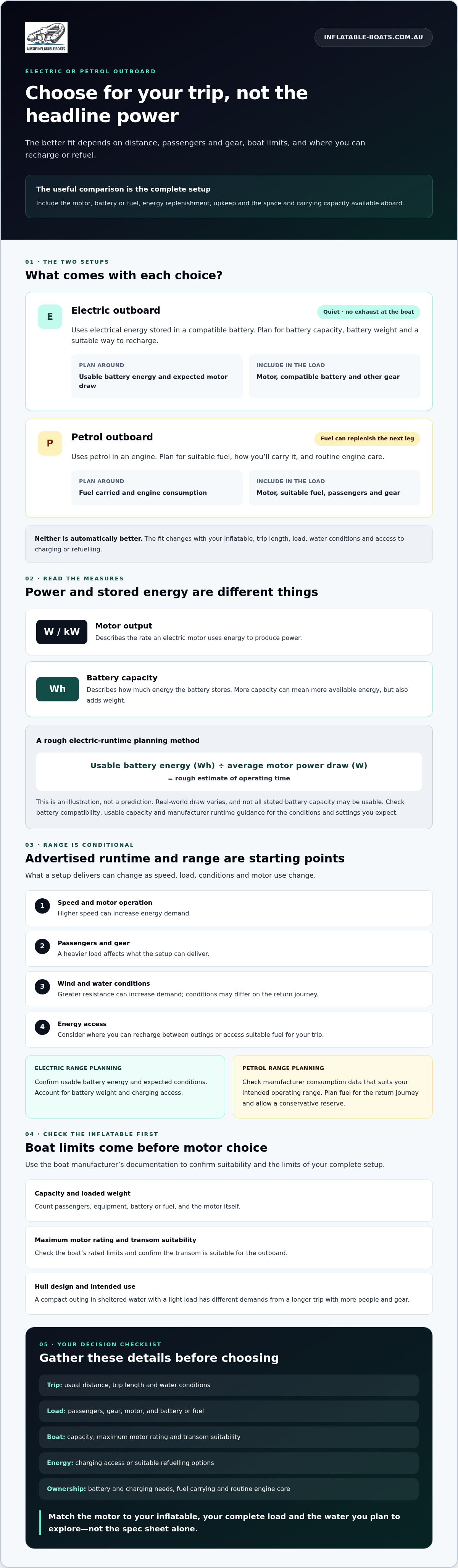
How to choose an outboard for your inflatable boat: a practical checklist
Make the decision in order: begin with the trip, then confirm the boat can carry the complete setup within its limits. This keeps the electric outboard vs petrol for inflatable choice grounded in your actual use rather than a motor’s headline rating.
- Map the trip. Note distance, expected duration, water conditions and access to charging or refuelling. Include the return journey and consider whether conditions could change.
- Check the boat’s limits. Read the capacity plate and manufacturer documentation for passenger and load limits, maximum motor rating and transom suitability.
- Work out the all-up load. Record the weight of passengers, gear and motor. For an electric setup, include the battery and charging equipment. For petrol, include fuel and its container.
- Confirm energy access. For electric, check charging options between outings and that the battery is compatible with the motor. For petrol, consider fuel availability and how you’ll store and handle it safely.
- Plan transport and storage. Check that you can move, secure and store the motor and its energy supply, both at home and during the trip.
- Compare ongoing care. Review the manufacturer’s instructions for servicing, battery care, charging and storage, as applicable. Consider the time and equipment each setup requires.
Match the motor to the boat and all-up load
Capacity and transom compatibility are not assumptions to test on the water. Check the intended motor’s rating against the boat manufacturer’s guidance, then add passenger, equipment and propulsion-system weights to assess the loaded boat. Don’t exceed rated capacity or make transom modifications unless the manufacturer provides clear, applicable guidance.
If you’re still weighing up hull options, browse inflatable boat collections and compare each boat’s stated capacity and motor guidance with your intended use.
Plan for Australian safety and compliance
Recreational vessel requirements can vary between Australian states and territories. Check the relevant marine authority’s current guidance for equipment and operating requirements before heading out. For battery handling, charging and electrical connections, follow the battery and motor manufacturers’ instructions. Store and handle petrol in accordance with applicable safety guidance, and keep it secured as directed. Don’t rely on general advice in place of current local requirements.
Gather your trip plan, passenger and gear weights, boat documentation and preferred energy arrangement before narrowing the options. Explore inflatable boats and use the manufacturer’s specifications to check whether a boat suits your intended outboard setup.
Choose your inflatable-boat setup and plan the next step
The best choice comes from matching your usual trips to the boat’s limits and the practicalities of carrying and replenishing energy. Short outings with charging access may point towards electric propulsion; plans built around refuelling and longer operation may favour petrol. Either way, payload, storage, transport and maintenance matter. For the electric outboard vs petrol for inflatable decision, confirm the boat and motor requirements before choosing a setup.
Information to gather before choosing your setup
Pull together these details before comparing options or asking for guidance. Manufacturer information is essential for confirming compatibility, so keep the boat’s documentation handy.
- Boat: Model, manufacturer’s capacity and maximum motor rating, transom details, and any stated compatibility requirements.
- Typical use: Passenger numbers, usual trip distance and duration, expected water conditions, and whether trips are sheltered or more exposed.
- Energy access: Where and when you can charge a compatible battery, or access and safely store suitable fuel.
- Complete load: Passenger and gear weights, along with the motor and the battery or fuel arrangement.
- Practicalities: Available storage and transport options, and how much routine maintenance you’re prepared to manage.
This information helps you compare complete setups rather than judging by motor output alone. If any rating, transom detail or compatibility point is unclear, confirm it with the boat manufacturer before proceeding. For outboard-specific questions, check the motor manufacturer’s documentation or consult a suitably qualified outboard specialist.
How Inflatable Boats can support the boat side of the decision
Inflatable Boats sells inflatable boats, accessories and spare parts, and offers inflatable-boat repairs. Browse the inflatable boat range to review boat options, then compare each relevant boat’s published capacity and transom information with your intended use. Use the boat manufacturer’s guidance and the outboard maker’s specifications to verify that the boat and motor are compatible.
Ready to check a boat option? Contact the team with your boat details and intended use. Include the model, expected passenger and gear load, typical trips and any questions about the boat’s published specifications. A considered setup starts with a suitable inflatable and a clear understanding of its limits.
Choose a setup that’s ready for your kind of trip
The electric outboard vs petrol for inflatable decision comes down to your trip profile, payload and access to charging or fuel. Compare the complete setup, not just the motor: battery or fuel, transport, storage and upkeep all shape how practical it will be. Before you commit, check your inflatable’s capacity, maximum motor rating and transom suitability against the manufacturer’s documentation.
Inflatable Boats serves customers nationally across Australia with inflatable boats, accessories, spare parts and inflatable-boat repair services. Compare the range and consider how each option’s stated capacity and intended use fit your plans.
Explore inflatable boats and plan your next day on the water. Check the boat’s published specifications against your trip and intended outboard setup before choosing.
Frequently Asked Questions
Is an electric outboard powerful enough for an inflatable boat?
Yes, an electric outboard can be powerful enough when its output suits the boat, load and conditions. Consider the inflatable’s hull design, passenger and gear weight, and the type of water you’ll use it on. Check the manufacturer’s maximum motor rating and the outboard maker’s performance guidance before choosing. “Horsepower equivalent” claims can vary between manufacturers, so don’t use that figure alone to judge suitability.
How far can an electric outboard take an inflatable boat?
There isn’t one reliable distance that applies to every electric outboard and inflatable. Practical range depends on usable battery energy, power demand, speed, load, wind and water conditions, and how you operate the motor. Check the manufacturer’s range or runtime guidance for comparable conditions, and plan for the return trip with a conservative reserve. A larger battery may provide more energy, but it also adds weight to the boat’s load.
Can you use a petrol outboard on an inflatable boat?
Yes, if the inflatable is designed for an outboard and the motor suits its transom and stated limits. Check the boat manufacturer’s maximum motor rating, transom guidance and capacity information, then account for the motor, fuel, passengers and gear in the total load. Confirm shaft length and installation requirements with the boat and motor manufacturers. Don’t exceed the boat’s ratings or make unverified transom modifications.
Is an electric outboard cheaper to run than a petrol outboard?
Not necessarily. Running costs depend on how often and how far you travel, electricity and fuel use, and the specific equipment. Ownership costs can also include the motor, battery or fuel system, charging arrangements, maintenance and eventual replacement needs. Compare manufacturer consumption information with your expected use, and assess the complete setup rather than assuming one type will always cost less over time.
What size electric outboard do I need for an inflatable boat?
Choose an electric outboard that fits the boat’s stated maximum motor rating and transom requirements, then consider your usual passenger and gear load, trip conditions and desired performance. Check both the outboard maker’s output information and the boat manufacturer’s documentation. Don’t select by a horsepower-equivalent label alone, as these comparisons can vary between makers. If compatibility or ratings aren’t clear, confirm them with the manufacturers before buying.
Do electric outboards need a special battery?
They need a battery that’s compatible with the particular motor. Some electric outboards use an integrated battery, while others require a separate one. Check the motor maker’s specified battery type, voltage, capacity, connections and charging requirements. Don’t assume a battery will work because its connector appears to fit. Follow the manufacturer’s instructions for charging, storage, transport and handling, and include the battery’s weight when checking the boat’s total load.
Are electric outboards allowed on Australian waterways?
Requirements depend on the state or territory and the waterway, so check current guidance from the relevant marine authority before heading out. Look for rules covering vessel operation, required safety equipment and any local restrictions that may apply. An electric motor doesn’t automatically exempt a vessel from other requirements. Confirm the rules for your intended location, and check that the inflatable and motor setup comply with their manufacturers’ guidance.