
Compare high quality inflatable SUPs for safety and performance
The lightest inflatable boat isn’t automatically the best choice. For peace of mind with a high-quality inflatable boat, compare how its construction, stability and safety accessories suit your needs, then weigh portability against performance.
It’s sensible to look beyond packed weight: a boat also needs to feel stable on the water and be practical to carry and store. Length is one part of that decision; 10′ to 12′ is a moderate length range to consider when comparing inflatable boats.
This comparison explains what to look for in safety equipment, construction, stability, certification and portability. You’ll see how these features affect a boat’s likely use, helping you focus on the trade-offs that matter before choosing an inflatable boat for Australian waters.
Key Takeaways
- Compare included safety and repair accessories to understand what supports your boating and what may help with basic upkeep.
- Look at construction details alongside durability claims to judge how an inflatable boat may handle regular use.
- Use boat width, length and intended load to weigh stability against performance on the water.
- Consider packed size and weight as well as on-water performance when portability matters for transport and storage.
- Compare brands by their stated features and certification information, then use the decision guide to narrow down the options that suit your needs.
Included safety and repair accessories
Included gear can make an inflatable SUP easier to prepare and maintain, but package contents vary. Separate items included in the box from optional accessories, then match each to your intended use. A paddle, pump, leash, fin and repair materials serve different purposes. Check the product specifications to see what’s supplied and what you may need to buy separately.
Common risks include punctures, losing balance and being carried away from a chosen landing point by wind or moving water. Before launching, inspect the board and its fittings, inflate it according to the manufacturer’s instructions, and use suitable safety equipment for your conditions. Beginners can build confidence in calm, familiar conditions before attempting more challenging outings.
A repair kit is useful only if it suits the board’s material and construction. Check that it contains compatible patches and adhesive, and that the instructions explain surface preparation and curing. A kit may help with a small puncture, but it isn’t a substitute for having damage to a seam, valve or other structural area assessed.
Specifications help make accessory comparisons practical. For example, the Funwater 10' Feath-R-Lite is listed at 10' x 30" x 6". Hand inflation can take 10-15 minutes, so compare the pump type and the effort involved alongside the board’s dimensions. For prices, compare the total package in A$, including any separately sold pump, paddle or repair kit, rather than judging the board price alone.
| Option | Accessories to assess | Best suited to | Key comparison |
|---|---|---|---|
| Board package | Listed included items | Beginners seeking a ready-to-use setup | What is included versus optional |
| Repair kit | Compatible patch materials and instructions | Routine care and minor damage preparation | Material compatibility |
| Storage or fishing setup | Dry storage and attachment points | Carrying essentials or fishing equipment | Secure fit without obstructing movement |
Storage accessories should protect the board and keep loose equipment organised between outings. A carry bag can simplify transport, while a dry bag helps keep essentials separate from wet gear. For fishing, consider how a mounted holder or other attachment affects paddle access, balance and clear deck space. A stable setup is more useful than extra fittings that get in the way.
Warranty coverage is set by each product’s written terms, while Australian suppliers’ repair support varies by product and fault. Read the coverage and exclusions alongside the repair process, including whether damage from use or storage is treated differently.
Choose accessories by matching the package contents, board specifications and intended activity, then compare the total price in A$.
Durability and construction
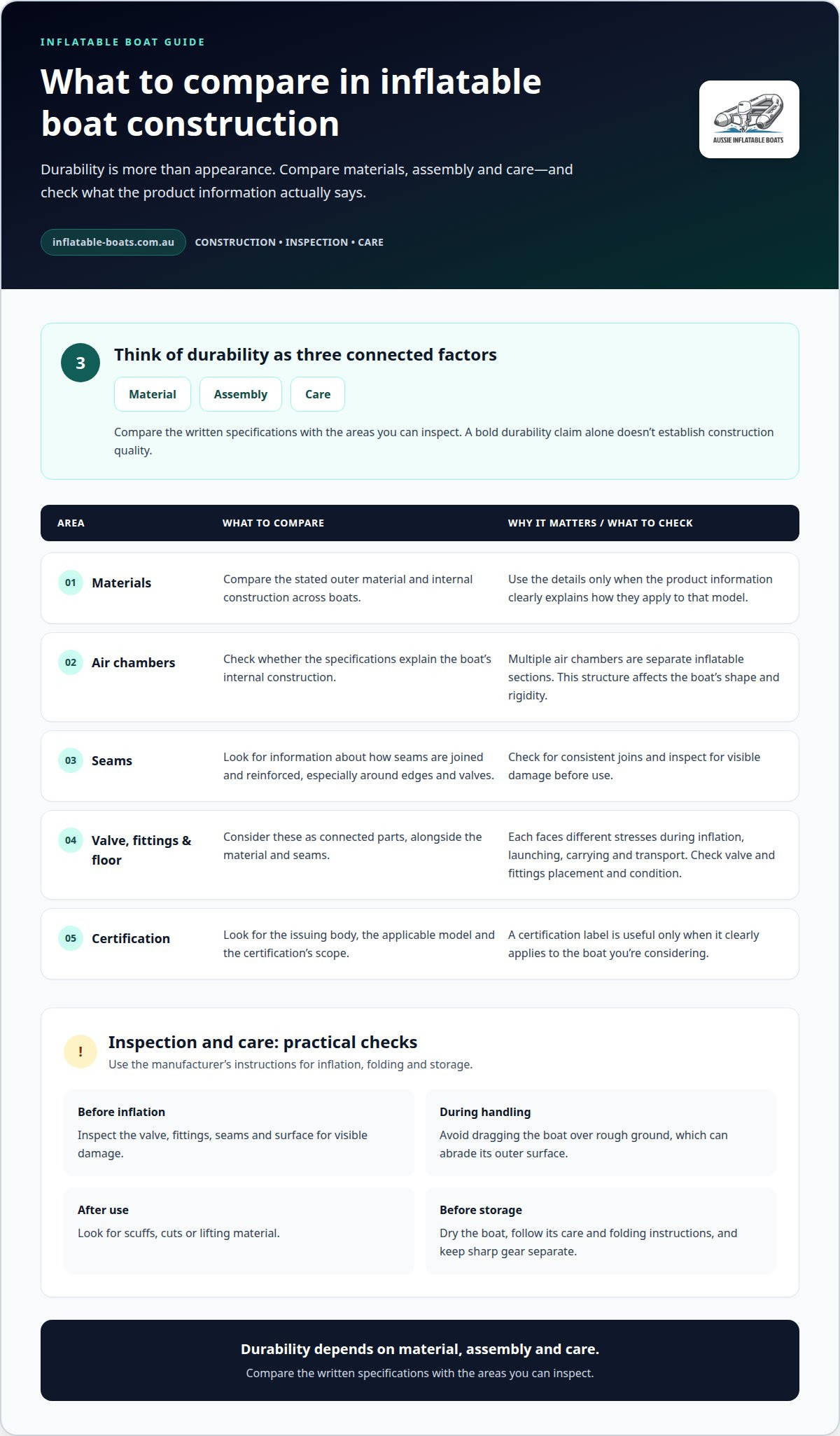
An inflatable boat’s durability depends on more than its appearance. Consider the material, seams, valve, transom fittings and floor as connected parts. Each faces different stresses during inflation, launching, carrying and transport. Clear specifications help you compare models without treating a bold durability claim as proof of construction quality.
Start with the materials description. If the manufacturer identifies an outer fabric and internal construction, compare those details across boats. Multiple air chambers, for example, describe separate inflatable sections within the boat. This structure affects the boat’s shape and rigidity, while the outer material protects it from everyday contact. These terms are useful only when the product information clearly explains how they apply to that model.
Pay close attention to the seams. Check whether the product description explains how they are joined and reinforced, particularly around the boat’s edges and valves. An unevenly seated valve or inconsistent-looking seam can make inflation and inspection harder. Before each outing, check these areas for visible damage and follow the manufacturer’s inflation and care instructions. Avoid dragging the boat over rough ground, which can abrade its outer surface.
For a concrete size reference, the Funwater 10' Feath-R-Lite is listed as 10' x 30" x 6". Dimensions alone don’t establish durability, but they help distinguish a boat’s footprint from its construction. Weight also affects carrying and transport; compare it with the packed dimensions and your storage space. A slightly lighter boat may be easier to move, while construction details still matter for how it handles repeated use.
What materials and safety certifications should I look for in an inflatable boat? Compare the stated outer material, internal construction and seam design. Look for certification details that identify the issuing body, applicable model and scope. A certification label is useful only when it clearly applies to the boat you’re considering.
- Seams: Check for consistent joins and clear construction information.
- Valve and fittings: Inspect their placement and condition before inflation.
- Surface: Look for scuffs, cuts or lifting material after use.
- Storage: Dry the boat and follow its care instructions before packing it away.
Transport adds another wear point. A boat folded tightly or packed while damp may be harder to inspect before its next outing. Follow the manufacturer’s folding and storage instructions, and keep sharp gear separate from the boat. For a broader look at inflatable watercraft construction and equipment, browse inflatable watercraft information.
Durability depends on material, assembly and care. Compare the written specifications with the areas you can inspect, then choose a boat whose construction and handling suit your regular use.
Stability and on-water performance
Boat width is a useful starting point when comparing stability. A moderate inflatable boat width range is 30″ to 33″, while the Molokai 10'6" Ka-ulu is 32 inches wide. That example sits within the range, but width alone can’t predict how every person will find a boat. Load, water conditions and hull shape all influence how steady it feels.
A wider inflatable boat can offer more room to move around, while a narrower hull can feel more responsive when turning. The trade-off depends on the boat’s shape and how you use it. Compare the stated width with the boat’s length and recommended load, rather than treating one measurement as a complete performance rating. A premium label doesn’t replace practical specifications.
Load affects stability and performance. A boat carrying passengers and equipment sits differently from one carrying only passengers. Keep the total load within the manufacturer’s stated capacity and distribute gear evenly instead of stacking it at one end. If the boat feels uneven during a calm-water test, reposition the load before setting off.
Inflation matters, too. Follow the manufacturer’s pressure instructions, because an underinflated inflatable boat can feel less firm. A firm, evenly inflated boat gives passengers a consistent platform. Don’t assume that adding pressure improves performance. Stay within the product’s stated limits.
Hull design influences how an inflatable boat moves through the water. The hull helps resist sideways movement, while the boat’s outline and steering affect turning. Check that the boat is assembled securely before launch. When travelling straight, make controlled steering adjustments as needed to maintain direction.
- For a stable feel: Compare width and load capacity, then consider where equipment will sit.
- For tracking: Check the boat’s setup and make controlled steering adjustments.
- For turning: Consider whether the boat’s shape and responsiveness suit your usual routes.
- For comfort: Match the boat to your needs, load and intended conditions.
The Molokai 10'6" Ka-ulu’s 32-inch width offers a concrete reference for comparing dimensions, not a universal measure of comfort. A durable boat still needs to suit its passengers and purpose. Compare specifications, then consider how the boat responds under its intended load. The best fit is the one that balances stability with the manoeuvrability you want on the water.
For recreational boating, choose a bigger boat when the planned load is within 50lb of the limit. Treat that guidance as part of the capacity comparison, alongside the boat’s dimensions and the equipment you expect to carry. If the planned load falls within that range, use the bigger-boat recommendation when selecting between options rather than relying on width alone. Consider the boat’s stated capacity together with its shape and size when deciding whether it suits your plans.
Portability and lightweight designs
A lightweight inflatable boat is easier to carry, but packed weight tells only part of the story. A backpack-style bag may help on the walk from a car park to a beach, while a bulky bundle can be awkward through a narrow gate. Compare the boat, pump and oars together, not as separate pieces of equipment.
Boat size affects how easily it fits in a vehicle or storage space. Even when deflated, a large boat may need a clear boot or roof space. Check the packed dimensions against your car’s boot opening, garage shelf or cupboard. This simple fit test can matter more than a small difference in listed weight.
Handles also shape the carrying experience. A centre handle helps balance the folded boat at your side; front and rear handles can help when moving it with another person. Check their placement and grip, especially if your route includes stairs or uneven ground. A bag with adjustable shoulder straps can leave both hands free for a pump and oars.
Think through the whole journey. For example, a solo boater may need to carry a packed boat, pump, oars and dry bag from a parking area to the launch point. If the load is uncomfortable before you reach the water, a lightweight boat alone won’t solve the problem. Oars that break down can also be easier to pack than fixed-length ones.
There’s a trade-off between easy handling on land and performance afloat. Boat length and shape influence space and manoeuvrability, while width can affect stability. A shorter boat may be easier to store and turn, while a longer shape can suit smoother, straighter travel. Match those characteristics to your usual outing rather than choosing solely by how the packed bundle looks.
- Check the carry: Lift the packed boat using its handle or shoulder straps.
- Check the fit: Compare the folded package with your vehicle and storage area.
- Check the route: Consider stairs, sand, narrow paths and the distance to launch.
- Check the full kit: Include the pump, oars and personal equipment in your carrying plan.
On a smooth path from the car to a sheltered launch, a balanced bag and accessible handles can make setup easier. On a longer walk or uneven track, total kit weight and shoulder comfort matter more. These differences are practical, not cosmetic.
The clearest takeaway is to choose portability for the journey you actually make. Compare packed size, total carrying load, handle placement and storage fit, then balance those factors against on-water performance.
Which inflatable brands are best rated in Australia?
A brand name alone can’t show whether an inflatable boat suits your needs. Ratings are more useful when they refer to a specific model and assess comparable features, such as construction, stability, accessories and portability. A boat praised for easy transport may not suit someone who prioritises capacity or durability.
There’s no useful single ranking without comparable, current Australian rating data. Instead, treat ratings as one part of a product comparison. Look for comments describing actual use, then compare them with the specifications. A review mentioning a stable hull, for example, is more useful when the model’s construction and recommended inflation instructions are clear.
Separate product feedback from service feedback. A supplier rating may describe delivery or support, while a boat review may discuss handling, stability or durability. These are different measures. If a rating combines several products or services, it won’t tell you how one particular inflatable boat performs.
Compare models using the same criteria. Note the boat’s stated dimensions and load limit, the accessories included in the package, and how its construction is described. Then weigh those details against your boating and storage needs. A higher score can be a useful signal, but it doesn’t replace checking whether the boat suits your use.
- Read for specific details: Prioritise reviews describing the model and the conditions of use.
- Separate the rating types: Distinguish feedback about the boat from feedback about the seller.
- Compare like with like: Use the same construction, stability and accessory criteria across models.
- Match claims to specifications: Check whether feedback aligns with the product’s stated features.
For example, if two boats receive similar praise, compare the reasons behind it. One review might value easier transport, while another highlights a stable feel for newer boaters. Those comments describe different strengths, not a definitive winner. Give each point weight according to where and how you plan to use the boat.
Look for repeated, model-specific observations rather than relying on one striking comment. Descriptions of seam wear, valve use or fitting accessories give you concrete points to compare with product information. General statements such as “great quality” reveal less about construction or performance.
For peace of mind with a high-quality inflatable, use ratings to narrow your options, then decide by specifications and intended use. If you’re also considering an inflatable boat, explore inflatable boat options for a different kind of time on the water.
Inflatable Boats
If your plans extend beyond paddle boarding to an inflatable boat, Inflatable Boats is a natural next step. Its range includes inflatable boats, accessories and spare parts, and the business provides repairs for inflatable vessels. These options can help you consider the equipment and upkeep involved in choosing and maintaining an inflatable boat for time on the water.
If you’re weighing an inflatable boat or need support with parts, accessories or repairs, contact Inflatable Boats to discuss your needs.
Choose your next step with confidence
Your next decision is how you want to spend time on the water. When choosing an inflatable boat, use a practical approach: match the craft and equipment to your plans, storage and upkeep needs. That’s where peace of mind with a high-quality inflatable comes from: choosing gear suited to how you’ll use it, rather than relying on a label alone.
Inflatable Boats sells inflatable boats, accessories and spare parts, and provides inflatable boat repairs. These options can support a different kind of outing or help meet equipment needs for an inflatable boat. The right next step depends on what you’re planning, whether that’s exploring a boat setup or finding relevant parts and accessories.
Contact Inflatable Boats for advice about its inflatable boats, accessories or spare parts. Then make room for your next day on the water.
Frequently Asked Questions
What makes an inflatable boat high quality and durable?
Quality comes from consistent construction, clear specifications and suitable care, not a premium label alone. After use, for example, rinse off residue, dry the boat fully and store it away from sharp objects. Follow the manufacturer’s inflation and folding instructions, too. These habits help limit avoidable wear, while a written warranty clarifies how the maker handles particular faults and what conditions apply.
How much does a high-quality inflatable boat cost in Australia?
There isn’t one useful price for every high-quality inflatable boat, because packages and specifications vary. Compare Australian listings in A$, checking whether the price includes the pump, carry bag, oars and repair materials. A lower package price may exclude items you’ll need, while a more complete kit may reduce separate purchases. Judge the total setup against the boat’s construction and intended use, not price alone.
How do I choose the right inflatable boat for my needs and Australian conditions?
Start with where you expect to use the boat and how you’ll get it there. A sheltered estuary outing and a windy, exposed shoreline call for different planning. Consider your experience, the gear you’ll carry, storage space and how far you’ll walk to launch. Choose a boat suited to your load and ability, then plan outings around local weather and water conditions rather than relying on the boat to compensate.
How do premium and budget inflatable boats compare for reliability and value?
Premium and budget labels don’t establish reliability by themselves. Compare each model’s actual warranty terms, stated construction, package contents and replacement-part support. For example, if two boats suit your needs, a clearly documented repair process or practical included accessories may matter more than a decorative finish. Value depends on how well the complete setup meets your needs and how straightforward it is to maintain over time.