
Compact Inflatable Boats: Australian Buyer's Guide 2026
Can a genuine ocean-capable vessel deliver rugged open-water performance while packing neatly into the boot of your four-wheel drive? For years, boaters have assumed that serious maritime exploration requires a heavy aluminium hull, a registered trailer, and an overloaded vehicle payload. If you are tired of battling crowded launch ramps and tight garage storage, you aren't alone. Still, venturing across open water demands uncompromising build quality, because nobody wants to risk remote swells in a craft prone to fabric tears or blown seams. Choosing a premium compact inflatable craft means you never have to trade portable convenience for structural integrity.
This guide shows you how to select, deploy, and maintain high-performance craft without sacrificing on-water durability. From heavy-duty commercial fabric specifications and high-pressure floor designs to essential spare parts and pack-down logistics, here is everything you need to unlock secluded coastal bays and remote inland rivers with absolute confidence.
Key Takeaways
- Discover how multi-chamber engineering allows a modern compact inflatable craft to fit neatly into a vehicle boot without needing a registered boat trailer.
- Learn why heavy-gauge commercial marine fabrics, welded seams, and high-pressure air decks deliver the structural stiffness required for rugged coastal conditions.
- Compare drop-stitch inflatable floors against rigid panel systems to find the ideal balance between rapid solo assembly and open-water tracking performance.
- Master staging ground preparation and balanced chamber inflation sequences to protect internal fabric baffles and extend hull longevity.
- Build a dedicated field repair kit with critical spare parts, marine valve tools, and reliable adhesives to ensure self-sufficiency on remote waterways.
What Defines a Modern Compact Inflatable Craft?
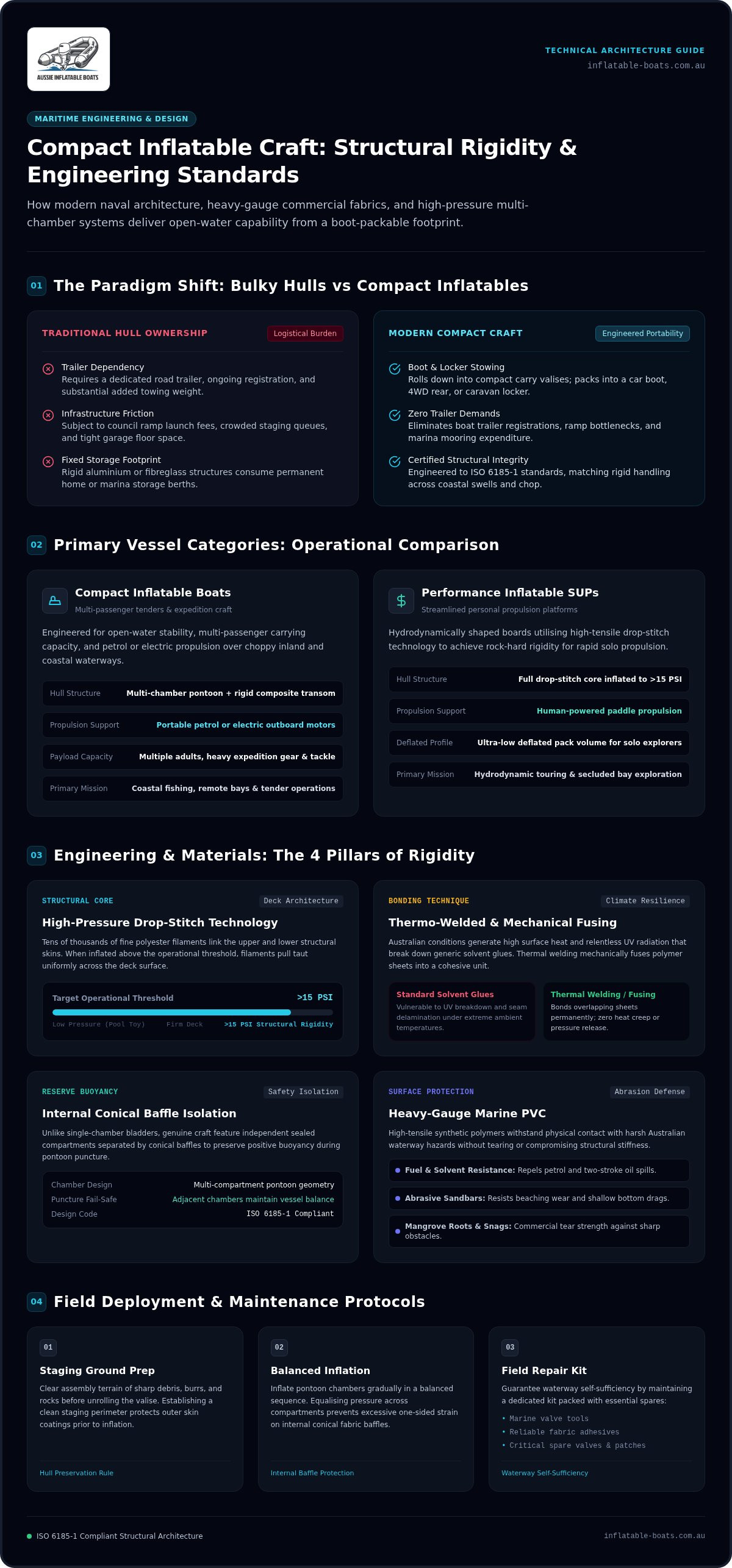
A compact inflatable is a packable, multi-chamber vessel engineered for rapid deployment, rugged stability, and easy transport. For decades, recreational skippers faced a difficult trade-off between hull strength and portable convenience. Traditional boating meant managing heavy boat trailers, paying council ramp fees, and allocating substantial garage floor space just to store a tender. Today, advanced naval architecture allows manufacturers to build lightweight craft that fold neatly into a car boot or caravan locker without cutting corners on structural integrity.
Modern vessels range from small transom-hung motor tenders and packable expedition dinghies to rigid high-pressure paddle boards. Unlike cheap pool toys that rely on single-chamber bladders, a genuine modern inflatable boat incorporates independent, sealed air compartments alongside reinforced composite transoms. These chambers provide crucial reserve buoyancy if an outer pontoon sustains damage on isolated waterways. Crucially, they deliver genuine payload ratings, comfortably carrying multiple adults, expedition gear, and compact outboard motors while maintaining a light overall profile.
The Evolution from Bulky Tenders to Packable Performance
Early tender designs were notoriously heavy and difficult to stow. Skippers had to drag awkward, rubberised hulls onto vehicle roof racks or invest in dedicated road trailers that added hundreds of kilograms to their towing weight. That dynamic has changed completely. High-tensile synthetic polymers and refined thermo-welded joints now allow heavy-duty hulls to roll down into compact carry valises. You can easily fit your entire maritime setup into the rear of an everyday SUV. If you want to explore the full range of hull shapes and configurations, inspect our wide array of inflatable craft designed for varied Australian waters.
Key Categories: Inflatable Boats Versus Performance iSUPs
Selecting the right craft comes down to your operational goals and passenger needs. Both categories bypass marina berth costs and storage fees, but their on-water execution differs significantly:
- Compact Inflatable Boats: Engineered with rigid transoms, solid bench seating, and multi-chamber pontoons. They handle portable petrol or electric outboard motors, cut through choppy inland water, and offer stable platforms for coastal fishing or tender duties.
- Performance Inflatable SUPs: Designed for streamlined hydrodynamics and rapid human propulsion. These boards use drop-stitch construction to achieve rock-hard rigidity at higher pressures, packing into an ultra-low deflated volume that suits solo explorers.
Engineering and Materials: What Gives Compact Inflatables Their Rigidity?
True on-water performance hinges on advanced engineering, not just pumping air. A heavy-gauge compact inflatable relies on fabric tensile strength, internal pressure thresholds, and deliberate chamber design to mirror the handling of a traditional rigid hull. Quality vessels adhere to the ISO 6185-1 safety standard, ensuring structural integrity against crashing swell, heavy payloads, and sudden hull abrasion.
High-Pressure Drop-Stitch Technology Explained
Drop-stitch construction revolutionised portable marine flooring. Tens of thousands of fine polyester filaments link the upper and lower structural skins inside the chamber. When inflated beyond 15 PSI, these internal threads pull taut uniformly across the entire deck area. The result is a rock-solid platform that mimics aluminium or timber decking without the punishing storage footprint. You get surefooted stability for hauling heavy tackle boxes, standing to cast, or hauling supplies through chop.
Seam Construction and UV Resilience Across Australia
Harsh local conditions quickly ruin sub-par watercraft. Relentless ultraviolet exposure and high surface heat break down generic solvent glues, causing seam delamination and sudden pressure loss. Professional craft utilise thermal welding or high-frequency mechanical fusing. This process bonds overlapping polymer sheets into a single, cohesive unit that won't give way when ambient temperatures climb. Heavy-gauge marine PVC shrugs off fuel spills, abrasive sandbars, and razor-sharp mangrove roots season after season.
Air Chamber Isolation and Safety Architecture
Safety on remote waterways requires engineered redundancy. Quality pontoons feature multiple independent air chambers divided by internal conical baffles. If a submerged snag punctures an outer pontoon, the adjacent chambers maintain stability and buoyancy so you can motor back to the ramp without panic. Spring-loaded push-turn valves prevent accidental leaks, while overpressure relief valves vent excess air when baking midday sun causes internal gas expansion. To source a heavy-duty hull engineered for these demanding environments, inspect the rugged fleet at Inflatable Boats.
Choosing the Right Compact Hull: Floor Types and Capacity
Selecting a hull style demands an honest assessment of how you travel, store gear, and launch. Floor architecture dictates three fundamental variables: total pack-down weight, assembly speed, and dynamic open-water handling. A design that feels solid underfoot during coastal swell may prove frustratingly cumbersome if you need to heave it into a vehicle boot without assistance. Matching the deck structure to your transport constraints ensures that owning a compact inflatable remains a liberating pursuit rather than an exhausting staging chore. To evaluate diverse hull styles and load ratings, inspect our verified marine collections.
High-Pressure Air Deck Versus Slatted and Sectional Decks
Every floor design balances pack-down convenience against hydrodynamic rigidity:
- High-Pressure Air Decks: Inflatable drop-stitch floors stay inside the boat during pack-down, rolling up into a single valise. They provide firm footing, dampen hull vibrations over chop, and maximise convenience for solo mariners loading gear into passenger cars.
- Slatted Timber Decks: Built with spaced marine-ply battens permanently bonded to the fabric floor. They roll up in seconds without disassembling internal panels, offering a reliable, low-maintenance platform for quick tender duties and sheltered estuary hops.
- Aluminium Sectional Floors: Interlocking alloy panels lock into structural side stringers to produce an exceptionally stiff planing surface. While they handle heavy throttle loads and sharp equipment with ease, they add physical weight and require extra assembly time on the bank.
Evaluating Pack-Down Dimensions Against Your Vehicle Space
A vessel only delivers true freedom if it fits your vehicle layout without hassle. Measure deflated valise dimensions against vehicle boot space, ute tub drawers, or caravan under-bed lockers. Don't overlook secondary equipment either. High-volume pumps, sectional oars, bench seats, safety gear, and external fuel tanks quickly claim vehicle volume. Splitting heavier hulls and floor panels into separate valises keeps individual lift weights manageable, protecting your back during solitary launches and preserving payload capacity for long outback transits.
How to Assemble, Inflate, and Pack Down a Compact Inflatable
Deploying a compact inflatable requires methodical discipline, especially when setting up on unmaintained riverbanks or remote tidal flats. A rapid launch starts with inspecting your staging ground. Never unroll marine fabric directly over razor-sharp river gravel, broken glass, or jagged mangrove snags. Laying down a heavy groundsheet or thoroughly sweeping grass flats shields the bottom skin from point abrasions before the craft even hits the water.
Inflation Sequencing and Pressure Management
Rushing the pump cycle causes unnecessary mechanical stress. Because multi-chamber pontoons rely on flexible internal conical baffles, you should never inflate one chamber to maximum pressure while the adjacent tube remains completely flat. Work methodically around the craft. Bring each tube chamber up to roughly half volume so the internal dividing fabric remains balanced. Once the boat takes structural shape, bring each compartment up to rated working pressure using an accurate mechanical or digital pressure gauge. Remember that air expands rapidly under direct sunlight. A tube inflated in the cold dawn air will increase in internal pressure by midday, requiring a quick venting adjustment. To see these steps performed by technicians in real-world field conditions, watch practical setup demonstrations on our dedicated marine video resource page.
Pack-Down Hygiene: Rinsing, Drying, and Folding Routines
Hull longevity depends largely on how you pack down at the end of an expedition. Salt crystals, fine river silt, and decaying weed act like abrasive grit against welded seams when compressed inside a transport bag. Flush the hull, transom joints, and valve seats with clean fresh water. Allow the craft to air dry fully in the shade, because packing a damp hull inside a dark vehicle locker fosters mildew and fabric staining. Deflate the tubes by locking the valve pins open, draw out excess air, and fold the pontoons along factory seam lines rather than forcing sharp, unnatural creases into the fabric.
Ready to experience effortless storage without giving up open-water capability? Browse the high-performance watercraft and heavy-duty touring packages at Inflatable Boats to find your ideal expedition setup.
Essential Field Gear, Spare Parts, and Maintenance Support
Self-reliance is the golden rule of remote boating. Operating a compact inflatable lets you access hidden coves and secluded river bends far from crowded ramps, but venturing off the grid means you cannot rely on quick roadside assistance. Carrying a dedicated onboard spares inventory guarantees that minor valve issues or snagged hulls won't bring an expedition to an abrupt halt.
The Critical Onboard Spare Parts Checklist
Keep a water-resistant dry canister stowed on board with these mechanical essentials at all times:
- Fitted Valve Wrench: Valve bodies can loosen slightly after heavy wave pounding. A matched polymer valve tool lets you tighten a leaking core or replace a damaged seal in minutes.
- Compatible Two-Part Adhesive and Fabric Swatches: Generic hardware glue fails under water pressure. Carry marine patch fabric matched to your boat's specific polymer denier, paired with a reliable two-part contact adhesive formulated for salt-spray exposure.
- High-Output Manual Pump: Electric inflators make vehicle setup effortless, but batteries can run flat. A backup double-action hand pump ensures you can always top up pressure on remote shores.
- Hardware and Lines: Secure an eight-metre painter line for towing or mooring, along with collapsible aluminium oars clipped directly into the integrated pontoon rowlocks.
When to Seek Professional Workshop Repair Services
Knowing the operational limits of field repairs protects both your crew and your investment. A small hook puncture or superficial surface scuff is easily handled with a clean field patch. In contrast, delaminated floor seams, high-stress transom joint separations, and punctured internal baffles demand specialised workshop attention. The composite transom carries the full dynamic thrust, vibration, and weight of your outboard motor; attempting a temporary adhesive fix on high-load structural joints creates serious safety risks on open water.
If your vessel requires structural seam restoration or professional transom refurbishment, consult our technical team via Contact to arrange expert maintenance support. You can also explore our full range of certified vessels, heavy-duty pumps, and genuine marine accessories directly at Inflatable Boats to ensure your setup remains fully mission-ready.
Unlock Secluded Waterways with Absolute Confidence
Owning a capable vessel shouldn't mean wrestling with cumbersome trailers, paying hefty storage fees, or overloading your vehicle's payload. Modern engineering proves that you can pack genuine maritime performance into your car boot without sacrificing structural stiffness. By matching the right floor profile to your travel setup, following balanced inflation sequences, and carrying essential spare fittings, you gain unrestricted access to pristine bays and remote river systems across the country.
True peace of mind comes from using marine-grade materials engineered specifically for demanding freshwater and saltwater environments. Backed by nationwide Australian dispatch for watercraft, iSUPs, and spare parts, alongside dedicated professional workshop repair and technical overhaul services, self-reliant boating is easier than ever. Ready to transform your time on the water? Explore our full range of durable compact inflatable craft and accessories at Inflatable Boats and prepare for your next expedition today.
Frequently Asked Questions
Can a compact inflatable boat handle rough coastal waters safely?
Yes, provided it's a multi-chamber, commercial-grade craft with adequate pontoon diameter and a rigid floor profile. Wide-beam inflatable pontoons provide a low centre of gravity and exceptional buoyancy in choppy conditions. You'll still need to respect open-water limits, monitor coastal wind warnings, and carry certified lifejackets alongside mandatory safety equipment before negotiating tidal channels or exposed coastal headlands.
How much storage space does a deflated compact boat actually require?
A folded compact inflatable typically occupies the volume of a large suitcase or heavy-duty duffel bag. Most hulls between 2.4 and 3.5 metres roll down to roughly 110 by 60 by 35 centimetres. That compact profile slides directly into an everyday car boot, ute tub, or caravan locker, eliminating trailer registration fees while preserving your vehicle's payload capacity for extra camping supplies.
What is the lifespan of a quality compact inflatable boat in Australia?
A quality vessel built from heavy-gauge polymer with welded seams generally delivers 5 to 10 years of reliable service under local conditions, while Hypalon craft often exceed 15 years. Because intense ultraviolet radiation degrades materials rapidly, longevity depends on regular freshwater washing, applying marine fabric protectants, avoiding over-pressurisation on hot afternoons, and keeping the valise dry in garage storage.
Do I need a boat licence to operate a compact inflatable craft?
Licensing requirements depend entirely on your state or territory and the engine power fitted to your vessel. In Victoria, you need a marine licence for any motorised craft, whereas Queensland requires one once your motor exceeds 4.5 kW. New South Wales mandates a licence for speeds of 10 knots or greater. Check your state maritime authority rules before taking to the water.
What is the best way to clean and store an inflatable craft long-term?
Wash down the pontoons and floor thoroughly using fresh water and mild soap to strip away corrosive salt, mud, and sand. Ensure the boat dries completely in the shade, since trapping moisture inside storage bags encourages mildew and seam rot. Store the packed valise off cold concrete floors in a cool, sheltered space away from petrol vapour and rodents.
Can I attach an outboard motor to a compact inflatable dinghy?
Yes, genuine inflatable dinghies feature heavy-duty composite transoms designed to mount portable petrol outboards or quiet electric trolling motors. Always consult the vessel's Australian Builders Plate for certified engine power and transom weight limits. Matching your motor size correctly prevents transom stress, ensures flat planing trim, and keeps your rig fully compliant with local maritime safety standards.
How do I locate and repair an air leak on an inflatable boat?
Mix liquid dishwashing detergent with water in a spray bottle and coat the fully inflated pontoons, seams, and valve seals. Escaping air creates distinct clusters of soapy bubbles over the puncture site. Once identified, dry and scuff the surface, clean it with solvent, and apply marine contact adhesive with a fabric patch. Major structural seam splits require professional workshop servicing.