
Choosing Inflatable Tender Boats by Size, Material and Cost
The best tender is the one that takes you where your main boat can’t. Choose inflatable tender boats to suit your passengers, intended use and boating conditions, then compare engine power, construction material and storage needs. No single size suits every boat or trip.
A tender does more than ferry people between a yacht and shore. It can reach places your main boat can’t, or give you a practical way to go fishing or snorkelling. The right fit makes these trips easier to plan and more enjoyable.
This guide explains how tender length, passenger capacity and engine power work together, what material and construction mean for use and upkeep, and what affects prices in Australia. You’ll also see how your intended use can guide your choice, from reaching a port to exploring a remote stretch of coast.
Key Takeaways
- Match tender length and passenger capacity to who’ll travel aboard, where you’ll use it and how you’ll store it.
- Use the boat’s rated engine-power limit as a firm selection point when choosing an outboard.
- Compare PVC, Hypalon and polyurethane construction against your intended use, care needs and priorities for durability.
- Assess the full value of a tender by considering its construction, equipment and suitability for your trips, not price alone.
- Think beyond the trip to shore: a tender can also help you reach less accessible places or go fishing and snorkelling.
Boat length, engine power and passenger capacity
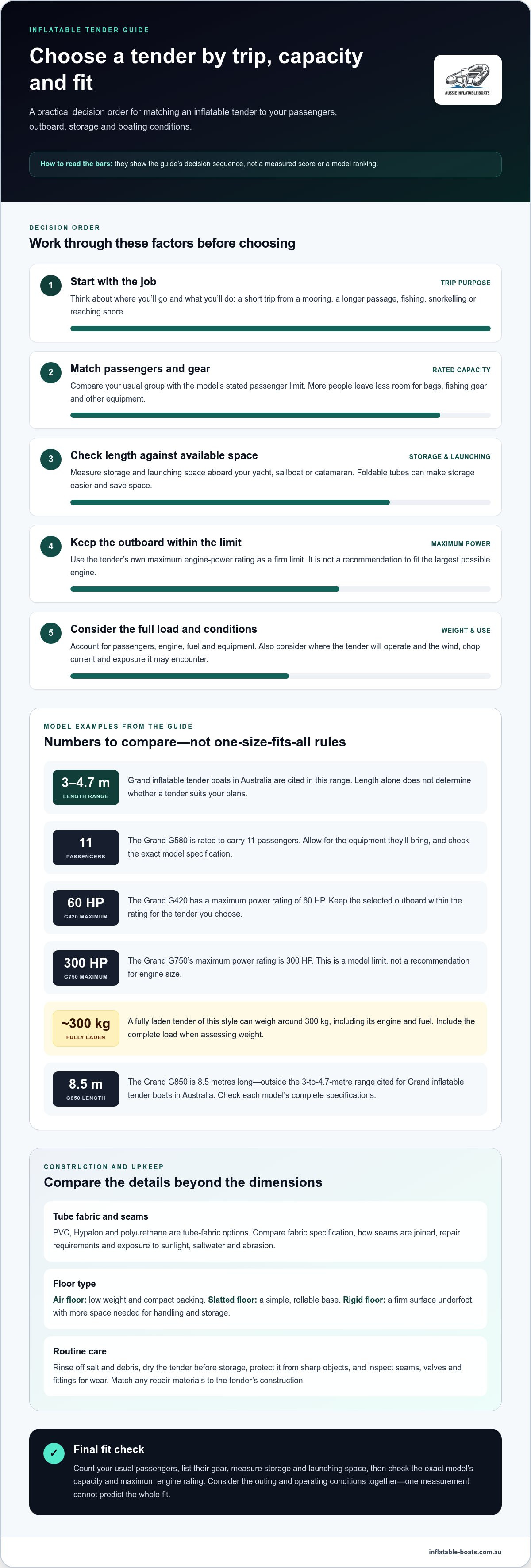
Start with the job, then match the tender’s dimensions to your main boat. A tender length should suit passenger numbers, intended application and sailing area. A compact option may suit short trips from a mooring, while longer passages or more people call for careful attention to space and capacity. In Australia, Grand inflatable tender boats range from 3 metres to 4.7 metres. That range gives a useful sense of scale, but length alone doesn’t determine whether a tender fits your plans.
Passenger capacity is a model-specific limit, not a rough guide to comfort. The Grand G580 is rated to carry 11 passengers. Consider how many people will travel together, then allow room for the equipment they’ll bring. A full passenger load leaves less space for bags, fishing gear or other items. Match the rated capacity to your usual trip, rather than choosing solely for the occasional largest group.
Engine power also varies by model. The Grand G420 has a maximum power rating of 60 HP, while the Grand G750’s maximum is 300 HP. These figures are limits for those models, not a recommendation to fit the largest possible engine. Compare a tender’s maximum power rating with the outboard you intend to use. Then consider how the tender will be loaded and where it will operate.
- Passenger count: Compare your typical group with the model’s stated capacity. The G580’s 11-passenger rating offers a concrete reference point.
- Length: Measure the available storage and launching space on your yacht, sailboat or catamaran. Foldable tubes can make storage easier and save space.
- Engine: Keep the selected outboard within the tender’s maximum power rating. The G420’s limit is 60 HP; the G750’s is 300 HP.
- Load: Account for passengers, engine, fuel and equipment when assessing the total weight. A fully laden tender of this style can weigh around 300 kg, including its engine and fuel.
Check the complete specification for the exact model before deciding. For example, the Grand G850 is 8.5 metres long, a useful reminder that model dimensions can sit outside the 3-to-4.7-metre range cited for Grand inflatable tender boats in Australia. Compare length, capacity and power together, rather than assuming one measurement predicts the others. A larger tender may offer more room, yet also needs suitable storage and handling arrangements aboard the main vessel.
Think through a typical outing from launch to return. Count the passengers, list their gear, and consider the distance and conditions. Then compare those needs with the tender’s length, rated capacity and maximum engine power. This sequence helps narrow your options to a model that suits both your trips and your boat.
Inflatable tender materials
Material choice affects how an inflatable tender handles storage, use and ongoing care. Compare the tube fabric, seams, floor construction and repair requirements together. PVC, Hypalon and polyurethane are different materials used in tender construction. Start with your operating conditions, storage space and maintenance preferences, rather than choosing by material name alone.
Check what the tube fabric is made from and how its seams are joined. Welded and bonded seams use different construction methods, so assess the finished build and repair requirements alongside the fabric. Consider repeated exposure to sunlight, saltwater, abrasion and contact with a pontoon or shore. These practical conditions can help you choose materials and construction that suit your routine.
Air, slatted and rigid floors suit different priorities. Choose an air floor when low weight and compact packing matter; slats provide a simple, rollable base. A rigid floor offers a firm surface underfoot but takes more space to handle and store.
Australian safety equipment and registration requirements depend on the state or territory, operating area and vessel circumstances. Identify the local marine safety rules that apply to your tender’s use, including where it travels and whether registration is required.
Grand is one named brand in Australian-market examples, with models including the G420, G580, G750 and G850. Compare each model’s own construction and specifications; a brand name alone doesn’t establish suitability.
For a safe launch, secure loose gear, keep the tender clear of hazards and use its lifting points as intended. Retrieve it under control, rinse off salt and debris, dry it before storage, and protect it from sharp objects and unnecessary pressure.
Clean the fabric with fresh water and a suitable gentle cleaning method, then inspect seams, valves and fittings for wear. Check air pressure carefully, to within 0.25 bar. Repair punctures or seam damage with materials compatible with the tender’s construction; professional inflatable boat repairs can address damage requiring specialist work.
In Australian coastal conditions, wind, chop, current and changing exposure can make a small tender harder to control. Abrasion against a beach, vessel or rocky landing can also damage tubes and fittings, so choose sheltered routes and landing points suited to the conditions.
Use material, floor type and construction as a practical shortlist, then compare complete tender specifications. Browse the inflatable boat range with your storage and operating needs in mind.
PVC, Hypalon and polyurethane construction
Australian buyers can choose soft-bottom inflatables, air-floor tenders and rigid inflatable boats (RIBs). Each combines tube material and floor construction differently, so compare both before choosing. PVC, Hypalon and polyurethane refer to tube fabrics, not complete tender designs. A RIB, for example, pairs inflatable tubes with a rigid hull.
PVC is a common synthetic fabric for inflatable tubes. Its suitability depends on the fabric specification, seam construction and expected handling. Welded PVC seams join fabric using heat, while other constructions use adhesive bonding. Check how the manufacturer describes the seams, patches and repair method. A repair kit designed for one fabric may not suit another, so match repair materials to the tender’s construction.
Hypalon is a familiar name for a coated synthetic fabric used in inflatable craft. Compare the specific fabric and construction details rather than treating the name as a complete measure of quality. Check how the seams are made and what care the manufacturer recommends. For a tender stored aboard a yacht, storage conditions and regular inspection matter as much as the fabric choice.
Polyurethane is another material used in inflatable boat construction. Some tender designs use polyurethane-coated fabric, but the material name alone doesn’t describe the complete build. Check how the tubes, seams and fittings are assembled, and follow the manufacturer’s cleaning and repair guidance. Salt, grit and repeated contact with hard surfaces can affect the upkeep of any tender.
- Compare the fabric: Identify whether the tubes use PVC, Hypalon or polyurethane, and note the stated fabric construction.
- Inspect the seams: Look for information on welded or bonded joins, then check that repair guidance suits that method.
- Assess the hull: A RIB has a rigid hull; a soft-bottom tender folds differently and has different storage demands.
- Match the floor: Air floors, slatted floors and rigid floors change packing, assembly and underfoot feel.
For example, a tender kept inflated on davits has different storage needs from one packed away between trips. A rigid hull requires suitable space and handling, while a foldable design can be stowed more compactly. Consider where the boat will sit, how it will be launched, and whether you’ll carry it aboard or move it ashore.
Use a simple selection sequence: decide on the tender style, identify the tube material, then compare seams and repair requirements. Finally, consider storage and regular care. The best fit is the construction that suits your launch routine, storage arrangement and intended use, not simply the material with the most familiar name.
Tender prices in Australia
Compare inflatable tender prices by configuration, not headline figure alone. A PVC tender with a basic floor differs from a RIB with a rigid hull, even at a similar length. Material, floor type, construction and included equipment all affect what a quoted price covers. Start by comparing tenders with similar dimensions and intended uses.
Tube fabric is one factor. PVC, Hypalon and polyurethane have different construction and care considerations that can affect a tender’s overall value. Compare the fabric, seams and repair approach together. A low initial price doesn’t show whether the boat suits your storage, use or maintenance needs.
Floor design also changes the configuration. Air, slatted and rigid floors involve different components and storage needs. A RIB adds a rigid hull beneath its inflatable tubes. Compare these designs with your launch routine and available space, rather than treating all tenders as equivalent.
Check what the quoted amount includes before comparing alternatives. Use this checklist:
- Boat only: Identify whether the quote covers the hull and tubes, or includes a floor and seat.
- Propulsion: Separate the tender from any outboard motor or related equipment.
- Accessories: Note whether items such as paddles, a repair kit, lifting points or a waterproof bag are included.
- Delivery and setup: Check which costs, if any, are included in the final amount.
Compare the equipment list line by line. For example, one quote might include a removable seat and repair kit, while another lists them separately. These differences affect what you’re comparing, even when both descriptions refer to the same tender size. Record each model’s inclusions to make the comparison clear.
Think about ownership as well as the purchase. A tender stored aboard a yacht may need a foldable design, while a RIB needs room for its rigid hull. Consider how you’ll transport, clean and maintain the boat. Replacement parts, repairs and accessories can matter over time, so compare construction and support needs alongside the initial outlay.
Build a practical shortlist: define your intended use, choose a suitable construction, then compare complete equipment lists. Keep the tender, outboard and accessories separate in your calculations. This makes comparisons across Australian listings more meaningful and helps identify the configuration with the features your trips require.
When reviewing any advertised rate from Inflatable Boats, treat that figure as a reference for a specific configuration, then check the accompanying equipment list and compare it with tenders of similar construction and intended use. The listed price alone doesn’t establish which items or delivery arrangements are included.
Inflatable tender boat uses
A tender’s strongest advantage is access. From a moored yacht, it can ferry people to shore or a nearby port, where the main vessel cannot berth conveniently. It can also reach remote places and landing spots too shallow or confined for the larger boat. These different jobs shape the tender’s useful range, passenger needs and equipment choices. For Australian boaters, planning around actual destinations makes the tender more than an occasional shuttle.
Imagine a coastal day with your yacht anchored in a sheltered bay. The tender can carry passengers ashore, then return for another trip with bags or supplies. At a port, it can make a short transfer between the vessel and a landing point. These trips call for straightforward boarding and enough room for passengers and their gear. Think through the whole journey, including where everyone will step ashore.
Remote access changes the outing. An inflatable tender can take you from a moored main boat to a less accessible beach or inlet, letting you visit the shore without moving the larger vessel. Before setting off, choose a suitable landing place and consider how the return trip will work. A secluded destination is useful only if the tender can approach and leave safely.
Fishing and snorkelling are practical uses, too. A tender can carry fishing gear to another spot or take snorkellers from the main boat to a suitable area. The activity determines what you’ll bring aboard: fishing tackle, a small catch, snorkelling equipment or dry bags. Allow room for passengers, since bulky gear can make boarding awkward and reduce usable space.
- Shore transfers: Plan passenger movements, bags and the landing point before leaving the yacht.
- Port access: Use the tender for short journeys between a mooring and shore.
- Remote exploration: Identify a reachable beach or inlet, then plan the return route.
- Fishing or snorkelling: Match onboard space to the equipment needed for the activity.
For inflatable tender boats, test your options against a typical outing. Name the destination, count the people, list the equipment and picture the landing. A tender used mainly for port transfers may have different priorities from one carrying fishing gear or snorkellers. Starting with the use helps you compare suitable designs without choosing on appearance alone.
Before you set out, match the trip to the tender’s capacity, equipment and conditions. Keep the route appropriate to the outing, and avoid treating a compact tender as a substitute for the main boat on every journey. Explore inflatable boat options with your planned trips and landing points in mind.
Inflatable Boats: Inflatable Boats
Inflatable Boats sells inflatable boats, accessories and spare parts, and provides repair services for inflatable vessels. These options can help when you’re matching a tender to planned trips, maintaining your existing boat or addressing damage that affects its use.
For a new tender, compare boat size, construction and intended use before choosing a model. For an existing boat, the right accessory or spare part can support your setup, while repairs can address wear or damage. Be specific about your needs, such as the tender’s material, the component you need or the repair required.
Contact Inflatable Boats to discuss your tender requirements or repair needs.
Plan your next tender trip
Before settling on inflatable tender boats, turn your preferred option into a practical plan. Picture an outing from launch to return: who is aboard, what needs to travel with them, and where will the tender be stored afterwards? This final check can reveal whether the setup suits your routine as well as your destination. Write down your priorities to keep comparisons grounded in how you’ll use the boat.
Think beyond the first outing, too. A tender may support regular trips ashore or become your way to explore a new stretch of coast. Consider how it will fit into your boating routine through the season, including the time and space needed to prepare it between trips. Choose a boat that works for the journeys you expect to make, not simply one that looks right on a product page. If you’re considering a new boat or need accessories or spare parts, contact Inflatable Boats.
Ready to discuss what fits your plans? Contact Inflatable Boats and take the next step towards more confident days on the water.
Frequently Asked Questions
What size inflatable tender is best for a yacht or boat?
Choose a tender that fits your yacht’s storage and launch setup, then check that it can carry your usual passengers and gear. Measure the storage area, including access through hatches or around deck fittings. A tender that fits on deck, for example, may still be awkward to move through a narrow passage. Compare packed dimensions as well as operating length, and consider where you’ll secure the boat between trips.
How much do inflatable tender boats cost in Australia?
Prices depend on the tender’s size, construction, floor, included equipment and whether an outboard is part of the purchase. Compare complete configurations rather than headline prices: a package with seats or paddles differs from a boat-only listing. Also include any accessories needed for your planned use. For a fair comparison, note what each option includes and identify any equipment you’ll need to buy separately.
What are the differences between PVC and Hypalon inflatable tenders?
PVC and Hypalon are different tube-fabric materials, but the name alone doesn’t tell you how a tender is built or maintained. Compare the fabric specification, seam construction and manufacturer’s care instructions. If you expect to repair a small puncture yourself, for example, check that the repair materials and method suit the fabric. This makes upkeep easier to plan and helps you compare construction details rather than relying on material labels alone.
What outboard motor size and weight suit an inflatable tender?
Choose an outboard within the tender’s maximum power rating, and check that its weight suits the transom and the boat’s load. Start with the manufacturer’s specifications: power must stay within the stated limit, while motor weight affects handling and balance. Account for passengers, fuel and equipment when considering the total load. Even a motor within the power limit may be a poor fit if its weight compromises the tender’s setup.
Which inflatable tender brands and models are popular in Australia?
Grand models mentioned include the G420, G580, G750 and G850. The Australian-market examples also include the Aurora Lite RIB 260 and Brig Eagle 340.