
Choosing an Inflatable Surf SUP for Small Waves
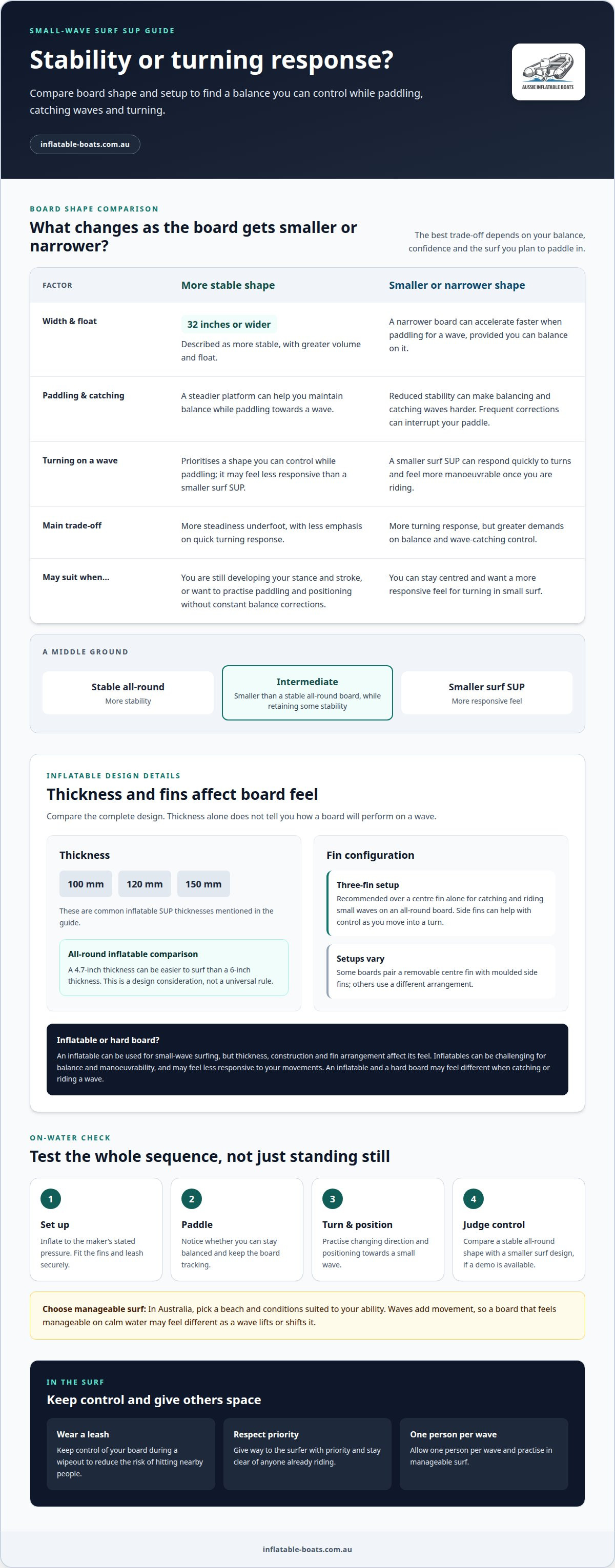
A board at least 32 inches wide offers more stability and float, while a narrower shape can accelerate faster when paddling for a wave if you can balance on it. Choosing an inflatable paddle board for surfing small waves means weighing that stability against the responsiveness you need to turn and ride.
It’s a real trade-off: a more manoeuvrable board can feel lively on a wave, but may be harder to balance on and to use when catching small surf. The right fit depends on your confidence, balance and the conditions you want to paddle in.
This guide explains how length, width and stability shape your choice, what inflatable construction and fin setup can mean in the surf, and how testing a board on the water can help you judge its feel. You’ll have a clearer way to choose a SUP for small waves and your experience level, so you can focus on the ride.
Key Takeaways
- Match board length and width to your balance, experience and the kind of small waves you plan to ride.
- Consider how an inflatable board’s thickness and fin configuration can affect its feel when catching and riding waves.
- Use an on-water test to judge whether a board feels stable underfoot and responsive enough for your turns.
- Paddle-board surfing offers a higher vantage point on the water, adding a different perspective to a beach session.
- Learn which design trade-offs matter most before choosing a board for your next surf.
Choosing a surf SUP by length, width and stability
For an inflatable paddle board for surfing small waves, balance length and width against the stability you need to paddle and catch waves. Inflate it to the maker’s stated pressure, fit its fins and leash securely, then paddle with control. In Australia, choose a beach with small, manageable surf suited to your ability and conditions.
Balancing stability and manoeuvrability
A smaller surf SUP can respond quickly to turns, making it easier to manoeuvre once you’re riding. The trade-off is reduced stability: balancing and catching waves may feel harder than on a larger board. Compare the board’s dimensions with your ability to stay centred while paddling, then consider how much turning response you want on a wave.
Length matters, too. A longboard-style shape feels different from a shorter, more responsive surf SUP. Intermediate boards sit between these choices: they’re smaller than stable all-round boards, yet retain some stability. For small surf, prioritise a shape you can control while paddling rather than choosing solely for its turning potential.
Width, float and paddling stability
Width affects how steady a board feels underfoot. Surf SUPs measuring 32 inches or wider are described as more stable, with greater volume and float. That extra steadiness can make it easier to maintain balance while paddling towards a wave, particularly if you’re still developing your stance and stroke.
Narrower boards can accelerate faster when paddling for a wave, provided you can balance on them. That advantage matters only if you can keep the board tracking while your attention shifts to the surf. Compare width alongside length and your own balance. A fast, narrow board may be less practical if frequent corrections interrupt your paddle.
Stability for novice paddlers
If you’re new to SUP surfing, choose enough stability to practise paddling and positioning without constant balance corrections. A wider board can provide a steadier platform, while a smaller board may demand more control before you’re ready to use its manoeuvrability. Your confidence on flat water is a useful starting point, but waves add movement and require active adjustments.
Think through the sequence: stand comfortably, paddle with control, then turn towards a wave. If any step feels unstable, a more stable shape may suit your current ability better. As your balance improves, an intermediate surf SUP can help you progress towards greater responsiveness while retaining some stability.
Entry-level surf SUPs for small waves
For your first surf SUP, consider how its design affects balance, wave-catching and turning. A demo can show how those trade-offs feel in moving water, beyond what the dimensions alone tell you.
Testing and demoing surf SUPs
Try a surf SUP on the water before choosing it, if a demo is available. Paddle, turn and practise positioning towards a small wave. Notice whether you can keep your balance while changing direction.
Assess the board through the whole sequence, not just while standing still. A board that feels manageable on calm water may feel different as a wave lifts or shifts it. Compare a stable all-round shape with a smaller surf design, and let your control guide the decision.
Inflatable SUPs for small-wave surfing
An inflatable SUP can be used for small-wave surfing, but its design affects how it behaves. Thickness, construction and fin arrangement all contribute to how the board feels underfoot and responds to a turn. Focus on whether you can paddle, catch a wave and steer with control.
Inflatables have limitations in waves: balance and manoeuvrability can be challenging, especially when the board feels less responsive to your movements. A hard board and an inflatable may therefore feel different when catching or riding a wave. Judge the individual board in the conditions you intend to surf rather than assuming either type will suit every rider.
Fin setup options
Fin configuration influences how a SUP tracks and turns. For catching and riding small waves on an all-round board, a three-fin setup is recommended over a centre fin alone. The extra side fins can help with control as you move from paddling straight into a turn.
Check the setup before heading out. Some designs pair a removable centre fin with moulded side fins, while others use a different arrangement. Fit the fins securely, then assess how the board tracks and responds during a demo.
Catching and riding waves on different boards
A narrower board can accelerate faster when paddling for a wave, if you can balance on it. A smaller surf SUP can then feel more responsive, but its reduced stability may make catching waves harder. These trade-offs also matter when comparing an inflatable with a hard board, so weigh control and wave-catching rather than material alone.
In Australian surf, wear a leash and keep control of your board during a wipeout to reduce the risk of hitting nearby people. Give way to the surfer with priority, allow one person per wave, and stay clear of anyone already riding. Check local conditions before choosing a beach, and practise in manageable surf. To explore inflatable paddle boards, consider how their design matches the waves you plan to ride.
Inflatable SUP design for surfing
Inflatable design choices affect how an all-round SUP feels when paddling into small surf. Compare thickness, overall shape and fin arrangement together rather than treating one specification as the whole answer.
Thickness and board feel
Inflatable SUPs commonly come in thicknesses of 100 mm, 120 mm or 150 mm. These measurements describe board depth, but they don’t tell you by themselves how a board will perform on a wave. Shape and construction also influence how it feels underfoot, so assess the complete design.
For an all-round inflatable, a 4.7-inch thickness can be easier to surf than a 6-inch thickness. Use this comparison as a design consideration, not a universal rule for every board or rider. During a demo, notice whether the board feels manageable as you paddle, shift your stance and begin a turn.
Choosing a design for your surfing
“Custom” can mean choosing a design that suits your priorities rather than ordering a bespoke board. An all-round SUP favours broader use, while a surf-focused shape puts more emphasis on manoeuvrability. For small waves, weigh stability against responsiveness and your ability to control the board.
Make the choice in sequence. First, decide how steady you need the board to feel while paddling. Next, consider how easily you want it to turn after you catch a wave. Finally, compare thickness and fin arrangement with those priorities. This process helps identify a suitable design without assuming one specification fits every surfer.
Fin design and setup
Fin arrangement is another part of a board’s surf design. A three-fin configuration is recommended for catching and riding small waves on an all-round SUP, rather than relying on a centre fin alone. The setup should suit the board’s intended use and the way you want it to respond during a turn.
Before paddling out, fit each fin as intended and make sure it sits securely. Then consider how the board tracks in a straight line and responds as you change direction. This practical check connects the fin design to your control, instead of judging the arrangement by appearance alone.
No single combination of thickness, shape and fins guarantees the right feel. Use the stated dimensions to narrow your options, then judge the complete board on the water. A 4.7-inch all-round design and a 6-inch design may feel different underfoot, while a three-fin setup changes the design from a centre-fin-only arrangement. Each choice should support the balance of paddling control and wave manoeuvrability you want.
Testing a board before choosing one
A demo lets you judge a surf SUP by feel, not dimensions alone. Test how the stand-up paddle board behaves as you paddle, turn and position for a wave. A board that feels comfortable while stationary may feel different once you start moving.
Use a demo to assess the actions that matter in small surf. Paddle in a straight line, change direction, then practise turning towards an approaching wave. Notice whether the board responds as you expect and whether you can keep your stance relaxed. Try a surf SUP before choosing one, and look for a retailer offering demos where possible.
During a trial, work through these checks:
- Start with balance: Stand in your normal paddling position and notice whether you can remain steady while holding the paddle.
- Check tracking: Paddle straight and observe whether you can maintain your direction without repeated corrections.
- Practise a turn: Change direction on both sides and feel how the board responds to your paddle strokes and stance.
- Simulate wave positioning: Turn towards small surf and assess whether you can control the board while preparing to catch a wave.
A beginner choosing a surf-style paddle board should prioritise control during those steps. If balance feels difficult before reaching the waves, a more stable all-round shape may be a better starting point than a compact surf design. A contributor advises against going shorter than about 9-6 if the aim is to improve wave-catching in very small waves. Treat that as a practical reference, then assess how the board feels under you.
Compare shapes by the task you want them to perform. A longboard-style SUP may suit someone who values a steadier paddle and easier wave-catching, while a smaller surf SUP can offer greater manoeuvrability. During a demo, assess both rather than deciding from the board’s label. The key question is whether you can paddle into position, catch a wave and steer with control.
Include the conditions you expect to surf in your decision. A test on calm water can reveal balance and tracking, but cannot fully show how the board handles a moving wave. Use a suitable demo setting and focus on your control, not simply how quickly the board turns. If one design feels difficult to manage, test another shape before deciding.
After testing, compare your observations: which board was easiest to paddle, which felt controlled through a turn, and which helped you position for a wave? Those answers provide a practical basis for choosing a beginner surf SUP. A successful demo isn’t about performing perfectly; it’s about finding a board whose response you can manage as your skills develop.
Advantages of paddle-board surfing
Standing on a paddle board gives a surfer a few feet of extra height compared with sitting on a board. That elevated position changes how you read a small beach break: you can scan the approaching water while upright. The advantage is a different perspective, not a guarantee of catching every wave.
For a small-wave session, that view can help you notice how the surf is shifting before committing to a take-off. From a standing position, you can observe the wave face and adjust your position with a paddle stroke. This can make waiting and watching an active part of your session.
The paddle also provides propulsion before a wave arrives. For example, you can use it to move into position, then turn your attention to the approaching wave. This brings paddling and surfing together, but requires you to manage the paddle while maintaining balance. The board’s feel still matters.
Small waves can produce short rides. A typical ride at a local beach may last 10-15 seconds at most, so the experience isn’t only about time spent standing on a wave. Reading the water, positioning yourself and paddling into the right place are meaningful parts of a session, too.
A SUP offers a distinct way to experience familiar surf. Instead of beginning from a seated position, you approach the wave while standing and paddling. That changes your sightline and how you move across the water. For someone choosing an inflatable paddle board for surfing small waves, those differences can matter as much as turning response.
There’s a practical trade-off. The height and paddle can help with observation and movement, but they also require active balance and board control. On a small wave, you’ll still need to manage your stance as the board moves beneath you. A SUP’s perspective is an advantage when you can use it without losing control.
Think of paddle-board surfing as a combination of reading, positioning and riding, rather than a shortcut to more waves. On your next session, notice whether standing gives you a useful view and whether paddling helps you position comfortably. If you’re considering inflatable watercraft for your time on the water, explore the available options.
This distinction helps keep expectations grounded: standing and using a paddle do not replace the skills needed for more demanding surfing. Riding advanced surf SUPs requires confidence in waves, good balance and the ability to handle a SUP in a crowd. Consider those abilities when deciding what kind of session suits you, rather than assuming extra height alone makes a board suitable. Choose an experience that matches your confidence, balance and comfort managing the board around others.
Inflatable Boats
Inflatable Boats can help when your time on the water calls for more than choosing a surf SUP. Its range includes inflatable boats, accessories and spare parts, along with repair services for inflatable vessels. These options support broader inflatable-watercraft needs, from selecting equipment to addressing a repair.
If you’re weighing your next move after comparing SUP designs, consider whether an inflatable boat or related parts better suit your plans on the water. For help with those options, contact Inflatable Boats.
Make your next water session count
Turn your next session into a practical test of your board choice. Before heading out, decide what you want to learn: how the board feels underfoot, how easily you can position yourself, or whether you’re ready to progress to a more responsive shape. A few clear observations can help you refine your choice over time.
Choosing an inflatable paddle board for surfing small waves is one part of planning your time on the water. If your plans also involve inflatable watercraft, Inflatable Boats offers inflatable boats, accessories and spare parts to support those needs.
For help with inflatable watercraft and related equipment, contact Inflatable Boats. Take your next step with a clear plan, and enjoy the freedom of getting out on the water.
Frequently Asked Questions
What Matters When Buying a SUP For Surfing?
Choose a SUP you can control throughout your session, from carrying and launching to paddling back out. Consider where you’ll store and transport it, how you’ll inflate it, and whether its setup suits the surf conditions you expect. A board that feels lively on a wave still needs to be manageable between sets. Prioritise practical handling alongside surfing performance.
What length, width and thickness of inflatable SUP works best for small-wave surfing?
There isn’t one ideal combination for every rider. A board at least 9 feet 6 inches long is a useful consideration for catching very small waves, while surf SUPs 32 inches wide or more offer greater stability and float. Thickness affects feel: an all-round board at 4.7 inches thick may be easier to surf than one at 6 inches. Choose by fit and control.
What fin setup and paddle length are best for small-wave SUP surfing?
A three-fin arrangement is a useful starting point for an all-round SUP in small waves, rather than a centre fin alone. Paddle length depends on your height, stance and stroke, so adjust it for comfortable, controlled paddling instead of relying on a universal measurement. During a trial, check that the paddle lets you reach the water cleanly without forcing an awkward posture.
How to inflate, set up and paddle an inflatable SUP for surfing?
Inflate the board to the maker’s stated pressure, fit its fins and leash securely, then paddle with controlled strokes. Practise in small, manageable surf suited to your ability and conditions.
Which inflatable paddle boards are recommended for surfing small waves in Australia?
The Ocean Pacific Sunset is described as a stable option for novices. The Shark iSUP Surf 9 Foot 2 Inch has a quick-fit fin and two moulded side fins, a setup suited to catching and riding small waves.
Where can you surf small waves on an inflatable paddle board in Australia?
Choose an Australian beach with small, manageable surf suited to your ability, and check local conditions before heading out.