
Choose an Inflatable SUP for Beginners by Durability and Price
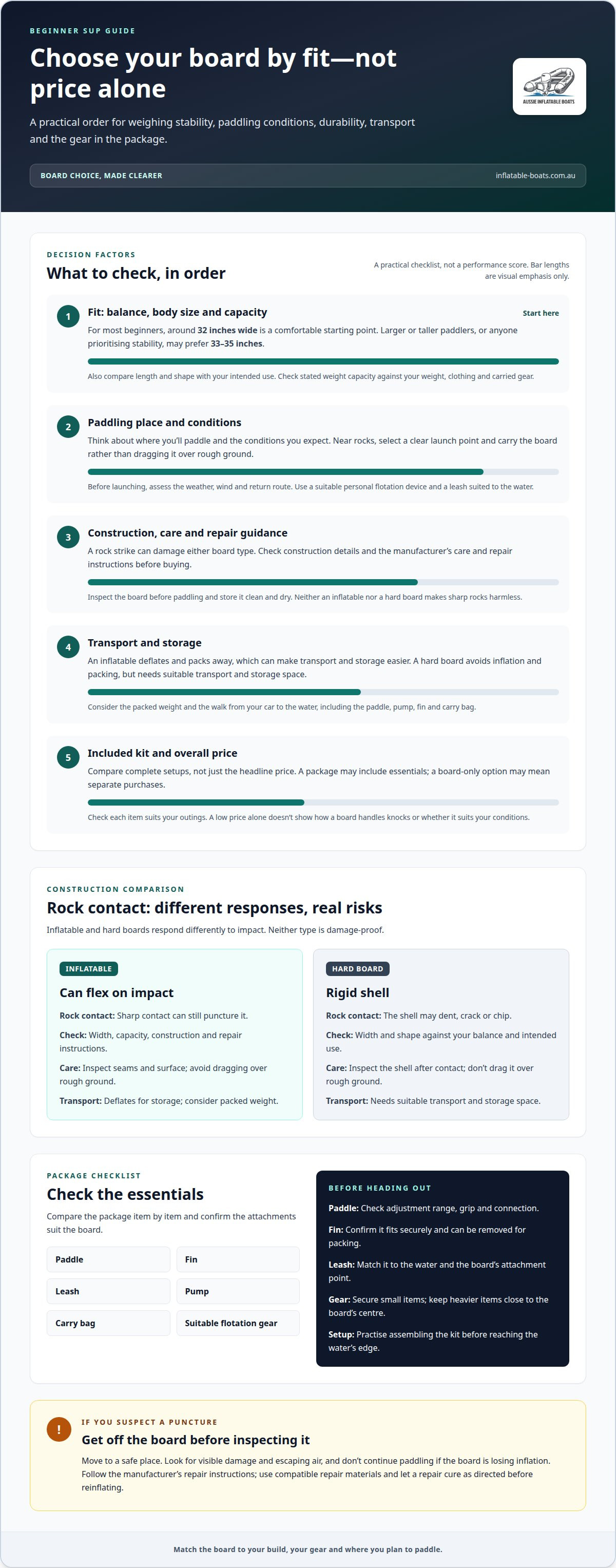
A rock strike doesn’t automatically mean an inflatable board will pop, but no board is immune to damage. For most beginners, a 32-inch-wide inflatable SUP for beginners is a comfortable starting point; boards 33 to 35 inches wide may suit larger or taller paddlers and anyone seeking more stability.
It’s sensible to weigh price against how you’ll use the board, especially if you plan to paddle near rocks. A low price alone won’t tell you how well a board handles knocks or whether it suits your conditions.
This guide compares seven broad options by price positioning, durability considerations and suitability for Australian paddling, helping you make a more informed choice. You’ll also learn which features matter for stability and everyday use, and when an inflatable board may not suit your plans.
Key Takeaways
- Compare inflatable and hard boards by where you’ll paddle, how you’ll transport your gear and how you’ll store it between outings.
- Choose a beginner board around your balance, body size and intended use, rather than relying on price alone.
- Assess budget options by their construction and intended conditions, then weigh those details against how often and where you plan to paddle.
- Learn how Australian conditions can affect wear, and which handling and care habits help protect your board over time.
- Use the package checklist to compare essentials such as the paddle, fin and leash before deciding what suits your first outings.
Won’t an Inflatable Board Pop if I Run into a Rock?
A rock strike can puncture an inflatable board, so it isn’t damage-proof. Before buying, check the board’s width, stated weight capacity, construction details and repair instructions. These details help you assess stability, fit and what to do if the board is damaged.
Inflatable and hard boards respond differently to impact. An inflatable board can flex, while a hard board has a rigid shell that may dent, crack or chip when struck. Neither construction makes sharp rocks harmless. In shallow water, avoid dragging either type over rough ground. Step off in a safe spot before moving the board across a rocky shoreline.
For most beginners, a board around 32 inches wide offers a comfortable starting point. A larger or taller paddler, or someone prioritising stability, may prefer a width of 33 to 35 inches. Width is only one part of the fit: compare the board’s length and shape with your intended use, and check its stated weight capacity against your weight plus clothing and carried gear.
Weight and packed size also affect your choice. An inflatable board deflates and packs away, which can make transport and storage easier than carrying a rigid board. Still, consider its packed weight when carrying it from your car to the water. A hard board doesn’t need inflating or packing, but does require suitable transport and storage space.
| Option | Rock contact | Stability and dimensions | Transport and care |
|---|---|---|---|
| Inflatable board | Can flex on impact; sharp contact can still puncture it. | Choose width for balance and capacity for paddler and gear. | Deflates for storage; inspect seams and surface before paddling. |
| Hard board | Rigid shell may dent, crack or chip on impact. | Compare width and shape with your balance and intended use. | Needs space for transport and storage; inspect the shell after contact. |
Match the board’s width and capacity to your build and gear, then weigh transport needs against where you plan to paddle.
If you suspect a puncture, get off the board and move to a safe place before inspecting it. Look for visible damage and escaping air. Don’t continue paddling if the board is losing inflation. Follow the manufacturer’s repair instructions, which may distinguish a patchable puncture from damage that needs professional attention. Use repair materials compatible with the board’s construction, and let any repair cure as directed before reinflating.
For a beginner inflatable SUP, durability means more than surviving a single bump. Check the manufacturer’s guidance on construction, care and repairs, then store the board clean and dry. Near rocks, choose a clear launch point and carry the board instead of dragging it over abrasive surfaces.
What is the best paddle board for beginners in Australia?
Choose a beginner board that’s manageable to transport, comes with a suitable paddle and fin, and offers enough stability for your plans. Wear a suitable personal flotation device, use a leash suited to the water, and assess the weather, wind and return route before launching.
Portability and Included Accessories
An inflatable board packs down for transport, while its accessories determine how much extra gear you’ll carry. Compare the packed board with the paddle, pump, fin and carry bag, and consider the walk from your car to the water. A kit with essential items can simplify preparation, provided each one suits your outings.
Check the paddle’s adjustment range and grip before setting off. A paddle that’s too short or long can make each stroke awkward, and a loose connection can interrupt your paddling. The fin helps the board track through the water, so check that it fits securely and can be removed for packing. Treat the leash as essential equipment, not an optional extra.
At a sheltered lake, practise fitting the fin, adjusting the paddle and attaching the leash before launching. On a breezy estuary, plan where you’ll turn back and protect your phone or communication device from water. Your personal flotation device should fit properly and allow comfortable movement. Avoid carrying loose gear that could shift or fall overboard.
Paddle and Accessory Kits
A paddle and accessory kit brings together equipment for setting up and using the board. Compare its contents item by item: the paddle, fin, leash, pump and storage bag each serve a different purpose. A complete kit can reduce separate purchases, while a board with fewer accessories lets you choose each component yourself. Either way, identify what’s missing before your first outing.
Cargo storage and accessory mounts provide options for carrying small items, but they don’t replace a secure way to carry essentials. Check where the storage area sits and whether its straps can hold a dry bag firmly. Keep heavier items close to the board’s centre to limit movement. Mounts should suit the equipment you plan to bring, such as a camera or fishing accessory.
Before buying, make a simple checklist: paddle, fin, leash, inflation equipment, carry bag and suitable flotation gear. Confirm the fin and leash attachment points match the board, and practise assembling the kit at home. A few minutes spent learning the setup can prevent confusion at the water’s edge. For replacement or additional gear, browse inflatable watercraft accessories suited to your setup.
Budget inflatable SUP options
A low purchase price matters only if the board suits your paddling and includes the gear you need. Compare complete setups, not just headline prices: a board-only option may require separate purchases, while a package may include several essentials.
Start with how you plan to use the board. For short sessions on sheltered water, prioritise a suitable board, paddle, fin and leash. If you’ll carry gear for fishing or longer outings, consider whether the storage and attachment points suit your plans. Extra features add value only if you’ll use them.
Check each listing for the same details: board dimensions, stated weight capacity, construction information, included accessories and repair guidance. A package with a paddle and pump may seem more complete, but compare whether its components suit your needs, not just how many there are. Even a low-cost kit may leave you needing a replacement fin or a suitable leash.
| Buying option | What to compare | Budget trade-off |
|---|---|---|
| Board only | Board dimensions, capacity and construction | May need separate essential gear |
| Board with paddle | Paddle adjustment and fit | Check whether other setup items are excluded |
| Board with pump | Pump compatibility and setup instructions | Useful for inflation, but not a complete paddling kit |
| Board with fin | Fin fit and attachment method | Confirm the matching fin is included |
| Board with leash | Leash type and attachment point | Assess suitability for your paddling location |
| Complete accessory package | Every included component and its purpose | Compare useful items against extras you won’t use |
| Repair-ready option | Repair instructions and compatible materials | Understand care needs before purchase |
Use the table to compare like with like. For example, add the cost of a paddle, fin and pump to a board-only listing before comparing it with a package. Include a suitable leash and storage solution in your assessment instead of treating them as optional because they’re sold separately.
Construction details deserve attention when comparing prices. Look for clear information about materials, seams and care, then consider where you’ll launch. A board used near abrasive shorelines needs careful handling, whatever its price. A low price doesn’t prove poor quality, just as a higher price doesn’t prove greater durability.
Before choosing, list your non-negotiables: the water you’ll paddle on, paddler and gear load, transport needs, essential accessories and repair approach. Rule out packages that lack something necessary. Then compare the remaining options by total setup cost and suitability, not by the biggest discount or longest feature list.
SUP durability in Australian conditions
Australian paddling can expose a board to strong sun, saltwater, sand and rough launch areas. Each can stress a different part of an inflatable SUP: sunlight affects exposed materials, salt and grit collect around fittings, and abrasive ground can wear the outer surface. Durability depends on construction and care, not price alone.
Start with the manufacturer’s care and inflation instructions. Air inside a board can warm as the surface heats in the sun, so avoid leaving an inflated board on hot ground or inside a hot vehicle. Keep it shaded between sessions and follow the stated pressure guidance when inflating. Don’t guess based on how firm the board feels.
After paddling in saltwater, rinse the board, fin box, valve and attachment points with fresh water. Salt crystals and sand can build up around seams and fittings, where repeated movement may cause wear. Dry the board before storage, including beneath straps and around the valve. A clean, dry surface also makes scuffs and small cuts easier to spot.
At a rocky Australian shoreline, carry the board over sharp stones rather than dragging it. Set it down on a clear patch of sand or grass, and keep the fin from scraping the ground. On a sandy beach, check the fin box before fitting the fin. Grit in the connection can prevent a secure fit or cause abrasion during use.
- Before launching: inspect the seams, valve, fin box and outer surface for damage or grit.
- After paddling: rinse off salt and sand, then dry the board before packing.
- During storage: keep the board out of direct sun and away from sharp tools or rough surfaces.
- After an impact: inspect the contact area and follow the manufacturer’s repair instructions.
Storage conditions matter between outings. A damp board folded into its bag can trap moisture, while direct sunlight can expose it to unnecessary heat. Follow the manufacturer’s instructions for folding and storage, and avoid sharp creases or heavy objects pressing against the board. A cool, dry storage area helps protect the material and fittings.
For beginners, routine inspection is a practical way to check durability. Inflate the board according to its instructions, then look and listen for escaping air around the valve, seams and any repaired area. Don’t launch with visible damage or a board that’s losing pressure. Note where scuffs appear so you can check them again after cleaning and decide whether they need repair.
Choose a board with clear construction, care and repair guidance, then match its upkeep to your launch spots. A board used on sheltered water and carried across a beach faces different wear from one regularly carried over rocky access points. Consistent rinsing, drying and careful handling help protect either setup.
What accessories should an inflatable SUP package include?
A useful package should let you inflate, assemble and paddle the board without missing essential components. First compare the paddle, pump, fin, leash and carry bag, then assess storage, repair materials and instructions. A longer accessory list isn’t automatically better. Each item should suit the board and your planned outings.
Paddle: Check that it adjusts to suit your height and separates or packs away as needed. Inspect the handle, shaft and blade for secure connections. A loose joint can interrupt a stroke, while a paddle that’s difficult to adjust can make practice less comfortable. Confirm that the package includes a paddle rather than assuming every board comes with one.
Pump and fin: The pump should connect to the board’s valve, and its instructions should explain how to inflate the board. Follow the manufacturer’s pressure guidance instead of relying on feel. Check that the fin fits the fin box and locks into place. A fin that’s difficult to secure can cause problems during setup, while a missing fin may leave you unable to paddle as intended.
Leash and carry bag: Match the leash attachment to the board’s designated point, then consider whether the leash type suits your paddling location. The carry bag should hold the packed board and included components without forcing sharp bends or straining the zips. If you’ll walk from your car to the water, comfortable carrying straps can make the journey easier.
- For setup: look for a compatible pump, clear inflation instructions and a fin that fits.
- For paddling: check the adjustable paddle and leash attachment.
- For transport: assess the bag’s capacity and how the packed kit sits inside.
- For upkeep: review repair guidance and any included materials for board compatibility.
Small extras should serve a clear purpose. A dry bag can help protect personal items from splashes, while deck storage straps can secure suitable cargo. Check where the straps attach and whether the load could shift as you paddle. A phone pouch, spare fin or repair kit may be useful for a particular outing, but don’t assume an accessory is essential just because it appears in a package photo.
Before buying, compare the listed contents with your planned setup. Note what’s included, what needs to fit the board and what you already own. Read the care and repair instructions, too. Compatible repair materials and clear steps are more useful than a generic patch kit.
For a practical package comparison, explore inflatable watercraft and accessories, then match the gear to your board and outings.
Inflatable Boats: Inflatable Boats
Inflatable Boats can help you choose a beginner board and maintain inflatable watercraft for future outings. If your SUP needs compatible gear, replacement components or attention after damage, explore the range of Inflatable Boat Accessories, Inflatable Boat Spare parts and Inflatable Boat Repairs. These services and products can help when a worn fitting, missing part or repair need affects your equipment.
If you’re considering a different way to spend time on the water, Inflatable Boats also offers inflatable boats. The right option depends on how you plan to explore, carry equipment and use your watercraft. Choose the product or support that meets your immediate need, whether you’re outfitting your setup or addressing damage.
Contact Inflatable Boats to discuss your equipment needs.
Make your first outing the start of a better setup
Before you buy, list what would make your first season enjoyable: easy transport, comfortable balance, room for your gear or confidence with routine care. Rank your priorities. This gives you a practical way to compare an inflatable SUP for beginners without getting distracted by features that don’t support your plans.
After your first outings, note what worked and what felt awkward. You may find that the paddle needs adjusting, the packed kit is heavier than expected, or your preferred launch spot calls for more careful handling. These observations can guide future choices and help you focus on useful changes instead of replacing equipment unnecessarily.
If you’re weighing up your options or need help with inflatable watercraft equipment, ask Inflatable Boats for advice. Take your time, choose for the water you’ll actually explore, and look forward to getting out there.
Frequently Asked Questions
Are Inflatable SUPs Worth it?
Yes, an inflatable SUP can be worthwhile if compact storage and easier transport suit your routine. It packs away between outings and can be carried without transporting a full-length rigid board on a roof rack. Value also depends on how complete the package is and whether its components suit your paddling. For occasional sessions on sheltered water, portability may matter more than features designed for specialised activities.
Can you Leave a SUP Inflated?
You can store an inflatable SUP inflated if the manufacturer’s care instructions allow it, but storage conditions matter. Keep it out of direct sunlight and away from heat, sharp objects and heavy items that could press against the surface. A garage or shaded storage area is preferable to a hot car or exposed deck. Follow the manufacturer’s guidance on pressure, cleaning and whether to loosen or remove accessories.
Do I need an electric pump for my SUP?
No, an electric pump isn’t essential. A compatible manual pump can inflate your SUP, though it takes physical effort. An electric pump can reduce that effort, particularly when preparing more than one board, but it adds equipment to carry and needs a suitable power source. Whichever pump you use, follow the manufacturer’s pressure guidance and stop at the recommended level rather than inflating by feel.
How Long Does an Inflatable SUP Last?
An inflatable SUP’s usable life depends on its construction, how often you use it, how you handle it and how you store it. Repeated abrasion, poor drying and prolonged heat exposure can contribute to wear. Rinsing after saltwater sessions and keeping the board clean can help protect it. Inspect the valve, seams and surface as part of routine care. Follow repair instructions when you spot damage instead of continuing to paddle on a compromised board.
How do I choose between an inflatable and a rigid SUP?
Choose an inflatable SUP if compact storage and easier transport matter for your setup. A rigid SUP may suit you if you have room to store and transport a full-length board and prefer not to inflate equipment before paddling. Consider your launch point, vehicle, storage space and usual outings. For example, carrying a packed board from an apartment may make an inflatable option more practical.
What size inflatable SUP is best for beginners?
For an inflatable SUP for beginners, a width around 32 inches is a useful starting point. Larger or taller paddlers, and those wanting extra stability, may prefer a board 33 to 35 inches wide. Choose length and shape according to your intended use and the paddler’s load, including carried gear. Check the manufacturer’s capacity guidance so the board is suited to the combined weight it will carry.
What width and thickness should a beginner inflatable SUP have?
For width, use 32 inches as a useful starting point; consider 33 to 35 inches if you’re larger or taller, or want more stability. Thickness depends on the board’s construction and design, so compare the manufacturer’s specifications rather than assuming thicker always means better. Also assess the board’s stated capacity and intended use, since width and thickness alone don’t establish whether it suits your load.
How much do beginner inflatable SUPs cost in Australia?
Prices vary across Australian options, and a single figure wouldn’t reflect differences in board construction or package contents. Choosing an inflatable SUP for beginners means comparing the complete setup: board, paddle, pump, fin, leash and carry bag. A board-only option may require extra purchases, while a package may include components you don’t need. Check current Australian-dollar prices and compare equivalent equipment for your planned outings.