
Boating on a Budget with an Inflatable: Full Guide
The cheapest inflatable isn’t always the best value over time. Boating on a budget with an inflatable means weighing how long a boat may serve you against the care and repairs it needs; lower-cost models may last 2-4 summers. For lasting use, construction and how you look after the boat matter as much as the initial outlay.
It’s natural to focus on the purchase price when comparing compact boats for fishing, family outings or tender duties. But the right choice also depends on where you’ll use it, what it needs to carry and whether its construction and features suit those conditions.
This guide compares what sub-A$1,000 options in Australia can offer with features that support durability, then looks at the ongoing costs to plan for. You’ll come away with a practical way to assess value, choose an inflatable for your needs and budget for more than just the day you buy it.
Key Takeaways
- Judge value by expected service life and construction, not purchase price alone; fabric, seams and transom design all matter.
- Match the boat’s size and load capacity to your crew, gear and intended water conditions before choosing a budget model.
- Prioritise separate air chambers, suitable safety equipment and features that fit the way you plan to use the boat.
- Allow for maintenance and repairs in your ownership budget, and rinse, dry and store the boat carefully after each trip.
- Compare the full setup, including any outboard, fuel and essential boating gear, before settling on a boat.
What's the minimum I should spend on an inflatable boat that will last?
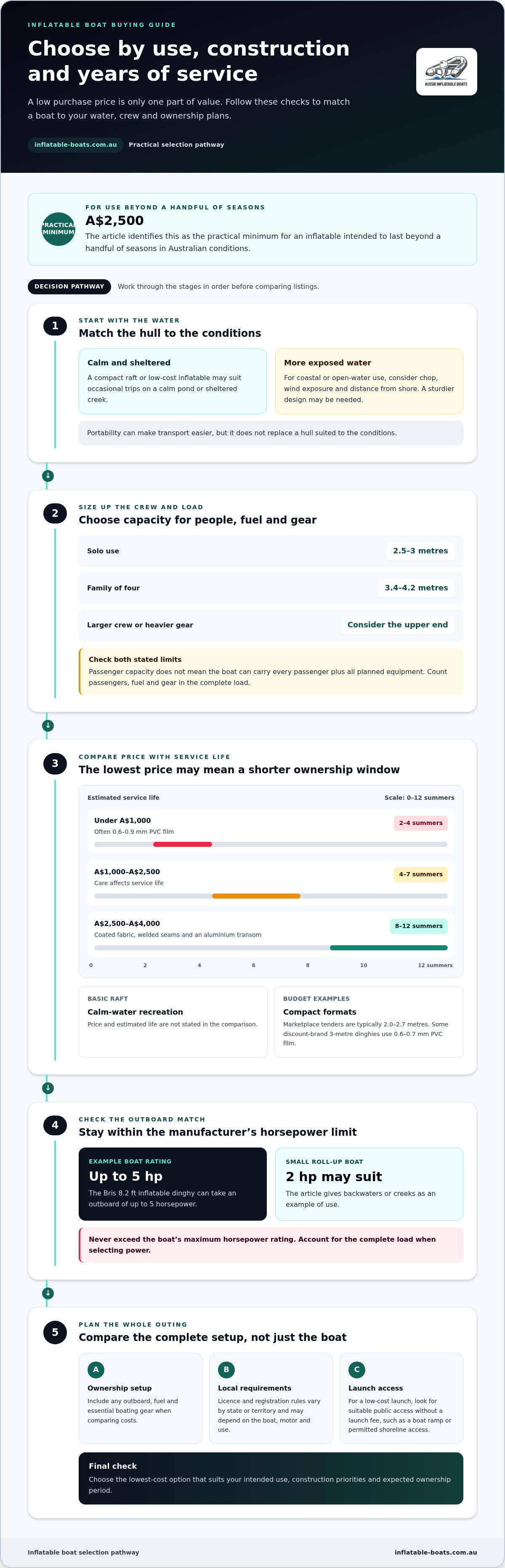
For an inflatable boat intended to last beyond a handful of seasons in Australian conditions, A$2,500 is the practical minimum; models under A$1,000 may last 2-4 summers. Australian licence and registration requirements vary by state or territory and may depend on the boat, its motor and its use. For a low-cost launch, look for a suitable public access point without a launch fee, such as a boat ramp or permitted shoreline access.
Boat Models and Prices
These examples show why load capacity matters, but neither figure alone establishes whether a boat suits your planned waters or crew.
For longer use, compare price tiers rather than judging by the word “marine” or “zodiac” in a listing. Boats priced A$2,500-A$4,000 may last 8-12 summers and use coated fabric, welded seams and an aluminium transom.
| Option | Price in Australia | Estimated life | Typical construction or use |
|---|---|---|---|
| Basic raft | Not stated | Calm-water recreation | |
| Under-A$1,000 inflatable | Under A$1,000 | 2-4 summers | Often 0.6-0.9 mm PVC film |
| Mid-tier inflatable | A$1,000-A$2,500 | 4-7 summers | Care affects service life |
| Longer-life tier | A$2,500-A$4,000 | 8-12 summers | Welded seams, coated fabric, aluminium transom |
Choose the lowest-cost option that suits your intended use, construction priorities and expected ownership period.
Water Conditions and Boat Choice
A low-cost inflatable suited to a calm pond or sheltered creek isn’t automatically suitable for exposed coastal water. Match the hull and its intended use to expected conditions, including chop, wind exposure and distance from shore. A compact raft may suit occasional calm-water trips, while open-water use calls for a sturdier design. Portability makes transport easier, but it doesn’t replace a suitable hull.
Engine Power, Boat Size and Load
Match an outboard to the boat’s maximum horsepower rating; never exceed the manufacturer’s limit. The Bris 8.2 ft inflatable dinghy, for example, can take an outboard of up to 5 horsepower. A 2 hp engine may suit a small roll-up boat used in backwaters or creeks. Passengers, fuel and gear all add weight, so assess the complete load before selecting power.
Size, Weight and Passenger Capacity
For solo use, a 2.5-3-metre inflatable boat offers a manageable size to compare. A family of four should consider boats between 3.4 and 4.2 metres, while larger crews or heavier gear may call for the upper end. Check the stated passenger and weight limits together: seating capacity doesn’t mean the boat can carry every passenger plus all planned equipment.
What sub-A$1,000 inflatable boats offer in Australia
Under A$1,000, Australian buyers can find compact inflatable tenders and recreational models. Their portability and versatility suit selected outings, but design, fittings and intended conditions differ.
Buying Options
Marketplace tenders under A$1,000 are typically 2.0-2.7 metres long. That compact format is easier to transport than larger inflatable boats, but offers less room for people and gear. Some discount-brand dinghies measure 3 metres and use 0.6-0.7 mm PVC film. Compare the boat’s intended use, load limits and construction, rather than size alone.
Look at marine retailers, specialist inflatable boat sellers and online marketplaces to compare models. A retailer’s product information can help you assess fittings and warranty terms; a marketplace listing may offer a wider mix of new and used boats. Read the full specifications and identify the intended water conditions before deciding. A boat-in-a-bag around 2.4 metres differs markedly from a 5.7-metre centre-console rigid inflatable boat, or RIB, in size and setup.
General Benefits and Fishing Use
Inflatable boats can be deflated and packed away, making portability a practical benefit where storage space is limited. Some models pack into a bag just over a metre long, while some can be inflated in about 15 minutes. Those features suit occasional outings and transport in a vehicle, but a soft-sided craft and a rigid inflatable are different propositions in construction, size and intended use.
For fishing, check whether the layout supports your gear and movement aboard. The Intex Excursion 5 has four fishing rod holders, offering dedicated places for rods rather than leaving them loose across the floor. Short outings with light tackle place different demands on a boat than fishing with several people and extra equipment. Match the model’s carrying limits and intended conditions to the trip.
A 3.0-metre soft inflatable boat with a 5 hp outboard is described as travelling at 10-15 km/h. Actual suitability depends on the boat’s design, total load and conditions, so that example isn’t a universal speed expectation. Choose based on the outing, not a headline figure.
Before buying, compare construction, portability, fittings and intended use side by side. For a closer look at different inflatable boat designs, consider how each configuration fits your storage and boating plans.
What features should you look for?
Choose features to suit your crew, route and likely conditions. For boating on a budget with an inflatable, suitable design and safety equipment matter more than extras that don’t support your planned use.
Essential Safety and Boating Accessories
A properly fitted personal flotation device is essential boating equipment. Australian guidance for inflatable-boat users says to wear one and notes that it’s required by law in most states. Children need correctly fitted life jackets and constant supervision on family trips. Prepare suitable equipment for everyone aboard rather than relying on one item shared between passengers.
Keep safety equipment accessible, not buried under bags or fishing tackle. Before departure, make sure each passenger can reach their own flotation device quickly. A repair kit can help with minor damage, but it doesn’t replace proper repairs when a fault affects safe operation. The equipment you carry should support both the trip and the boat’s upkeep.
Weather Limitations and Safety Advice
Check the Bureau of Meteorology forecast before launching, and plan around the conditions for the full trip. The guide advises inflatable-boat users to stay within a maximum wind speed of 15 knots. Wind can affect handling, particularly in exposed coastal water, so consider the return journey as well as conditions at launch.
A boat designed for a calm pond or pool may not suit open water or rougher conditions. On rivers, consider the exposure along your route; for coastal trips, account for changing conditions and the boat’s intended use. Set practical limits before departure. A suitable forecast doesn’t override the manufacturer’s operating guidance.
Safety Features and Operating Advice
Follow the manufacturer’s instructions for inflation, passenger and weight limits, speed, maintenance and weather. These recommendations apply to the specific boat, so don’t use another model’s limits instead. Inflate it as directed and check that the valves are properly closed before loading passengers or gear.
Include chamber layout in your safety assessment. The Intex Seahawk has three separate air chambers and one auxiliary chamber; the HydroForce Caspian Pro has four high-density nylon-supported PVC chambers. Multiple chambers are a design feature, not a substitute for flotation devices or safe operating practices.
Stability Features
Stability depends on the craft’s design and how passengers and equipment are positioned. Distribute weight as the manufacturer directs, and avoid sudden movements aboard. A load shifted to one side can affect balance and control, even on sheltered rivers. Organise and secure gear before launching.
Compare floor and chamber design alongside the stated passenger and load limits. A stable tender intended for calm water isn’t automatically suited to coastal conditions. When boating on a budget with an inflatable, judge its safety features against your actual route, crew and load, not just its purchase price.
Budgeting for ongoing ownership costs
Plan for care, repairs, storage and use, not just the purchase. Unlike a tinny, an inflatable can be deflated for compact storage; a rigid hull keeps its shape and may need trailer storage.
Purchase and running costs depend on the boat, motor, upkeep and transport setup. Compare those costs against the waters you plan to use and how often you expect to go out.
Outboard Motor and Fuel Costs
Fuel spending depends on engine size, load, speed and time underway. Fuel use can vary from trip to trip, so estimate costs based on your usual outings rather than assuming every trip uses the same amount.
Keep the motor within the boat manufacturer’s horsepower limit, and include routine motor care in your ownership plan. Record fuel use after each trip; over time, the log gives you a practical basis for budgeting.
Essential Boating Gear Costs
Safety equipment and boating gear are separate from the hull and motor budget. List what your trips require, then allow for replacement when items wear out or no longer suit your needs. Correctly fitted life jackets remain essential for adults and children on family outings.
Store gear dry and ready to use, rather than leaving it loose in the boat. A simple inventory before each launch can reveal missing or damaged items before they disrupt your day on the water.
Maintenance affects how long an inflatable remains useful. Typical PVC inflatable boats last around 2-10 years, while Hypalon models last around 7-15 years, depending on type, use and care. These ranges make material and upkeep relevant to long-term budgeting, not merely the initial purchase.
After each trip, rinse the boat with fresh water, dry it thoroughly and store it away from direct sunlight. That routine helps limit damage from salt, dirt and prolonged sun exposure. Allow about 10 minutes for a wash-down after use, then give seams, valves and fabric time to dry before packing.
Regularly inspect pressure, valves and seams. Repair minor damage promptly, before it becomes a larger problem. Keep a repair kit with the boat, and note any patch or leak so you can monitor the area on later outings.
Storage affects the practical cost of ownership. An inflatable that deflates and packs away may suit a home without room for a permanently stored hull. A tinny’s rigid shape affects where it can be kept and how it’s transported, while a trailer adds another item to organise and maintain.
Build an annual budget with separate allowances for fuel, equipment replacement, routine care and repairs. Update it after each season using your trip log, maintenance notes and record of replaced parts. This helps identify recurring needs and plan for the next boating season in Australia.
How much do an outboard motor, fuel, and essential boating gear cost?
Budget for the complete setup, not just the inflatable hull. Plan for the motor, fuel and required gear as part of your overall boating budget, based on your usual trips.
Outboard motor and fuel
A small petrol outboard may suit a compact inflatable, while an electric outboard has a higher listed purchase range. Match engine power to the boat manufacturer’s rating and the load you expect to carry.
Fuel spending varies with the engine, load, speed and time underway. Estimate it from your planned route and frequency of use, rather than assuming one trip represents every outing. Record litres used and fuel receipts after each trip. After several outings, your own log provides a more useful budget baseline than a generic estimate.
Include the motor’s ongoing needs in your plan. Follow its maintenance schedule, keep it in suitable condition and allow for the fuel type it requires. A short sheltered-water trip and a longer day of cruising, for example, place different demands on fuel and maintenance budgets.
Essential boating gear
Safety gear is a separate part of the setup. List the equipment your crew and boating conditions require, including correctly fitted personal flotation devices, a way to inflate the boat and a repair kit. The kit is for minor damage; it doesn’t replace proper repairs when a fault affects safe operation.
Gear costs depend on what you already own, the boat’s design and your planned trips. Don’t buy equipment just because it appears in a bundle. Compare what’s included with what your outings require, then budget for missing essentials and replacement of worn items. Keep an inventory to avoid duplicate purchases eating into your boating budget.
For inflatable boat accessories, consider the practical fit with your craft and use. A pump must suit the boat’s inflation requirements, while storage and repair items should be appropriate to its materials. Explore inflatable boat accessories to plan the supporting equipment alongside your boat.
Use a simple worksheet before buying: list the hull, motor, fuel allowance and essential gear separately. Compare petrol and electric setups using the listed motor ranges, then account for your own usage pattern. This makes the initial cost clear and helps prevent recurring fuel and equipment needs from being overlooked.
Inflatable Boats: Inflatable Boats
Inflatable Boats can help once you’ve narrowed down your boat size, intended waters and ownership budget. The range includes inflatable boats, accessories and spare parts, and repair services are available to help maintain your vessel.
Use your shortlist to focus the decision: passenger and gear load, construction, outboard compatibility, storage and ongoing care. These priorities help you assess the full cost of ownership instead of treating the hull as a stand-alone expense. Turn to Inflatable Boats to explore suitable boats or find parts, accessories and repairs for your inflatable vessel.
Visit Inflatable Boats online to explore further.
Choose your setup and get ready to launch
For boating on a budget with an inflatable, start by picturing the outings you want to enjoy. Think about who’ll come aboard, what you’ll bring and how you’ll use the boat. A focused plan separates essential requirements from optional upgrades, so your choice suits your time on the water rather than simply offering a long list of features.
Once you’ve settled on those priorities, you can explore a setup that fits your boating plans. Inflatable Boats can help you consider the available options and the equipment that supports your vessel. Contact Inflatable Boats for advice as you decide what suits your needs.
Take the time to choose deliberately, then look forward to making more of your days afloat. A well-considered setup is a solid starting point for the adventures ahead.
Frequently Asked Questions
Are there any good inflatable boats under A$1,000?
Some lower-priced inflatables can suit short, calm-water outings if their capacity and construction match your plans. Treat them as recreational craft, not automatic choices for exposed water or heavy loads. Before buying, compare the manufacturer’s passenger and weight limits, intended conditions, included fittings and repair options. A compact tender for a sheltered trip has different demands from a boat carrying fishing gear or several people.
Budget Breakdown: What’s It Gonna Cost?
Break your budget into categories: boat, propulsion, fuel, safety equipment, maintenance, storage and repairs. This shows the full cost of getting afloat instead of focusing on the hull alone. A small-boat setup without an outboard, for example, has different expenses from one with a motor and regular fuel use. Estimate each category against your planned trips, then revise the budget after recording actual use.
An inflatable can be a trial option for calm, sheltered outings if it suits your intended use and load. Consider where you’ll launch, how you’ll transport and store it, and whether the crew can manage setup and packing. A low purchase price doesn’t make an unsuitable craft safe for rough water. Treat your first outings as a test of your boating routine, not just the boat.
Why Choose an Inflatable Boat for Family Adventures?
An inflatable can simplify family outings when home storage or vehicle space is limited. Deflating the boat lets you pack it away rather than store a rigid hull. Before a family trip, assign an adult to manage setup and another to keep children clear of the inflation and loading area. Keep passenger space organised so bags and loose equipment don’t obstruct movement aboard.
What does an inflatable boat cost in Australia?
Costs vary with boat type, construction, size and intended use, so no single figure suits every Australian buyer. A recreational raft, soft-sided tender and rigid inflatable boat serve different needs. Compare complete setups, including propulsion and essential gear, rather than hulls alone. Expected service life and care also affect value over time.
What are the cheapest reliable inflatable boats for Australian waters?
Reliability depends on matching the boat to its intended conditions and maintaining it, not simply choosing the lowest-priced listing. For sheltered waterways, compare compact recreational models with their stated use and load limits. For exposed conditions, prioritise a design intended for those waters. Before buying, especially used, inspect the seams, valves, transom and fabric for damage that could affect safe operation.
Are inflatable boats suitable for fishing, camping, and coastal trips?
Inflatables can suit fishing or camping when they have enough capacity for the people and equipment involved. A short, sheltered fishing trip has different demands from carrying camping supplies or travelling along an exposed coast. Choose a craft intended for the conditions, keep gear secure and accessible, and leave passengers room to move safely. A compact recreational inflatable isn’t automatically suitable for every coastal route.
What safety equipment is required on an inflatable boat in Australia?
Wear a properly fitted personal flotation device. The guidance for this topic says PFDs are required by law in most Australian states, while exact requirements depend on where and how you boat. Children should wear correctly fitted life jackets and remain supervised. Before departure, check the Bureau of Meteorology forecast, keep safety gear accessible and follow the boat manufacturer’s operating instructions.