
Best Way to Store an iSUP Board: A Practical Care Guide
Clean, completely dry storage does more to protect your iSUP than choosing between rolling it away and leaving it inflated. If you’re weighing the best way to store iSUP board gear between paddles, consider whether moisture could be trapped, whether packing might create sharp creases, and whether you have a sheltered place away from heat and direct sunlight.
Both inflated and deflated storage can work when you follow the manufacturer’s instructions and avoid moisture, pressure and extreme temperatures. This guide covers how to rinse and dry your board, pack it carefully and choose a storage position that suits your space. You’ll also find practical steps for storing it during a longer break, so it’s ready for your next paddle.
Key Takeaways
- Clean and completely dry your board after paddling, before putting it away.
- Choose the best way to store iSUP board equipment based on your available space and the board maker’s instructions.
- Pack carefully, avoid sharp creases and store detachable parts separately.
- Keep the board protected from moisture, direct sunlight and unnecessary pressure.
- Before your next paddle, inspect the surface, seams and valve, then prepare the board according to its instructions.
Why the Best Way to Store an iSUP Board Starts Before You Pack It Away
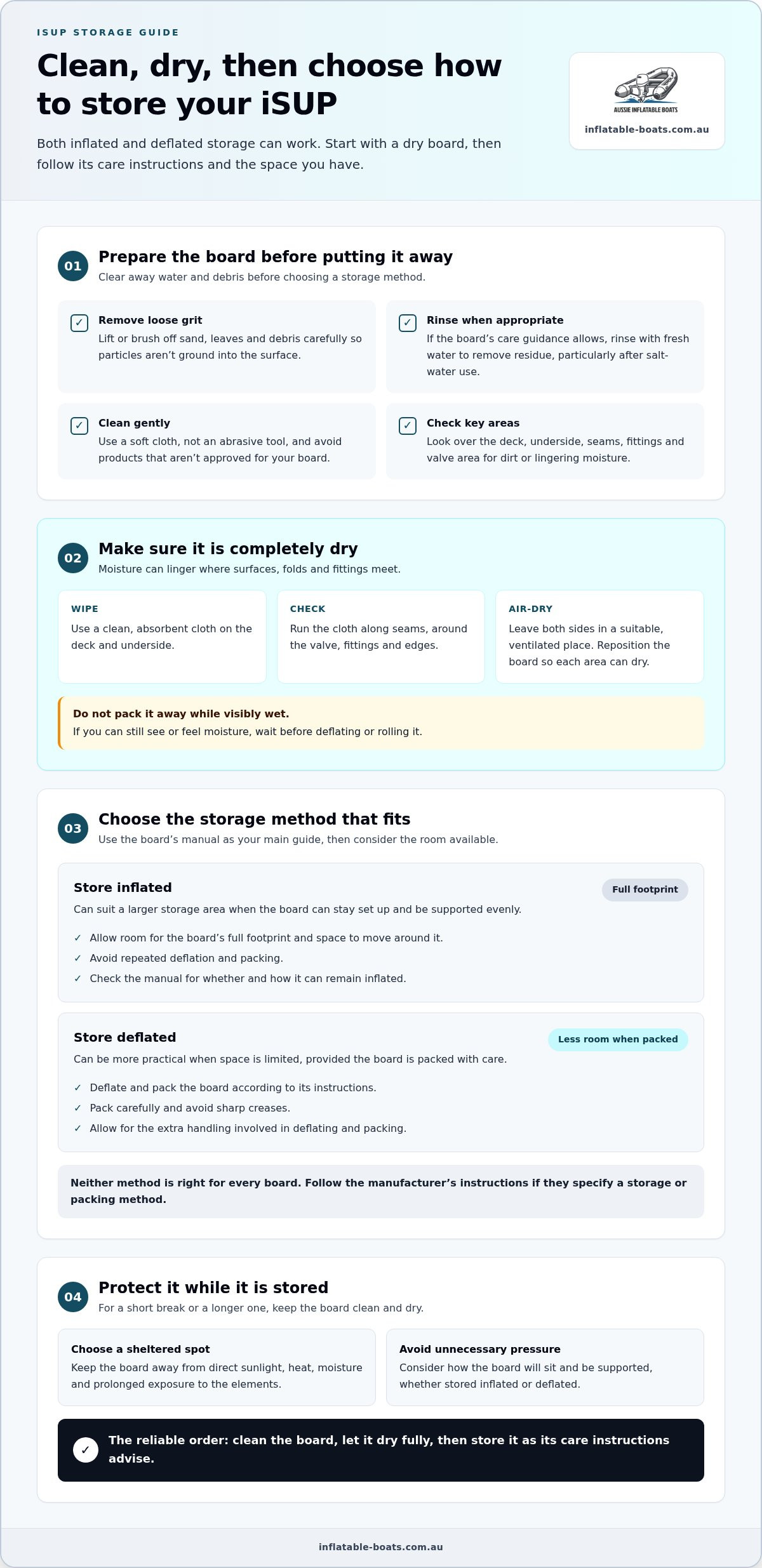
A simple post-paddle routine makes storage easier. Clear away water and debris before deciding whether to leave the board inflated or pack it down. The best way to store iSUP board equipment starts with preparation, not with finding the perfect corner of the garage.
For a short break between paddles, clean and dry the board, then keep it somewhere sheltered until you use it again. A longer break calls for more care when choosing where and how it will sit. In either case, deal with water, grit and prolonged exposure to the elements before storage. Clean and dry the board before choosing how to store it.
What can go wrong when an iSUP is packed away wet or dirty?
Moisture caught between the board’s surfaces or inside a fold or roll can leave the board and its storage bag damp. Give the board enough time and airflow to dry fully, including around areas where water can collect, before packing it for a longer break.
Sand and small debris need attention too. Trapped against the board, particles can rub against its surface as it’s handled or stored. Check for loose grit and remove it carefully before packing. Rinse with fresh water after use where appropriate, particularly after paddling in salt water, then dry the board before putting it away.
Does every iSUP need the same storage routine?
No single method suits every board or storage space. The board’s construction and care instructions can affect how it should be cleaned, folded, rolled or stored inflated. Your available room matters as well: limited space may make deflated storage more practical, while a larger area may let you keep the board set up. General information about the portability of an inflatable boat offers useful context, but it doesn’t replace the instructions for your specific board.
Use the care guidance supplied with your iSUP as your main reference, especially if it specifies a packing or storage method. Then match the routine to your situation. Between paddles, focus on cleaning, drying and protecting the board. Before a longer break, take extra care with the storage position and packing method. The following sections explain the practical options without treating one approach as right for every board.
How to Clean and Dry an iSUP Board Before Storage
A reliable cleaning routine is straightforward: remove loose debris, rinse where appropriate, inspect the board and let it dry fully. A clean cloth and a careful final check are more useful than rushing to get the board into its bag.
Never pack the board away while it’s visibly wet. Moisture can linger around seams, the valve or other areas that dry more slowly than the open deck. This applies whether you’re packing the board after a paddle or preparing it for a longer break. Follow the care instructions supplied with your board if they specify a cleaning method.
What should you do immediately after paddling?
When practical, move the board out of direct exposure while you prepare to clean it. Lift or brush off loose sand and debris by hand, taking care not to grind particles into the surface. If the board’s instructions allow, rinse it with fresh water to remove residue. Pay attention to seams and fittings, but don’t force water into openings.
- Clear first: Remove sand, leaves and other loose material before wiping or rinsing.
- Rinse appropriately: Fresh water can help remove residue, especially after use in salt water, if the board’s care guidance permits it.
- Clean gently: Use a soft cloth rather than an abrasive tool, and avoid products that aren’t approved for your board.
- Inspect as you go: Check the deck, underside, seams and valve area for dirt or moisture.
For further general guidance, caring for your inflatable SUP board includes practical advice on rinsing and handling an iSUP. Use your own board’s instructions for model-specific care.
How can you make sure the board is dry before packing?
After rinsing, wipe the deck and underside with a clean, absorbent cloth. Carefully run it along the seams and around the valve, where water can linger. Then leave both sides to air-dry in a suitable, ventilated place. If you can still see or feel moisture, wait before deflating or rolling the board.
Check the less obvious spots too: around fittings, along the edges and anywhere a fold could bring two damp surfaces together. Turn or reposition the board as needed to let each area dry. The best way to store iSUP board equipment starts with this final check, not with the packing itself.
Once the board is dry, choose a storage method that suits its instructions and your available space. If you’re building out your paddling setup, explore inflatable paddle boards and accessories.
Store an iSUP Inflated or Deflated? Compare the Practical Options
Both storage methods can work. Choose based on the board’s care instructions and the space available, rather than assuming every iSUP must be kept inflated or packed away. Consider how the board will be supported, protected and accessed, as well as the space it takes up in each state.
Follow your board’s manual and choose a method that suits your storage space. Use this comparison as a starting point, then follow the manufacturer’s guidance if it specifies how to prepare or store your board.
Inflated storage
- Space: Requires room for the board’s full footprint, with space to move around it.
- Handling: Avoids repeated deflation and packing, but you’ll need to support the board evenly.
- Guidance: Follow the manual on whether and how the board can remain inflated during storage.
Deflated storage
- Space: Takes up less room once packed, which can help in a small home or vehicle.
- Handling: Requires deflation and careful packing before the board can be stowed or transported.
- Guidance: Follow the manual for valve handling, folding or rolling, and use of the carry bag.
When might storing the board inflated suit your setup?
An inflated board may suit a storage area with enough clear space to keep it away from sharp edges and pressure points. Use a suitable, supportive surface or rack that distributes its weight, rather than leaving it resting awkwardly. Keep it sheltered from direct sunlight and heat, and follow the maker’s advice about storing it inflated.
Consider access as well. Position an inflated board where it won’t be knocked, squeezed between other gear or used as a shelf. A spare room may have enough space but still be unsuitable if the board blocks a walkway or sits beside a heat source. Its position matters as much as whether it’s inflated.
When is deflated storage the more practical choice?
Deflating can make a board easier to store when indoor space is limited or when you need to transport it. Follow the manual’s instructions for the valve and packing sequence, then roll the board carefully without forcing tight turns or sharp creases. Store it where heavier equipment won’t crush it.
For many owners, the best way to store iSUP board equipment is the method they can carry out correctly and consistently. Before deciding, consider the board’s instructions, the storage space, protection from sun and heat, and whether the board can rest without pressure points. Neither option is automatically best for every board or situation.
How to Pack and Store an iSUP Board Step by Step
A consistent packing sequence makes it easier to put your board away without rushing or overlooking small parts. Work through these steps in order, following the instructions supplied with your board for its valve, deflation and packing method.
- 1. Confirm it’s dry. Check the deck, underside, seams and valve area. If you find moisture, leave the board to dry before packing.
- 2. Remove detachable components. Take off removable fins and other parts as directed in the board’s instructions. Clean and dry them separately so they don’t press against or scratch the board.
- 3. Prepare the valve and board. If you’re deflating the board, follow the manufacturer’s valve-handling instructions. Keep small components together separately rather than loose against the board.
- 4. Roll or pack gently. Use the supplied packing method and avoid forcing sharp bends or folds. Don’t trap accessories between the board’s surfaces.
- 5. Use the appropriate bag. Place the packed board in its supplied storage bag if it’s available and suitable for that board. Don’t overfill the bag or force the board into a tight space.
- 6. Choose its storage position. Place the bag or board in a clean, dry, ventilated indoor location where it won’t be crushed, struck or exposed to direct sunlight.
Remember: dry board, gentle packing, protected storage. These are the essentials. Your board’s instructions determine the correct packing details.
How should you roll and pack a deflated board?
Start with the board’s instructions for deflation and rolling direction. Different designs may require a particular sequence, so don’t assume that a method used for another board will suit yours. Roll steadily, easing the material along rather than pulling it tight or forcing a crease. Keep fins, tools and other accessories out of the roll so they don’t press against the board. Use the storage bag if the maker provides one and recommends it for packing.
Where should you keep an iSUP between outings?
Choose a clean, dry, ventilated place away from direct sunlight, sharp objects and heavy items. A cupboard may keep a packed board out of the way, while a garage could offer more room but expose it to changing conditions or clutter. Consider how the space is used and whether the board can stay protected and accessible without being squeezed behind other gear.
For the best way to store iSUP board gear, match your packing method to the board’s instructions and the space available. If you’re preparing your setup for future paddles, explore inflatable paddle boards and accessories.
Check Your iSUP Before the Next Paddle and Keep Its Care Simple
Unpacking your board is the right time for a pre-paddle check. Lay it out so you can see the full surface, then inspect the deck, underside, seams and valve before reinflating. Storage keeps your gear organised, but it doesn’t replace checking the board each time you prepare to use it. A steady inspection can help you spot anything unusual before you head for the water.
What should you inspect after taking the board out of storage?
Unroll the board or remove it from its bag without pulling at it. Check for visible damage, unusual wear or debris, paying close attention to the seams and valve area. Make sure the valve and its surrounding parts appear as expected. Check that removable components, such as the fin, are present and fit as intended. Follow the manufacturer’s instructions for reinflating and preparing the board, including the steps for its valve and removable parts.
- Surface: Check the deck and underside for marks, debris or anything that seems out of place.
- Seams and valve: Look for visible damage and make sure the valve area is clear.
- Components: Confirm removable parts are present and fit according to the board’s instructions.
- Preparation: Follow the maker’s guidance for reinflating and completing the setup.
Don’t rush from unpacking straight to the water. If something looks different from the last time you used the board, pause and assess it rather than assuming it’s ready. The best way to store iSUP board gear is only part of responsible ownership. A brief check before each paddle helps you make a considered decision about whether the board is ready to go.
When should a storage issue become a repair issue?
Visible damage, a valve concern or anything else that gives you doubt is a reason to stop and assess the board before paddling. Don’t take it onto the water until the issue has been addressed. Avoid improvised fixes if you’re unsure how they could affect the board; use the care and repair guidance provided for your model. If it needs professional attention, Inflatable Boats offers repair support for inflatable watercraft.
Keep the routine straightforward: inspect the board, follow its instructions and deal with concerns before setting out. That pause makes storage a practical part of getting ready for your next paddle, rather than something to second-guess at the water’s edge.
For inflatable boards and related accessories to support your time on the water, explore Inflatable Boats.
Make Your Next Paddle Easier to Prepare For
A little planning can make getting on the water more straightforward. Decide where your board and accessories will live between paddles, then make that spot part of your gear routine. The best way to store iSUP board equipment is a method you can follow consistently while respecting the board’s instructions and the space you have.
Think about what will make your equipment easy to find and prepare. Keeping it organised can make the transition from storage to shoreline calmer, whether you’re heading out for a quick session or planning a longer day on the water.
Inflatable Boats sells inflatable stand-up paddle boards and accessories to help you prepare for your next adventure. Explore inflatable boards and accessories, then set up a care routine that suits your board and your home.
Frequently Asked Questions
Can I store an iSUP board inflated?
Yes, an iSUP may be stored inflated if you have a protected spot with enough room to support it without pressure from other gear. Whether that suits a longer break depends on the board, so follow its manual rather than applying a general rule. Keep it away from direct sunlight, heat and heavy objects. If the manufacturer recommends deflating it for storage, use that method instead.
How long should an iSUP dry before I pack it away?
There’s no single drying time that suits every board or set of conditions. Check that the deck, underside, seams and valve area are dry to the touch, and give the board more time if any moisture remains. After paddling in wet or sandy conditions, inspect around fittings and edges as well as the open surfaces. Follow the care instructions supplied with your board before packing it.
Can I leave my iSUP in its storage bag between paddles?
Yes, a storage bag can keep a clean, dry board together and make it easier to move between outings. Don’t use the bag to hide dampness or force the board into a tight pack. Check that both the board and bag are dry, and follow the board’s packing instructions. For the best way to store iSUP board gear between paddles, keep the packed board somewhere protected and ventilated.
Should I leave the valve open when storing a deflated iSUP?
Valve handling varies by board, so use the instructions supplied with your iSUP rather than relying on a general rule. Deflate it as directed and keep sand or grit away from the valve while packing. Don’t force or overtighten valve components. If the valve appears damaged or doesn’t seem to function as expected, pause and have the issue assessed before taking the board onto the water.
Can an iSUP be stored in a garage or shed?
A garage or shed may suit your board if it’s clean, dry, ventilated and protected from direct sunlight, heat and sharp objects. Conditions differ between homes, so consider whether the space becomes damp, hot or cluttered. Keep the board clear of heavy items that could press against it, and follow its storage instructions. If the area doesn’t provide suitable protection, choose another sheltered place.
What should I do if my iSUP looks damaged after storage?
Don’t launch the board if you notice a puncture, damaged seam, valve problem or another concern that could affect its condition. Check the board’s care and repair guidance, and avoid improvised fixes that may worsen the issue. Arrange an appropriate repair assessment before paddling again. Inflatable Boats offers repair services for inflatable watercraft when your board needs attention.