
Best Portable Boat for Solo Fishing: Buying Guide
What if the easiest boat to carry is the wrong choice once you start fishing? Finding the best portable boat for solo fishing means looking beyond its packed size. You also need a craft you can manage from car to water, launch without a struggle and fish from with confidence.
It’s reasonable to think carefully about handling an inflatable boat alone. Portability, stability and room for gear can pull your decision in different directions. The right choice depends on your routine and where you fish, not on broad claims about convenience. A boat that suits sheltered water and a light tackle setup may feel less practical when you need more space or expect changing conditions.
This guide covers the features that matter, including transport and setup, hull shape, usable fishing space, stability and equipment compatibility. You’ll learn how to weigh those trade-offs against your solo launch routine and fishing style, then compare inflatable boats with clearer priorities. Choose for the water you actually fish and make a considered decision before heading out.
Key Takeaways
- Assess the full solo routine, from storing and loading the boat to launching, fishing and packing down.
- Compare hull format and layout by considering how you’ll move, sit and position gear while fishing.
- Use packed handling, usable space, construction and setup as practical comparison points, then check each boat’s specifications.
- Rehearse handling the boat alongside your pump, fishing gear and other equipment before deciding it suits your solo launch plan.
- Choose the best portable boat for solo fishing by matching your shortlist to the trip: prioritise compact handling or make room for the gear and movement you need.
What makes a portable boat practical for solo fishing?
A boat can look compact in its bag and still be awkward to manage on your own. For solo fishing, practical portability covers the whole outing: getting the boat from storage to your vehicle, carrying it to the water, setting it up, fishing comfortably and packing it away afterwards. A difficult launch or cramped fishing position can outweigh the convenience of a small packed size.
A solo-ready portable boat is one you can transport, set up and pack down alone while leaving enough usable space for your fishing essentials. That balance is personal. The best portable boat for solo fishing depends on how you fish, what you carry and how much effort you’re willing to spend getting afloat.
Start with the way you fish alone
Begin with the trips you actually take. A short session in one familiar spot may call for a simpler setup than a long day that involves changing locations or carrying extra equipment. Picture yourself aboard, not just the boat stored at home. You need room for yourself, tackle and any onboard equipment you plan to use, without making it difficult to move around.
Separate essentials from additions. A rod, tackle and safety equipment may be central to your outing. Extra storage or electronics may be useful, but can add weight and setup steps. Choose a balance that supports your fishing routine without turning each launch into a complicated operation.
Portability means more than a small packed size
Trace the boat’s full route: where it’s stored, how it fits into your vehicle, how you’ll carry it to the water’s edge and what you’ll need to bring back after fishing. Include the pump, tackle, personal gear and other equipment in your plan. A boat that’s manageable on its own may feel less so once everything else is added.
Different portable designs make different trade-offs. For instance, folding boats show how a craft can be designed to reduce transport and storage demands, though the format alone doesn’t tell you whether its fishing layout suits your needs. Consider the complete process rather than treating “portable” as a promise of effortless handling.
- At home: Consider where the packed boat and its equipment will be stored.
- At the vehicle: Think through loading and unloading with the full kit you intend to take.
- At the water: Account for carrying distance, setup steps and the space needed to prepare the boat.
- After fishing: Allow for packing down and handling damp equipment.
If you’re weighing up boat type and intended use, choosing your first inflatable boat is a useful next step. Then compare options against your solo routine. Compact handling may suit a minimal setup, while more room may matter when your fishing requires extra gear or freedom to move.
How hull design and layout affect a solo fishing boat
Hull shape influences how a boat sits and responds on the water, but it doesn’t determine the whole experience. For a solo angler, layout matters just as much. A seat that leaves room to cast, with tackle within easy reach, can make a boat more workable than a roomier design with awkwardly placed gear. Consider hull and layout together, then judge each against the waters you intend to fish.
Catamaran or monohull: which trade-offs matter?
A monohull has one main hull beneath the boat; a catamaran uses two hulls set apart. These are different design approaches, not a simple ranking. Consider stability, tracking (how consistently a boat holds its direction) and manoeuvrability together. A quality you value in one situation may matter less in another. Choose according to your intended waters and fishing habits, not a label or broad performance claim.
A catamaran and a monohull represent different hull layouts, and neither is automatically the better solo fishing choice. Fit depends on the design, conditions, load and operator. A sheltered-water session with frequent changes of direction may call for different handling priorities from a longer outing on open water. The boat’s intended use and verified specifications are more useful than assuming every craft of one hull type behaves alike.
Check the fishing layout before choosing
Picture a typical cast from the seat or position you’d use. Can you turn comfortably, reach your tackle and manage a rod without constantly shifting equipment? Think about where personal items and planned onboard gear will sit. Loose or poorly placed items can obstruct movement, so consider how you’ll secure them rather than assuming storage points or fittings come as standard.
Also consider how your position and gear affect balance. A load concentrated on one side or at one end may change how a boat sits. Follow the boat’s instructions for loading and operation. Handling depends on the specific design, conditions, total load and operator experience, so a hull description alone can’t promise a particular feel on the water.
- Movement: Leave a clear path for casting, turning and reaching essential gear.
- Placement: Arrange tackle and personal items without crowding your working space.
- Conditions: Match the intended use to the water you plan to fish, and account for your own experience.
For general boating safety information, the U.S. Coast Guard boating safety guidelines provide background, but they aren’t a substitute for Australian guidance on local requirements. As you compare the inflatable boat range, focus on the particular hull, layout and specifications rather than relying on category names alone. That’s a more considered way to find a setup that gives you room to fish without carrying more boat than your trips call for.
Which portable boat features should solo anglers compare?
Compare how each boat fits your real fishing setup, not a long list of features in isolation. Record the details provided for each model and compare like with like. If a specification isn’t provided, treat it as unknown rather than making an assumption. Base your decision on information you can verify.
Capacity, space and load planning
A boat’s rated capacity and usable fishing space answer different questions. The published limit sets the boundary for loading; the layout determines whether you can sit, cast and reach your gear comfortably within that space. Use the specific boat’s stated capacity and loading instructions. Never estimate a limit or exceed it.
Include everything you intend to bring when assessing the available room: fishing gear, personal items and any planned onboard equipment. Extra equipment takes up space and adds to the overall load, which can affect how the boat handles. A capacity figure alone won’t tell you whether the layout works for your fishing routine.
Construction and setup details worth comparing
Construction varies between boats, so compare the details provided for each one. Material, seams and floor design can help you understand how a particular boat is built and whether its stated intended use matches yours. Treat these as boat-specific attributes, not features shared by every inflatable craft. The same applies to inflation information and supplied components.
Think through setup as a sequence: unpack the components, prepare the boat, inflate it as instructed and arrange your fishing kit. Consider whether you can manage those steps and packed pieces on your own. If you’re considering add-ons, compare them with the equipment already supplied so you can plan the complete setup without assuming anything is included.
Compare the inflatable boat range against these points, using the published specifications for each option. A focused checklist can help narrow down your shortlist by separating must-haves from attractive extras.
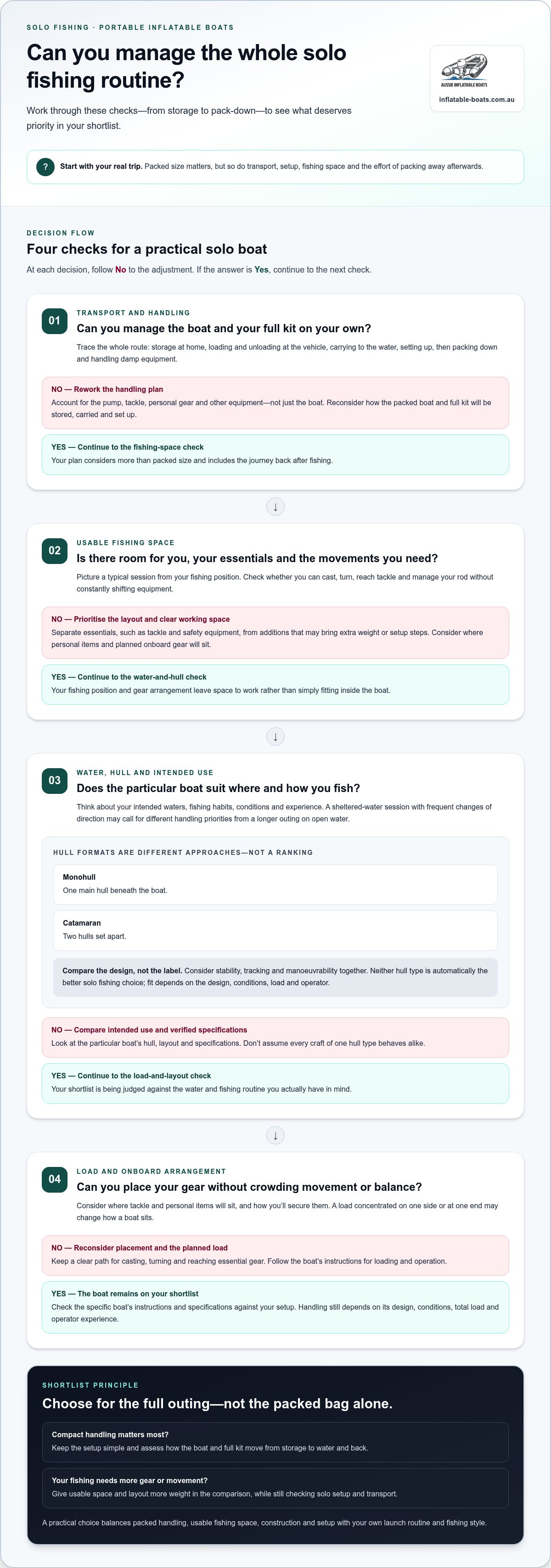
Can you carry, launch and pack down the boat on your own?
A solo launch is a complete handling test, not just a question of whether you can lift the packed boat. Rehearse each stage with the equipment you plan to take, including the pump, fishing gear and safety equipment. A short walk over firm ground may feel straightforward, while a longer carry, uneven access or wind at the water’s edge can make the same setup more demanding.
Use this practical rehearsal to spot awkward steps before they become part of your fishing routine:
- Storage: Check where the packed boat and its components will live, and whether you can retrieve them without moving other bulky items.
- Vehicle loading: Picture lifting the boat, pump and planned gear into and out of your vehicle. Include the space needed to organise everything for the trip.
- Carrying: Consider the route from vehicle access to a suitable setup area. Note the distance, slope, soft ground, steps or obstacles that could complicate carrying the full load alone.
- Inflation: Follow the boat’s instructions and consider where you’ll place each component while setting it up. Check that you can manage the pump and boat without relying on a second person.
- Launch: Think through the move from setup area to water, including how you’ll keep gear organised and avoid rushing as conditions change.
Plan a realistic solo launch
Access can shape the effort as much as the boat itself. A clear, sheltered launch area gives you more room to organise equipment than a narrow or exposed water’s edge. Wind, water movement and the surface underfoot can also change how easy it is to control the boat during preparation and launch. Practise the setup in a safe, controlled setting before taking it on a fishing trip.
Prepare for the return trip and changing conditions
Plan the return routine, too: retrieve the boat, manage the gear, deflate it as instructed and pack it for transport. Consider where you can let the boat dry, if needed, and how you’ll handle the packed load on your own. Watching inflatable boat setup videos can help you understand the general sequence, but practice will show whether it suits your routine.
Include a suitable personal flotation device (PFD) and essential safety equipment in your planning, and follow the boat’s instructions. Boating requirements can depend on where you operate, so check current rules for your Australian state or territory and the waterway you intend to use. Conditions can change; choose a launch plan that leaves you time and space to respond safely.
A realistic rehearsal can help you judge whether the best portable boat for solo fishing is manageable with your full kit. Keep your storage, transport and launch routine in mind when comparing inflatable boats.
Choose your solo fishing boat and take the next step
The strongest shortlist starts with your fishing, not a headline feature. Decide where you plan to fish, how long your outings usually last and what you need aboard. Then assess each option against your solo transport and setup routine, its fishing layout and the specifications published for that particular boat.
Use a final shortlist before buying
Rank the priorities that will shape your actual trips: solo transport, setup effort, room to fish and the conditions you expect to encounter. Compare product-specific details, including packed dimensions, weight, capacity, included components and operating limits. Treat a missing figure as unknown rather than filling it in from another model or a general claim about inflatable boats.
Rule out any option that won’t fit your storage space or launch routine, even if its other features look appealing. A compact boat may suit short outings with a pared-back kit and a straightforward launch. If you need to carry more tackle or value room to change position while fishing, usable space may matter more than the smallest packed size. The best portable boat for solo fishing is the one that fits the whole trip, including its limits.
Make ownership part of the decision
Think beyond the first launch. Consider how you’ll clean the boat after an outing, where it can be stored and how you’ll follow its care instructions between trips. Regular attention helps you spot wear or damage early. Inflatable boat repairs can also form part of longer-term ownership when a boat needs attention. Allow time and space for care as well as for getting out on the water.
Inflatable Boats sells inflatable boats, accessories and spare parts, and provides repair services for inflatable boats. Keep your decision grounded in what your fishing requires, and use the published details for each boat to compare its intended use and practical handling.
With your priorities clear, explore inflatable boats for your next fishing trip. Choose with care, plan for ownership and prepare for more independent time on the water.
Make your next fishing trip your benchmark
Before choosing, picture one real outing from the moment you leave home to the moment you pack away. That practical test can reveal what matters most, whether it’s a simpler carry, more room to move or a layout that keeps essential tackle close. Use those priorities to judge each option on its own details, not on a broad promise of portability.
The best portable boat for solo fishing is the one that fits your routine and gives you confidence to get afloat within the conditions and limits it’s designed for. Keep your intended use in view as you compare, and give yourself time to become familiar with your setup before relying on it for a day on the water.
Ready to compare options for your plans? Explore portable inflatable boats for your next fishing trip.
Frequently Asked Questions
What is the best type of portable boat for fishing alone?
The best type depends on your fishing location, kit and preferred way of getting afloat. Compare the boat’s hull and internal layout, then consider whether it gives you room to cast and reach tackle without crowding your working area. The best portable boat for solo fishing is not automatically the lightest or smallest option. Choose according to the intended use and verified specifications for the particular boat.
Are inflatable boats stable enough for solo fishing?
An inflatable boat’s stability depends on its design, load, water conditions and how you move aboard, so don’t assume every model will feel the same. Follow the boat’s loading instructions and place gear so it doesn’t all shift to one side. On the water, move deliberately and avoid standing or leaning suddenly. Build familiarity in suitable conditions before taking on a less sheltered fishing spot.
Can one person carry and launch an inflatable fishing boat?
Yes, if the packed boat and its equipment suit your strength, transport and access route. Consider a practical test with the pump, tackle and personal gear included, rather than judging the boat alone. For example, a longer walk over soft sand or an uneven bank may make several smaller loads easier to manage than carrying everything at once. Practise setup and launch in a safe, controlled place first.
How do I choose the right size portable boat for solo fishing?
Start with the space you need for yourself, rods, tackle and any equipment you plan to bring, then compare that with the boat’s published dimensions and capacity. A compact option may suit a light kit and straightforward trip; more interior room can help if you need to change position or carry bulkier gear. Check the manufacturer’s loading guidance, and don’t treat passenger capacity as a measure of fishing comfort.
Can I use an inflatable boat with a motor for fishing?
Only use a motor if the specific boat is designed and listed for motor use. Check its published motor compatibility, mounting arrangement, capacity and operating instructions before selecting an outboard. A motor and its battery or fuel also add load and take up space, so include them when planning your fishing setup. Don’t fit a motor based on appearance or assume a specification for one boat applies to another.
What safety equipment should I take when fishing alone from a boat?
Take a suitable personal flotation device and check the current boating safety requirements for your state or territory and the waterway. A charged phone in a waterproof pouch, a whistle and a basic first-aid kit can also help you prepare for common mishaps. Consider how you’ll call for assistance if you’re separated from your gear or your phone becomes unusable. Select additional equipment to suit the location, conditions and trip duration.
How do I store and maintain a portable inflatable fishing boat?
Follow the boat manufacturer’s care instructions for cleaning, drying, deflation and storage. After an outing, remove grit and fishing debris, check the hull, seams and valves for signs of damage, and make sure the boat is dry before packing it away as directed. Store it in a suitable place, away from avoidable abrasion or sharp objects. Regular checks can help you notice wear early and decide when repair attention is needed.