
Best Inflatable Paddleboard for Beginners: 2026 Buying Guide
A longer hull won't save your balance if the deck bends beneath your feet. Many newcomers assume that raw length equals stability, only to find their craft sagging in the centre and fighting the chop. Choosing the right inflatable paddle board for beginners comes down to internal rigidity, chamber volume, and robust maritime construction rather than sheer surface area. It's completely natural to feel overwhelmed by technical jargon around drop-stitch densities and PVC lamination, especially when you want peace of mind against field punctures and valve leaks.
You shouldn't have to guess whether your gear can handle your weight on the open water. In this guide, you'll master the critical structural specifications, stability factors, and construction standards needed to select your ideal craft with total confidence. We examine the exact hull dimensions, chamber pressure thresholds, and multi-layer fabric builds that guarantee a rigid, reliable platform across diverse Australian conditions.
Key Takeaways
- Target an outline width between 32 and 34 inches paired with a 6-inch profile to secure optimal primary balance on open water.
- Discover why high-tensile drop-stitch cores and multi-layer rail construction form the mechanical backbone of a rigid inflatable paddle board for beginners.
- Learn how calculating your total working payload protects against mid-hull flex and keeps your craft gliding effortlessly across local waterways.
- Evaluate complete gear packages, focusing on composite paddle shafts, heavy-duty marine valves, and reliable safety leashes that hold up under pressure.
- Master crucial inflation thresholds and sun-care habits to prevent seam stress and preserve structural stiffness across changing temperatures.
Dimensions and Volume: Finding the Stable Platform for Beginners
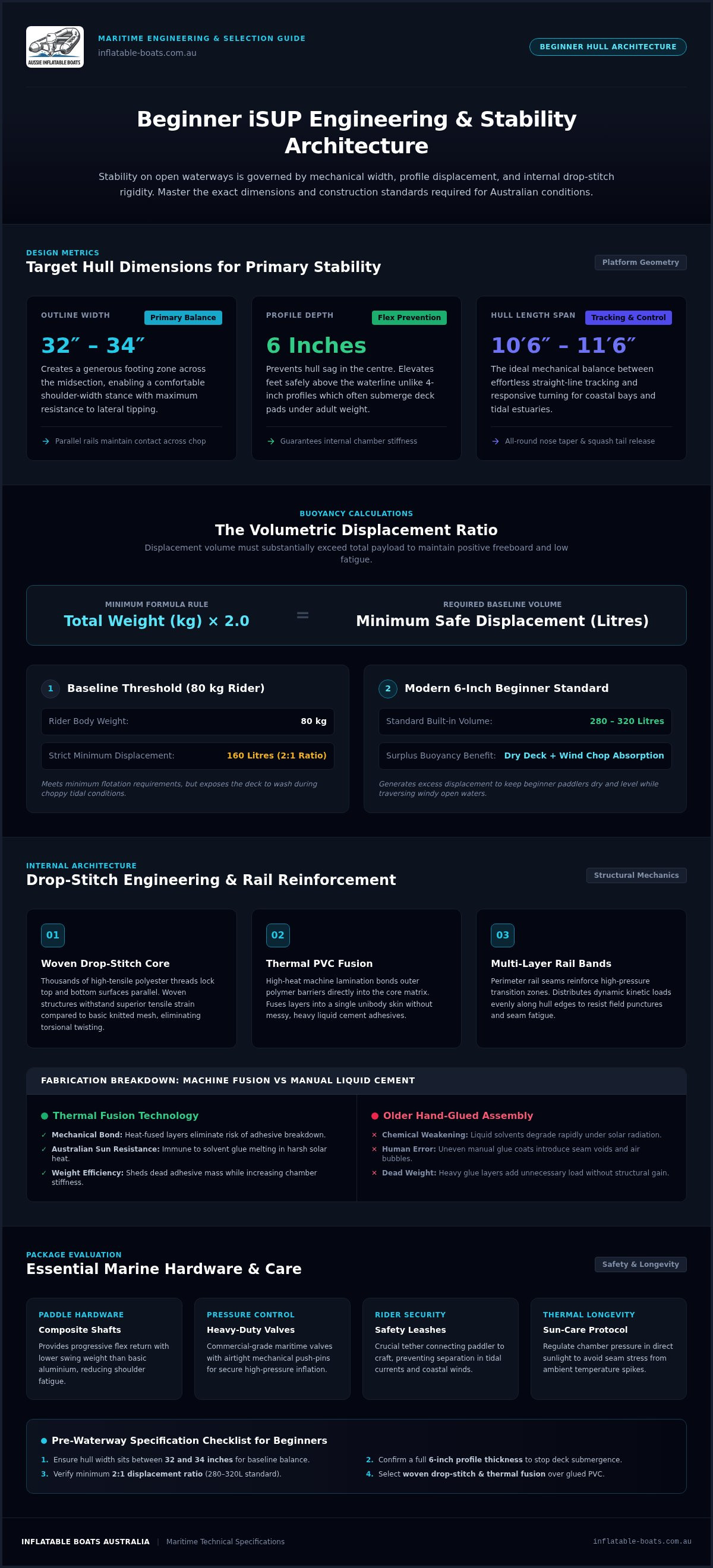
Board stability is never accidental. It relies on the direct mechanical relationship between outline width, profile thickness, and total internal displacement. While conventional showroom advice often suggests that any ten-foot-six hull suits all riders, true primary stability demands exact dimension matching. When choosing an inflatable paddle board for beginners, you need a balanced platform engineered to resist rolling motions while maintaining positive buoyancy under dynamic load.
Width and Outline Shaping for Primary Balance
Width dictates your platform's resistance to side-to-side tipping. For newcomers to stand-up paddleboarding, target a hull width between thirty-two and thirty-four inches. This span creates a generous footing zone across the midsection, letting you establish a comfortable, shoulder-width stance without teetering. Parallel rail outlines carry this wide footprint forward and aft, creating steady contact with the water surface across coastal bays and tidal estuaries. While a pointed nose profile pierces choppy swell efficiently, an all-round board balances gentle nose taper with a rounded squash tail. This configuration ensures smooth, predictable water release without sudden lateral pitching when you adjust your stance.
Board Thickness and Volume Displacement Metrics
Internal air displacement prevents hull flex. A six-inch profile provides optimal structural stiffness, keeping your feet positioned well above the waterline. Four-inch profiles frequently submerge their deck pads under adult weight, creating a sunken feeling that compromises footing. To ensure reliable flotation, apply a simple volumetric formula: your craft's litre displacement must exceed your total body weight in kilograms by at least two to one.
- Target Hull Width: Thirty-two to thirty-four inches delivers optimal primary balance for novice paddlers.
- Profile Thickness: Six inches ensures superior rigidity and prevents water ingress across the standing area.
- Displacement Volume: A minimum 2:1 litre-to-kilogram ratio guarantees confident buoyancy for adult riders and dry gear.
- Length Span: Ten-foot-six to eleven-foot-six lengths offer the ideal balance between straight-line tracking and responsive turning.
A paddler weighing eighty kilograms needs a hull displacing at least one hundred and sixty litres, though most modern six-inch beginner craft provide two hundred and eighty to three hundred and twenty litres of volume. This surplus displacement keeps the deck dry, lowers fatigue, and ensures your inflatable paddle board for beginners remains rigid and level when traversing wind-blown chop.
ISUP Construction: Drop-Stitch Engineering and Rail Durability
Rigidity starts deep within the core. While two boards may appear identical on the surface, their internal architecture dictates how they perform under dynamic load. Budget builds cut corners with thin skins and sparse threading, causing unsightly sagging. A commercial-grade inflatable paddle board for beginners relies on dense textile matrices and advanced polymer fusion, transforming internal air pressure into absolute structural stiffness.
The Mechanics of Internal Drop-Stitch Cores
Drop-stitch fabric connects the deck to the bottom hull with thousands of high-tensile polyester threads. When you pressurise the chamber, these filaments pull taut, locking the flat surfaces parallel. Premium hulls employ woven drop-stitch structures rather than basic knitted mesh. Woven fabrics hold their shape under higher tension, dramatically reducing torsional twisting when you punch through ocean swell or turbulent river flow. Consistent thread spacing prevents pressure bulges, keeping your standing platform perfectly flat.
Fusion PVC Lamination Versus Glued Layers
How manufacturers bond their exterior skins makes a massive difference to long-term reliability. Older construction methods rely on hand-applied liquid cement. This technique adds dead weight, leaves room for human error, and deteriorates quickly when left out in the harsh Australian sun. Modern fusion technology eliminates these issues through machine lamination:
- Thermal Welding: High-heat processes fuse dual PVC layers directly into the core matrix, creating a mechanical bond that won't delaminate over time.
- UV Degradation Resistance: Heat-treated polymer barriers withstand intense solar radiation, preventing the chemical breakdown common in solvent adhesives.
- Reinforced Rail Bands: Multi-layer PVC tape lines the perimeter seams, shielding vulnerable edges against abrasive rock shelves, gravel boat ramps, and clumsy paddle strikes.
- Target Weight Balance: Fusion lamination cuts overall hull weight by up to twenty percent compared to double-glued systems, making portage to the water effortless.
Perimeter seams bear the highest stress. If you run up against jagged boat ramps or coarse sand, cheap glued rails split and leak air. Selecting watercraft built with robust dual-layer fusion ensures dependable longevity, while routine maintenance supported by specialised marine accessories keeps your craft sea-ready for years. To explore commercial-grade craft engineered for punishing outdoor waterways, consult the expert team at Inflatable Boats for dependable gear that never compromises on safety.
Essential Package Gear: Paddles, Pumps, Fins, and Safety Leashes
Your board is only half the system. The hardware included in your box dictates how quickly you hit the water, how comfortably you cruise, and how safely you navigate changing winds. Many generic bundles treat these accessories as afterthought freebies, supplying heavy aluminium shafts and fragile plastic clips that break under mild strain. Investing in a properly appointed inflatable paddle board for beginners ensures that every component performs reliably under harsh maritime conditions.
Paddles and Efficient Propulsion Mechanics
Heavy paddles sap upper-body energy fast. While base-level alloy shafts keep packaging costs low, they transfer substantial vibration into your elbows and shoulders across an hour-long session. Choosing a lightweight fibreglass or composite blend dampens joint stress and preserves forward momentum. Look for a teardrop blade profile; its wider base catches clean water instantly at the catch phase without fluttering from side to side. Strong cam-lock clasps prevent inner shaft rotation, ensuring your blade stays true through every power stroke.
Fins, Leashes, and Pumping Hardware
Launching without friction depends on functional deck hardware. A standard tool-free US fin box lets you swap profiles without hunting for tiny brass screws on a sandy beach. Pair this tracking stability with sensible inflation tools and retention gear:
- Dual-Action High-Pressure Pumps: High-volume chambers push air on both upward and downward strokes, cutting manual prep time in half before switching to single-action mode for high-pressure topping off.
- Interchangeable Centre Fins: Large rake fins offer superior directional tracking for novices, keeping the board straight between paddle hand-switches.
- Coiled Deck Leashes: Coiled cords sit neatly on the rear deck pad rather than dragging through shallow weed beds, snapping taut only when you fall.
- Quick-Release Safety Belts: If paddling moving tidal rivers or estuaries, pair your leash with a waist belt to release yourself instantly from submerged snags.
A failed valve gasket or bent fin pin can ruin a long-planned weekend adventure. High-grade seals, marine-spec inflation adapters, and durable replacement foils keep your setup functional year after year. Explore the comprehensive range of watercraft accessories to upgrade essential components or secure heavy-duty backups built for punishing conditions.
The 5-Step Evaluation Framework for First-Time iSUP Buyers
Buying your first watercraft shouldn't feel like a gamble. Cut through marketing noise by assessing prospective models against concrete engineering metrics rather than cosmetic graphics. When evaluating an inflatable paddle board for beginners, run through this five-step checklist to verify that the hull, fittings, and after-sales support meet strict maritime standards before making an investment.
- Calculate Working Payload: Add twenty kilograms of cargo allowance to your dry body weight to account for wet gear, dry bags, safety equipment, and dynamic stance shifts.
- Profile Waterway Suitability: Match hull rocker and rail profiles to your local environment, favouring rounded nose tapers for choppy open bays and parallel rails for sheltered lakes.
- Verify Operating Pressure Thresholds: Confirm the hull achieves structural stiffness between fifteen and eighteen PSI, ensuring the platform resists sag without placing seam bonds near maximum tolerance.
- Inspect Valve Standards: Ensure the chamber utilises a standard Halkey-Roberts mechanical valve, allowing direct connection to universal pressure gauges, field pumps, and maintenance spanners.
- Audit Spares and Restoration Support: Verify that replacement parts, spare seals, and technical repair assistance remain readily available within the country.
Weight Capacity and Waterway Profiling
Never size a craft right to its theoretical weight limit. Pushing a board against its maximum load threshold submerges the side rails, increasing hydro-drag and compromising stability when wake rolls across your line. An all-round hull featuring moderate continuous rocker absorbs wind chop without pearling the nose. Generous diamond-grooved deck pads extending well behind your standing position allow for controlled foot movement when learning to trim or pivot turn.
Pressure Thresholds and Marine Support
A board that maxes out at ten or twelve PSI lacks the tensile firmness required for serious water safety. Target craft rated for fifteen to twenty PSI working thresholds. Standardised valves prevent catastrophic field issues; proprietary plastic fittings often fail without notice, leaving you stranded without compatible replacement parts. Verify that your supplier stocks genuine hardware, replacement seals, and dedicated workshop support before buying. If you encounter an unexpected puncture, leaky seal, or stubborn valve, access professional repair services from genuine marine craft specialists to restore your hull back to factory operating pressure.
Setup, Inflation, and Waterway Care for Long-Term Rigidity
Rigid performance doesn't end at the factory floor. How you prepare, inflate, and stow your gear directly impacts internal pressure retention and deck stiffness over time. Even the best-built inflatable paddle board for beginners will lose structural performance if subjected to improper inflation practices or careless storage habits. Adopting a methodical setup routine preserves your watercraft's high-pressure integrity, keeping the deck solid underfoot season after season.
Inflation Protocol and Heat Safety
Before locking your hose fitting into place, always verify that the spring-loaded centre valve pin is in the raised, sealed position. Connecting to a depressed valve means your chamber dumps its air volume the second you detach the nozzle. Pump firmly until your pressure gauge reads between fifteen and eighteen PSI, which establishes structural stiffness identical to a composite hard-board. If you plan to leave your inflated craft resting on hot sandbanks during a midday break, bleed two PSI out of the main chamber. Solar radiation causes internal air to expand rapidly, and releasing a small amount of pressure prevents undue strain on perimeter seam welds.
Washing, Rolling, and Dry Storage
Salt crust and fine river silt are natural abrasives. Allowing grit to dry inside the valve seat or beneath the EVA traction pad slowly grinds away protective polymer coatings. Protect your investment through consistent pack-down habits:
- Freshwater Rinsing: Spray down the hull, fin box, and valve assembly with clean tap water after every paddle session to dissolve dried salt crystals.
- Shade Drying: Let the fabric air dry completely out of direct sunlight before stowing to eliminate foul mildew and unsightly surface staining.
- Loose Rolling Discipline: Roll the hull loosely starting from the nose toward the tail, allowing residual air to escape freely without forcing tight, sharp creases across drop-stitch filaments.
- Valve Port Inspection: Keep the protective dust cap secured tightly during transport to block road grit and sand from fouling internal spring seals.
Cramming a damp board into a zippered transit bag invites seam rot and fabric discolouration over the cooler winter months. Store the packed craft in a cool, ventilated garage away from sharp workshop tools. If you notice slow valve leaks, stubborn air weeping around seams, or require technical maintenance advice, consult our team via our contact page to keep your inflatable paddle board for beginners performing at factory specification.
Hit the Water with Absolute Rigidity and Confidence
Selecting the right inflatable paddle board for beginners comes down to verified structural metrics rather than flashy graphics. When you prioritize a thirty-two to thirty-four inch stance width, generous volume displacement, and thermal-fused drop-stitch construction, you eliminate the mid-hull sag that undermines your balance. Paired with reliable high-pressure inflation and routine valve care, a well-engineered hull delivers the steadfast stability you need to master your stroke across any waterway.
Never settle for flimsy gear that leaves you stranded when conditions shift. Explore premium inflatable paddle boards and marine accessories engineered for demanding Australian waterways. Backed by nationwide technical support, professional repair capabilities, and a comprehensive inventory of marine-grade valves and pumps, your craft will stay rigid and adventure-ready for seasons to come. Pack your dry bag, secure your leash, and take your first strokes with complete peace of mind.
Frequently Asked Questions
Is an inflatable paddle board genuinely stable enough for an absolute beginner?
Yes, modern inflatables are exceptionally stable when inflated to factory pressure. High-tensile drop-stitch filaments and six-inch hull profiles create a firm standing platform that resists bowing underfoot. In fact, an inflatable paddle board for beginners often feels more forgiving than a hard composite alternative. The softer deck pad cushions accidental falls, while the uniform thickness from nose to tail delivers predictable buoyancy across choppy surface water.
How many PSI should I pump into my inflatable paddle board for optimal balance?
You should pump your board to between fifteen and eighteen PSI for optimal balance. Lower pressures, such as ten or twelve PSI, allow the board to sag in the centre beneath your stance. That flex acts like a hinge, drastically reducing your primary balance. Operating near fifteen PSI ensures the drop-stitch internal core locks taut, creating a rigid hull that glides efficiently over chop.
Can an inflatable stand up paddle board puncture easily on rocks or gravel?
No, quality inflatable boards resist abrasions from rocks, coarse sand, and boat ramps. Commercial-grade PVC skins and reinforced rail tapes provide military-spec protection against sharp scrapes. While you should avoid dragging your board over jagged oyster leases or concrete edges, typical recreational use won't puncture the hull. If severe damage occurs, professional repair solutions and marine-grade patches can fully restore chamber integrity.
What length and width paddle board should a beginner look for?
Beginners should target a width between thirty-two and thirty-four inches paired with a length of ten feet six inches to eleven feet six inches. This footprint provides a wide, forgiving footing area that prevents side-to-side tipping. Shorter or narrower boards feel twitchy under initial foot movement. Choosing a generous outline ensures an inflatable paddle board for beginners tracks straight while maintaining solid footing.
How long does it take to inflate a stand up paddle board with a manual pump?
Inflating an all-round board with a dual-action hand pump typically takes five to ten minutes of steady effort. The dual-action setting pushes high air volume during both the upstroke and downstroke to fill the chamber quickly. Once internal resistance builds around seven PSI, you switch the pump to single-action mode to reach your target fifteen PSI without straining your back muscles.
Can I leave my inflatable paddle board inflated inside my vehicle or under the sun?
You shouldn't leave a fully pressurised board in a hot vehicle or under direct sunlight. Intense ambient heat rapidly expands the compressed air inside, causing internal pressure to spike beyond safe working thresholds. If you must leave the board on a hot bank or roof rack between paddles, bleed two to three PSI from the valve, then top it up before returning to the water.
What is the main difference between single-layer and double-layer drop-stitch boards?
Single-layer boards use a single PVC skin over the inner yarn core, resulting in a lighter hull that easily flexes under load. Double-layer boards utilise thermal fusion to bond a secondary structural skin over the base fabric. This dual-layer build dramatically increases torsional rigidity, resists harsh UV degradation, and protects against punctures, making it far more dependable for beginners demanding long-term gear durability.