
Best Inflatable Dinghy Australia 2026: A Practical Buying Guide
The roomiest inflatable dinghy isn’t automatically the right choice. The best inflatable dinghy Australia 2026 has to offer is one that suits your passengers and gear, launch routine and intended water conditions. Match the boat to those needs and you can avoid a setup that’s awkward to handle or store.
Comparing floor and hull designs can be confusing, especially when capacity, motor compatibility and durability claims vary between listings. A boat’s specifications are most useful when you compare them with your actual plans. This guide sets out practical criteria for assessing slat, air-deck and rigid-floor options, along with construction, capacity and motor fit. It also covers safety checks and ongoing care, so you can build a shortlist and plan for ownership, including suitable accessories, spare parts and repairs.
Key Takeaways
- Match the dinghy to its main job, whether that’s tender use, sheltered-water outings, fishing or general recreation.
- Compare construction, floor and hull designs against your priorities for portability, setup and onboard use.
- Use the best inflatable dinghy australia 2026 buying criteria to build a shortlist around your passengers, gear and intended conditions.
- Before buying, compare each boat’s stated capacity and motor compatibility with the manufacturer’s documentation, and review the boating requirements for your state or territory.
- Plan for suitable accessories, spare parts and ongoing care to support your dinghy through regular use.
Start with your plans: what makes an inflatable dinghy the right fit?
An inflatable dinghy is a small boat with air-filled buoyancy tubes. It might take passengers between a larger vessel and shore, or be used for time on the water. The right configuration depends on what you’ll do with it, not just how it looks in a listing. If you’re new to the category, this overview of inflatable boat designs introduces common types and uses.
Start with a typical trip. A tender may need to carry passengers and supplies between a parent vessel and shore. A fishing trip can call for room to move and space for equipment, while casual outings may put more emphasis on transport and storage. Sheltered-water plans also differ from trips in more demanding conditions, so be realistic about where you intend to use the boat.
Which activities should shape your dinghy shortlist?
Write down who usually comes aboard and what you routinely carry. Include bags, fishing gear and other equipment, not just passengers. Then map out the launch routine: where the dinghy will be stored, how it will get to the water, and how much setup effort you’re prepared to manage. A boat that suits the outing but is difficult to store or launch may be a poor fit in practice.
What does “best” mean for your boating routine?
A suitable dinghy balances intended use, capacity and the practicalities of ownership. If you go out occasionally, portability and straightforward setup may be high priorities. With frequent use, you may give more weight to construction, upkeep and access to compatible accessories or spare parts. Neither routine points to one universal design. The best dinghy is the one that fits how you’ll use it.
That’s the useful starting point for finding the best inflatable dinghy Australia 2026: define your routine before comparing specifications. Note your usual passenger numbers, gear, launch method and storage limits, then use those requirements to narrow the options. For a broader overview, start with an inflatable boat buying guide. When you’re ready to compare available options, browse the inflatable boat collections.
Compare inflatable dinghy construction, floor types and capacity
Once you’ve identified how you’ll use the dinghy, compare its construction and the capacity stated in its documentation. A floor that packs down easily may suit a different routine from one assembled from rigid panels. Fabric, seams, valves and transom construction are also worth checking. Look for clear manufacturer information rather than relying on broad claims.
How do inflatable dinghy floor options differ?
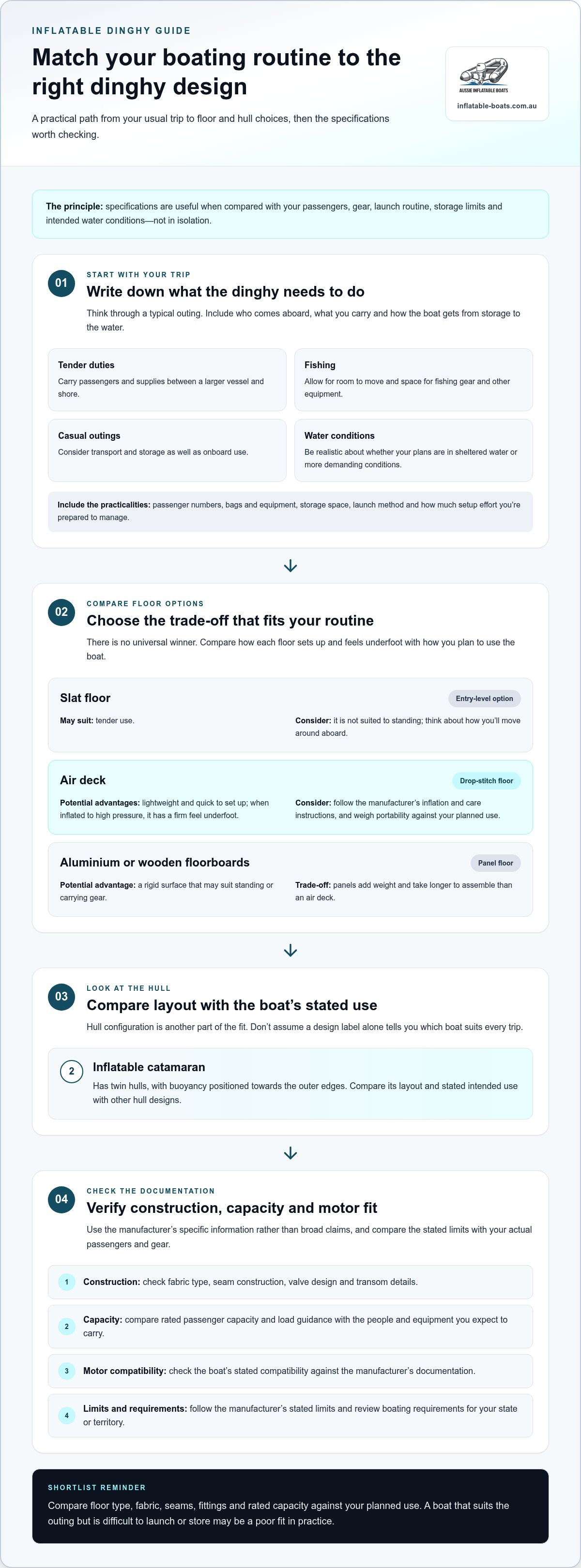
Floor choice involves practical trade-offs, not a universal winner. Use the comparison below to identify what matters for your routine, then check the specific boat’s setup instructions and specifications.
Slat floor: An entry-level option described as suitable for tender use. Consider how it assembles and whether its intended use fits your activities.
Air deck: A drop-stitch floor that inflates to high pressure. It’s typically lightweight and quick to set up, with a firm feel underfoot when correctly inflated.
Aluminium or wooden floorboards: Panel floors that provide a rigid surface, but add weight and take longer to assemble than an air deck.
Hull configuration matters too. An inflatable catamaran, for example, has twin hulls with buoyancy positioned towards the outer edges. Compare its layout and stated intended use with other hull designs rather than assuming one shape suits every trip.
Which construction details deserve a closer look?
Check the manufacturer’s documentation for fabric type, seam construction, valve design and transom details. Look for specific descriptions rather than relying on general durability language. Then compare the rated passenger capacity and load guidance with the people and equipment you expect to carry. Consider passengers and gear together, and follow the manufacturer’s stated limits.
Compare floor type, fabric, seams, fittings and rated capacity first, then weigh each detail against your planned use. This keeps technical claims in context and helps distinguish useful specifications from general sales language.
To compare available options against these criteria, browse the inflatable boat range. The best inflatable dinghy Australia 2026 for your needs is the one whose documented construction and capacity suit your routine, not simply the one with the longest feature list.
Which inflatable dinghy design suits your needs? Compare the trade-offs
No single configuration is automatically best for every Australian buyer. A tender kept aboard a larger vessel has different space and launch constraints from a dinghy used for fishing or relaxed outings. Compare the practical trade-offs, then check each shortlisted boat’s stated use and specifications rather than relying on a broad design label.
| Configuration | Potential advantages | Trade-offs to consider |
|---|---|---|
| Slat-floor dinghy | An entry-level floor option described as suitable for tender duties. | Not suited to standing, so consider how you’ll move around aboard. |
| Air-deck dinghy | A drop-stitch floor is lightweight and quick to set up; when inflated to high pressure, it offers a firm surface underfoot. | Follow the manufacturer’s inflation and care instructions, and weigh portability against your planned use. |
| Aluminium or wooden floorboards | A rigid floor can suit buyers who prioritise a firm surface for standing or carrying gear. | Panels add weight and take longer to assemble than an air deck. |
| Inflatable catamaran | Twin hulls position buoyancy towards the outer edges, a design associated with stability. | Compare the specific hull layout, stated capacity and intended use. The configuration alone doesn’t guarantee suitability for every activity or condition. |
What should a tender-focused buyer prioritise?
Think through the whole cycle: where the dinghy will be stored, how it moves from storage to the water, and how you’ll launch and recover it. A floor that takes longer to assemble may be inconvenient if you deploy the tender often. A heavier arrangement may be less appealing when handling and stowage space are limited. Your routine matters as much as the boat’s features.
What should recreational and fishing buyers weigh up?
For fishing or general outings, compare the space for passengers and equipment with the manufacturer’s capacity guidance. Consider where gear will sit and whether the layout leaves room to move safely. Stability is worth comparing too, but a hull description is no substitute for documented specifications or suitable conditions. Check which accessories fit the boat and support your plans.
The best inflatable dinghy Australia 2026 is the one that matches design trade-offs to real use, not a universal winner. Shortlist options by launch effort, storage, usable space and intended conditions, then compare the manufacturer’s documentation before deciding.
Check capacity, motor compatibility and Australian boating requirements
A dinghy can look like a close match and still be unsuitable if its load or motor limits don’t fit your plans. Use this checklist to compare shortlisted boats with their manufacturer documentation, then check the rules that apply where you’ll operate. Requirements can vary between Australian states and territories.
How do you check capacity and outboard compatibility?
Start with the boat’s capacity plate or manufacturer documentation. Use the stated limits for the exact boat, not figures from a similar-looking model. When assessing the planned load, count passengers and include the equipment you expect to carry, such as bags or fishing gear.
- Find the capacity guidance. Record the manufacturer’s stated passenger and load limits, including any conditions or notes.
- Estimate your real load. Consider the usual passengers and the gear they’ll bring. Compare the combined load with the boat’s stated limits, and don’t assume an empty-boat rating reflects a typical outing.
- Check motor compatibility. If you plan to fit an outboard, use the boat’s manufacturer documentation to establish compatible motor guidance. Don’t infer a suitable motor from the boat’s size or another model’s specifications.
- Confirm the configuration. Make sure the documentation applies to the floor, hull and transom configuration you’re considering, and keep it for reference.
- Identify your operating jurisdiction. Before buying and again before launching, consult the relevant state or territory maritime safety authority for current registration, operator licensing and safety equipment requirements.
What safety checks matter before buying and launching?
Plan safety equipment around the craft, activity and conditions. Requirements may differ by jurisdiction and by where you intend to operate, so verify the specific obligations with the relevant maritime safety authority rather than relying on a general checklist or advice for another state. Recheck current guidance if your boating plans change.
Manufacturer specifications set the boat’s capacity and motor guidance; state or territory authorities set the applicable boating requirements. Keep those checks separate. A boat’s documentation doesn’t replace checking local rules, and meeting a local requirement doesn’t make an unsuitable load or motor combination appropriate.
These checks help turn a shortlist into a considered decision about the best inflatable dinghy Australia 2026 for your intended use. Explore the inflatable dinghy options and compare each boat’s documentation with your passenger, gear and motor plans before choosing.
Choose your inflatable dinghy and plan for long-term ownership
A strong shortlist should reflect your boating routine, the boat’s construction and floor, its stated capacity, and compatible motor guidance. Review those criteria together before deciding. A dinghy that suits your outings on paper also needs to fit your transport, storage and care routine.
What should you plan for after choosing a dinghy?
Think beyond the first launch. Read the manufacturer’s setup and care instructions, and decide where the boat will be stored between trips. Suitable accessories depend on the boat’s configuration, your activity and the manufacturer’s guidance. Match them to your needs instead of adding equipment without a clear purpose.
- Setup: Learn the correct assembly and inflation process from the manufacturer’s instructions.
- Storage: Choose a practical place to keep the dinghy and its components between outings.
- Inspection: Check the boat and its fittings before use, following the care guidance supplied with it.
- Ongoing care: Use the manufacturer’s advice for cleaning, drying and storing the boat to help maintain it over time.
Browse the inflatable boat collections to compare relevant boats and accessories as you refine your choice. Keep notes on the features and documentation that matter most, so you can assess each option against the same criteria.
Where can you find boat, parts and repair support?
Long-term ownership includes access to suitable parts and maintenance support. Inflatable Boats sells inflatable boats, accessories and spare parts, and offers professional inflatable boat repairs. Keep the boat’s manufacturer information handy when selecting accessories or parts, and follow its guidance for maintenance and use.
Use your shortlist to make the final comparison: intended activities, passenger and gear needs, launch and storage routine, documented specifications, and ownership considerations. The best inflatable dinghy Australia 2026 is the one that brings those factors together for your plans on the water.
Explore inflatable boats and boating essentials to take the next step towards choosing your dinghy.
Choose with confidence and get ready for the water
The right dinghy starts with your routine: what you’ll use it for, how many people and how much gear it needs to carry, and how you’ll store and launch it. Compare floor and hull designs with the manufacturer’s capacity and motor guidance, then check the safety and registration requirements that apply in your state or territory.
That’s a practical way to find the best inflatable dinghy Australia 2026 for your plans, without assuming one design suits every boater. Think about ownership as well as the purchase: suitable accessories, spare parts and regular care all matter once your boat is in use.
Inflatable Boats offers inflatable boats, accessories and spare parts, as well as professional inflatable boat repairs. Explore the range and take the next step towards your time on the water: Explore inflatable boats and boating essentials.
With a clear shortlist and the right checks, you can choose a dinghy that fits your plans and head out with greater confidence.
Frequently Asked Questions
What size inflatable dinghy should I choose?
Choose a size that accommodates your usual passengers and gear within the manufacturer’s stated capacity. Consider the dinghy’s intended use too: a tender may have different space needs from a fishing or recreational boat. Account for where you’ll store it, how you’ll transport it and the effort involved in launching. To find the best inflatable dinghy Australia 2026 for your routine, compare the full load you expect to carry with each boat’s documentation.
Is PVC or Hypalon better for an inflatable dinghy?
Neither material is automatically better for every owner. Hypalon has a longstanding reputation for UV resistance and durability, while modern heat-welded PVC is a practical option for many recreational uses. Compare the specific boat’s fabric and seam construction, care instructions and intended use in its manufacturer documentation. Don’t rely on the material name alone: construction quality and ongoing care also matter to the boat’s service life.
Can I fit an outboard motor to an inflatable dinghy?
You can fit an outboard only if the particular dinghy is designed for one and the motor falls within the manufacturer’s guidance. Check the boat’s plate or documentation for motor compatibility and any stated limits. Don’t infer a suitable motor from the boat’s size or another model. A motor can also affect registration and licensing requirements, which vary across Australia, so check the relevant state or territory maritime safety authority.
Which floor type is best for an inflatable dinghy?
The best floor depends on how you’ll use, carry and assemble the dinghy. Slat floors are an entry-level option described as suitable for tender use. Air decks are lightweight and quick to set up, while aluminium or wooden floorboards provide a rigid surface but add weight and assembly time. Compare each option with your routine and the manufacturer’s instructions; no floor type is right for every activity.
Do I need to register an inflatable dinghy in Australia?
Registration requirements depend on the dinghy, how it’s powered and the jurisdiction where you use it. Rules differ between states and territories, so don’t assume an exemption or requirement applies nationwide. Before buying a motorised dinghy, check current registration guidance with the relevant maritime safety authority. Also verify whether any tender provisions apply to your circumstances. Unpowered boats are generally treated differently, but confirm the current local rule.
What safety equipment should I carry in an inflatable dinghy?
Carry the safety equipment required for your craft and intended operating area, and check current requirements with your state or territory maritime safety authority. Requirements can vary with location and conditions. Lifejackets, an anchor and a way to remove water are examples of equipment commonly relevant to dinghy outings; additional items may be required for particular waters. Check the authority’s guidance before each trip, and make sure equipment is serviceable and accessible.