
Benefits of a Deep V Hull on a RIB: Ride, Control and Trade-offs
A RIB’s smoother ride in choppy water can come with a trade-off when you’re back at anchor. The benefits of a deep V hull on a RIB are most noticeable when the boat meets waves: its sharper hull shape can cut through them rather than slap across the surface, helping reduce impact and fatigue. But that doesn’t automatically make it the right choice for every trip.
If you’re weighing comfort against stability and efficiency, consider the conditions you actually boat in. A deeper hull can feel less settled at rest and may need more power in calm water than a flatter design. The RIB’s inflatable tubes also contribute to the performance of the complete boat, so hull shape is only part of the picture.
This article explains what “deep V” means in hull geometry, how it can influence ride and control, and where the compromises matter. You’ll also learn what to consider when assessing a RIB for your usual waters, crew and priorities, so you can judge whether the trade-off suits your boating.
Key Takeaways
- A deep V describes a pronounced V-shaped hull cross-section, which can influence how a RIB behaves underway.
- The benefits of a deep V hull on a RIB may include a more forgiving ride in waves, though results depend on the boat’s design and conditions.
- Compare deep-V and shallower hulls with both underway comfort and movement at rest in mind.
- Base your choice on the water you usually travel, trip length, load and comfort priorities, not only occasional rough conditions.
- Assess the whole RIB: hull geometry, overall design, loading and intended use work together to shape performance.
What does a deep V hull mean on a RIB, and why does its shape matter?
Hull shape influences how a RIB behaves underway, particularly when it meets waves. A deep V describes a hull bottom with a pronounced V-shaped cross-section when viewed from the front or rear. The shape of that rigid running surface affects how the boat interacts with the water, but it’s only one part of the design.
Hull geometry influences ride, handling and practical trade-offs, but the result depends on the whole RIB and the conditions it’s used in. The benefits of a deep V hull on a RIB are best understood by looking beyond the label to the hull’s angles and contours. This Rigid Inflatable Boat (RIB) with Deep-V Hull overview places the geometry in the context of the wider RIB design.
How is deadrise measured on a RIB?
Deadrise is the angle between the hull bottom and a horizontal reference, commonly measured at the transom. Viewed from behind, a more pronounced V has a steeper angle rising from the keel towards the sides. It’s a useful comparison point, but not a complete description of how the hull will behave.
A hull can change shape along its length. The angle at the transom may differ from the form further forward, where the hull meets incoming water. One deadrise figure can’t capture every contour or predict performance by itself. When comparing RIBs, treat the stated angle as one design detail and consider how it relates to the full hull profile and intended use.
How does the rigid hull work with inflatable tubes?
The rigid hull forms the boat’s running surface, including the V-shaped bottom that meets the water as the RIB moves. Inflatable tubes sit around the hull’s sides and contribute to the complete craft, but they don’t set the hull’s deadrise or replace the role of its underwater shape.
Keep these functions distinct when assessing a boat. Hull geometry helps explain how the RIB moves through water; buoyancy and stability relate to the performance of the complete vessel and depend on its overall design and loading. A deep-V label alone can’t tell you how a RIB will feel at rest or underway.
This distinction makes comparisons more useful. Look at the hull’s shape, where its form changes, and how the tubes are integrated with the rigid structure, rather than assuming every deep-V RIB behaves alike. For the wider decision, The Rugged Guide to Choosing Your First Inflatable Boat in 2026 puts hull choice alongside other considerations involved in selecting an inflatable boat.
How a deep V hull can improve a RIB’s ride and control
A deeper V can change how a RIB meets a wave. Rather than presenting a relatively broad, flatter section to the water, its sloping surfaces can enter the wave at a less abrupt angle. This may soften the impact felt on board, particularly in short, uneven chop. It won’t guarantee a smooth ride: wave shape, speed, hull design and loading all influence what passengers experience.
Hull shape influences ride quality, but it doesn’t determine it on its own. Geometry can help explain how a boat interacts with waves, but it can’t promise comfort in every sea state or remove the need to operate with care.
Why can a deep V feel more comfortable in chop?
A flatter section may meet a wave more directly, while a pronounced V can part the water progressively as the hull advances. In suitable conditions, this may reduce the sharpness of impacts transmitted through the boat. The difference can be most noticeable when repeated wave contact would otherwise make a trip tiring.
Spray and passenger comfort also depend on the design and conditions. The hull’s overall shape, the direction and spacing of waves, speed and loading all affect the ride. A deep V won’t make every patch of rough water comfortable, and it’s no reason to push on when conditions call for a more cautious approach.
What can deep-V geometry mean for handling underway?
When the hull meets waves more progressively, the boat may feel less abruptly disturbed, which can help the operator maintain a composed course. A steadier-feeling ride can also help passengers stay settled and the operator focus on the water ahead. These are possible handling advantages, not guaranteed outcomes.
Control still depends on the whole setup: hull design, load distribution, speed, operator input and conditions all play a part. A poorly matched load or unsuitable operating approach can undermine the qualities a hull is designed to provide. A deep V doesn’t eliminate rough-water risk or protect a RIB from sudden changes in conditions.
Use hull design as one factor in your decision, then consider the water you’re likely to encounter and how the complete boat is configured. When comparing options, explore inflatable boats with your typical trips and comfort priorities in mind, rather than relying on the hull label alone.
Deep V versus shallower hulls: what does the ride benefit trade away?
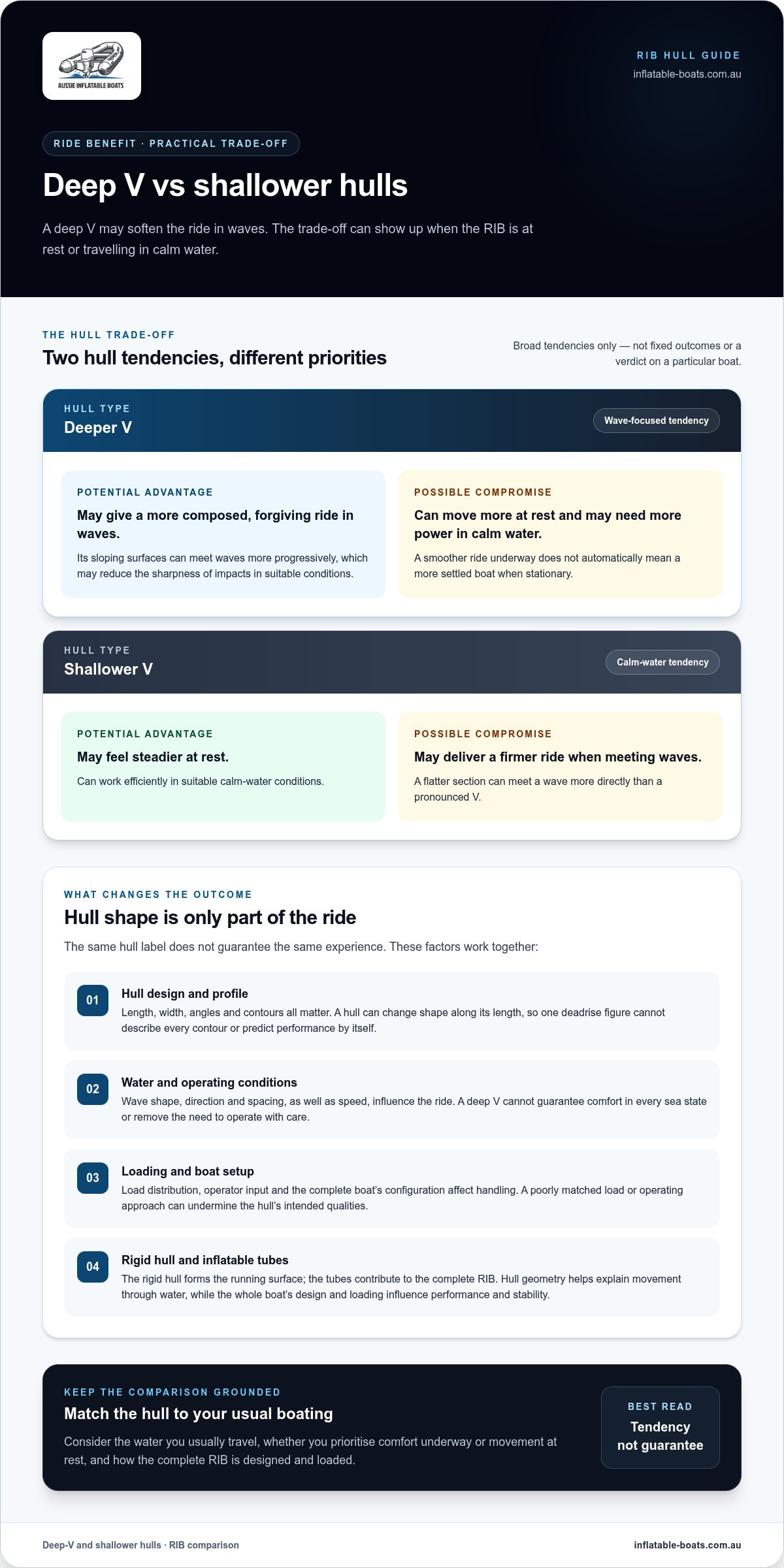
A deep-V design can favour a more forgiving ride in waves, while a shallower hull may feel more settled when the boat is stationary and suit some calm-water use. These are broad tendencies, not fixed outcomes. Hull length, width, shape through the water, loading and the rest of the boat’s design all influence performance.
| Hull tendency | Potential advantage | Possible compromise |
|---|---|---|
| Deeper V | May give a more composed ride in waves | Can move more at rest and may demand more from the engine in some conditions |
| Shallower V | May feel steadier at rest and work efficiently in suitable calm-water conditions | May deliver a firmer ride when meeting waves |
Use the comparison as a starting point, not a verdict. A hull’s behaviour can’t be summed up by the depth of its V alone, and one boat’s performance shouldn’t be assumed to represent every RIB with similar geometry.
What stability differences should RIB owners understand?
Stability at rest describes how a boat feels while stationary, such as when passengers move about or prepare gear. Comfort and control underway describe different qualities: how the boat responds as it moves through waves. A hull may feel more active at rest yet provide a ride some owners prefer underway. Don’t treat these different meanings of stability as the same thing.
Actual behaviour also depends on the boat’s load and the water conditions. Passenger positions and gear can affect balance, so no hull shape should be treated as stable in every configuration. Consider where people will sit, what you’ll carry and whether the boat will spend more time stopped or travelling.
Can a deep V affect efficiency and operating demands?
Potentially. A deep V’s sharper underwater form can create different resistance from a shallower hull, but the effect on efficiency depends on hull design, engine, load and operating speed. There’s no universal fuel-use figure or engine-power requirement for every RIB. Assess the complete boat rather than inferring its operating demands from the hull label.
If you regularly travel across choppy or exposed water, a more comfortable ride may be worth weighing against how the boat will perform on calmer days. If most outings are short and in sheltered conditions, that ride advantage may matter less than a settled feel at rest or efficient operation at your usual speeds.
Ask how often you’ll encounter the conditions that make a deeper V appealing. Compare your regular trips, not just the occasional challenging day, and remember that these are tendencies rather than guarantees. The benefits of a deep V hull on a RIB matter most when they align with your usual boating priorities.
How to decide whether a deep-V RIB suits your boating
Start with your regular boating, not the roughest trip you can imagine. The benefits of a deep V hull on a RIB matter most if your usual routes and conditions make ride comfort a frequent priority. Work through these factors to build a practical picture of what you need from the boat.
- Typical water: Think about where you usually travel and how often you meet chop or waves along your expected route. Separate regular conditions from the occasional challenging outing.
- Trip length: Consider how long you’re typically underway. Repeated impacts may matter more on longer trips, especially if passenger comfort is a priority.
- Load: Account for passengers, equipment and how they’ll be distributed. A boat’s behaviour depends on its load as well as its hull.
- Comfort and handling: Decide whether a more composed ride underway matters more to you than a settled feel while stopped, and consider who’ll be aboard.
- Operating demands: Think about your usual speed and the conditions in which you’ll operate. Choose a hull that fits your real use, not an imagined ideal.
Which boating conditions make ride comfort a priority?
Regular exposure to chop, the frequency of wave contact and the route you expect to travel can all make ride comfort a stronger consideration. So can trip duration and your passengers’ needs. A deep V may appeal if you often travel through waves, but an occasional rough outing alone may not outweigh the compromises for everyday use. Judging weather and sea state remains essential with any hull.
What should you compare when reviewing RIB specifications?
Look beyond a single deadrise figure. Compare it with the hull’s shape and dimensions, the stated load and the RIB’s overall design. Read performance descriptions closely: useful information explains the conditions, load and operating assumptions behind the claims. Without that context, a general statement about ride or efficiency may not reflect how you’ll use the boat.
Consider the boat’s construction and category alongside its hull geometry. Category-level information can help frame your options, but it isn’t a specification for an individual boat.
Once you’ve defined your typical conditions, passenger needs and priorities, explore inflatable boats for your boating needs and use those requirements to guide your comparison.
Choosing a RIB with confidence: match hull design to the whole boat
A deep V can be a strong choice when a more forgiving ride through waves is high on your list. It isn’t automatically the best hull for every RIB or outing. Make your decision by considering geometry alongside the complete boat, how it will be loaded and where you expect to use it.
Balance the advantages against the compromises
The benefits of a deep V hull on a RIB matter most when your typical boating makes its potential ride and wave-handling qualities valuable. Weigh those possible gains against what matters while the boat is stationary and how you expect it to operate. Individual hull designs, loading and conditions can all change the outcome.
- Ride underway: A pronounced V may help soften the feel of wave impacts in suitable conditions.
- Wave handling: Its shape may support a more composed passage through chop, depending on the hull and how it’s operated.
- Stability at rest: A deeper V may bring more movement while stationary than a shallower hull.
- Operating demands: Efficiency and power needs depend on the hull, engine, load and speed, so don’t assume a universal result from the hull type alone.
Compare those tendencies with your actual boating routine. If you regularly travel in choppy water with passengers who value ride comfort, the potential benefit may carry more weight. If your outings are mostly calm and involve plenty of time stopped, other qualities may matter more. Neither scenario points to one universal answer: the whole design and intended use remain central.
Explore inflatable boats with your priorities in mind
As you compare options, keep your priorities consistent. Consider your usual route and conditions, the people and gear aboard, and how much time you spend underway versus stationary. Then compare hull geometry with the RIB’s wider design rather than treating one specification as a complete performance verdict.
Explore inflatable boats alongside accessories and spare parts for the needs that come with boat ownership. Compare the construction and design of each boat with your intended use, and rely on the individual boat’s specifications to assess its hull.
Choose for the trips you’re most likely to take, not only an occasional demanding day. A deep V may prioritise comfort underway, but a confident choice accounts for the trade-offs and the complete RIB. Explore inflatable boats with your boating priorities in mind.
Make your next RIB choice with purpose
Before comparing boats, picture a typical day on the water from launch to return. Note who’s aboard, what you’ll carry, how long you’ll be underway and the conditions you commonly encounter. That reference point gives hull specifications context and helps you judge whether the benefits of a deep V hull on a RIB matter to your routine, rather than just sounding appealing on paper.
Use it as a practical brief while exploring inflatable boats, accessories and spare parts. Professional inflatable boat repairs can also help support ownership beyond the initial purchase. The best choice is the one that fits the boating you genuinely plan to do.
Explore inflatable boats and choose a RIB with your boating priorities in mind.
Frequently Asked Questions
Can a deep-V RIB be used in shallow water?
It depends on the specific boat and how it’s operated, so there’s no universal yes or no. Draft and shallow-water suitability are affected by the complete hull, load, engine setup and operating conditions. A hull’s ability to handle waves doesn’t tell you how little water it needs. Before choosing a route, consult the boat’s specifications and use sound judgement around changing depth and underwater hazards.
Does a deep-V hull make a RIB safer in rough seas?
No hull shape makes rough conditions safe. Geometry can influence ride and handling, but capability also depends on the whole boat, its condition, loading, operator skill and the conditions encountered. The benefits of a deep V hull on a RIB aren’t a guarantee of safety or a reason to continue if conditions worsen. Conservative decisions remain essential, whatever the hull design.
Will a deep-V RIB stay level when passengers move around?
Not necessarily. Passengers moving from one side to another change the load distribution on any boat, and a deep-V hull’s ride underway doesn’t mean the RIB will remain level while stationary. Follow the manufacturer’s loading guidance and arrange people and gear appropriately for the boat. For example, avoid having everyone shift to one side at once, as this can alter the boat’s balance.
Does a deep-V hull make a RIB faster?
Not by itself. Hull shape alone can’t establish a RIB’s acceleration or top speed, which also depend on the hull’s full design, engine, load, water conditions and setup. Deep-V geometry is generally valued for its potential ride behaviour, not as a universal speed upgrade. Compare performance information for the particular boat and its stated conditions rather than assuming a deeper V will make it faster.
How can I find a RIB’s deadrise angle?
Look in the manufacturer’s specifications or technical documentation, where deadrise may be listed as an angle measured at the transom. When comparing boats, check that the figures refer to the same measurement point. The number describes only one aspect of hull geometry; it won’t show every contour or predict exactly how the boat will ride. Read it alongside the wider design information.
Is a deep-V RIB a good choice for someone new to boating?
Being new to boating doesn’t automatically make a deep-V RIB suitable or unsuitable. Consider the water you expect to use it in, your planned trips and comfort priorities, as well as your ability to operate and load the boat responsibly. Take time to understand its handling characteristics and follow the manufacturer’s guidance. Hull design can inform your choice, but it can’t replace preparation or sound judgement.