
Are Inflatable Catamarans Safer for Families on the Coast?
A twin-hull layout can help an inflatable catamaran resist side-to-side roll, but it can’t make rough coastal water safe. Whether inflatable catamarans are safer for families depends on conditions, construction and use. They’re generally better suited to calm water than rough conditions, so choosing a sheltered route matters as much as hull design.
It’s understandable to want a stable, reassuring ride with children aboard. A wide stance and buoyancy across two hulls can support stability, while suitable materials, sound seams and separate air chambers add important layers of resilience.
This guide explains how Australian coastal conditions, including wind chop and tidal flow, affect a trip, what to look for in hull design and construction, and why separate chambers matter. It also covers practical ways to reduce risk, including fitting children with correctly sized life jackets and supervising them throughout the outing. Use it to make informed choices about where and how to take your family boating, while remembering that no boat design replaces good judgement.
Key Takeaways
- Choose calmer, sheltered coastal routes rather than treating a twin-hull design as protection from rough water.
- Check wind, waves and tides before setting out, and head for shelter if conditions worsen.
- A catamaran’s separated hulls provide a wider stance that resists side-to-side roll compared with a single-tube inflatable.
- Assess fabric, reinforced seams and transom construction as part of your boat’s readiness for coastal use.
- Look for separate air chambers across the hulls, which add flotation security if one chamber is damaged.
1. Can inflatable boats handle rough water?
Inflatable boats are generally better suited to calmer water, such as sheltered bays and lakes, than rough conditions. A twin-hull layout can improve stability, but it doesn’t make an exposed coastal launch safe in every sea state. For families, match the route to the conditions, not just the boat’s design.
Choppy water brings repeated impacts, spray and sudden changes in balance. Two separated hulls create a wider stance that helps resist side-to-side roll and bridge short chop within safe limits. This can provide a stable platform in suitable conditions, but you still need to avoid rough water and turn back if conditions deteriorate.
A lower profile, closer to the water, is associated with a smoother ride than a higher-sided craft. It may make movement feel less abrupt in modest chop, but also exposes passengers to spray and waves. Keep children seated while moving and supervise them throughout the trip.
Soft edges are another practical feature for family use. Compared with hard surfaces, inflatable boat edges can reduce the risk of young children getting hurt when they bump against the sides. They don’t replace close supervision: set a clear rule that children stay seated and don’t lean over the tubes.
Before launch, inflate each chamber to the manufacturer’s recommended pressure. Correct inflation supports the hull’s intended shape and performance, while underinflated tubes can deform under load. Distribute passengers and gear evenly, too. A heavy bag or several passengers on one side can make the boat sit unevenly and compromise stability.
If you’re assessing a Kolibri Sea Cat design, focus on its hull arrangement and intended conditions rather than its name. Consider the distance between the hulls, how the floor supports passengers and how the boat is meant to be operated. These details help explain performance; a catamaran label alone doesn’t establish suitability for rough water.
So, are inflatable catamarans safer for families? Their twin hulls can resist roll, while soft edges and distributed buoyancy offer useful design advantages. But calmer water remains the more suitable choice for inflatable boats. Before setting out, check local weather, choose a sheltered route, fit each child with a correctly sized life jacket and supervise them continuously.
For a family outing, treat comfort and safety as separate questions. A smoother ride can help passengers feel more secure, yet wind chop, tidal flow and exposed anchorages can quickly make conditions demanding. Choose a protected bay or estuary when conditions are unsettled, and keep the trip within the boat’s intended use.
2. Are inflatable Catamarans Safe for Coastal Waters?
Inflatable catamarans can suit sheltered Australian coastal trips, such as outings in bays, estuaries and anchorages. Short-period wind chop, tidal flow and exposed water can quickly change the level of risk. Plan around the conditions, not just the hull design. A fishing trip inside a protected bay calls for different decisions from an exposed island transfer.
Are inflatable catamarans safer for families than rigid catamarans or monohull boats? Their separated hulls provide a wide stance that resists side-to-side roll, but that alone can’t establish which boat is safer. Conditions, construction, passenger load and responsible operation all matter.
How stable are inflatable catamarans in waves, wind and chop? Twin hulls can reduce roll and bridge short chop within safe limits. This stability doesn’t make strong winds, rough water or large vessel wakes suitable for a family outing.
How much do family-sized inflatable catamarans cost in Australia? Cost depends on factors such as boat length, construction, floor design and included accessories. Compare boats by intended use and specifications, rather than relying on one price to represent every family-sized model.
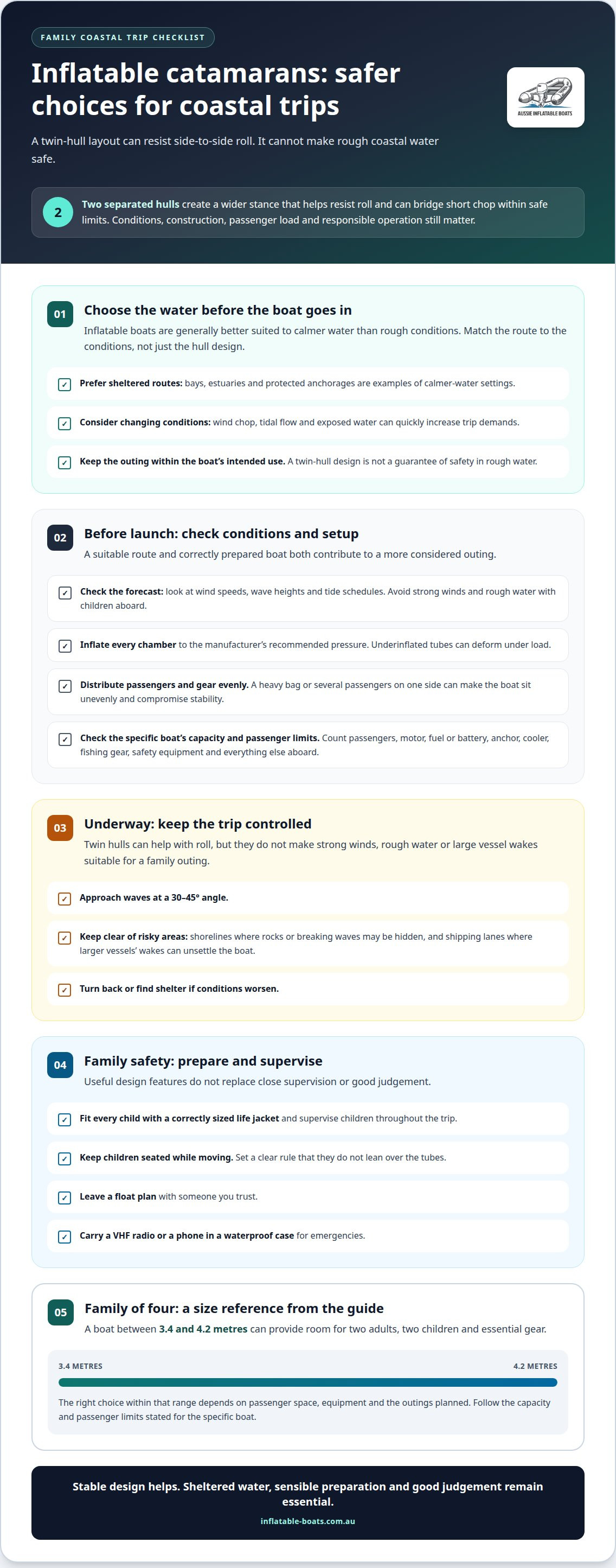
What size inflatable catamaran is suitable for a family with children? For a family of four, a boat between 3.4 and 4.2 metres can provide room for two adults, two children and essential gear. The right choice within that range depends on passenger space, equipment and the outings planned.
What load capacity and passenger limits apply to popular inflatable catamarans? Follow the capacity and passenger limits stated for the specific boat. Capacity includes passengers, motor, fuel or battery, anchor, cooler, fishing gear, safety equipment and everything else aboard. Account for the full load before packing.
Before launch, check the forecast for wind speeds, wave heights and tide schedules. Avoid strong winds and rough water with children aboard. Approach waves at a 30-45° angle, keep clear of shorelines where rocks or breaking waves may be hidden, and avoid shipping lanes where larger vessels’ wakes can unsettle the boat. Turn back or find shelter if conditions worsen.
Carry an approved personal flotation device for every passenger, and supervise children throughout the trip. Leave a float plan with someone you trust, and carry a VHF radio or a phone in a waterproof case for emergencies. For calmer-water family adventures, explore inflatable boat options suited to your intended use.
3. Catamaran versus single-hull inflatables
The key difference is the footprint on the water. An inflatable catamaran has two separated hulls, creating a wider stance than a single-hull inflatable. That spacing helps resist side-to-side roll and can bridge short chop within safe limits. The advantage is a broader base, not immunity from rough conditions.
Buoyancy is distributed across both hulls, which support the boat on either side of its central platform. With passengers seated evenly, this layout can feel steadier when someone shifts position. A single-hull inflatable concentrates buoyancy in one main hull, so movement on one side can affect balance more directly. Both designs still depend on suitable loading.
That wider stance can be valuable for family activities such as fishing, when passengers may move to handle rods or gear. On a catamaran, the space between the hulls contributes to the platform’s support. Keep children seated while the boat is moving, and distribute people and equipment evenly. A stable platform still requires sensible passenger behaviour.
Single-hull inflatable boats can suit users who value a simpler footprint or need a particular setup. Their narrower arrangement may respond more noticeably to sideways movement, while a catamaran’s twin hulls resist roll. Neither design is automatically right for every Australian outing. Consider the launch site, route, passengers and gear before deciding.
Weight matters in either layout. Count passengers, motor, fuel or battery, anchor, safety equipment and other gear together, then stay within the boat’s stated capacity. Heavy items on one side can cause uneven trim. On a catamaran, even loading helps both hulls share support; on a single hull, balanced placement also helps maintain control.
Construction and setup influence how each design behaves. Correctly inflated hulls maintain their intended shape, while secure fittings and a sound transom support the motor and steering. Before launch, inspect the hull fabric, seams and attachment points. These checks matter for catamaran and single-hull models alike: a wide stance can’t compensate for neglected equipment.
In short chop, a twin-hull configuration has a stability advantage over a single-hull inflatable: its separated hulls reduce roll and can bridge small waves. This comparison applies only within safe limits. Strong wind, steep waves or a large wake can challenge either platform, so don’t treat hull shape as permission to venture beyond the conditions in your trip plan.
Choose a boat that matches your family’s actual use. A catamaran may suit passengers who value a broad platform and reduced roll; a single-hull model may suit a different launch or storage arrangement. Compare the stated capacity, layout and intended operating conditions, then consider how your family will board, sit and stow equipment. Design advantages matter most when the boat fits the outing.
4. Materials, seams and transom construction
For coastal boating with children, inspect the materials before judging a boat’s stability. Marine-grade fabric, reinforced seams and a rigid transom are key construction features. Each has a separate job: fabric forms the hull, seams join loaded panels, and the transom supports the motor. A weakness in any area can affect performance.
Fabric thickness and weight offer useful comparison points between models. Treat fabric below 1000 GSM or 0.9 mm thick as a red flag for a primary family boat. These figures aren’t a substitute for checking the whole construction, but they help identify lightweight materials that may be less suited to demanding use. Look for abrasion, cuts, worn patches and lifting edges before every launch.
German VALMEX® fabric is described as having a lifespan of 10-12 years in the Australian climate when used in a high-quality inflatable boat. That lifespan is not a reason to ignore care. Rinse away salt and grit after coastal trips, dry the boat before storage, and keep it away from sharp objects. Those steps help preserve fabric and seams through regular use.
Reinforced seams matter because they join the panels that contain air and support the hull’s shape. Before boating, inspect each seam for separation, damage or wear. Pay particular attention to areas near handles, attachments and the transom, where loading and movement place extra demands on the structure. Repair damaged areas before taking children out.
A rigid transom provides a firm mounting point for the motor. Check it for visible damage and make sure its joins to the hull remain secure. The motor must stay within the boat manufacturer’s maximum horsepower rating. A sound transom and correctly rated motor work together, but neither makes an unsuitable coastal route safe.
Floor construction also affects the family’s working platform. A high-pressure drop-stitch air deck inflated to 8-10 PSI provides a firm floor when inflated to the specified pressure. Check the deck’s pressure before launch and avoid placing sharp fishing gear directly on it. A stable footing can make boarding and moving aboard more manageable, especially with children.
Treat these checks as part of preparing for family time on the water, not just as a one-off purchase inspection. Before each coastal outing, examine the fabric, seams, transom and floor, then confirm correct inflation. Strong materials support dependable use, but careful handling and conditions suited to the boat remain essential for safe boating.
5. Multiple air chambers and redundancy
Separate air chambers add flotation redundancy to an inflatable catamaran. If one chamber is punctured, the others can continue providing buoyancy. This may help keep the boat afloat, but its balance and handling can change. It’s not a reason to continue the trip after damage.
Chambers should be independent, not simply separate sections connected to one air space. CE-certified inflatable boats must have multiple independent air chambers under ISO 6185-3. For family use, a 3+1 arrangement means at least three tube chambers and one floor chamber. Check the design and inflation points before choosing a boat.
The 10' Rover Marine Battle Cat has 4+1 air chambers. That layout separates buoyancy across its tubes and floor, giving a family a specific example to compare against simpler arrangements. More chambers don’t make punctures impossible, and they don’t remove the need to inspect the fabric, seams and valves before launch.
What are the risks of punctures, capsizing and falling overboard in an inflatable catamaran? A puncture can reduce buoyancy and affect trim, while rough conditions, uneven loading or sudden movement can increase capsize risk. Anyone can fall overboard, so fit every passenger with an approved life jacket and supervise children closely.
Before each outing, check every chamber separately. Confirm that valves are secure, tubes hold their shape and the floor is properly inflated. Look for cuts or abrasion that could become a leak. If a chamber loses pressure, head towards a safe landing or sheltered area rather than treating the remaining chambers as a guarantee of normal performance.
A stable boat still depends on balanced loading. Distribute passengers and gear evenly, and include the anchor, safety equipment, motor and fuel in the boat’s capacity. A heavy anchor or packed storage bag on one side can alter trim. Secure loose items so they don’t shift when the boat crosses chop.
Use the same precautions for a short tender trip as for a family day on the water. Keep children seated underway, explain that they mustn’t lean over the side, and have an adult manage the anchor. These simple actions reduce avoidable movement around the boat and help keep the load balanced.
Redundancy is most useful when paired with maintenance and sensible decisions. Rinse and dry the boat after use, protect tubes during storage, and arrange repairs for damaged fabric or valves before the next launch. Explore inflatable boat options with chamber layouts suited to your planned family use.
Inflatable Boats: Inflatable Boats
Inflatable Boats can help you move from researching safety to choosing and maintaining an inflatable boat for family outings. Consider how you’ll use it, the coastal conditions you plan to encounter, and the capacity, construction and chamber layout that suit your passengers and gear.
Inflatable Boats also offers Inflatable Boat Accessories, Inflatable Boat Spare parts and Inflatable Boat Repairs. These can support your setup, replacement needs and upkeep as your boating plans evolve. Contact Inflatable Boats to discuss the next step.
Plan a family outing that fits your boat
The best next step is to picture a real day on the water, not an idealised one. Think about who’ll be aboard, the gear you’ll carry, where you’ll launch and which sheltered routes suit your experience. This practical picture helps turn specifications into a setup your family can use with confidence.
Ultimately, whether inflatable catamarans are safer for families depends on choosing a boat and outing that work together. A design advantage matters most when the craft suits your plans, is prepared carefully and is used in conditions you can manage. Keep early trips straightforward, build familiarity close to shelter and let experience guide longer coastal adventures.
Use that checklist as you compare your options and prepare for time afloat. Explore Inflatable Boats’ website as you plan your next step. With thoughtful preparation, your family can head towards the coast ready to make the most of a day on the water.
Frequently Asked Questions
Are inflatable catamarans safe for coastal waters?
Inflatable catamarans can be used in coastal waters when the route and conditions suit the boat. For a family outing, choose a sheltered bay, harbour or estuary, and plan a nearby landing place in case the weather turns. Island transfers and exposed anchorages call for greater care than a protected shoreline. Build the trip around sheltered water rather than assuming a coastal boat can handle every stretch.
Why is an inflatable boat perfect for family adventures?
An inflatable boat can make short, simple outings accessible for families who want time on calm water. For toddlers and children up to around six years old, shorter trips may be a better fit. Plan a nearby destination and finish before children become tired or cranky. A first outing on a calm bay or sheltered estuary can help your family find a comfortable routine before planning longer adventures.
What makes an inflatable boat genuinely safe for kids?
Children’s safety depends on preparation and supervision, not just the boat. Before setting off, take a short practice ride near shore so children can get used to the motor and movement. Set clear rules: stay seated while underway, and ask an adult before leaning over the side. Keep fishing gear secured when not in use, and make sure an adult can supervise children throughout the trip.
Can inflatable boats handle rough water?
Inflatable boats are generally better suited to calmer water than rough conditions, so don’t plan a family outing around challenging seas. If the forecast points to strong wind or rough water, choose another day or a sheltered route. Wind chop, tidal flow and wakes can make a trip uncomfortable and harder to manage. A catamaran’s hull design doesn’t remove the need to make conservative decisions about conditions.
Do I need life jackets on an inflatable boat?
Carry an approved personal flotation device for every passenger, and have children wear correctly fitted life jackets. Fit them before boarding, not after leaving shore, and supervise children throughout the outing. Choose devices that fit each wearer properly, including children’s sizes, rather than relying on an adult-sized jacket for everyone. A life jacket is essential safety equipment, but it doesn’t replace attentive supervision.
Is an inflatable catamaran more stable than a single-hull inflatable?
An inflatable catamaran’s separated hulls create a wider stance that helps resist side-to-side roll. This can be an advantage when passengers shift or handle fishing gear, provided people and equipment are distributed evenly. Stability still depends on conditions and loading. For a fair comparison, consider the intended water, passenger layout and gear you’ll carry, rather than judging the boat by its hull arrangement alone.
What’s better for families: an inflatable catamaran or a monohull?
Neither layout is automatically better for every family. A catamaran’s separated hulls offer a wider stance, but the right choice also depends on passenger space, total load, launch location and planned trips. Include the motor, fuel or battery, anchor, safety equipment and other gear when considering capacity. Think through how your family will board, sit and stow equipment before choosing a layout.
Why do inflatable boats have multiple air chambers?
Independent air chambers provide flotation redundancy: if one is punctured, the others can continue providing buoyancy. For family use, a 3+1 arrangement means at least three tube chambers and one floor chamber. Before each outing, check the valves and pressure in every chamber, rather than assuming one quick glance at the tubes is enough. If a chamber loses pressure, head for a safe landing instead of continuing as normal.