
Are Air Deck Floors Durable? Strengths, Limits and Care
An air deck can be durable, but it isn’t automatically the toughest floor for every boating trip. So, are air deck floors durable enough for the way you plan to use your inflatable boat? It depends on the floor’s construction, how it’s inflated and what it encounters on the water and shore.
Weigh the risk of punctures and abrasion against the benefits of a lighter, more portable floor. Air decks use drop-stitch construction to create a firm surface when inflated, but sharp gear and rough handling can still cause damage. A rigid or slatted floor may better suit heavier-duty use, while an air deck can be practical when easy transport and pack-down matter.
This guide explains what affects air deck longevity and compares the main floor types, so you can choose with your boating habits in mind. You’ll also learn how to inspect, inflate, clean and store an air deck to help protect it for more days on the water.
Key Takeaways
- Whether are air deck floors durable depends on their construction, correct setup, use and care, not simply on being inflatable.
- Drop-stitch construction, outer fabric, seams and bonding can all influence an air deck’s strength and wear.
- Compare air deck, slatted and rigid floors by portability, setup, comfort and likely wear to find the right trade-off for your boating.
- Use a before-use, after-use and storage check to spot potential damage early, and follow the boat maker’s pressure guidance.
- Before choosing a boat, check its floor construction, care instructions and support, alongside how you’ll transport, store and load it.
Are air deck floors durable in everyday boating use?
Yes, an air deck can stand up to everyday boating when its construction suits the use and it’s set up, handled and cared for correctly. If you’re asking, “are air deck floors durable?”, the practical answer is that durability varies by design and conditions. An air deck isn’t indestructible. Sharp equipment, abrasive ground, incorrect inflation and rough handling can all contribute to wear or damage. There’s no single lifespan that applies to every floor.
A little movement underfoot doesn’t automatically mean something’s wrong. An inflatable panel may feel more yielding than a rigid floor, even when correctly inflated. Watch for changes such as a new soft spot, pronounced or uneven flex, a raised bubble, visible damage or pressure that keeps dropping. Check the boat’s instructions and seek an inspection if the floor’s condition affects its stability or performance.
What does an air deck floor consist of?
An air deck is an inflatable floor panel fitted inside an inflatable boat. It’s separate from the hull tubes, which form the boat’s sides, and from any separate keel beneath the floor. Drop-stitch construction is common: internal threads connect the panel’s upper and lower surfaces to help it hold a flatter shape when inflated. Designs vary, so check the specific boat’s construction rather than assuming every air deck uses the same materials or method. For background on inflatable boat construction, including common floor types, see Wikipedia.
What does durable mean for an inflatable floor?
For an air deck, durability means more than feeling firm on the first outing. It includes resisting surface wear and punctures, retaining pressure, and coping with repeated inflation, handling and storage. The panel’s fabric, coatings, seams and bonding may all affect how it holds up, but a material label alone can’t show how it will perform in your conditions. Follow the manufacturer’s inflation and care guidance for the specific boat.
Comfort and firmness are useful qualities, but they don’t prove long-term durability. A well-cared-for floor used with suitable gear and on appropriate surfaces may serve well. Frequent contact with sharp or abrasive objects raises the risk of damage. Regular checks can help you spot changes early, before a small concern disrupts a day on the water.
How air deck construction affects strength and wear
Construction affects how an air deck carries weight and copes with repeated use. In common drop-stitch designs, numerous internal threads connect the top and bottom surfaces. Inflation tensions these threads, helping the panel hold a flatter shape underfoot. That internal structure supports rigidity, but it doesn’t make the surface immune to punctures or abrasion.
Drop-stitch construction, fabric and seams
Not every air deck is built the same way. The outer fabric and its coating affect how the surface stands up to contact and exposure, while seams, valve fittings and the bonds between layers are points to inspect. A material name alone can’t guarantee durability or indicate how long a floor will last. Check the boat maker’s specifications for the particular model, including its construction, care instructions and any stated limits.
Pressure matters, too. Underinflation can leave a panel less supportive than intended, while temperature-related pressure changes may affect how it feels during use. Loading beyond the maker’s guidance can also compromise performance. Construction quality, correct inflation, suitable loading and protection from abrasion all contribute to how an air deck performs in real conditions.
For a broader perspective on how inflatable tenders are assessed in use, Practical Boat Owner’s compact tender boat tests include air-deck models. Test results can illustrate differences in handling and design, but always check the specifications and guidance for the boat you’re considering.
Common causes of air deck wear or damage
Small hazards can create avoidable stress. Fishing hooks, sharp-edged gear, grit trapped beneath equipment and repeated friction may scuff or puncture the floor. Dragging the boat across rough ground can wear exposed surfaces, too. Lift or carry it as directed, keep the panel clear of sharp items, and remove grit before packing it away.
Different faults can look similar at first, so don’t assume every soft spot is a puncture:
- Puncture: A sharp object may breach the floor material and cause pressure loss.
- Seam or bond issue: Separation or a raised area may indicate a structural fault that needs assessment.
- Valve leak: Air escaping around the valve may have a different cause and repair approach from a puncture.
Avoid using the floor if it becomes unstable or shows a significant change. If you’re comparing boats, browse the available inflatable boat range and confirm each model’s floor construction and care requirements before choosing.
Air deck vs slatted or rigid floors: which lasts longer?
There’s no universal winner. Air deck, slatted and rigid floors differ in how they handle transport, assembly and wear, and the exact materials and construction matter. When comparing whether are air deck floors durable, consider how you’ll use and care for the boat instead of assuming one floor type always lasts longer.
| Floor type | Portability and setup | Underfoot feel | Care and wear considerations |
|---|---|---|---|
| Air deck | Inflates for use and can be deflated for packing. No separate rigid panels to position. | Can feel cushioned, with firmness depending on correct inflation and the design. | Protect it from sharp objects and abrasion; check the surface, seams and valve for damage or air loss. |
| Slatted floor | Separate slats need to be handled and positioned during setup, but can pack away with the boat. | Support comes from the individual slats, so feel depends on their fit and construction. | Inspect slats and contact points for wear or damage. Materials and construction vary, so follow the maker’s care guidance. |
| Rigid floor | Panels need to be carried, assembled and stored; how manageable that is depends on the boat’s design. | Often provides a firm surface underfoot. | A hard surface can be more resistant to punctures from sharp objects, but panels and edges still need checking for damage. |
Air deck floors compared with slatted floors
An air deck may suit you if you want to avoid handling and fitting separate slats each time you launch. A slatted floor has a different setup: you position individual sections, which may appeal if you prefer a panelled surface. Neither option has a guaranteed lifespan. Check what the slats are made from, how they’re secured and what care their manufacturer recommends. Then weigh that against how often you’ll pack down and relaunch.
Air deck floors compared with rigid panels
Rigid panels commonly feel firmer and are generally less vulnerable to punctures from sharp gear than an inflatable floor, but that doesn’t make every rigid floor more durable in every respect. Panel materials, joins, handling and storage all affect wear. An air deck can be more convenient to pack, while rigid panels need space and care during transport. Compare the specific boat’s construction, load guidance and intended use before deciding.
Choose the floor that fits your transport, storage and use: an air deck for a packable setup, or slatted or rigid panels if their assembly and feel better match your routine.
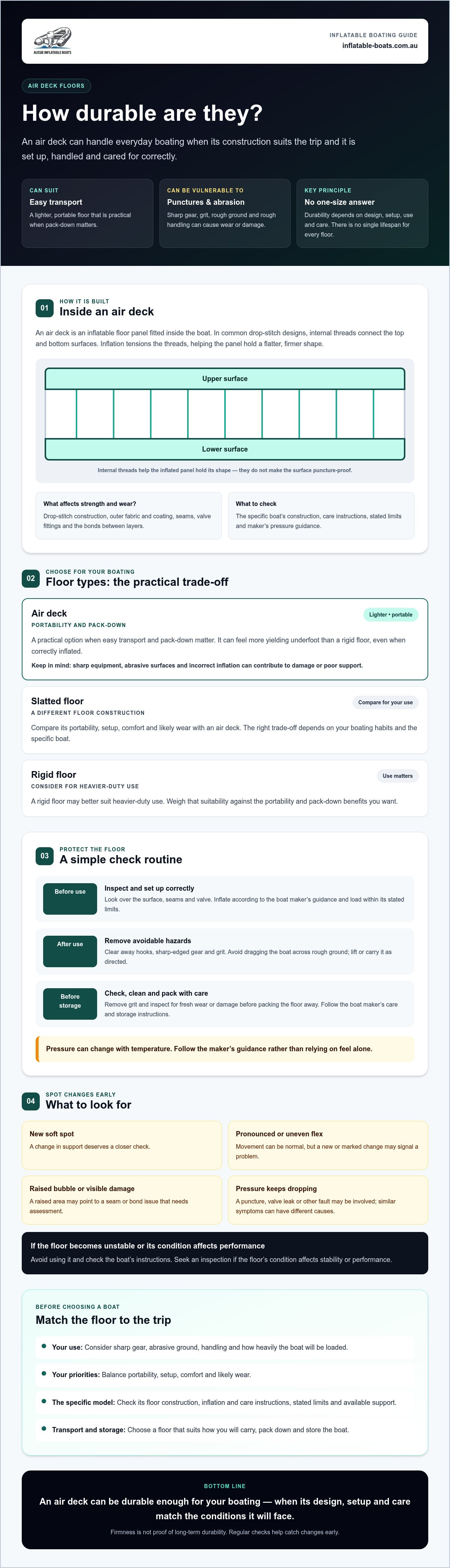
How to protect an air deck floor and spot problems early
Routine checks can help you spot changes before they spoil a day on the water. If you’re asking, “are air deck floors durable?”, remember that inflation, handling, cleaning and storage all play a part. Follow the boat maker’s instructions for your specific model, especially for pressure, loading, cleaning and storage. Don’t rely on generic pressure figures: the correct setting can vary between boats.
A practical air deck inspection routine
Build a quick check into your launch and pack-down routine:
- Before use: Look over the floor surface, edges, seams and valve area. Check for cuts, unusual bulges, separation or other changes, then set up and inflate the panel exactly as the manufacturer directs.
- After use: Check again for fresh scuffs or damage. If the floor felt unusually soft, uneven or unstable, note where and inspect that area before the next outing.
- Before storage: Check for trapped grit and debris, and make sure the floor is clean and dry as directed in the care instructions.
A pressure change may have more than one cause, so don’t assume it’s a puncture. Surface damage, a seam problem or a valve issue may each need a different assessment. If you see a significant change, the panel won’t hold pressure as expected, or the floor feels unstable, stop using it until the cause has been checked. Don’t attempt an unfamiliar repair that could worsen the damage.
Cleaning, drying and storing the floor
Grit trapped between the floor and gear can rub against the surface as the boat moves. Clear debris before use and remove it again before packing. Clean and dry the panel according to the boat maker’s care instructions. Avoid cleaners or repair products unless they’re approved for that floor’s materials. Pack and store it as directed, away from conditions the manufacturer identifies as damaging.
Keep a brief record of recurring pressure loss or visible changes, including when you noticed them. That information can help a repair professional assess the problem. Repair options depend on the floor’s construction and the fault, so confirm what can be assessed before arranging work. For information about inflatable boats and available support, explore inflatable boat options.
Choosing an air deck boat that suits your use
The right floor is the one that fits your routine, not just the one that sounds toughest on paper. Think about where you’ll launch, how you’ll transport the boat and what you’ll carry. If you’re weighing up whether are air deck floors durable enough for your needs, use the maker’s specifications and your expected use to guide your decision.
Questions to ask before selecting an air deck boat
- How will you transport and store it? Consider how much room you have for the packed boat, floor and accessories. Decide whether you’re comfortable inflating and deflating the floor at each outing or would rather handle separate panels.
- How often will you use it? Regular outings mean more inflation, pack-down and handling. Check the recommended care routine and how the floor should be stored between trips.
- What will you carry? List passengers, fishing gear and other equipment, then compare your expected load with the boat maker’s stated limits. Don’t assume a floor’s firmness means it can carry any load.
- What does the manufacturer specify? Confirm the floor material and construction, inflation pressure, intended use, load guidance and care requirements for that exact model.
Consider the whole floor system, not just one selling point. The panel, seams, valve, fit inside the hull and the manufacturer’s use guidance all matter. Ask how the floor should be cleaned, dried and packed, and what support is available if inspection or repair is needed. Construction details and service options differ between boats, so get model-specific answers rather than relying on general advice.
Where to get product and repair guidance
A buying guide can help you compare boat types and features, but the model’s own documentation should settle questions about materials, pressure and loading. If you’re considering a particular boat, ask the retailer to confirm its floor construction and care instructions. If an existing floor shows damage or loses pressure, a repair specialist can assess it. The appropriate repair depends on the fault and construction.
Inflatable Boats sells inflatable boats, spare parts and accessories, and offers inflatable boat repairs. For help checking what’s available or discussing a specific floor, explore inflatable boats and expert support.
Choose your floor with confidence
So, are air deck floors durable? They can be, but longevity depends on the floor’s construction, correct setup, the conditions it faces and the care it receives. Check the maker’s pressure, load and maintenance instructions for the specific boat, and inspect the panel regularly for changes.
Floor choice is a trade-off, not a contest with one winner. An air deck may suit your transport and storage needs, while slatted or rigid options may better match your preferred feel and handling routine. Compare the complete floor system with how often you’ll use the boat, what you’ll carry and how you’ll pack it away.
Ongoing care and timely assessment can help you address issues before they disrupt an outing. Inflatable Boats supplies inflatable boats, accessories and spare parts, and offers repairs and technical support for structural components. For guidance about a specific floor construction, check the details for the boat you’re considering.
Explore inflatable boats and get guidance, then choose a floor that fits your plans and care routine.
Frequently Asked Questions
Are air deck floors durable?
Yes, air deck floors can be durable when they’re well constructed, correctly inflated and used as intended. Whether air deck floors are durable depends on the floor’s materials, seams, handling, storage and exposure to wear. They’re still vulnerable to sharp objects and abrasion, so don’t treat one as puncture-proof. Check the boat maker’s guidance, inspect the floor regularly and don’t assume every model has the same service life.
Can an air deck floor puncture easily?
An air deck floor can be punctured by sharp objects, although the risk depends on its construction and how it’s handled. Clear grit and debris before setting up, avoid dragging the floor over rough surfaces and prevent sharp gear from pressing against it. If you find damage or notice pressure loss, follow the manufacturer’s instructions. Have the issue assessed before relying on the boat, particularly if the floor feels unstable or uneven.
Is an air deck floor as strong as a rigid floor?
Air deck and rigid floors use different designs, so there isn’t a universal answer about which is stronger. A rigid floor may feel firmer underfoot, while an air deck can be easier to pack and handle. Performance depends on the boat’s materials, construction and intended use. Compare specifications, load guidance and care requirements for the specific models you’re considering, rather than judging durability by floor type or firmness alone.
How long does an inflatable boat air deck last?
There’s no reliable single lifespan that applies to every inflatable boat air deck. Construction, frequency of use, loading, inflation, cleaning and storage can all affect wear over time. Follow the maker’s maintenance instructions and check the surface, seams and valve area for changes. For a model-specific estimate, or if you’re concerned about damage or pressure loss, consult the manufacturer or a qualified inflatable boat repair specialist.
What happens if an air deck floor loses pressure?
Stop and assess whether the floor remains stable before deciding what to do next. Check the valve and visible surfaces for an obvious issue, but don’t assume you’ve identified the cause or continue using a compromised floor. Follow the manufacturer’s troubleshooting instructions. If pressure loss continues or you find damage, seek qualified advice or repair before taking the boat back onto the water.
How should I care for an inflatable boat air deck?
Remove grit and debris, then clean and dry the floor as its maker directs. Inspect the surface, seams and valve area regularly, and use the specified inflation guidance rather than guessing at pressure. Avoid dragging the floor across rough ground or using care products that aren’t approved for its materials. Store the floor according to the manufacturer’s instructions to help reduce avoidable wear between outings.
Are air deck floors suitable for regular boating?
They may suit regular boating if the specific boat and floor are designed for the conditions and loads involved. Consider how often you’ll launch, transport and store the boat, along with the surfaces and gear the floor will encounter. Check the product specifications, load limits and care requirements before buying. If your planned use is demanding, ask the retailer or manufacturer whether that model is appropriate.