
Aluminium vs Fibreglass RIB Boats: Which Suits Your Use
A lighter hull isn’t automatically the better choice. Choosing between aluminium vs fibreglass RIB boats means weighing aluminium’s lower weight, toughness and repairability against fibreglass’s quieter ride and ability to cut through chop. The right fit depends on where you boat, how you launch and what you expect from the hull.
Both materials can perform well on the water, but they respond differently to impacts and affect towing, fuel use and ongoing care. Look beyond the material label and consider the conditions your RIB will actually face.
This guide compares durability, weight, fuel use, comfort and corrosion, then relates those differences to Australian launch conditions and intended use. You’ll get a practical way to judge which hull suits your boating, including when fibreglass’s ride and layout advantages may matter more than aluminium’s rugged, lighter build.
Key Takeaways
- Match hull material to your use, boating conditions and launch method, rather than choosing on material alone.
- Aluminium’s lower weight can make towing easier, while its hull can dent on impact and is generally easier to repair and customise.
- Fibreglass can offer a quieter, more comfortable ride through chop and allows for complex hull shapes and fit-outs.
- Consider the different damage and upkeep needs: fibreglass can crack and needs care to protect its gelcoat, while aluminium requires corrosion inspections.
- For a practical choice, weigh ride comfort and layout against impact exposure, towing needs and where the boat will be launched.
Aluminium and fibreglass hull material properties
Aluminium and fibreglass suit different needs because their hulls respond differently to impact and noise, and offer different design options. Aluminium is tough, lightweight and straightforward to maintain, making it practical for demanding use. Its strength and recyclability can also appeal for professional applications where durability and customisation matter.
Aluminium can dent rather than crack on impact, and it is generally easy to repair and customise. Manufacturers can tailor details such as console and seat placement, paint and hull thickness. That flexibility can help when a working RIB needs a specific layout or faces frequent knocks. Fibreglass, by contrast, allows complex hull shapes and integrated features such as seating, livewells and tackle stations.
Fibreglass resists water and impact, and its hull can cut through water and chop. It also absorbs sound and movement more effectively than aluminium, which can make the ride quieter and more comfortable. These qualities may suit leisure users who value comfort and a refined layout. Aluminium can be noisier because the material reflects sound.
Which RIB hull material gives a smoother ride in choppy Australian waters? Fibreglass generally absorbs sound and movement better, and its hull can cut through chop. Aluminium can be noisier, so hull design and the conditions you encounter still matter.
What are the resale values of aluminium versus fibreglass RIBs in Australia? Material alone doesn’t determine resale value. Compare boats of similar size, condition, layout and equipment, since these factors affect the value of an individual RIB.
What Australian boating regulations and safety requirements apply to RIB boats? Requirements depend on where and how the RIB is operated, not on hull material alone. The operating location, vessel setup and activity all matter when identifying applicable rules.
What are typical Australian prices for aluminium and fibreglass RIB boats? A useful comparison requires boats of similar size, construction, fit-out and condition. These features affect asking prices, so material alone doesn’t provide a meaningful price comparison.
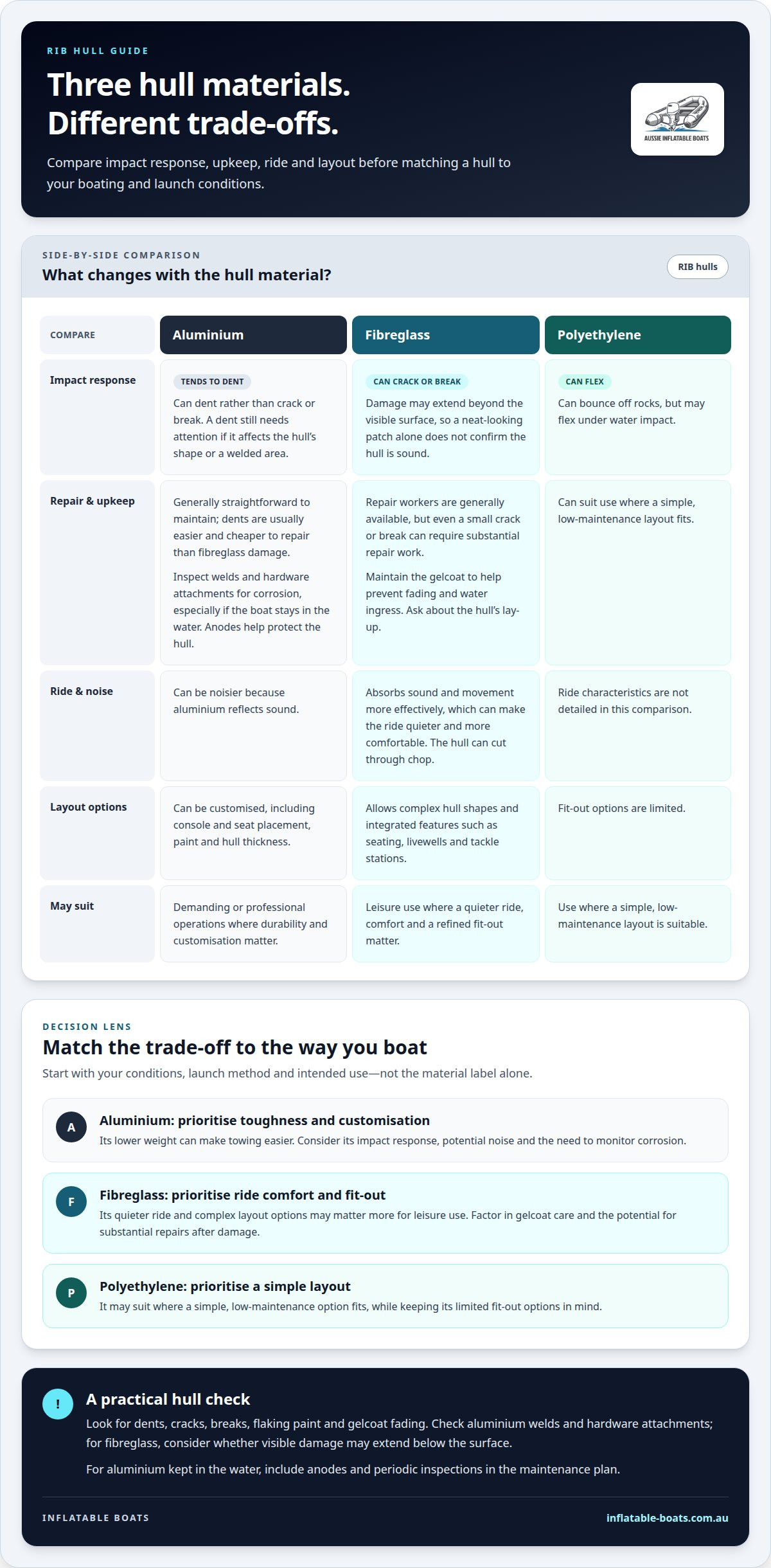
| Hull material | Impact and upkeep | Ride and layout | Use that may suit |
|---|---|---|---|
| Aluminium | Tough; dents can be easier to repair | Can be noisier; customisable layout | Demanding or professional operations |
| Fibreglass | Resistant to water and impact | Quieter ride; complex hull designs | Leisure use prioritising comfort and fit-out |
| Polyethylene plastic | Can bounce off rocks, but may flex under water impact | Limited fit-out options | Use where a simple, low-maintenance layout fits |
Choose by matching the hull’s response to impact, ride characteristics and fit-out options to your needs, whether that means a customisable aluminium workboat or a quieter fibreglass leisure RIB.
Fibreglass durability and repair availability
Fibreglass is widely used in marine construction, and repair workers are generally available. That support matters when a hull takes a knock: even a small crack or break can require substantial repair work. Damage may extend beyond the visible surface, so a neat-looking patch alone doesn’t show that the hull is sound. The lay-up, or arrangement of fibreglass layers, also affects how the hull is built. Ask about the lay-up when comparing boats.
Aluminium responds differently to impact. The hull can dent rather than crack or break, and repairs are usually cheaper than fibreglass repairs. A dent still deserves attention, particularly if it affects the hull’s shape or a welded area. Aluminium is generally straightforward to maintain, but it still needs inspection. After a hard knock, repair needs depend on the damage and its location.
How do maintenance and repair costs compare for aluminium and fibreglass RIB hulls? Aluminium repairs are usually cheaper, while even a small fibreglass incident can lead to substantial repair costs. Regular fibreglass maintenance also helps prevent gelcoat fading and water ingress.
Corrosion resistance differs by material. Fibreglass resists corrosion, while aluminium needs particular care if the boat stays in the water. Anodes help protect an aluminium hull’s structural integrity in these conditions. Corrosion may start around welds or hardware attachments, where paint can flake, so periodic inspections help identify issues early. Impact response differs too: aluminium tends to dent, while fibreglass can crack or break.
How resistant are aluminium and fibreglass RIBs to corrosion, impacts and UV damage? Fibreglass resists corrosion and water, while aluminium needs corrosion monitoring, especially around welds and fittings. Aluminium tends to dent on impact; fibreglass can crack or break. Fibreglass gelcoat can fade, so regular maintenance helps protect its finish and prevent water ingress.
Use these checks to assess hull condition and likely repair needs:
- Look for dents, cracks, breaks, flaking paint and visible gelcoat fading.
- Pay close attention to aluminium weld points and hardware attachments.
- For a fibreglass hull, consider whether visible damage could extend beyond the surface.
- Ask about the fibreglass lay-up to understand how the hull is constructed.
- For an aluminium boat kept in the water, include anodes and periodic inspections in its maintenance plan.
When damage needs attention, inflatable boat repair support can help address the condition and performance of an inflatable vessel.
Aluminium hulls are easy to repair and customise, making them a preferred choice in high-impact situations. Choose material for operational requirements, environmental conditions and long-term maintenance implications.
Aluminium weight and fuel consumption
The aluminium vs fibreglass RIB boats comparison starts with the complete load, not the bare hull. Aluminium hulls are lighter than fibreglass hulls, which can affect towing choices and the load the engine must move. The practical advantage depends on the finished boat. The engine, trailer, fuel, passengers, fishing gear and safety equipment all add weight before you reach the water.
For towing, compare each boat in its ready-to-travel condition. A bare-hull figure doesn’t include the trailer or equipment you carry. An aluminium RIB with a substantial fit-out may weigh more than a lightly equipped fibreglass model. The aluminium vs fibreglass RIB boats decision is more useful when you compare the combinations you’d actually tow, with similar equipment and fuel loads.
Weight also affects the work required to move a boat through the water. A lighter aluminium hull can reduce the load the engine must move, but that alone doesn’t determine fuel consumption. Engine choice, hull design, speed, passenger load and conditions all influence fuel use. For example, two RIBs with different hull materials may use different amounts of fuel if one carries more gear or travels at a different speed.
Make the comparison practical by assessing both boats in the same operating scenario. Consider a ramp launch with equivalent passengers, equipment and fuel aboard, then compare how each boat performs. This helps avoid attributing a difference in fuel use to hull material when the engine, load or operating style may have more influence.
- Compare the boat, trailer, engine and carried equipment as one towing load.
- Include fuel, passengers and regular gear when considering on-water weight.
- Use the same route, speed and load assumptions for each boat’s fuel comparison.
- Consider how often towing and launching feature in your usual trips.
Frequent towing can make aluminium’s lower hull weight a practical advantage, particularly when the boat travels with its usual equipment. If the boat stays near a ramp or launches from a fixed location, towing weight may matter less. Fuel use still deserves attention, but hull material is only one part of the calculation.
Consider the complete setup: tow vehicle, trailer, hull, engine and typical load. Aluminium may reduce the hull’s contribution to total weight, while a fibreglass boat’s towing and fuel demands depend on its build and fit-out. Match your choice to your trips, the gear you carry and how you transport the boat between launches.
Aluminium noise, temperature and corrosion considerations
Hull material changes the sound and feel of a RIB underway. Aluminium can reflect impact noise, so waves striking the hull may sound sharper than they do against fibreglass. Fibreglass absorbs sound and movement more effectively, which can make a trip quieter. The difference is especially noticeable when repeated impacts meet an aluminium hull.
That difference can affect conversation and how clearly you hear equipment aboard. A fishing crew, for example, may notice hull noise while drifting or moving through chop. Fibreglass dampens sound and movement more effectively, while aluminium can make impacts more audible. The hull is only one influence on the experience, but it’s worth considering if quieter travel matters on longer outings.
Temperature is another practical difference. Aluminium transfers heat more readily than fibreglass, so its exposed surface can feel warmer or cooler as conditions change. A sunny, uncovered aluminium surface may feel different to the touch from a fibreglass one. Consider where passengers sit, where they handle the hull and whether the boat is stored exposed to the elements.
Corrosion needs particular attention on aluminium hulls, especially when a boat stays in the water. Anodes help protect the hull’s structural integrity in that situation. Corrosion can start around welds and hardware attachments, where paint may flake. Inspect these locations periodically, as deterioration can lead to corrosion and structural fatigue if it goes unnoticed.
Fibreglass resists corrosion, but both materials need care suited to their construction. On aluminium, look for flaking paint around welds and fittings, and inspect the hull periodically. Fibreglass maintenance focuses on the hull’s surface and condition rather than aluminium corrosion points. Routine observation helps identify changes before they become harder to address.
- At rest: Notice whether hull impacts are likely to disturb conversation or quiet activities.
- In changing conditions: Consider how exposed hull surfaces feel to passengers handling or leaning against them.
- For aluminium kept afloat: Maintain anodes and inspect welds, hardware attachments and paint condition.
- During regular care: Look for changes in hull condition, not just obvious impact damage.
For a boat that spends time afloat, make corrosion protection and inspection part of its maintenance routine. For a quieter ride, fibreglass has an advantage in absorbing sound and movement. Aluminium’s more audible hull impacts may matter less if other material qualities take priority. The best balance depends on how you use the RIB, where it’s kept and which comfort details matter most aboard.
Choosing a boat material based on use and launch conditions
Start with three practical details: what the RIB will do, where it will operate and how it reaches the water. A boat used for professional work has different priorities from one used for relaxed coastal trips. The launch setting matters too. An ocean ramp, an off-road fishing destination and a sheltered marina each create different demands for the hull and its upkeep.
For a new boater using an ocean ramp, fibreglass may not be the best choice. That doesn’t rule it out, but it makes the launch and expected handling important parts of the decision. Fibreglass can cut through water and chop, and it is less affected by swell than aluminium. If a smoother ride in changing conditions is a priority, these qualities may weigh heavily.
An adventurous off-road fisherman may find aluminium or plastic more suitable. Aluminium is tough and can suit high-impact situations, while plastic can bounce off rocks rather than sustain impact damage. Plastic has trade-offs: its fit-out options are limited, and polyethylene can flex under water impact. The best material depends on whether impact tolerance or a particular layout matters more for the trip.
Professional use can favour a different balance from leisure boating. Aluminium’s strength, repairability and customisation options can suit demanding operations. Fibreglass allows complex hull designs and integrated layouts, such as seating, livewells and tackle stations. A fishing RIB that needs specialised storage may benefit from that design flexibility, while a working boat may prioritise a hull that is straightforward to repair.
Use this decision guide to narrow the choice:
- Frequent impacts or rough handling: Consider aluminium’s toughness and dent-oriented impact response.
- Chop, swell and ride comfort: Consider fibreglass for its ability to slice through chop and absorb sound and movement.
- Off-road fishing: Compare aluminium and plastic against the launch route, impact exposure and fit-out needs.
- Professional operations: Weigh aluminium’s customisation and repairability against the layout possibilities of fibreglass.
- Local ocean-ramp launches: Factor in your experience and launch conditions, particularly if you’re new to boating.
Don’t choose by material name alone. A fibreglass hull’s ride and layout strengths may suit one coastal use, while an aluminium hull’s toughness may better suit frequent impacts. For an off-road trip, plastic might suit rocky conditions, but limited fit-out options could conflict with fishing needs. Match the material to the whole outing, from launch to return.
Use your intended routes and operating tasks to guide the final comparison. Explore inflatable boat options to continue narrowing down a RIB for your use.
Inflatable Boats
Inflatable Boats is a natural next step once you’ve matched hull material to your launch conditions and intended use. Explore inflatable boats, accessories and spare parts to support your setup, or consider repairs when an existing inflatable vessel needs attention. This is useful when your comparison has narrowed the type of RIB you want, but you still need to choose the boat and supporting equipment.
For help with your next step, contact Inflatable Boats to discuss your inflatable boating needs.
Set your next RIB up for the water ahead
Before settling on a hull, picture the trips you want to take in the coming seasons. A regular fishing run, a family outing and a demanding workday can place very different priorities on one boat. The most useful choice is the one that supports the outings you’ll actually take, rather than a hypothetical best-case day.
For aluminium vs fibreglass RIB boats, turn your decision into a short list of practical priorities: how you’ll use the boat, what matters most aboard and what setup will support those plans. That gives you a clear basis for moving from research to a suitable boat and its supporting equipment.
Inflatable Boats can help you take that next step with inflatable boats, accessories and spare parts. If you’re ready to discuss what could suit your plans, contact Inflatable Boats for advice. A well-matched setup makes it easier to focus on the water ahead and enjoy each launch with confidence.
Frequently Asked Questions
What are the main differences between aluminium and fibreglass RIB boats?
Aluminium and fibreglass differ in how they handle impacts and noise, and in the hull designs they allow. Aluminium is often suited to practical, demanding use, while fibreglass allows more complex hull shapes and fit-outs. For example, a fishing layout with integrated seating and tackle stations may benefit from fibreglass design flexibility. Compare the complete boat, including its layout and intended conditions, rather than treating material as the only deciding factor.
How do aluminium and fibreglass RIBs compare in weight, strength and durability?
Aluminium RIBs are generally lighter than fibreglass models, which can affect the towing setup. Their hulls tend to dent on impact, whereas fibreglass can crack or break. That difference changes what damage to look for after a collision or rough handling. Compare boats in their equipped condition, and consider how hull construction and existing condition affect suitability for your regular use.
How do aluminium and fibreglass RIBs compare for stability, speed and fuel consumption?
Neither material alone determines stability, speed or fuel consumption. Hull shape, engine, load and operating conditions all influence performance. Fibreglass hulls can cut through chop, while an aluminium model’s lower hull weight may reduce the load being moved. For a useful comparison, consider the same type of trip, passenger load and equipment. This helps separate material differences from the effects of setup and use.
Which RIB hull material is better for beach launching, rocky shorelines and shallow water?
No single hull material is automatically best for every beach, rocky shoreline or shallow-water launch. The launch surface, water depth, hull design and likelihood of impact all matter. Aluminium can suit high-impact situations, while plastic may bounce off rocks but has limited fit-out options and can flex under water impact. Consider the actual launch and operating conditions together, rather than relying on the material label alone.
How should buyers choose between an aluminium and fibreglass RIB for their intended use?
Choose a boat that matches your typical trips, launch method and priorities aboard. A professional operator may value a practical, customisable hull, while a leisure user may prioritise a quieter ride or tailored layout. Consider where you’ll launch, what equipment you’ll carry and how the boat will be maintained. Then compare complete boats against those needs, not just their hull materials.