
Air Deck vs Aluminium Floor Inflatable Boats: Which Suits Your Boating Style?
The most portable floor isn’t automatically the best choice for every trip. In the air deck vs aluminium floor inflatable decision, a compact pack-down can make transport and storage easier, while a firmer platform may better suit days spent standing, shifting gear or handling changing water. It’s a practical trade-off, not a universal winner.
To choose between them, think through how you’ll transport, assemble, use and store the boat. This comparison explains how the two floor types differ in construction, setup, packing and underfoot feel. It also shows why floor design is only part of the decision: boat size, hull shape, load and intended conditions matter too. Use the practical checks below to build a shortlist around your routine, whether you prioritise an easier pack-up or a rigid platform beneath you.
Key Takeaways
- Compare the air deck vs aluminium floor inflatable by how each fits your usual transport, storage and time on the water.
- Look beyond the floor: boat size and hull design also shape the feel and performance you can expect.
- Think about how often you’ll assemble, carry and pack away your boat before weighing up the floor options.
- Build a shortlist around the complete boat package, its specifications, your storage space and the activities you have in mind.
- Use the side-by-side comparison to identify which trade-offs matter most for your boating routine.
Air Deck vs Aluminium Floor Inflatable Boats: What Actually Changes?
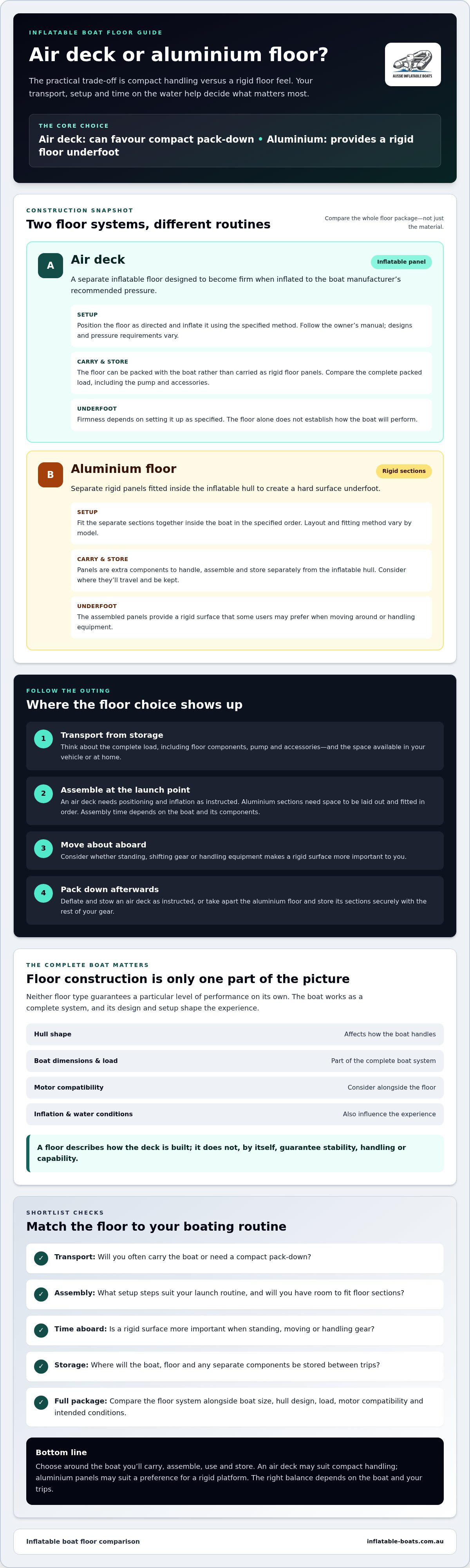
An air-deck floor is an inflatable panel that forms a firm deck when inflated to the boat manufacturer’s recommended pressure. An aluminium floor uses rigid sections fitted inside the inflatable hull to create a hard surface underfoot. The air deck vs aluminium floor inflatable choice mainly changes how the floor is assembled, carried and felt beneath you. Neither construction guarantees a particular level of performance on its own.
A boat works as a complete system. Hull shape, dimensions, load, motor compatibility and the conditions you use it in all affect how it handles. Compare floor construction alongside setup and pack-down, storage space, carrying demands, underfoot feel and intended activities. A floor that suits a frequently transported tender may not suit a boat used with heavier gear.
What is an air-deck floor?
An air deck is a separate inflatable floor designed to become firm when correctly inflated. Its construction and recommended pressure vary by boat, so use the owner’s manual for setup. Don’t assume every air floor uses the same design or inflation requirements. A general overview of types of inflatable boat floors places high-pressure air floors alongside rigid floor options.
Because the deck inflates rather than being made from rigid sections, it can be packed with the boat instead of carried as a set of floor panels. That may suit people who need a more compact load for transport or storage. The practical result still depends on the whole package: how the floor fits the hull, what equipment is needed to inflate it and how the boat packs away.
What is an aluminium floor?
An aluminium floor is made from rigid sections fitted into the inflatable boat. Once assembled, the panels provide a hard surface underfoot, which some users may prefer when moving around or handling equipment. Not every aluminium-floor boat will feel or perform identically. Panel layout, fit and the rest of the boat’s design all influence the experience.
The panels are separate components to handle and store, rather than an inflatable deck that can be packed with the boat. Their arrangement and the components supplied vary by model. When comparing boats, consider the complete floor system, not just the material. How the sections fit together and where they’ll be carried between trips can shape your routine.
The central trade-off is simple: an air deck can favour compact handling, while aluminium panels provide a rigid floor feel. The right balance depends on the boat and how you’ll use it.
Start with the handling question, then test it against your intended use. Will you often carry and store the boat in limited space, or is a firm deck more important for standing and moving gear? How much assembly suits your launch routine? Your answers put the floor comparison in context, without mistaking one construction feature for a standalone measure of stability, handling or capability.
How Air-Deck and Aluminium-Floor Construction Affects Setup and Feel
The floor choice matters at every stage of ownership: lifting the package from storage, assembling it at the launch point, moving around aboard and packing it away afterwards. The difference is not simply “inflatable versus rigid”. Each system has its own handling steps, and the time and effort involved depend on the boat, its components and your routine.
Air-deck construction, inflation and handling
With an air deck, unpack the floor, position it as directed and inflate it using the method specified for that boat. Follow the manufacturer’s instructions for inflation and check pressure as directed. Recommended procedures and pressures aren’t universal. Once ready, the floor may be easier to pack alongside the boat because it doesn’t require separate rigid panels.
That can simplify carrying and storage, particularly if you’re loading gear into a vehicle or have limited room at home. But don’t assume every air-deck package is lighter or more convenient. Compare the complete packed load, including the pump and accessories. At pack-down, deflate and stow the floor according to the boat’s instructions.
Aluminium panels, assembly and underfoot feel
An aluminium floor involves handling separate sections and fitting them together inside the boat in the specified order. The assembled panels provide a rigid surface beneath your feet, which may feel more solid as you move or reposition equipment. That firmness comes with extra components to carry, assemble and store separately from the inflatable hull.
Panel shape, arrangement and fitting method vary between boats, so there’s no universal assembly time. At the launch point, consider where you’ll lay out the parts and whether you’ll have enough room to fit them without rushing. After use, allow for taking the floor apart and storing the sections securely with the rest of your gear.
From launch to pack-down: judge the whole setup
Aboard, the floor affects underfoot feel, but it doesn’t determine the boat’s behaviour by itself. Hull design, loading, inflation and water conditions also matter. An air deck’s firmness depends on following its specified setup. Aluminium panels create a hard surface, but that alone doesn’t guarantee a particular level of stability or handling. For broader context on boating and manufacturing, NMMA provides marine industry standards information.
A floor describes how the deck is built; the boat’s overall performance depends on the complete design and setup. Keep that distinction in mind when comparing an air deck vs aluminium floor inflatable. Think through the whole outing: who carries the package, how you assemble it, whether you’ll stand or shift gear, and how much space you have to pack everything away. Those details are more useful than a broad claim that one floor is always quicker or more stable.
Browse the inflatable boat range alongside your transport and storage needs. Assess each boat as a complete package rather than judging its floor in isolation.
Air Deck vs Aluminium Floor: Compare the Trade-Offs Side by Side
Floor choice is easiest to assess against your actual routine, not a single headline such as “lighter” or “more stable”. An air deck may reduce the number of rigid components to handle, while aluminium panels offer a firm surface once fitted. The full boat package, including its dimensions, hull design and supplied equipment, influences how those differences feel on the water and during transport.
| Factor | Air deck | Aluminium floor |
|---|---|---|
| Portability | May be convenient to pack with the boat; compare the complete package and pump. | Panels add separate items to lift and carry; their size and handling depend on the model. |
| Assembly | Requires positioning and inflation as directed by the manufacturer. | Requires fitting the floor sections in the specified arrangement. |
| Storage | May pack compactly with the boat, depending on its design and other gear. | Panels need space of their own when removed from the boat. |
| Underfoot feel | Designed to form a firm deck when correctly inflated. | Provides a rigid, hard surface once assembled. |
| Intended activity | May appeal if fewer rigid parts and pack-down convenience matter most. | May suit users who value a rigid platform, subject to the boat’s specifications. |
No floor type wins every category; the better fit depends on what you prioritise and how the complete boat is designed. Don’t treat the table as a substitute for the manufacturer’s guidance on use, loading or operating conditions. For broader context, manufacturers such as inflatable boat construction experts work across different inflatable craft and construction approaches. The specifications of the boat you’re comparing remain the practical reference.
Where an air deck may suit better
An air deck may suit buyers who want to avoid carrying and storing rigid floor sections, or who value packing the floor alongside the inflatable boat. That can simplify handling for some transport and storage setups. It doesn’t guarantee a smaller or lighter overall package: account for the boat, floor, pump and accessories together, and match intended conditions to the boat’s guidance.
Where an aluminium floor may suit better
An aluminium floor may appeal if a rigid surface is high on your list, particularly for moving around the boat or positioning equipment. Those uses still depend on the boat’s design and manufacturer’s stated limits. Include assembly and panel storage in the decision: the firm underfoot feel comes with separate sections to handle, fit and pack away after your trip.
For the air deck vs aluminium floor inflatable comparison, picture a real outing from vehicle to water and back. If carrying fewer rigid parts matters most, investigate how the complete package is packed. If a hard platform matters more, consider how the panels fit your assembly and storage routine. In either case, compare boat specifications and intended activity before drawing conclusions from floor material alone.
How to Choose an Inflatable Boat Floor for Your Trips
Turn the floor comparison into a practical shortlist by starting with the parts of boating you can’t easily change: where the boat lives, how it reaches the water and who handles it. Then weigh your preferred underfoot feel against the activities you have planned. This keeps the decision grounded in your routine instead of broad claims about either floor type.
Match the floor to transport, storage and setup
Work through these checks in order. Start with your transport and storage reality, not a feature that sounds appealing in isolation.
- Map transport and storage. Will you carry the boat packed between outings, keep it assembled, or store it in a confined space? Consider vehicle room, storage access and where separate floor parts could be kept.
- Picture the handling. How often will you assemble, carry and pack away the boat? Think about how many people will manage the complete package, including any pump, floor sections and other supplied components.
- Compare the full package. Don’t judge portability by floor material alone. Check the boat’s overall dimensions, components and packing arrangement. A floor that seems convenient by itself may not make the entire boat easier to move or store.
For example, if you regularly pack the boat into a vehicle, compare how the complete package fits alongside your other gear. If it will stay assembled between trips, frequent packing may matter less than floor feel and intended use.
Match floor feel to activity and boat specifications
Next, consider what you’ll do aboard. If you expect to stand or reposition equipment, a rigid surface may be a priority. If easy handling and packing weigh more heavily in your routine, an air deck may deserve closer consideration. These are starting points, not guarantees of performance or suitability.
- 4. Define your intended activity. List the usual passengers, equipment and movements on board. Then compare those needs with the boat’s stated capacity and use guidance.
- 5. Check the boat, not assumptions. Floor type alone doesn’t establish the boat’s capacity, motor compatibility or suitable conditions. Use the manufacturer’s specifications for those details, and assess the hull and complete setup too.
- 6. Compare likely options. Browse the inflatable boat collections and compare boats as complete packages.
Use this checklist to weigh selection factors beyond the floor itself. The air deck vs aluminium floor inflatable decision becomes clearer once transport, storage, setup and intended activity are considered together.
Ready to compare boats against your checklist? Explore inflatable boats and focus on the specifications that fit your trips.
Make Your Air-Deck vs Aluminium-Floor Shortlist With Confidence
The right floor is the one that fits how you’ll transport, store and use the boat. An air deck may better suit a routine where carrying and packing matter most; an aluminium floor may appeal if a rigid surface underfoot is a priority. Neither choice decides the whole experience. Hull design, boat fit and the full setup also shape how a boat feels and handles.
Before settling on a shortlist, compare each boat as a complete package rather than treating the floor as a shortcut to performance. Use the manufacturer’s documentation to compare specifications and understand how a particular model is intended to be assembled and used.
What to compare before choosing a boat
Use this checklist to keep the comparison specific to the boats you’re considering. A difference that matters for one model may not apply to another.
- Floor description and instructions: Review how the manufacturer describes the floor and what its assembly or inflation process requires.
- Boat specifications: Compare the documented capacity, intended use and other relevant specifications. Don’t infer these from floor material alone.
- Complete package: Note which components are supplied, what you’ll handle during setup and how everything can be stored after use.
- Storage and transport: Consider where the packed boat and its floor components will go, both in transit and between outings.
This gives you a fair basis for comparing options without relying on general claims about weight, stability or performance. Keep each conclusion tied to the model’s documentation.
Choose for the outings you actually plan
Be honest about what matters most on a typical trip. If straightforward transport and packing are central to regular use, give those priorities more weight. If a rigid underfoot feel is essential to the activities you have in mind, make that a key comparison point. Then check that the boat’s documented specifications align with your intended use.
For the air deck vs aluminium floor inflatable decision, write down your priorities in order: handling, storage, setup, preferred floor feel and planned activity. Compare boats against that list, including how the hull and floor fit together, rather than assuming one construction will perform the same across every design.
That’s a more dependable way to shortlist than choosing by floor type alone. The details of the complete boat matter, and the right balance is the one that makes sense for the outings you actually plan.
Ready to put your shortlist into practice? Explore inflatable boat options and compare the full boat package against your transport, storage and activity needs.
Choose a Boat That’s Ready for Your Next Outing
Before making your choice, picture an ordinary day on the water from the first lift to the final pack-away. Where will the boat be stored? Who will help set it up? What will you carry aboard? These practical details can reveal whether your priorities suit your regular trips, not just whether they sound appealing on paper.
Use the air deck vs aluminium floor inflatable comparison to assess the whole boat and how it fits your plans. A well-matched setup should feel manageable before launch and suit the way you intend to spend your time afloat. Keep your shortlist focused on the specifications and complete package that support that routine.
Inflatable Boats sells inflatable boats, accessories and spare parts, and provides professional inflatable boat repairs. Explore inflatable boats and compare your options to find a setup that fits your next adventure.
Frequently Asked Questions
Is an air-deck floor as rigid as an aluminium floor?
Not necessarily. The air deck vs aluminium floor inflatable comparison depends on the individual boat, floor design, inflation and correct setup. Aluminium sections generally create a rigid surface, while an air deck is engineered to become firm when inflated. That doesn’t mean the two feel or perform identically. Compare the manufacturer’s floor description and instructions for the specific model, including how it should be set up for use.
Can you stand on an air-deck floor?
Standing suitability depends on more than the floor. Boat design, floor construction, load limits and operating conditions all affect whether standing is within the intended use. Don’t assume an air deck is suitable for standing just because it feels firm underfoot while stationary. Check the manufacturer’s intended-use guidance and capacity information for that boat, and follow those specifications rather than relying on floor type as an indicator.
Does an inflatable boat with an aluminium floor take longer to set up?
It may involve different steps rather than always taking longer. Aluminium floors require handling and fitting their sections, while an air deck needs inflation. Setup also includes preparing the rest of the boat, so the overall process varies with the model, the operator’s familiarity and conditions at the launch point. Compare the assembly instructions and supplied components to understand what your regular setup will involve.
Can an air deck lose pressure during a trip?
Pressure loss isn’t inevitable, but an inflatable floor does need correct setup and attention in line with its instructions. Temperature and use can affect how owners should monitor inflatable components, so follow the manufacturer’s guidance for the conditions you expect. Before departure, check the floor as directed and make sure it’s set up correctly. Don’t rely on a pressure threshold from another boat; use the instructions for your own model.
Which inflatable boat floor is easier to store?
An air deck can be packed as an inflatable component, while aluminium floors need room for separate rigid panels. Which option takes less space overall depends on the boat, accessories and how you store the package. If you’re comparing models, check their package dimensions and consider where each component will go at home and in transit. This gives a clearer picture than assuming one floor type always packs more compactly.
Are aluminium floors more durable than air decks?
Floor type alone can’t establish which boat will last longer. Durability depends on the materials, construction, care and how the boat is used. Aluminium panels and inflatable floors have different components and handling needs, so compare their product documentation for relevant care guidance. Follow the manufacturer’s instructions when setting up, using and storing the boat. Avoid treating a general claim about either floor as a lifespan guarantee for a particular model.
Does an air deck or aluminium floor work better with an outboard motor?
Neither floor type automatically makes a boat better suited to an outboard. Compatibility depends on the complete boat and its manufacturer’s stated motor ratings and capacity. Before choosing, compare those specifications for the model, along with its intended-use guidance. Don’t infer a suitable motor size from the floor material or apply one boat’s rating to another. The manufacturer’s documentation is the relevant reference for the complete setup.